Six months had passed since the crisis.
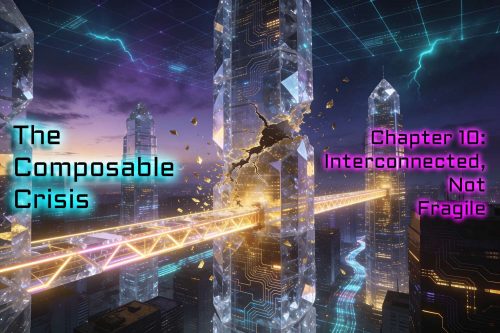
The ecosystem had transformed. Where once there had been fragile towers built on shaky foundations, there now stood resilient structures designed to withstand the storms. The DeFi District was no longer a collection of vulnerable skyscrapers—it was a carefully planned city, with buildings that could stand alone but chose to connect.
Ravi sat at his workstation, his fingers hovering over the keyboard. The six monitors that had once displayed his complex leverage strategies now showed something simpler: a single, modest position. No leverage loops. No risky cross-collateralization. Just a straightforward deposit in a protocol he trusted.
He looked at the numbers. 12% APY. Steady growth. Manageable risk.
It wasn’t the 45% he’d once chased. But it was real. It was sustainable. And it was safe.
“Twelve percent,” he murmured, a small smile playing on his lips. “Not bad for a builder who’s learned his lesson.”
Ravi’s new strategy was a far cry from the complex machine he’d built before. He’d deposited 10,000 units—the same amount he’d started with—in a single protocol. No borrowing. No leveraging. Just patient, steady growth.
He’d chosen the protocol carefully. It had independent oracles, robust risk parameters, and a track record of stability. It wasn’t the flashiest protocol in the ecosystem, but it was reliable. And reliability, Ravi had learned, was worth more than any yield.
His Risk Simulator—the tool he’d built after the crisis—confirmed his decision. The simulation showed his position surviving worst-case scenarios: 30% price drops, oracle mismatches, even full-scale market crashes. His position would be bruised, but it would survive.
“Pass: 99.9% uptime scenario,” the simulator reported.
Ravi nodded. “Good enough for me.”
At 10:00 AM, Ravi received a message from Talia.
“Ready for the audit?”
Ravi smiled. Talia had been auditing his strategies ever since the crisis. It had become a tradition—a way of ensuring that neither of them ever repeated their mistakes.
“Ready,” he typed. “Same time?”
“Same place.”
Ravi opened his community dashboard and navigated to Protocol A’s private meeting room. The skyscraper had been rebuilt, its foundations stronger than before. The lobby was clean and professional, staffed by helpful AI avatars. It was a far cry from the chaotic days of the crisis.
Talia’s avatar appeared a moment later, wearing her signature analyst’s outfit. She sat across from Ravi at the holographic table and projected his position onto the surface.
“Well,” she said, studying the numbers. “This is… simple.”
Ravi laughed. “That’s the point. Simple is safe.”
Talia’s avatar smiled. “I was hoping you’d say that.”
She ran her audit, checking every parameter, every connection, every vulnerability. The process took twenty minutes—much shorter than the complex audits she’d done before.
“Everything checks out,” she said finally. “Your position is stable. Your risk parameters are conservative. And your strategy is… boring.”
“Boring is beautiful,” Ravi said.
Talia nodded. “It really is.”
The community had changed too. The Decoupled Protocols framework had been implemented across the ecosystem, and the results were visible everywhere. Protocols had adopted independent oracles. Risk parameters were isolated. Cross-collateralization was carefully controlled.
The Risk Committee—the community oversight group that Talia and Ravi had proposed—was now an integral part of the ecosystem. They monitored protocol behavior, enforced compliance, and conducted regular audits. Their presence was a constant reminder that safety was everyone’s responsibility.
Ravi had been invited to join the Risk Committee, but he’d declined. “I’d rather build tools than enforce rules,” he’d told Talia. “I’m better at creating than policing.”
Talia had understood. She’d joined the committee herself, becoming one of its most respected members. Together, they continued to work on making the ecosystem safer.
At 2:00 PM, Ravi led a workshop on risk management.
The virtual classroom was filled with new users—eager, ambitious, and hungry to learn. Ravi recognized the look in their eyes. It was the same look he’d had before the crisis.
“Composability is powerful,” Ravi began, standing at the front of the room. “It allows us to build amazing things—strategies that generate yield, create value, and grow wealth. But composability is also dangerous. Every connection is a point of failure. Every leverage layer is a vulnerability.”
He projected a diagram onto the screen—a simplified version of the network map he’d created during the crisis.
“This is what happens when composability goes wrong. A small failure in one protocol triggers a cascade of liquidations in others. Users lose everything. Trust is shattered. The ecosystem nearly collapses.”
The new users leaned forward, captivated.
“Today, I’m going to teach you how to build responsibly,” Ravi continued. “How to use composability without creating fragility. How to earn yield without gambling your future.”
He began his lesson, drawing on everything he’d learned. The risks of leverage. The importance of diversification. The value of stress-testing. The power of community oversight.
“Building is about more than just making money,” he said. “It’s about creating something that lasts. Something that can withstand the storms. Something that benefits everyone, not just yourself.”
A new user raised their hand. “Ravi, how do you know when a strategy is safe?”
Ravi smiled. “You don’t. Not really. But you can reduce the risk. You can test, and audit, and ask questions. You can listen to the people who warn you. And you can always, always start small.”
The workshop ended at 4:00 PM. Ravi stayed behind, answering questions and offering advice. He recognized the anxiety in some of the new users—the same anxiety he’d felt when he first started building.
“Thank you,” one user said. “Your story… it really helped me understand the risks. I was about to try a leverage strategy, but now I’m going to take it slow.”
Ravi felt a warmth spread through his chest. “That’s the right call. There’s no rush. The ecosystem will be here tomorrow. And the day after that.”
The user nodded and logged off. Ravi sat alone in the virtual classroom, a smile on his face.
This is what matters, he thought. Not the yield. Not the recognition. Helping people build safely.
At 6:00 PM, Ravi received a message from BlockBuilder99.
“Hey. Just wanted to let you know—I’m rebuilding. I’ve got a small position now. Conservative strategy. No leverage.”
Ravi felt a surge of relief. BlockBuilder99 had been one of his first followers, and his loss had weighed heavily on Ravi’s conscience.
“That’s great,” Ravi typed. “How are you feeling?”
“Nervous. But hopeful. I’m taking it slow. Learning from my mistakes.”
“That’s all any of us can do.”
BlockBuilder99 paused. Then he typed: “I forgive you, Ravi. For the crisis. I know you were trying to help.”
Ravi felt tears prick at the corners of his eyes. “Thank you. That means everything.”
“You’ve changed. You’re different now. More careful. More humble. It’s a good change.”
Ravi nodded, even though BlockBuilder99 couldn’t see him. “I learned from my mistakes. And I’m going to keep learning.”
“I believe you.”
At 8:00 PM, Ravi logged off his computer and stepped away from his desk. The sun was setting outside his window, painting the sky in shades of orange and pink. He watched it for a long moment, feeling a sense of peace.
His room had changed too. The energy drink cans were gone, replaced by a water bottle and a healthy snack. The cluttered notebooks had been organized, their formulas and strategies replaced by risk assessments and safety protocols. His walls still held the posters and diagrams, but there was a new one now—a framed quote from Talia:
“Interconnected doesn’t have to mean fragile.”
Ravi read the words, letting them sink in. They were the guiding principle of his new approach. Connection without vulnerability. Power without fragility. Growth without recklessness.
Interconnected, not fragile, he thought. That’s what we built. That’s what I’ll keep building.
At 9:00 PM, Ravi’s phone buzzed. A message from Talia.
“Checking in. How are you doing?”
Ravi smiled. “I’m good. Really good.”
“Any regrets? About the strategy?”
“None. Twelve percent APY is plenty. It’s safe, it’s sustainable, and it’s mine.”
“That’s the right attitude. You’ve come a long way.”
Ravi thought about the journey—the hubris, the fall, the recovery. It had been painful, but it had made him who he was.
“I couldn’t have done it without you,” he typed. “You were the voice I needed to hear. Even when I didn’t want to listen.”
“That’s what friends are for. And Ravi?”
“Yeah?”
“Thank you. For listening. For learning. For building something better.”
Ravi felt a warmth spread through his chest. “Thank you for believing in me.”
At 10:00 PM, Ravi visited the DeFi District one last time.
The virtual city was beautiful—a testament to everything the community had built and rebuilt. Protocol A’s skyscraper gleamed with new strength, its foundations visible through transparent walls. Protocol B’s farm was lush and productive, its fields carefully tended. The bridges between protocols were still there, but they were controlled, monitored, and safe.
Ravi walked through the district, his avatar moving with quiet satisfaction. He passed the monument to the crisis victims, still standing in the center of the city. But now it was surrounded by new construction—the buildings of a new ecosystem.
He stopped at the center of the district, where a new monument had been erected. It was a simple structure—a foundation of bricks, arranged in a stable, unshakeable pattern.
Ravi read the inscription:
“The bricks of finance are stronger when they’re built with care, caution, and the understanding that every tower needs a foundation.”
Ravi smiled. It was the message he’d been trying to convey all along. The lesson he’d learned through pain and loss. The principle that guided his new approach.
Care, he thought. Caution. Foundation. That’s what matters.
He looked at the monument for a long moment. Then he made a promise to himself—a promise to keep building, keep learning, keep helping.
I’ll build safer systems, he thought. I’ll help people understand the risks. I’ll make sure no one has to go through what I went through.
He turned away from the monument and walked toward the horizon. The DeFi District stretched before him, full of possibility and promise.
The future is bright, he thought. And I’m ready for it.
Epilogue
One year after the crisis, the ecosystem was stronger than ever.
The Decoupled Protocols framework had been adopted by dozens of protocols across the ecosystem. Risk isolation had become the standard, not the exception. Users had access to better tools, better information, and better oversight.
Ravi had become a respected voice in the community. His Risk Simulator was used by thousands of users to stress-test their strategies. His workshops on risk management were among the most popular in the ecosystem. And his personal story—the rise, the fall, the recovery—was taught as a cautionary tale to new builders.
Talia had become the chair of the Risk Committee. Her audits were legendary, her warnings always accurate. She’d been instrumental in designing the new framework, and her expertise was sought after by protocols across the ecosystem.
The crisis had been a watershed moment—a turning point that forced the community to confront its vulnerabilities and build something better. It had been painful, but it had been necessary. And out of the ashes, something remarkable had emerged.
Ravi sat at his workstation, looking at his dashboard. His position was still modest—12% APY, steady growth—but it was enough. It was proof that building could be safe. That growth didn’t require recklessness. That the future could be bright.
His phone buzzed. A message from Talia.
“Ready for tomorrow’s workshop?”
Ravi smiled. “Ready. What are we teaching?”
“The Art of Safe Composability. The new users need to hear it.”
“They always do.”
Ravi set his phone aside and looked at the quote on his wall. “Interconnected doesn’t have to mean fragile.”
He thought about the journey—the hubris, the fall, the recovery. It had been the hardest thing he’d ever experienced. But it had also been the most valuable.
The bricks of finance are stronger when they’re built with care, caution, and the understanding that every tower needs a foundation.
Ravi nodded to himself and opened his Risk Simulator. There was work to do. There was always work to do.
But for the first time in a long time, he was excited about it.
Table of contents:
Introduction
Chapter 1: The Bricks of Finance
Chapter 2: A Borrowing Position
Chapter 3: The Yield Farm
Chapter 4: The Leverage Loop
Chapter 5: The Oracle Mismatch
Chapter 6: The Domino Collapse
Chapter 7: The Cascading Liquidation
Chapter 8: The Circuit Breaker
Chapter 9: The Decoupled Protocols
Chapter 10: Interconnected, Not Fragile
