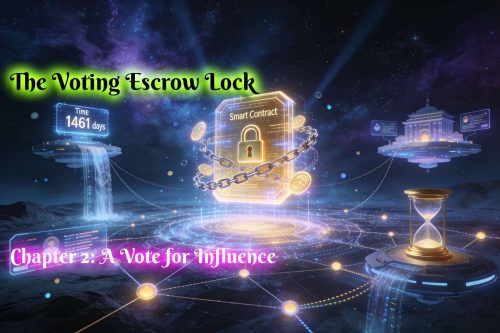
The Nexus Protocol Governance Forum materialized around Nina as she logged in, a vast cathedral of light and data that stretched in every direction like an infinite digital coliseum. Thousands of avatars floated in the tiered seating that spiraled upward toward a luminous dome, each one representing a community member from every corner of the globe. Some were elaborate—dragon-like creatures with shimmering scales, crystalline humanoids that refracted light into rainbows, or whimsical constructs of pure geometry. Others were simple: minimalist spheres, silhouettes, or even just names hovering in space.
Nina’s avatar was modest but distinctive—a young woman with warm brown skin and dark hair that seemed to float in a zero-gravity breeze, dressed in the practical tunic of a protocol developer. But what caught the eye of those around her was the badge that pulsed gently on her shoulder: a golden hourglass with the inscription LONG-TERM HOLDER — 4 YEAR LOCK. It was a mark of distinction, a public declaration of her commitment to the protocol’s future.
She found her seat near the front of the assembly, close to the central podium where the proposal’s author would soon speak. Her friend Mira materialized beside her, her starfish avatar bobbing excitedly.
Mira (whispering through private channel): “Nina! Look at this turnout. I’ve never seen the forum this packed. Even the casuals are showing up.”
Nina: “That’s because this proposal matters. Everyone knows it.”
Mira: “Or they just want to see a good fight. Half the people here probably haven’t read a single line of the technical spec.”
Nina smiled ruefully. Mira wasn’t wrong. The Governance Forum attracted all kinds—dedicated contributors, curious onlookers, and those who simply enjoyed the spectacle of digital democracy in action. But Nina hoped that the quality of the debate would win over the undecided.
A gong sounded, deep and resonant, and the crowd’s murmuring faded into expectant silence. The dome above them shimmered, and a single figure materialized at the podium—a tall, lean man with sharp features and eyes that gleamed with the intensity of someone who had spent countless sleepless nights perfecting his craft. His avatar was simple: a dark suit, a single glowing sigil on his chest representing the Quantum Storage project, and an air of quiet authority.
Kael. The lead developer of the Quantum Storage Upgrade. He was a legend within the Nexus Protocol—a brilliant architect who had designed some of the system’s most critical components. But even legends could be wrong, and today he would have to convince the community that his vision was the right one.
“Thank you for gathering,” Kael began, his voice calm but carrying easily through the vast space. “I know many of you have been following this proposal for months. Some of you have questions. Some of you have doubts. I’m here to address them all.”
He raised his hand, and a holographic schematic appeared above him—a complex web of interconnected nodes representing the current storage architecture. Then, with a flick of his wrist, the schematic transformed into something sleeker, more elegant: the Quantum Storage system.
“The current system,” Kael explained, “was designed eight years ago. It’s served us well, but it’s reaching its limits. Transaction speeds have plateaued. Energy costs are rising. And we’re falling behind competitors who are already using next-generation storage solutions.”
He zoomed in on a section of the new schematic, highlighting its intricate inner workings. “The Quantum Storage Upgrade replaces our legacy architecture with a quantum-compressed database that stores information at the subatomic level. The benefits are substantial: forty percent reduction in operating costs, triple the transaction throughput, and half the energy consumption. Our carbon footprint would drop dramatically.”
A murmur rippled through the crowd. Those numbers were impressive—almost too impressive.
“But,” Kael continued, his tone growing more serious, “there are risks. The upgrade requires a complete overhaul of our infrastructure. We’ll need to undergo a migration period where the network will operate at reduced capacity for approximately seventy-two hours. And if anything goes wrong during the migration, we could lose data or face extended downtime.”
He paused, letting the weight of his words sink in. “I believe these risks are manageable. I’ve built redundancies into the system. We have contingency plans for every scenario. But I won’t pretend this is a simple or easy upgrade. It requires trust—trust in the developers, trust in the process, and trust in each other.”
The forum erupted into discussion. Avatars turned to each other, voices overlapping in a cacophony of opinions. Some were already convinced, nodding vigorously and signaling their support. Others were wary, their avatars flickering with uncertainty. And a vocal minority was outright hostile, accusing Kael of reckless ambition.
Nina watched the debate unfold, her fingers twitching with the urge to participate. She knew this proposal inside and out. She’d read every audit, every technical appendix, every community critique. She’d spent hours in private discussions with Kael and his team, asking the hard questions and pressing for better answers. She believed—truly believed—that this upgrade was the right path forward.
When the floor opened for community comments, Nina didn’t hesitate. She raised her hand, and a spotlight fell upon her avatar, marking her as a speaker.
“Nina, long-term holder and protocol contributor,” she announced, her voice steady despite the flutter of nerves in her chest. “I’ve been part of this community for three years. I’ve seen us weather storms before—contentious votes, technical failures, even a few near-meltdowns. And every time, we’ve come out stronger because we chose to trust in our shared vision.”
She paused, letting her gaze sweep across the assembled avatars. “The Quantum Storage Upgrade isn’t just about efficiency. It’s about survival. If we don’t evolve, we’ll stagnate. And stagnation in this world is just a slower form of death. I’ve read every line of the proposal. I’ve questioned Kael until he probably wanted to block me. And I’ve come away convinced that this is the right move.”
Member X (interrupting): “Easy for you to say! You’ve locked your tokens for four years. You’re not worried about short-term volatility or migration risks because you’re not planning to sell anytime soon!”
Nina turned toward the voice, her expression unruffled. “Exactly. I’ve locked my tokens because I believe in the protocol’s long-term future. And that’s precisely why I support this upgrade. I’m not thinking about next week or next month. I’m thinking about where we’ll be in five years, in ten years. This upgrade positions us for that future.”
Member Y (skeptical): “But what about the risks? What if the migration fails? What if we lose data? You’re asking us to gamble the entire protocol on a single upgrade.”
Nina shook her head. “I’m asking us to invest in our future. There’s a difference between gambling and investing. Gambling is taking a risk without understanding the odds. Investing is taking a calculated risk because you believe in the outcome. I’ve done the calculations. I believe in the outcome.”
She stepped back, her piece said. A smattering of applause rippled through the forum—mostly from fellow long-term holders, but also from a few skeptics who seemed impressed by her conviction.
Meanwhile, in a dimly lit corner of the forum, Drew’s generic avatar flickered into existence. He’d deliberately chosen the most forgettable appearance possible—a gray silhouette with no distinguishing features, no badges, and no identifying marks. He was a ghost in the machine, anonymous and unremarkable.
Drew (to Vex through his private interface): “Status report. What’s the current vote tally?”
Vex (synthesized whisper): “The vote is ongoing. Current tally: 48% in favor, 47% against, 5% undecided. Early results favor the opposition by a narrow margin.”
Drew nodded, a predatory smile curling his lips. The “No” camp was slightly ahead. That was useful information. He had no interest in the debate itself—the technical jargon, the passionate speeches, the noble ideals. It was all noise to him. What mattered was the outcome, and more specifically, being on the winning side.
“Perfect,” he murmured. “I’ll vote ‘No’ to align with the majority. If the tide shifts, I’ll adjust before the vote closes. But for now, ‘No’ it is.”
Vex: “Are you certain? The ‘Yes’ camp has momentum. Their arguments are compelling, and the speaker—Nina—has significant credibility within the community.”
Drew waved dismissively. “Credibility doesn’t matter. Numbers matter. And right now, the numbers favor ‘No.’ I’m going with the numbers.”
He opened the voting portal—a sleek interface that appeared as a translucent panel before him. The question was simple:
PROPOSAL ID: QSU-2157-09
QUANTUM STORAGE UPGRADE
VOTE: YES / NO / ABSTAIN
Drew selected NO and confirmed his choice with a single tap. The system registered his vote, and a small confirmation flashed: VOTE CAST. THANK YOU FOR PARTICIPATING.
He closed the portal and leaned back, satisfied. His influence in the vote was minimal—his tokens had no lock duration, so his voting power was negligible compared to long-term holders like Nina. But every vote counted in a close race, and he’d just added his weight to the side that was currently ahead.
Drew (to Vex): “Now we wait. The moment the vote closes, I want sell orders triggered. Every token, gone within the first minute. I don’t care about the price—I just want out.”
Vex: “Understood. Sell orders prepared. Awaiting execution signal.”
Drew glanced around the forum, watching the avatars debate with a mixture of contempt and amusement. They were so earnest, so invested in their beliefs. They thought this was about building a better world. He knew better. It was about extracting value from those who were too naive to see the game being played.
His gaze drifted across the crowd and landed on Nina’s avatar. The golden hourglass on her shoulder glowed brightly, a beacon of her commitment. Drew studied her for a moment, noting the way she engaged with other members—patient, articulate, genuinely passionate.
“What a waste,” he thought. “All that energy, all that conviction, and for what? A digital community that could dissolve tomorrow? She’s throwing her life away on something that doesn’t matter.”
He turned away, dismissing her from his thoughts. There were profits to be made, and sentiment was a distraction.
The vote continued for hours, the tally fluctuating as undecided members finally made their choices. Nina stayed engaged throughout, answering questions, addressing concerns, and gently rebutting arguments from the opposition. Her stamina was remarkable—she’d been at this for nearly six hours, and she showed no signs of flagging.
But as the evening wore on, a troubling pattern emerged. Nina noticed that many of the “No” votes were coming from addresses with zero lock duration—tokens that had been acquired just days before the snapshot. She pulled up the blockchain explorer on her private interface, cross-referencing the voting data, and confirmed her suspicions.
Nina (to Mira on private channel): “Look at this. See those addresses? They all bought tokens forty-eight hours ago. They voted ‘No,’ and they’re already preparing to sell. They don’t care about the protocol. They’re just here to manipulate the outcome.”
Mira (alarmed): “That’s… that’s not right. How can they have the same voting power as someone who’s been here for years?”
Nina: “Because the snapshot only checks token ownership at a single moment. It doesn’t account for how long those tokens have been held.”
Mira: “That’s a massive loophole. We need to close it.”
Nina: “We will. But first, we need to win this vote.”
She redoubled her efforts, posting detailed analyses of the proposal’s benefits and addressing the most common criticisms head-on. She even created a live spreadsheet comparing the voting patterns of long-term holders versus short-term acquirers, illustrating the disparity with stark visual clarity.
Nina (public post): “Look at these numbers. 67% of ‘No’ votes are coming from addresses that acquired tokens in the last 72 hours. This isn’t a referendum on the proposal’s merits—it’s a raid by short-term speculators. If you care about this protocol’s future, please vote ‘Yes’ and show them that our community isn’t for sale.”
Her post went viral within the forum, shared and amplified by dozens of other long-term holders. The “Yes” tally began to climb—slowly at first, then more steadily—as outraged community members rushed to counter the apparent manipulation.
But the “No” camp fought back, arguing that Nina was trying to delegitimize valid opposition.
Opposition leader (public post): “Accusing anyone who disagrees with you of being a speculator is a cheap tactic. Many of us have genuine concerns about the upgrade. We’re not ‘raiding’ anything—we’re exercising our rights as token holders.”
Nina (public reply): “I’m not accusing everyone who voted ‘No’ of being a speculator. I’m pointing out a factual pattern in the voting data. If you have genuine concerns, I’m happy to address them. But let’s be honest about what’s happening here.”
The debate grew more heated, with tempers flaring on both sides. But through it all, Nina remained calm and focused. She knew that emotion alone wouldn’t win this battle. She needed data, logic, and a clear vision of the future.
The final hour of the vote arrived. The tally stood at 51% in favor, 49% against—a razor-thin margin that could shift at any moment. Nina’s heart pounded as she watched the numbers flicker, each new vote potentially deciding the outcome.
Nina (to Mira): “This is too close. If the vote closes now, it passes, but barely. We can’t govern by a margin of one percent. It’s not enough.”
Mira: “What do you mean?”
Nina: “A 51% victory means 49% of the community is opposed. That’s not consensus—that’s division. We need something more decisive, more unifying.”
But she knew there was nothing she could do to change the vote’s mechanics. The process was automated, transparent, and unforgiving. She could only wait and hope.
The final seconds ticked down. Nina held her breath.
10… 9… 8… 7…
6… 5… 4… 3…
2… 1…
The voting portal closed with a resonant chime. The tally froze, and a banner appeared above the forum:
VOTE CLOSED
YES: 51.3%
NO: 48.7%
PROPOSAL PASSES
Nina exhaled, a wave of relief washing over her. It had passed. The Quantum Storage Upgrade would move forward. But the narrow margin left a bitter taste in her mouth. This wasn’t a victory—it was a warning.
She looked at the blockchain explorer again, at the clusters of short-term addresses that had tried to tip the vote against the proposal. They’d almost succeeded. They’d come within a fraction of a percentage point of derailing the protocol’s future.
Mira: “We won! Nina, we actually won!”
Nina (quietly): “Yes. We won. But barely. And next time, we might not be so lucky.”
Later that night, as the forum emptied and the avatars faded away, Nina remained in the silent space. She pulled up the governance dashboard, her eyes fixed on the numbers—the fleeting influence of short-term voters, the precarious balance of power, the fundamental weakness in the system’s design.
She started drafting a new proposal. It was just a rough sketch, a kernel of an idea, but it had the potential to transform everything.
PROPOSAL DRAFT: THE VETOKEN UPGRADE
SUMMARY: Modify the Voting Escrow contract to calculate voting power proportional to the SQUARE of the lock duration. A 4-year lock would yield 16x the voting power of a 1-year lock.
She knew it would be controversial. She knew she’d face fierce opposition from the speculators and the short-term holders. But she also knew it was necessary.
Nina (internal monologue): “If we’re going to build a future worth believing in, we need a system that rewards belief. Commitment creates value. It’s time we proved it.”
She saved the draft and closed her interface, her mind already racing ahead to the battles to come.
Across the digital divide, in his cold, minimalist workspace, Drew watched the same vote results with a satisfied smirk. His sell orders had executed perfectly, netting him a tidy profit. The proposal had passed, but that didn’t matter to him. He’d made his money, and that was the only thing that counted.
Vex: “Profit realized: 1,840 credits. The trade was successful.”
Drew: “Of course it was. It always is.”
He leaned back, stretching his arms. “What’s next, Vex? What other protocols have votes coming up?”
Vex: “I’m scanning the market now. There are several opportunities—”
But Drew’s attention was elsewhere. A notification had appeared on his interface: PROPOSAL DRAFT: VETOKEN UPGRADE. He opened it out of idle curiosity and read through Nina’s preliminary ideas.
His expression darkened.
Vex: “Is something wrong?”
Drew: “This… this is dangerous. She’s trying to change the rules. She’s trying to eliminate influence entirely.”
Vex: “The proposal appears to be in early draft form. It has not been formally submitted.”
Drew: “But it will be. And if it passes, I’m done. I won’t be able to sway votes anymore. My strategy becomes worthless.”
He stared at the draft, a cold anger building in his chest. For the first time, he saw Nina not as a naive idealist, but as a genuine threat.
“I’ll stop her,” he vowed silently. “Whatever it takes, I’ll stop her.”
The narrator’s voice echoed softly in the vast digital silence:
“Two paths. One future. Only one of them cared which path the community would take.”
“But the other was about to learn that some investments can’t be measured in credits.”
Table of contents:
Introduction
Chapter 1: The Governance Token
Chapter 2: A Vote for Influence
Chapter 3: The Locking Period <<<<<< NEXT
Chapter 4: The Voting Escrow
Chapter 5: The Long-Term Commitment
Chapter 6: The Short-Term Speculator
Chapter 7: The VeToken Upgrade
Chapter 8: The Lock Extension
Chapter 9: The Governance Alignment
Chapter 10: Commitment Creates Value
