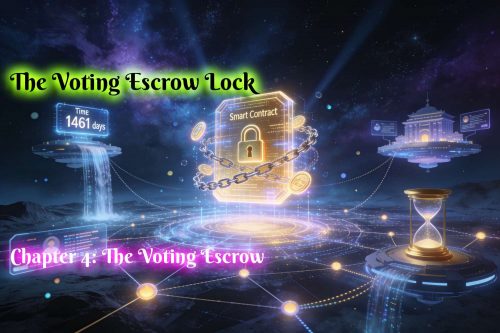
The Nexus Protocol’s VeToken Contract was a masterpiece of elegant simplicity—a few hundred lines of code that governed the most important mechanism in the entire ecosystem. Nina had studied it countless times before, but tonight she approached it with fresh eyes, determined to understand every nuance, every edge case, every possible weakness.
Her virtual workspace was bathed in the soft blue glow of the blockchain explorer, the contract’s source code scrolling before her like an ancient scroll of wisdom. She’d pulled up the original documentation, the developer notes, and even the archived discussions from when the contract was first proposed five years ago. She wanted to understand not just what the contract did, but why it was designed that way in the first place.
Nina (to herself, reading aloud): “The VeToken Contract enables users to lock their tokens for a predetermined period. In exchange, users receive voting power proportional to their lock duration. The contract is immutable, transparent, and fully auditable. It is the cornerstone of our governance system.”
She paused, frowning. “Cornerstone.” That was a strong word. But was it accurate? If the contract was truly the cornerstone, why was it so easy to exploit?
She pulled up the contract’s core logic, isolating the function that calculated voting power:
text
function getVotingPower(address user) public view returns (uint256) {
    VeToken storage token = veTokens[user];
    if (token.lockEnd <= block.timestamp) {
        return 0;
    }
    uint256 lockDuration = token.lockEnd - token.lockStart;
    uint256 basePower = token.amount;
    uint256 multiplier = lockDuration / 365 days; // 1 year = 1x, 4 years = 4x
    return basePower * multiplier;
}
Nina read the code three times, her mind tracing the logic. It was straightforward: voting power equaled the number of tokens multiplied by the lock duration in years. A 4-year lock gave 4x the voting power of a 1-year lock. Simple. Transparent. And fundamentally flawed.
Nina (to herself): “The contract measures lock duration for voting power, but the snapshot only checks token ownership at a single moment. That’s the disconnect. A 1-day holder has the same voting power as a 1-year holder, as long as they both hold tokens at the snapshot. The lock duration is irrelevant to voting eligibility.”
She leaned back in her chair, her mind racing. The VeToken Contract was designed to reward commitment, but the snapshot mechanism completely undermined that design. It was like building a fortress with a massive, unguarded gate. The walls were strong, but anyone could walk right through the entrance.
Nina: “The lock duration determines how much voting power you have, but it doesn’t determine whether you can vote at all. That’s the loophole. That’s what the speculators are exploiting.”
She began sketching out a diagram on her interface, mapping the relationships between token ownership, lock duration, and voting power. The diagram revealed a glaring asymmetry: a person who’d held tokens for three years had the exact same voting eligibility as someone who’d held them for three minutes. The only difference was the multiplier applied to their voting power.
“But even that’s not enough,” she muttered. “A 1-day holder with enough tokens can still swing a close vote. The multiplier might reduce their influence, but it doesn’t eliminate it. They still have a voice. They still have a vote.”
She stared at the diagram, her frustration growing. The VeToken Contract was supposed to be the solution to short-term manipulation. It was supposed to ensure that only committed community members had meaningful influence. But the snapshot mechanism rendered it toothless.
“The contract is fine,” she said finally. “The problem is the snapshot. We need to tie voting power to the lock duration at the moment of the vote, not just token ownership.”
She started drafting a new version of the contract in her mind, tweaking the logic to close the loophole. What if voting power was determined by the lock duration at the time of the vote, rather than at the snapshot? What if the multiplier was applied dynamically, based on how long the tokens had been locked?
But even as she thought it through, she realized the limitation. The snapshot was necessary—it prevented last-minute token transfers designed to manipulate the vote. The problem wasn’t the snapshot itself; it was the fact that the snapshot didn’t account for lock duration.
“We need a new metric,” she said. “A metric that combines token ownership with lock duration. Something that penalizes short-term holders and rewards long-term believers.”
She pulled up her draft proposal from the previous night, the one she’d titled “The VeToken Upgrade.” Her original idea was simple: make voting power proportional to the square of the lock duration. A 4-year lock would yield 16x the voting power of a 1-year lock. That would massively amplify the influence of long-term holders while reducing the impact of short-term speculators.
But now, as she studied the VeToken Contract in more detail, she realized her initial idea didn’t go far enough. The square multiplier would help, but it wouldn’t eliminate the problem entirely. A speculator with enough tokens could still influence a close vote, even with a reduced multiplier.
“We need more than just a multiplier change,” she thought. “We need a fundamental shift in how voting power is calculated. We need to ensure that only those with meaningful commitment can participate in governance.”
She began sketching out a more radical proposal. What if voting eligibility itself was tied to lock duration? What if you could only vote if your tokens were locked for at least a minimum period—say, six months or a year? That would instantly eliminate the 0-day holders, the ones who’d acquired tokens just before the snapshot.
But even as she explored the idea, she saw the problems. It would exclude genuine community members who couldn’t afford to lock their tokens for long periods. It would create a two-tiered system that favored the wealthy and well-established. It would be elitist—exactly what User_78421 had accused her of being.
“There has to be a middle ground,” she said. “A way to reward commitment without excluding participation.”
She thought back to her father’s words: “Commitment is the soil where everything grows.” She’d always interpreted that as a call to invest yourself fully in the things you believed in. But maybe it also meant something else—maybe it meant creating systems that recognized and rewarded commitment, while still leaving room for others to grow.
Nina: “The VeToken Contract is the soil. But the soil is thin right now. It needs to be enriched. It needs to be cultivated.”
She pulled up the contract’s development history, looking for inspiration. The original designers had clearly intended to reward long-term commitment—that’s why they’d created the Voting Escrow in the first place. But they’d also wanted to maintain broad participation, which is why they’d kept voting eligibility open to all token holders. The tension between those two goals was the root of the problem.
“Maybe the answer isn’t a single metric,” she mused. “Maybe it’s a combination of metrics. Lock duration and token ownership, together, determining voting power. A formula that balances both.”
She began experimenting with different equations, testing their effects on hypothetical voters. A simple multiplier like the current one gave too much influence to short-term holders with large token balances. A pure lock-duration requirement excluded too many people. But a hybrid approach—something that combined both factors—might strike the right balance.
After an hour of calculations and simulations, she arrived at a formula she liked:
Voting Power = Token Balance × (Lock Duration in Years)^1.5
It wasn’t as radical as the square multiplier, but it was significantly more powerful than the current linear system. A 4-year lock would yield 8x the voting power of a 1-year lock—a substantial improvement over the current 4x multiplier. And it would make short-term speculation far less profitable, since the impact of lock duration was amplified.
“This could work,” she said, a smile spreading across her face. “It’s not perfect, but it’s a step in the right direction.”
She saved her calculations and closed the contract interface, her mind buzzing with possibilities. She had a rough draft of a proposal, a solid understanding of the problem, and a growing conviction that change was not only possible but necessary.
But she also knew she couldn’t do it alone. She needed allies, supporters, a coalition of long-term believers who shared her vision. She needed to build consensus before she could even think about submitting a formal proposal.
Nina: “Tomorrow, I’ll start reaching out to other long-term holders. I’ll present my ideas, get feedback, and refine the proposal. If I’m going to do this, I’m going to do it right.”
The next morning, Nina woke early, her mind already racing with ideas. She’d barely slept—her thoughts had been consumed by formulas, simulations, and strategies. But she felt energized, focused, and determined.
She opened her interface and began composing a series of messages to her closest allies in the community. Mira was first, of course. Then Kael, the developer of the Quantum Storage Upgrade, who’d become a friend and mentor over the past few months. Then a half-dozen other long-term holders she’d met through governance workshops and community events.
Nina (message to Mira): “Mira, I’ve been thinking about the VeToken Contract all night. I have some ideas I want to share. Can we meet in the virtual cafe later today?”
Mira (immediate reply): “Of course! I was wondering when you’d call for a strategy session. I’ve been following the forum thread—User_78421 is really getting under people’s skin. We need to do something.”
Nina (message to Kael): “Kael, I hope you’re recovering from the vote. I’ve been analyzing the VeToken Contract, and I’ve identified some weaknesses I’d like to discuss with you. Your perspective would be invaluable.”
Kael (reply, several hours later): “I’d be happy to meet. I’ve been thinking about governance reform myself. The close vote exposed some serious flaws. Let’s talk.”
Nina smiled as she read the responses. She had allies. She had momentum. She had a vision.
But she also had opposition—fierce, determined opposition that would do everything in its power to stop her.
Across the digital divide, Drew was also awake, though he’d slept even less than Nina. His mind was consumed by the veToken Upgrade proposal, which he’d been tracking through back-channel communications and whispered rumors. Nina was mobilizing. She was building a coalition. She was preparing to make her move.
Drew (to Vex): “She’s meeting with her allies today. I need to know what they’re planning.”
Vex: “I’ve been monitoring communication channels. Nina has scheduled meetings with at least six long-term holders. The topics of discussion are not publicly available.”
Drew: “I don’t need the details. I know what she’s planning. She’s going to push for a change to the VeToken Contract. She’s going to try to lock us out of governance.”
Vex: “Is that a bad outcome?”
Drew: “For me? Yes. It’s a disaster. If she succeeds, I lose all influence. I can’t manipulate votes if I can’t participate in them.”
He paced his workspace, his frustration building. He’d been so confident after the Quantum Storage vote. He’d made a tidy profit, executed his strategy flawlessly, and moved on to the next target. But Nina had changed the game. She’d exposed the operation, rallied the community, and now she was preparing to close the loophole entirely.
Drew: “I need to stop her. But I can’t do it alone. I need allies of my own.”
He pulled up the governance forum, scrolling through the user directory. There were thousands of members, but most of them were casual participants—people who held tokens but rarely engaged in governance. They were his target audience: people who might be swayed by arguments that Nina was trying to create an elite class of voters.
Drew (to Vex): “I need to build a counter-coalition. I need to find other short-term holders, other speculators, other people who’ll be hurt by Nina’s reforms. We need to stand together.”
Vex: “I can identify potential allies based on token acquisition patterns and voting behavior. Shall I compile a list?”
Drew: “Do it. And start reaching out to them anonymously. Use disposable identities. I don’t want anyone tracing this back to me.”
Vex: “Understood. I will begin immediately.”
Drew watched as Vex’s interface flickered with activity, the AI scanning through millions of data points to identify potential allies. It would take time, but Drew was patient. He’d waited for opportunities before; he could wait again.
Drew (to himself): “Nina thinks she can change the rules. She thinks she can lock us out of governance. But she’s wrong. I’ll show her that you can’t eliminate influence—you can only shift it. And I’m very good at shifting influence to where it benefits me most.”
The virtual cafe materialized around Nina as she logged in, a cozy digital space filled with warm light, comfortable seating, and the gentle hum of conversation. The cafe was a popular gathering spot for long-term community members—a place where trust was built, alliances were formed, and ideas were born.
Nina found a table near the back, away from the main flow of traffic, and ordered a virtual cup of tea. She didn’t drink it—it was just a prop, something to hold while she talked. But the ritual of it helped her focus, helped her feel grounded.
Mira arrived first, her starfish avatar bobbing excitedly. “Nina! I’ve been thinking about your proposal all night. Tell me everything.”
Nina smiled. “I’ve been analyzing the VeToken Contract. I think I’ve found a way to fix the snapshot loophole. It involves changing how voting power is calculated.”
Mira leaned in, her eyes bright with curiosity. “How?”
Nina pulled up a holographic display, showing her formula: Voting Power = Token Balance × (Lock Duration in Years)^1.5
Mira studied the display, her expression shifting from curiosity to understanding. “So the voting power increases exponentially with lock duration. A 4-year lock would be much more powerful than a 1-year lock.”
“Exactly,” Nina said. “The current system is linear—a 4-year lock gives 4x the power of a 1-year lock. My system would give 8x the power. That’s a significant difference. It would make short-term speculation far less attractive.”
Mira nodded slowly. “But it’s not just about the formula, is it? It’s about the broader system. The snapshot, the voting eligibility, the way we define commitment.”
“You’re right,” Nina said. “The formula is just one part of the solution. I’m also thinking about changing the snapshot mechanism itself. What if we required a minimum lock duration to participate in governance? What if you had to have tokens locked for at least six months to vote?”
Mira winced. “That might be a step too far. A lot of people would be excluded. We’d lose the voices of newer members.”
“Maybe,” Nina said. “But we need to find a balance. We can’t let the system be manipulated by speculators, but we also can’t exclude genuine community members. The formula is a compromise—it rewards commitment without excluding participation.”
Mira thought for a moment. “I like it. It’s elegant. But we’re going to face a lot of opposition. User_78421 is already rallying the short-term holders. They’re going to fight this.”
Nina nodded grimly. “I know. That’s why we need to build a coalition. We need to show the community that this isn’t about power—it’s about integrity. We need to prove that commitment creates value.”
Kael arrived a few minutes later, his avatar—a tall, lean figure with sharp features and dark eyes—materializing at the table. “Nina, I read your message. I’m impressed by your analysis. I’ve been thinking about the same issues.”
Nina smiled. “Thank you, Kael. I’m hoping you can help me refine the proposal. Your technical expertise would be invaluable.”
Kael nodded. “I’ve been studying the VeToken Contract since the vote. The snapshot loophole is obvious now, but it wasn’t when the contract was first designed. The community has grown, and the threats have evolved. We need to evolve with them.”
The three of them spent the next hour discussing the proposal, refining the formula, and debating the potential consequences. They considered edge cases—what if someone locked tokens but then sold them? What if the protocol itself changed? What if the lock mechanism was exploited in new ways?
By the end of the session, Nina felt more confident than ever. She had a solid proposal, a growing coalition, and a clear vision for the future.
Nina (to Mira and Kael): “Thank you both. I’m going to formalize the proposal and submit it to the governance forum. I want to give the community a chance to debate it before we call for a vote.”
Mira: “When will you submit it?”
Nina: “Tomorrow. I want one more day to refine the language and gather support.”
As the meeting ended and her friends logged off, Nina remained in the virtual cafe, her thoughts swirling. She pulled up the draft proposal again, reading through it one last time.
PROPOSAL: THE VETOKEN UPGRADE
Summary: Modify the Voting Escrow contract to calculate voting power using the formula: Voting Power = Token Balance × (Lock Duration in Years)^1.5. This change will amplify the influence of long-term holders while reducing the impact of short-term speculators. It will also incentivize longer lock durations, aligning governance power with commitment to the protocol’s future.
Rationale: The current governance system is vulnerable to exploitation by short-term speculators who acquire tokens just before votes and sell immediately after. This undermines the integrity of our governance and reduces the influence of committed community members. The proposed change addresses this vulnerability while maintaining broad participation in governance.
Implementation: The change requires a modification to the VeToken Contract’s voting power calculation function. The new formula will be applied to all future votes. Existing lock durations will be honored, but the new formula will be used for calculating voting power.
Timeline: The upgrade can be implemented within 30 days of approval. Testing and auditing will be completed before the upgrade is deployed.
She saved the draft and closed her interface, a sense of peace washing over her. The proposal was ready. The coalition was building. And the future was within reach.
Nina (internal monologue): “This is just the beginning. But beginnings are important. They set the tone for everything that follows.”
Across the digital divide, Drew received a notification that Vex had compiled a list of potential allies. He opened the file, scanning through the names and profiles with growing satisfaction.
Drew (to Vex): “Good work. Now reach out to them. Use the same messaging I drafted earlier—Nina is trying to create an elite class of voters. She’s trying to exclude the little guy. We need to stand together.”
Vex: “Messages prepared. Sending now.”
Drew watched as the communications were dispatched, each one tailored to its recipient. He’d been in this game long enough to know how to appeal to people’s fears and insecurities. He knew how to turn them against each other.
Drew (to himself): “You want a fight, Nina? You’ve got one. But I’m not going to play by your rules. I’m going to play by mine.”
He leaned back in his chair, a cold smile spreading across his face. The game was just beginning.
The narrator’s voice echoed softly in the silence:
“Two paths. One future. But the path to that future would be paved with conflict, compromise, and the hardest choice of all: trusting that commitment could overcome exploitation.”
“The Voting Escrow was more than just a contract. It was a promise—a promise that commitment would be rewarded, that belief would be amplified, that the future belonged to those who believed in it.”
“And that promise was about to be tested.”
Table of contents:
Introduction
Chapter 1: The Governance Token
Chapter 2: A Vote for Influence
Chapter 3: The Locking Period
Chapter 4: The Voting Escrow
Chapter 5: The Long-Term Commitment <<<<<< NEXT
Chapter 6: The Short-Term Speculator
Chapter 7: The VeToken Upgrade
Chapter 8: The Lock Extension
Chapter 9: The Governance Alignment
Chapter 10: Commitment Creates Value
