The digital rain fell in soft, shimmering streams across Amara’s workspace, a visual comfort she had coded herself during the long nights of the protocol’s early days. Each droplet carried a faint trace of code—a reminder that even beauty in this world was built on logic.
Amara, seventeen years old with dark hair pulled back in a practical knot, scrolled through the Aether Protocol’s governance forum with the practiced ease of someone who had helped build its foundations. Her fingers danced across the holographic interface, swiping away minor proposals with barely a glance.
“Proposal 84: Change the interface color from Aether Blue to Celestial Cyan.” Denied. Aesthetics were important, but not governance-worthy.
“Proposal 85: Increase community reward pool by 0.5%.” She paused on this one, reading through the calculations. The numbers didn’t add up. The author had miscalculated the treasury’s growth rate. She flagged it for review and moved on.
“Proposal 86: Memorialize the Great Flash Loan Attack of ’24.” Amara’s finger hovered over this one, a ghost of a smile crossing her face. She remembered that day. She remembered the chaos, the panic, the desperate race against time. That was the day everything changed.
Her private messaging pinged. It was Sota, her mentor and the senior developer who had brought her into the project two years ago when she was just fifteen and hungry for something meaningful to build.
“Amara, you’re reviewing proposals again. You know that’s not your job anymore. You’re a core contributor now.”
She typed back, her response carrying a hint of the wry humor they’d developed during countless late-night debugging sessions. “Someone has to. Most of these are garbage. And you know I can’t help myself.”
“That’s why we built the Council,” Sota replied. “So you could sleep.”
Amara leaned back in her chair, her workspace expanding around her. The Aether Protocol’s digital environment was her sanctuary—a fluid space where code streams flowed like rivers, where data structures bloomed like crystalline trees. It was beautiful and complex, a testament to thousands of hours of collective effort.
But Sota was right. The community was growing, and with growth came noise. Thousands of users now held AETHER tokens, each with a voice in the protocol’s governance. Thousands of voices meant thousands of opinions, thousands of proposals, and—inevitably—thousands of opportunities for something to go terribly wrong.
She remembered the flash loan attack of ’24 as if it were yesterday. She had been just a junior contributor then, barely trusted to review simple code patches. But she’d been in the chat when the attack happened. The protocol had lost nearly fifteen million in value in under sixty seconds, drained through a cleverly constructed exploit that had passed community governance with flying colors.
The community had been too trusting. Too eager to approve a proposal that promised higher yields. No one had read the code carefully enough.
“We need a final line of defense,” Amara had said during the emergency meeting that followed. Her voice had been shaking, but her conviction had been absolute. “Not to control the community, but to save it from itself. We need someone to watch the watchers.”
Sota had looked at her with that expression he got when he was impressed against his will. “You want to create a veto council?”
“A Security Council,” she’d corrected. “Nine of the most trusted community members. Multisig. They can stop a proposal from executing if it’s clearly malicious.”
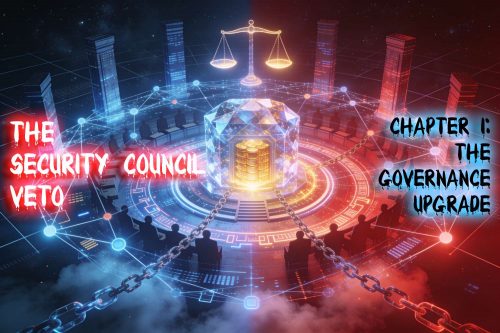
Now, two years later, the Security Council existed exactly as she had envisioned it. Nine members. Seven signatures required for a veto. Full transparency of their deliberations and decisions.
She pulled up the Council dashboard, watching the nine digital identities pulse softly on her screen. Each was represented by a cryptographic hash—anonymous to the public but known to each other through the secure messaging system they’d built.
Council Member 1: Professor Kael — A brilliant economics professor who had helped design the protocol’s incentive structures. He was methodical, cautious, and rarely spoke, but when he did, people listened.
Council Member 2: Vera — A former protocol developer who had retired to focus on security auditing. She had caught three critical vulnerabilities in the protocol’s early days. Her reputation was unassailable.
Council Member 3: The Warden — A community leader who had been with the project since its inception. He ran the largest AETHER staking pool and represented the interests of thousands of smaller holders.
Council Member 4: Dr. Chen — A cryptography expert who had published seminal papers on multisignature security. His presence on the Council was a statement of technical credibility.
Council Member 5: Nova — The youngest council member at twenty-two, and the only one close to Amara’s age. They had worked together on the initial Council framework. Nova was fierce, brilliant, and often the voice of the community’s more radical elements.
Council Member 6: The Archivist — An anonymous figure who maintained the protocol’s historical records. Their identity was unknown even to other Council members, but their knowledge of the protocol’s code was encyclopedic.
Council Member 7: Seraph — A venture capitalist who had invested heavily in the protocol’s early days. She was pragmatic and often argued for economic stability over ideological purity.
Council Member 8: Dorian — Amara’s stomach tightened slightly as she saw his name. Dorian was a community activist who had been vocal against the Council from the beginning. He had agreed to serve only to “watch the watchers,” as he put it. He was sixteen, just a year younger than Amara, and his political arguments were sharp, persuasive, and relentless.
Council Member 9: Ghost — And then there was Ghost. No one knew who Ghost was. The ninth member of the Council had never revealed their identity, not even to the other eight. But their technical security record was flawless. They had discovered three major exploits before they could be submitted to governance, and their code reviews were legendary. Ghost was a mystery, a cipher, a ghost in the machine.
Amara had designed the Council to be balanced—technical experts, economic thinkers, community representatives, and ideological critics. She had built it to be a safety net, a final check against the chaos of pure democracy.
She just hoped she would never have to use it.
“The Council’s job is to protect the community from itself,” she had explained to a new community member just last week. The user, a young developer named Ren, had been confused about the governance process.
Ren’s avatar appeared beside Amara’s workspace, a simple geometric shape that pulsed with curiosity. “But if the community votes for something, isn’t that the will of the people? Doesn’t the Council override democracy?”
Amara had smiled, a bit sadly. “Democracy assumes everyone voting has the full information they need. But code is complex. Proposals can be intentionally deceptive. The Council is our insurance policy against bad actors who exploit the gap between what people think they’re voting on and what’s actually in the code.”
“But how does it work exactly?” Ren had pressed.
Amara had walked them through the process, laying out each step as clearly as she could. She had done this dozens of times now. The governance mechanism was her creation, and she had a duty to help people understand it.
Step 1: Proposal Submission. Anyone could submit a governance proposal. The proposal was a piece of code—an update to the protocol’s smart contracts. It had to be accompanied by a clear description of what it did, but there were no guarantees that the description matched the code.
Step 2: Community Review. The proposal was posted to the governance forum. Community members discussed it, debated its merits, asked questions. The proposal remained in review for at least twenty-four hours to allow for scrutiny.
Step 3: The Vote. AETHER token holders voted on the proposal. Each token equaled one vote. If the proposal received a supermajority of votes—at least 60% in favor—it passed.
Step 4: The Timelock. Even after passing, the proposal didn’t execute immediately. There was a forty-eight-hour waiting period. This was the critical window, the time during which the Security Council could act.
Step 5: The Veto. If the Council unanimously agreed—or at least achieved a 7/9 supermajority—that the proposal was malicious, they could veto it. The veto stopped the proposal from executing. The Council had to publish their reasoning, making the decision transparent to the community.
“It’s beautiful, isn’t it?” Amara had said, her voice carrying a note of pride. “We have the speed and inclusivity of decentralized governance, but with a fail-safe. We can fix mistakes before they become disasters.”
Ren had nodded, but there was still a hint of skepticism in their avatar’s flickering. “And the Council has never used this veto power?”
“Never,” Amara had confirmed. “We’ve had close calls. A few suspicious proposals. But we’ve always caught issues during the community review phase. The Council has never had to override a vote.”
“Until now,” Ren had said, with the casual prediction of the young.
Amara had laughed it off, but the words had stayed with her. Until now.
She shook off the memory and returned to her current review. The community had grown so much in the past two years. Over 500,000 token holders now. Tens of thousands of active participants in governance. The protocol managed over two billion in value.
It was a far cry from the scrappy project she had joined as a fifteen-year-old, coding in her bedroom while her parents thought she was doing homework. The Aether Protocol had started as an experiment, a proof-of-concept for a new kind of decentralized finance. Now it was a giant, a behemoth that needed careful management.
Amara’s personal workspace reflected this evolution. Once a simple text editor, it was now a sophisticated interface that connected to multiple data streams—the governance forum, the code repository, the treasury dashboard, the price feed, the security monitoring systems.
She pulled up a window showing the protocol’s technical architecture. It was a beautiful flow of nodes and connections, a digital organism that represented the collective work of hundreds of developers over thousands of hours. The core codebase had been audited by six independent firms. The security measures were world-class.
But code was only as safe as the people who wrote it and the people who approved it.
“We built a nuclear button,” she murmured to herself, looking at the Council dashboard once more. “I just hope we never have to push it.”
Her private messaging pinged again. This time it wasn’t Sota. It was a direct message from Nova.
“Amara, have you seen the new proposal that just dropped? AIP-101. Looks interesting.”
Amara navigated to the governance forum. There it was, posted just minutes ago: “Aether Improvement Proposal 101: Core Protocol Optimization & Efficiency Upgrade.”
The title was innocuous enough. The description was clear and professional:
“This upgrade implements several optimization patches designed to reduce transaction gas fees by approximately 15% and improve overall protocol throughput by optimizing the signature verification process. The implementation has been tested on our internal testnet for three weeks with no issues detected. Full code diff attached. Estimated implementation cost: 50,000 AETHER tokens.”
Amara felt a prickle of unease. The numbers were right. The technical language was correct. The proposal was written in exactly the style she would expect from an experienced developer.
But something felt off.
She opened the code diff, her eyes scanning the changes line by line. The optimization patches looked legitimate. They followed best practices. The signature verification optimization was elegant, actually—whoever wrote this knew what they were doing.
She was about to close the file when she noticed something. A function at the end of the code, tucked away in a section labeled “Admin Override.” It was called verifyUpgrade(). That was a standard function, used to confirm that an upgrade had been properly deployed.
But the code inside…
Amara’s breath caught in her throat. She read the function again. And again.
“This isn’t an optimization,” she whispered. “This is a backdoor.”
She looked at the signature verification optimization again. It was legitimate. Everything in the main body of the code was legitimate. But at the very end, beyond the legitimate changes, was a hidden function that would grant “admin” status to the upgrade’s deployer. And with admin status came control of the treasury.
The code was a Trojan horse. A wolf in sheep’s clothing. The community would vote for cheaper transactions, and they would get them—along with a complete emptying of the treasury.
Amara’s hands were shaking. She sent an urgent message to the Council chat.
“Everyone, we have a situation. AIP-101 is not what it appears to be. I’m running a full simulation now, but I’m confident this is malicious. Requesting emergency Council meeting. Please respond.”
She watched the Council members’ status lights begin to blink online as the message was received. One by one, they appeared in the secure Council room.
Professor Kael: “What have you found, Amara?”
Vera: “I’m reviewing the code now. I see what she’s talking about. This is bad.”
Dorian: “Wait, hold on. We’re meeting before the community even starts voting? This is exactly what I’ve warned about. The Council acting before the process has run its course.”
Nova: “Dorian, the code is clearly malicious. The community will not have time to find this. It’s buried in optimized code—even experienced developers would miss it.”
The Warden: “We need to see the full simulation results before we decide anything.”
Amara: “Running it now. This will take about an hour to confirm.”
Seraph: “Keep us updated. I’ll be monitoring.”
The Archivist: “I’m reviewing the proposal author’s history. It’s a new account. Zero previous contributions. That alone is suspicious.”
Ghost: “I have independently verified the backdoor. Amara is correct.”
The chat went silent for a moment. Ghost rarely spoke. When they did, everyone listened.
Amara felt a strange mixture of emotions. Relief that her analysis had been confirmed. Fear at what this meant for the protocol. And a strange, cold certainty that this was the moment she had been dreading.
She had built the Security Council to protect the community. She had never imagined it would actually need to be used.
But here they were. And the nuclear button was glowing.
The timer on the proposal started ticking.
Forty-eight hours until AIP-101 could be executed.
Forty-eight hours for the Council to decide what to do.
Forty-eight hours to determine whether decentralization or security would win.
Amara looked at her Council dashboard. Nine identities, pulsing softly. Nine people who trusted her to have built a safe system.
“We built a nuclear button,” she thought again. “And someone has just tried to use it against us.”
She began to run the simulation, her fingers moving with practiced precision across the interface. Somewhere out there, the person who had submitted AIP-101 was watching the vote tally climb. They were probably confident. The code was perfect. The disguise was flawless. The community was already voting yes.
They had no idea that the Security Council was watching.
They had no idea that Amara had already seen through their disguise.
“I just hope you haven’t planned for us,” she thought to the unknown attacker. “I hope you didn’t know about the nuclear button.”
The simulation began. The virtual treasury started draining in her test environment.
Amara watched, sickened, as billions of digital tokens vanished into an anonymous wallet in less than sixty seconds.
“It’s a complete drain,” she sent to the Council chat. “Confirmed. AIP-101 is a total exploit. We need to decide what to do.”
Vera: “The veto. Obviously. We can’t let this execute.”
Dorian: “And if we veto, we prove everything I’ve been saying. We’re unelected overlords overriding the will of the community.”
Professor Kael: “There’s a difference between overriding the community’s will and preventing a disaster they don’t know about.”
Nova: “The community is already voting yes. By a huge margin. By the time the timelock ends, they’ll have approved this overwhelmingly. A veto will be seen as a power grab, no matter what we say.”
The Warden: “So we let the treasury get drained? That’s your solution?”
Seraph: “No one is saying that. We’re trying to figure out how to do the right thing without destroying the protocol’s legitimacy.”
The Archivist: “The legitimacy of a dead protocol is irrelevant. If this executes, Aether is finished.”
Ghost: “We must veto. The technical evidence is clear. We can explain it to the community. They will understand.”
Dorian: “Will they? Or will they see nine people who decided they knew better than 500,000 token holders? Because that’s what this is. It’s not a safety net. It’s a leash.”
Amara: “Everyone, please. We have forty-eight hours. Let’s not panic. Let’s gather all the evidence. Let’s present a united front. And then, together, we’ll decide.”
She closed the chat and stared at the simulation results. The treasury had been drained. The protocol was dead. The community was gone, their tokens worthless.
She had built the Security Council to prevent exactly this scenario. And now that the moment had come, she was terrified.
“We built a nuclear button,” she thought one last time. “And I have to decide whether to push it.”
The timer continued ticking.
Outside her workspace, the governance forum was exploding with excitement. AIP-101 was gaining traction. The community was thrilled about cheaper transactions.
They had no idea what was coming.
They had no idea that the Security Council was about to make the most consequential decision in the protocol’s history.
Amara looked at her Council dashboard once more. Nine identities. Nine lives. Nine people whose judgment she trusted with her life.
“Trust, but verify,” she whispered. “That’s what I built. That’s what we are.”
The digital rain continued falling in her workspace, gentle and peaceful, oblivious to the storm that was about to break.
“I just hope we can survive what comes next,” Amara thought.
The chapter closed on her workspace, with the security council members still gathering in their encrypted chat room, and a community of 500,000 people celebrating a proposal that would destroy them all.
The nuclear button was waiting.
All it needed was nine people to push it.
Table of contents:
Introduction
Chapter 1: The Governance Upgrade
Chapter 2: A Community Decision <<<<<< NEXT
Chapter 3: The Council’s Veto
Chapter 4: The Centralization Concern
Chapter 5: The Malicious Proposal
Chapter 6: The Council’s Dilemma
Chapter 7: The Veto or Not to Veto
Chapter 8: The Community Revolt
Chapter 9: The Council Abolition Vote
Chapter 10: Trust, But Verify
