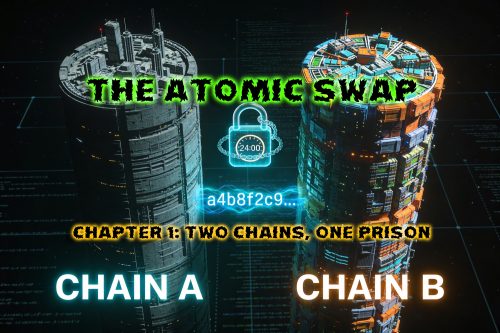
The screen glowed blue in the darkness of Val’s closet.
She’d been sitting here for forty-seven minutes, cross-legged on a pile of old sweaters, her back pressed against the cold wall. One hand cupped around the tablet’s screen to block any stray light from leaking under the door. The other hand kept refreshing the same message thread, her thumb moving in a rhythm that had become almost compulsive.
No new messages.
Outside her bedroom, the apartment was quiet. Her father had left for his shift at the Aureus Mint three hours ago. The government-issued wall clock in the kitchen ticked every second, loud as a hammer in the empty space. Val had memorized that sound years ago—the steady, relentless reminder that time was something Chain A controlled.
Just like everything else.
She pulled up the medical readout again. The image was grainy, forwarded through three proxy servers and a dead drop in the Neutral Zone. But she didn’t need clarity to recognize the downward slope of the blue line. Cellular degradation syndrome. Stage two. Thirty days, the doctor had written in a brief, terrified note. Thirty days until irreversible damage if treatment is not initiated.
Her sister Mira was thirteen years old. She lived on Chain B with their mother, in a chaotic, colorful world that Val had only seen through smuggled photographs. Mira had always been the bubbly one, the one who sent voice messages full of laughter and bad singing. The last voice message, two weeks ago, had been quiet. Breathy. “I’m tired, Val. When are you coming?”
Val had played it seventeen times.
She looked down at her digital wallet. 5,000 Aureus. A small fortune on Chain A—enough to buy a used transport pod, or a year’s worth of luxury food cubes, or a lifetime supply of the gray wool coats that everyone wore against the perpetually overcast sky. But on Chain B, the Aureus was worthless. They used Credits there. And the Warden of A had made sure there was no official way to convert one to the other.
“To protect our citizens from economic instability,” the Warden said every year in his annual address, his face plastered on every public screen. “Chain B is a casino. They will take your savings and leave you with nothing. Stay here. Be safe. Be loyal.”
Safe, Val thought bitterly. Mira is dying because there’s no medicine on Chain A, and the Warden won’t let anyone buy it from Chain B.
She closed the medical readout and opened a different screen—a hidden browser she’d installed using a bootleg firmware update she’d coded herself. The browser had no logo, no history, no tracking. It opened directly to a dark-gray interface with the words NEUTRAL ZONE ACCESS: LEVEL 2 at the top.
Val had been teaching herself cryptography for two years. She ran an underground study group called the “Hash Club”—five other teenagers who met in abandoned maintenance tunnels to discuss cross-chain protocols, hash functions, and the theoretical beauty of atomic swaps. None of them had ever actually done a swap. It was illegal. The penalty was asset forfeiture and up to three years in a Warden-run re-education facility.
But Mira’s timer was ticking.
Val navigated to a forum called The Bazaar Gate. It was a chaotic mess of pseudonyms, trust ratings, and desperate requests. She scrolled past posts offering “fast conversions—90% fee” and “guaranteed swaps—trust me bro” and “I know a guy who knows a guy.” Most of them were scams. She’d spent the last three nights analyzing the patterns, cross-referencing usernames with complaint threads, building a mental map of who was real and who was a Warden honeypot.
She took a breath. Then she typed.
USER: PreimageSeeker
FORUM: The Bazaar Gate > Swap Requests
TITLE: Need to swap Aureus for Credits. Legitimate. Urgent family medical.
She hesitated over the body of the message. How much to reveal? Too little, and no one would trust her. Too much, and the Warden’s bots would flag her for surveillance. She settled on something short.
5,000 Aureus → Credits at fair market rate. Medical necessity. Can provide proof to serious inquiries. Reputation: new user. Willing to use escrow or atomic swap only. No upfront fees. Respond here or DM.
She posted it, then immediately started a timer on her tablet. In her experience, legitimate swappers responded within ten minutes. Scammers responded within thirty seconds.
The first message arrived in eleven seconds.
CryptoCrusader: “I can do 4,200 Credits for your 5,000 Aureus. Send funds to this address first for verification.”
Val flagged the user as a probable scam. No trust rating displayed. No history. She ignored it.
The second message came at forty-five seconds.
QueenOfSwaps: “3,000 Credits. Take it or leave it.”
The rate was insulting. Val ignored it.
Three minutes. Four minutes. Six minutes. The offers kept coming, each one worse than the last—either obvious scams or predatory rates designed to exploit desperation. Val’s hope was fading. She’d known this wouldn’t be easy, but she hadn’t expected nothing legitimate.
At seven minutes and twenty-two seconds, a new message appeared.
HashlockHero: “I see your post. 5,000 Aureus → 4,800 Credits after my 4% fee (200 Credits). Atomic swap only. Hash timelock contract. You generate the preimage. I’ll walk you through it. Trust rating: 94% over 47 swaps. Can meet in the Neutral Zone in one hour to discuss terms. No obligation. Just talk.”
Val’s finger hovered over the username. She clicked through to HashlockHero’s profile. Ninety-four percent positive rating. Forty-seven completed swaps spanning two years. The complaints were minimal—mostly about response time, nothing about theft. Several users had left glowing reviews: “Saved my sister’s tuition.” “Fast and honest.” “Explained everything clearly.”
It looked real.
It looked too real.
But Val didn’t have the luxury of waiting for perfect. She typed back: “One hour. Where in the Neutral Zone?”
The reply came instantly: *“Terminal 47-G. Abandoned subway station under the old textile district. Come alone. Use pseudonym only. I’ll be there.”*
The abandoned subway station smelled like rust and rain.
Val had been here once before, six months ago, when the Hash Club had explored the deeper tunnels as a field trip of sorts. The station had been decommissioned after a structural collapse in the western concourse, and the Warden’s maintenance crews never bothered with repairs. The only light came from emergency beacons that flickered every few seconds, casting long shadows across the cracked tile walls.
Terminal 47-G was a single booth at the far end of the platform—a relic from when subway conductors used paper tickets. Someone had retrofitted it with a small holographic display, a keyboard, and a chair that looked like it had been stolen from a school classroom. The display glowed a soft blue, connected to the Neutral Zone through a hardwired fiber optic line that bypassed Chain A’s firewalls.
Val sat down. The chair wobbled.
She pulled up the interface and created a temporary identity: PreimageSeeker. The system assigned her an avatar—a generic silhouette—and dropped her into a private chat room with HashlockHero, who was already waiting.
HashlockHero: “You’re early. I like that.”
PreimageSeeker: “You said one hour. It’s been forty-five minutes.”
HashlockHero: “I stand corrected. You’re prompt. Also good.”
The chat window expanded as HashlockHero shared a video feed. A girl appeared on Val’s screen—probably seventeen, with dark skin and close-cropped hair and eyes that looked tired in a way that Val recognized. She was sitting in a similar booth somewhere, though her background showed different graffiti on the walls.
“Hi,” the girl said. Her voice was calm, professional. “I’m Dara. That’s my real name. You can check my reputation across four forums. I’ve been doing this for two years.”
Val didn’t turn on her own camera. “I’m PreimageSeeker.”
“Sure you are.” Dara smiled—a real smile, not a salesman’s grin. “Look, I know you’re scared. You should be. Cross-chain swapping is dangerous. The Warden has informants everywhere, and the Neutral Zone is full of people who will take your money and laugh about it later. But I’m not one of them.”
“Everyone says that.”
“Everyone does. That’s why you should check my reputation. Look at the negative reviews, not the positive ones. See if anyone ever accused me of stealing. See if anyone said I timed out on a swap.” Dara leaned back. “I’ll wait.”
Val already had. She’d spent the last hour doing exactly that. HashlockHero’s record was clean—not spotless, but clean where it mattered. The negative reviews were about delays, miscommunications, one incident where Dara had gotten the exchange rate wrong and refunded the difference three days late. But no theft. No timeout attacks. No complaints about funds disappearing.
“Your reputation checks out,” Val admitted.
“Good. Then let’s talk terms.” Dara’s demeanor shifted slightly—still friendly, but more focused. “You have 5,000 Aureus. You need Credits. Fair market rate right now is 1 Aureus = 1.02 Credits, but cross-chain friction means you’ll never get that. My fee is 4%. That gives you 4,800 Credits. Does that work?”
Val did the math. It was better than any other offer she’d received. “It works.”
“Great. Now comes the hard part.” Dara pulled up a blank document on her screen—two contract templates, side by side. One for Chain A, one for Chain B. “You’ve heard of atomic swaps?”
“Yes.” Val had read every paper she could find. She’d even built a mock swap on a testnet once, using fake currency. “Hashlock plus timelock. Either it completes fully, or it doesn’t happen at all.”
“Someone’s done their homework.” Dara looked impressed. “Most people come to me thinking I’m just going to Venmo them the money. So here’s how this works.” She pointed to the first template. “You lock your Aureus in a smart contract on Chain A. The contract has a condition—a hashlock. That means the funds can only be released if someone provides a specific secret string of data. We call that secret the preimage.”
“I know.”
“Let me finish.” Dara’s voice was patient but firm. “I lock my Credits in a similar contract on Chain B, using the same hashlock—the same fingerprint of your secret. I don’t know your secret, only its hash. Then we both wait. When you’re ready, you reveal your secret to me. I use it to claim your Aureus. I reveal my secret—which is the same secret, because it’s the same hashlock—and you use it to claim my Credits. The swap completes. Atomic.”
Val nodded. “Trustless. Neither of us has to trust the other because the code enforces fairness.”
“Exactly. But there’s one more piece.” Dara highlighted the second condition on each contract. “The timelock. Each contract has a deadline. If the secret isn’t revealed by that deadline, the funds go back to the original owner. That’s your safety net—if I disappear, you get your money back.”
“What about the order?” Val asked. “Someone has to reveal first.”
Dara’s eyes narrowed approvingly. “You really have done your homework. Yes. Someone reveals first. In an ideal world, we’d reveal at the exact same millisecond, but blockchains don’t work that way. So we stagger the timelocks. Your contract on Chain A gets a longer timer than mine on Chain B. That means I have to reveal my secret first—because if I don’t, my timer expires and my Credits go back to me, and you still have your Aureus. I’m incentivized to reveal.”
“And if you reveal first, then I have your secret, and I can claim your Credits.”
“Right. And once I see that you’ve claimed my Credits, I know you’ve seen my secret—so I can claim your Aureus with the same secret.” Dara smiled. “It’s elegant. No banks, no escrow, no middlemen except the code.”
Val studied the templates. Everything Dara said matched what she’d learned in the Hash Club. But there was always a gap between theory and practice. “What’s the catch?”
“The catch is that you have to trust the code—and yourself. If you lose your secret, the swap fails. If your internet goes down and you can’t reveal in time, the swap fails. If someone attacks the network and your transaction gets stuck, the swap fails. And if you’re dealing with a bad counterparty who tries to manipulate the timelocks…” Dara hesitated. “Well. That’s why you check reputations.”
Val felt the weight of the decision pressing down on her. 5,000 Aureus was everything she had. It was her father’s savings, her own earnings from tutoring younger students, money she’d scraped together over two years of relentless frugality. If this went wrong, she wouldn’t just lose her chance to help Mira. She’d lose her future.
But Mira’s timer was still ticking.
“Let’s do it,” Val said.
Dara didn’t celebrate. She didn’t even smile. Instead, she looked at Val with an expression that was almost grave. “Before we go any further, you need to understand something. There’s no bank. No judge. No one to complain to if something goes wrong. The code is the code. Either it works perfectly, or you lose everything.”
She paused.
“Do you still want to proceed?”
The flickering emergency beacon in the abandoned subway station cast Val’s shadow across the cracked tile floor. Somewhere above ground, the Warden’s surveillance drones were scanning the streets. Somewhere on Chain B, Mira was getting sicker.
Val thought about her sister’s laugh. About the voice message that had gone quiet. About the thirty days that were already down to twenty-eight.
“Yes,” she said. “Proceed.”
Dara nodded slowly. “Then let me explain how you’re going to generate your preimage—and why you must never, ever tell it to anyone until the reveal.”
She pulled up a new window. A blank text box. And for the first time, Val saw the real shape of what she was about to do.
Table of contents:
Introduction
Chapter 1: Two Chains, One Prison
Chapter 2: The Hashlock Agreement <<<<<< NEXT
Chapter 3: A Secret Preimage
Chapter 4: The Timeout Problem
Chapter 5: The Uncooperative Counterparty
Chapter 6: The Trustless Escrow
Chapter 7: A Cross-Chain Hunt
Chapter 8: The Reveal
Chapter 9: Settling the Swap
Chapter 10: Interlinked
