The conference hall was packed.
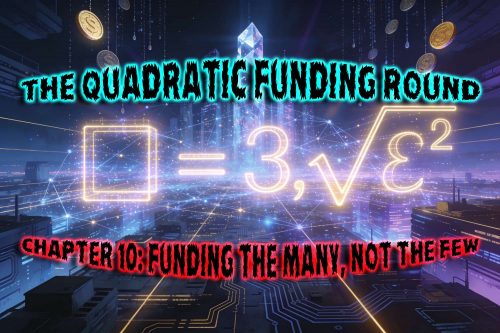
Aisha stood behind the podium, looking out at the sea of faces—community organizers, activists, tech enthusiasts, and curious onlookers who’d come to learn about the quadratic funding revolution. The holographic display behind her showed the familiar formula, the numbers dancing in the air like a promise.
She took a deep breath, steadying her nerves. She’d given this presentation dozens of times now, but it never got easier. The weight of the story—her story, the shelter’s story, the community’s story—was always there, pressing down on her.
“My name is Aisha,” she began, her voice carrying across the hall. “And this is the story of how we learned to fund the many, not the few.”
She told the story from the beginning. The first funding round, the excitement and hope, the devastating loss to a Sybil attack. The unlikely alliance with Tobin, the cynical data scientist who’d broken the system and then helped fix it. The Proof-of-Personhood system, the anonymous funding round, the quadratic miracle that had made everything possible.
“Quadratic funding is based on a simple principle,” she explained, gesturing at the formula behind her. “The matching pool amplifies small donations based on the number of unique contributors, not the total amount donated. A hundred people giving one coin each generates a hundred matching coins. One person giving a hundred coins generates only ten matching coins.”
She paused, letting the numbers sink in. “The system rewards breadth, not depth. It favors the many, not the few. And when it works, it’s beautiful.”
“But it wasn’t always beautiful,” she continued. “We faced challenges—Sybil attacks, collusion rings, donor cartels. Each time, we thought we’d solved the problem. And each time, a new problem emerged.”
She told the story of the Proof-of-Personhood system, the zero-knowledge proofs, the decentralized verification. She told the story of the anonymous funding round, the thousands of donors who’d given small amounts, the matching pool that had transformed a small community shelter into a thriving hub of activity.
“People often ask me: what’s the secret to success? How did you make it work?” She smiled, a genuine smile that reached her eyes. “The answer is simple: we trusted the math. And we trusted the community.”
She gestured at the holographic display, which showed a visualization of the funding round’s donor network. Thousands of points of light, each representing a unique donor, connected by threads of support that wove together into a beautiful tapestry.
“This is what community looks like,” she said. “Thousands of people, each giving a little, each believing in something bigger than themselves. The math amplifies their voices, but it’s the people who make the music.”
The audience applauded, a wave of sound that seemed to fill the entire hall. Aisha stood at the podium, feeling the warmth of their approval, the recognition of their support.
She found Tobin in the crowd, sitting in the back row, his tablet balanced on his knee. He was watching her with an expression she couldn’t quite read—pride, maybe, or just the quiet satisfaction of a job well done.
After the presentation, Aisha was mobbed by well-wishers and questioners. She answered each one patiently, explaining the math, the system, the lessons they’d learned. But her eyes kept drifting back to Tobin, who was standing in the corner, surrounded by his own crowd of admirers.
“Your monitoring tools are incredible,” someone was saying to him. “Real-time detection of suspicious patterns? That’s revolutionary.”
“The tools are just tools,” Tobin said, his voice carrying the familiar weight of understatement. “The real work is the community. The people who believe in the system and fight for it.”
“Fight for it? You mean protect it?”
“I mean build it. Strengthen it. Make it better.” He glanced over at Aisha, and something shifted in his expression. “That’s what we’ve been doing. And that’s what we’ll keep doing.”
Aisha excused herself from her own crowd and made her way over to him. “You’re a natural at this,” she said. “The public speaking, the explaining, the inspiring.”
“I’m terrible at it,” he said flatly. “I just say what’s true.”
“That’s why it’s inspiring. People can tell when you’re being honest.”
He considered this. “Maybe. Or maybe they just like the math.”
“Maybe both.”
The youth shelter was completed six months later.
Aisha stood in the finished space, surrounded by the community that had made it possible. The new wing was everything she’d dreamed of—bright, spacious, filled with the laughter of kids who finally had a safe place to go. The mural on the wall—the sun setting over the ocean—was finally complete, the rays stretching across the wall in a cascade of color.
“Every coin that went into this came from someone who believed in us,” Aisha said, addressing the crowd that had gathered for the opening ceremony. “Someone who gave a little, trusting that their contribution would make a difference. Someone who believed in the math, and in the community, and in the power of small voices amplified together.”
She paused, looking out at the faces before her. Volunteers, donors, community members, and the kids who would call this place home. Tobin stood in the corner, watching with an expression she’d come to recognize—quiet satisfaction, tempered with the knowledge that there was always more work to do.
“This is what quadratic funding makes possible,” she continued. “This is the quadratic miracle. Not just the math, not just the system—but the people who believe in it. The thousands of donors who gave a little. The community that came together. The future we built together.”
After the ceremony, Aisha found Tobin in the new wing, standing in front of the mural.
“I can’t believe it’s finally done,” she said, coming up beside him. “The shelter, the mural, everything.”
“It’s beautiful,” he said quietly. “The mural. The space. All of it.”
“You helped make it happen. Without your code, your system, your—”
“Without the community, it wouldn’t have mattered.” He turned to look at her, his gaze steady. “The code is just code. The system is just a system. It’s the people who give it meaning. And this—” He gestured at the shelter, the kids, the community. “—this is the meaning.”
Aisha felt a warmth spread through her chest. “You’ve really changed, Tobin. You used to be so cynical.”
“I still am. I just found something worth believing in.”
“And that is?”
He was quiet for a moment, and when he spoke, his voice was softer than she’d ever heard it. “You. The shelter. The idea that small voices can make a difference. All of it.”
Aisha reached out and took his hand, squeezing it gently. “We did this together.”
“Together,” he agreed. “And we’ll keep doing it. There will always be new challenges, new attacks, new ways to game the system. But we’ll be ready.”
“We’ll always be ready.”
The next funding round was announced a month later.
Aisha and Tobin watched from the shelter’s main room as the holographic display flickered to life, showing the new projects that were entering the competition. Thousands of projects, each with its own story, each with its own community, each hoping that the math would be on their side.
“Three thousand projects,” Tobin said, his voice filled with wonder. “More than ever before.”
“The system is growing,” Aisha said. “More people are hearing about it, trusting it, using it.”
“And we’ll keep building it. Keep improving it. Keep making it better.”
“That’s the whole point,” she said. “Progress is never finished. There’s always more work to do.”
Tobin nodded slowly. “I used to think that was a bad thing. The idea that nothing is ever truly done. But now…”
“Now?”
“Now I think it’s the best thing about the system. The fact that it can always be better. The fact that we can always make it better.”
Aisha smiled, a genuine smile that reached her eyes. “That’s the quadratic miracle,” she said. “Not just the math, not just the system—but the commitment to keep making it better.”
“Forever?”
“Forever.”
The new funding round began, and Aisha watched the donations stream in—thousands of small contributions from thousands of unique donors. The matching pool calculation ran automatically, amplifying each contribution, turning small acts of generosity into something much larger.
“We did it,” she said softly. “We built something that works.”
“We built something that works,” Tobin agreed. “And we’ll keep building it. Together.”
Aisha turned to look at him, seeing the person he’d become—the cynic who’d learned to believe, the data scientist who’d learned to trust, the ally who’d become a friend.
“We’ll always keep building,” she said. “Because the work is never done. And that’s what makes it worth doing.”
The holographic display flickered, showing the results of the funding round. The numbers were beautiful—thousands of donors, millions of coins, the math amplifying the voices of the many.
Aisha reached out and took Tobin’s hand, squeezing it gently. Together, they watched the future unfold.
Table of contents:
Introduction
Chapter 1: The Matching Pool
Chapter 2: One Person, One Vote, One Coin
Chapter 3: The Sybil Swarm
Chapter 4: A Square Root of Hope
Chapter 5: The Whale’s Distortion
Chapter 6: The Proof-of-Personhood Puzzle
Chapter 7: The Anonymous Voice
Chapter 8: A Quadratic Miracle
Chapter 9: The Retroactive Audit
Chapter 10: Funding the Many, Not the Few
