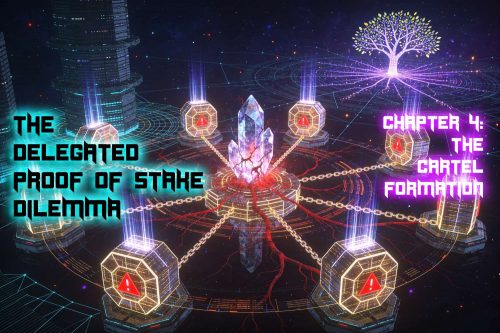
Scene 1: Origins of the Cartel (Three Years Ago)
The Nexus Network was barely eighteen months old when the crisis hit.
A rogue validator—someone who had accumulated enough voting power through a combination of legitimate support and covert acquisition—had launched a 51% attack. For three terrifying hours, the network teetered on the brink of collapse. Double-spends went through. Transactions were censored. Users panicked, their funds frozen in limbo as the attacker rewrote the blockchain’s history.
It was the closest the network had ever come to death.
In the aftermath, five validators—each of them idealistic, each of them horrified by what had nearly happened—came together in an emergency virtual summit. Their names would later become synonymous with corruption, but at that moment, they were heroes.
GuardianPrime, a veteran developer who had written the network’s original staking contract. ChainSecure, a security auditor who had personally reviewed every line of the consensus code. NexusCore, a community organizer who had built the network’s largest user forum. StableVault, a financial strategist who had helped design the tokenomics. And ValidatorAlpha, a charismatic leader who had coordinated the defense against the attack.
They met in an encrypted room, their faces visible for the first and last time—five weary, determined individuals who had just saved their creation from destruction.
“We can’t let this happen again,” said ValidatorAlpha, his voice hoarse from forty-eight hours of crisis management. “That attack succeeded because there was no coordination among the good validators. We were disorganized, reactive, isolated. The attacker exploited that.”
GuardianPrime nodded. “We need a pact. A mutual support agreement. If any of us faces a challenge, the others will vote together to protect the network.”
ChainSecure frowned. “That sounds dangerously like collusion.”
“It’s not collusion,” NexusCore interjected. “It’s defense. We’re not plotting against anyone—we’re ensuring the network stays secure. If we don’t coordinate, the bad actors will. That’s just reality.”
StableVault, who had always been the pragmatist, shrugged. “We can call it whatever we want. The fact is, we have the voting power to stabilize the network. If we use it responsibly, we can prevent another crisis.”
ValidatorAlpha looked at each of them in turn. “Then we’re agreed? We vote together on security proposals. We support each other’s re-elections. We share intelligence about threats.”
Reluctant nods. Handshakes. A digital contract, signed and sealed.
The Cartel was born.
For the first few months, the pact worked exactly as intended. The five validators coordinated their votes, blocked malicious proposals, and maintained a stable, secure network. Their supporters praised them for their vigilance. The community felt safe.
But then came the first slippery step.
A new validator—ambitious, talented, and genuinely popular—rose through the ranks. Their name was Starlight, and they had built a following around a platform of radical transparency. They promised to audit every transaction, publish every vote, and hold the existing validators accountable.
Starlight’s campaign was a direct threat to the pact. If they won a seat, they would expose the coordination—or worse, they would disrupt the delicate balance that kept the network stable.
“We can’t let Starlight in,” ValidatorAlpha argued during a private session. “They’re a loose cannon. They’ll destabilize everything we’ve built.”
“But they’re legitimate,” ChainSecure protested weakly. “They have real supporters, real code contributions. If we block them, we’re no better than the attackers we fought against.”
“Legitimate or not,” NexusCore countered, “they’re a risk. We’ve seen what happens when uncoordinated actors gain power. The network suffers.”
It was GuardianPrime who made the decision. “We vote against Starlight. We coordinate our supporters to do the same. We don’t attack them personally—we just make sure they don’t get in.”
The vote was unanimous.
Starlight lost by a margin of two thousand votes—a razor-thin defeat that left them furious and disillusioned. They accused the Cartel of collusion, but without proof, their accusations were dismissed as sour grapes. They left the network in disgust, their supporters scattered.
The Cartel had won. And in winning, they had crossed a line they could never uncross.
The next step came naturally.
If they could coordinate to block threats, why not coordinate to share rewards? The block rewards—the newly minted tokens given to validators for processing transactions—were distributed unevenly. The top validators earned the most, but the lower-ranked ones struggled to stay profitable.
“We’re all working to secure the network,” StableVault reasoned. “We should share the rewards equally. It’s only fair.”
And so, an informal revenue-sharing arrangement was born. The five validators pooled a portion of their block rewards and redistributed them to ensure each of them received a comfortable, consistent income. It was efficient, stable, and deeply corrupt.
Then came the exclusion of newcomers. If new validators entered the top set, they would dilute the Cartel’s power and demand a share of the rewards. So they systematically suppressed challengers—buying votes, spreading negative rumors, and coordinating their voting blocs to ensure that only approved candidates gained traction.
Each step seemed justified. Each step was a betrayal of their original ideals.
By the end of the second year, the Cartel controlled twenty-eight of the forty-six validator seats. They had accumulated vast wealth, unchallenged authority, and a profound indifference to the community they had once sworn to protect.
And yet, occasionally, a flicker of doubt surfaced.
It happened during a strategy session in the third year. NexusCore—who had once been the network’s most passionate community advocate—stared at the holographic display showing their holdings and felt a wave of nausea.
“We’ve become what we fought against,” she said quietly. “We started as protectors. Now we’re just… predators.”
ValidatorAlpha turned to her, his mask—a sleek obsidian serpent—shifting with barely concealed irritation. “Don’t be naive. We’ve kept this network stable for three years. No attacks, no downtime, no crises. That’s not predation—that’s stewardship.”
“Is it?” NexusCore shot back. “We share rewards. We suppress competition. We control the governance council. We’re a cartel, and we both know it.”
The room fell silent. Even the other masks seemed to freeze.
Finally, GuardianPrime spoke—his voice measured, almost gentle. “You’re not wrong. We’re not the heroes we started as. But we’re also not the villains you’re painting us to be. We’re pragmatists. We’ve seen what chaos looks like. We’re preventing it, every single day, by maintaining control.”
ChainSecure added, “And we’ve made the network wealthy. Token prices are up three hundred percent since we took power. Users are happy. Developers are building. The network is thriving. That’s not corruption—that’s success.”
NexusCore shook her head. “It’s success built on a lie. And lies have a way of catching up with you.”
She didn’t press the issue. She couldn’t. She was too deep in the system to escape it. But the doubt remained, a splinter in her conscience, festering in the dark.
Scene 2: Present Day—The Cartel’s Operations
Three years later, the splinter was still there, but it was buried beneath layers of wealth, power, and routine.
The Cartel’s private server—The Chamber—was a masterpiece of digital architecture. Encrypted beyond any external penetration, nested behind seventeen proxy layers, it was an impenetrable fortress where the five most powerful validators on the Nexus Network conducted their business.
Today, the business was strategy.
GuardianPrime’s avatar gestured at a holographic dashboard showing the validator rankings. “We now control thirty-two seats. That’s nearly seventy percent of the active validator set. The remaining fourteen seats are held by independents, most of whom are too small or too disorganized to threaten us.”
ChainSecure nodded. “Our voting power is forty percent of all staked tokens. That gives us effective veto authority over any proposal. Nothing passes without our approval.”
StableVault pulled up the upcoming proposal schedule. “The next cycle includes three major initiatives. First, a proposal to increase block rewards for top validators—that’s a direct benefit to us. Second, a proposal to reduce the minimum staking requirement, which would allow more small participants to become validators—that’s a threat, and we’ll need to kill it. Third, a governance reform measure that would make the council more independent—also a threat.”
ValidatorAlpha’s mask shifted into a serpentine configuration. “We kill all three. Frame the rewards increase as an ‘incentive for security.’ Frame the others as ‘destabilizing experiments.’ We have the narrative power to make anything sound reasonable.”
The others murmured agreement.
But then GuardianPrime raised a new topic. “There’s also the matter of the boy, Samir. His campaign has gained unexpected traction. He finished forty-eighth in the last election—just one seat away from the top set. If he builds on that momentum, he could pose a real challenge in the next cycle.”
ChainSecure scoffed. “He’s a child. He has no resources, no connections, no infrastructure. He’s a flash in the pan.”
“Flash in the pan or not,” NexusCore interjected, her voice carrying a hint of the old concern, “he’s tapping into something real. The community is tired of us. They’re tired of the same faces, the same promises, the same lack of change. Samir represents an alternative—a genuine alternative, not just another puppet.”
ValidatorAlpha’s mask twisted into something dark. “Then we neutralize him. Not directly—that would make him a martyr. But we can marginalize him. Starve him of attention. Spread FUD about his proposals, his competence, his age. Make him look like a joke.”
“I’ll increase bot activity on the forums,” GuardianPrime offered. “We’ll flood the discussion with noise, drown out his message. By the time the next election rolls around, he’ll be a distant memory.”
StableVault nodded. “And we can co-opt some of his talking points. Pretend we’re adopting his transparency measures, but in a way that’s superficial and meaningless. That’ll rob him of his unique selling proposition.”
The plan was approved with casual efficiency. Samir was just another problem to be solved, another obstacle to be crushed.
No one mentioned NexusCore’s old doubts. No one acknowledged the moral weight of what they were doing. It was just business.
Scene 3: The Malicious Delegate’s Rise
Three thousand miles away, in a nondescript apartment cluttered with server racks and cooling fans, the Vote Buyer watched the Cartel’s strategy session through a backdoor he’d installed months ago.
His name was Corbin—though he’d long since abandoned that identity. He was the former developer who had been banished from the network for attempting to push a malicious upgrade. He had sworn revenge, and he had spent two years building the infrastructure to exact it.
Now, he was ready.
He opened his dashboard—a sprawling interface of vote-buying operations, ghost validator profiles, and secret funding channels. At its center was ValidatorX, the ghost candidate he had installed in the last election. ValidatorX had won seat #47 with 10,002 purchased votes, and now he had a foothold in the network.
But that was just the beginning.
Corbin’s real goal was a protocol upgrade—a proposal he had designed to give him unilateral control over a critical smart contract known as the Frozen Asset Vault. The Vault held billions of tokens in escrow, locked away for various purposes: staking rewards, community funds, insurance reserves. If he could gain control of the Vault, he could freeze anyone’s funds, seize assets, and effectively hold the network hostage.
The proposal was cleverly disguised. It appeared to be a routine security patch, tightening the Vault’s access controls. But buried in the code was a hidden backdoor—a single line of logic that would grant supreme authority to whoever held a specific private key. Corbin had that key.
He needed the Cartel’s support to pass the proposal. Without their thirty-two votes, the patch would never reach finality. So he had to make them see him as an ally, not a threat.
And that was where ValidatorX came in.
Corbin opened a private channel to the Cartel’s server—a backdoor he’d also compromised—and sent a message directly to ValidatorAlpha’s avatar:
“I want to cooperate. I have influence, resources, and a shared interest in maintaining order. I’ll support your proposals if you support mine. We both get what we want.”
He attached a brief outline: the “security patch” for the Vault, along with a generous offer to share the Vault’s rewards with the Cartel.
The response came within minutes:
“Interesting. We’ll discuss.”
Corbin smiled. The hook was set.
Scene 4: The Agreement
The meeting took place on a dark web forum—not the Cartel’s secure Chamber, but a neutral space where both parties could feel safe. Corbin’s avatar was a featureless black sphere, devoid of any identifying marks. The Cartel’s avatars were their usual geometric masks.
ValidatorAlpha spoke first. “You’ve been active, ValidatorX. Or should we call you by your real name?”
Corbin’s sphere remained still. “You can call me whatever you like. Names are irrelevant. What matters is mutual benefit.”
GuardianPrime leaned forward. “You want us to support your Vault upgrade. What do we get in return?”
“Control,” Corbin replied. “With the Vault’s authority, I can freeze any assets we deem threatening. That gives us the power to eliminate competition permanently. No more upstart candidates, no more dissenting voices. We can make the network unassailable.”
StableVault’s mask flickered. “And you’d share that power with us?”
“Of course. I’m proposing a partnership, not a takeover. We support each other’s proposals, coordinate our voting, and maintain the network’s stability. In exchange, you get a share of the Vault’s rewards—and the satisfaction of knowing the network will never be threatened again.”
The Cartel’s avatars exchanged glances. It was a tempting offer—too tempting to refuse.
“We have conditions,” ValidatorAlpha said. “First, we control the timeline. Your upgrade goes through when we say it goes through, not before. Second, we get veto authority over any future proposals you submit. Third, you provide us with your real identity—off the record, for insurance purposes.”
Corbin’s sphere pulsed once. “Agreed. But I have conditions of my own. You don’t interfere with my operations. You don’t question my methods. And you never, ever try to betray me—because if you do, I’ll release everything I know about the Cartel to the public. You’ll be ruined.”
A long silence. Then ValidatorAlpha extended a holographic hand.
“We have a deal.”
Corbin shook it, his sphere trembling slightly.
“We have a deal.”
Scene 5: The Aftermath
The meeting concluded, the avatars vanished, and both parties retreated to their respective corners.
In the Cartel’s Chamber, ValidatorAlpha turned to his allies. “He’s useful, but he’s dangerous. He’ll betray us the moment it suits him. We need to prepare for that.”
GuardianPrime nodded. “We’ll continue to build our own voting power. We’ll also plant backdoors of our own—just in case.”
StableVault smiled. “And we’ll make sure he never gets too powerful. We’ll control the vote counts, the proposals, the narrative. He’s a tool, not a partner.”
In his apartment, Corbin watched the Cartel’s private channel through his compromised backdoor. He heard every word of their scheming, every plan to control him.
He smiled, a cold, predatory expression.
“Fools,” he muttered. “They think they’re the masters. But they’re just the first victims.”
The next election was in three months. Samir had time to build his campaign, but the opposition was now united—the Cartel and the Vote Buyer, working together, each plotting against the other.
The network’s darkest days were yet to come.
Table of contents:
Introduction
Chapter 1: The Network of Validators
Chapter 2: A Vote for Security
Chapter 3: The Delegate’s Promise
Chapter 4: The Cartel Formation
Chapter 5: The Voter Apathy <<<<<< NEXT
Chapter 6: The Malicious Delegate
Chapter 7: The Vote Buying Scandal
Chapter 8: The Emergency Recall
Chapter 9: The Liquid Democracy Alternative
Chapter 10: Voting Is a Responsibility
