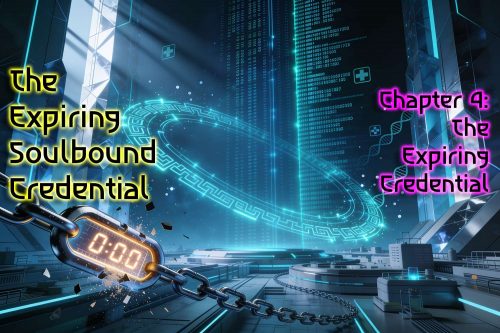
The morning light filtered through the blinds of Kiran’s small apartment, casting pale stripes across the cluttered desk where he had spent the entire night. His interface was still active, the proposal document glowing on the holographic display, its words a testament to hours of feverish work. But the document alone wasn’t enough. An idea, no matter how well-developed, couldn’t change the world without support.
Kiran knew exactly who he needed to talk to.
He arrived at County General earlier than usual, his eyes gritty from lack of sleep but his mind sharp with purpose. The hospital was just beginning to stir, the night shift preparing to hand over to the day crew. He found Dr. Amina in her office, reviewing patient charts with the focused intensity that characterized her approach to medicine.
“Kiran,” she said, looking up with mild surprise. “You’re early. And you look like you haven’t slept.”
“I haven’t,” Kiran admitted. “But I need to talk to you about something important. Something I’ve been working on.”
Dr. Amina studied him for a moment, her experienced eyes reading the exhaustion and determination on his face. She set down her interface and gestured to the chair across from her desk. “Sit down. Tell me what’s on your mind.”
Kiran settled into the chair, his hands trembling slightly as he activated his interface. The proposal document materialized above his wrist, its title clear in the morning light: Expiring Soulbound Tokens: A Proposal for Credentials That Reflect Current Knowledge.
“I submitted this proposal to the Credential Issuer last night,” Kiran said. “But before they respond, I wanted to get your feedback. You’re the one who showed me the problem. I need to know if I’ve found the right solution.”
Dr. Amina leaned forward, her expression shifting from curiosity to careful attention. “Expiring Soulbound Tokens? That’s a provocative idea. Tell me more.”
Kiran took a deep breath, gathering his thoughts. He had rehearsed this presentation a dozen times in his head, but now, facing his mentor, he felt the weight of his words.
“Your credential is supposed to be proof of your knowledge,” Kiran began. “That’s the whole point of the Soulbound Token system. But if knowledge changes, and the credential doesn’t, then the credential stops being proof of anything useful. It becomes a historical record, not a current qualification.”
Dr. Amina nodded slowly. “I’ve been saying this for years. But most people don’t want to hear it. They like the permanence. They like the security.”
“That security is an illusion,” Kiran said, his voice growing more animated. “My certification was only three months old, and it was already obsolete. Three months, Dr. Amina. If I had gotten that fellowship, I would have been treating patients with outdated protocols. That’s not security. That’s a danger.”
Dr. Amina was quiet for a moment. “What are you proposing instead?”
Kiran’s fingers flew across his interface, pulling up the core sections of his proposal. A diagram appeared above his wrist, showing a radical redesign of the credential system.
“I’m proposing that Soulbound Tokens should expire,” Kiran said. “Not instantly, but after a set period—maybe three years, maybe five. When they expire, they become invalid. To maintain their credential, the holder has to renew it through continuing education and assessment.”
He highlighted the diagram, showing the flow of the renewal process. “The expiration is automatic. The token would have a built-in timer, visible to everyone who views it. The credential holder would know exactly when their token will expire, and employers would be able to see the expiration date. An active credential would mean the holder has demonstrated current knowledge. An expired credential would mean they haven’t.”
Dr. Amina studied the diagram, her expression unreadable. “And what happens to the credential holders who can’t afford continuing education? Or who don’t have access to it?”
Kiran had anticipated this question. “That’s one of the challenges I’ve been thinking about,” he admitted. “The renewal process has to be accessible. It can’t create a situation where only wealthy professionals can maintain their credentials. I’ve been looking at models that offer sliding-scale continuing education, employer-sponsored renewal programs, and low-cost assessment options. The idea is to make renewal possible for everyone, not just those with resources.”
“And the Credential Issuer?” Dr. Amina asked. “They’ve built their entire system around permanence. The Soulbound Token framework is designed to be immutable. Changing that would require a fundamental restructuring of their technology.”
Kiran nodded. “I know. And I’ve addressed that in the proposal. The expiration and renewal wouldn’t change the underlying token technology. The token would still be soulbound—still tied to the holder’s identity, still non-transferable. The only change would be the addition of a time-based validity component. The token would have a status: active or expired. Renewal would update the status and the expiration date.”
He pulled up another section of the proposal. “I’ve also thought about the verification process. The Credential Issuer already maintains a verification API. Employers can query a credential’s status, authenticity, and holder identity. The API would simply be expanded to include expiration and renewal information. Employers would see not just that the credential exists, but whether it’s currently valid.”
Dr. Amina was silent for a long moment. When she spoke, her voice was thoughtful. “You’ve clearly put a lot of work into this. But what about the objections? The people who will say that credentials shouldn’t expire because professionals should be trusted to maintain their own knowledge?”
Kiran leaned forward, his passion evident. “That trust is exactly what’s broken. We’re trusting professionals to stay current without any mechanism to verify it. My credential said I was certified three months ago, and I assumed that meant I was competent today. But it didn’t. It meant I completed a program three months ago. Nothing more.”
He gestured to his interface, pulling up a timeline of medical knowledge. The timeline showed the rapid pace of discovery, the constant evolution of protocols. “If we rely on trust alone, we’re relying on professionals to be honest about what they don’t know. And most of us don’t even realize what we don’t know. I thought I was current. I was wrong.”
“Your proposal would change that,” Dr. Amina said. “It would force professionals to acknowledge that knowledge is not static.”
“Exactly,” Kiran said. “The expiration date is a reminder. It says: ‘This credential is valid now, but it won’t be forever. To keep it valid, you have to keep learning.’ It transforms the credential from a historical monument into a living document.”
Dr. Amina rose from her desk and walked to the window, looking out at the city below. The morning sun was fully up now, casting long shadows across the hospital grounds. Below, ambulances came and went, patients streamed through the entrance, and the rhythm of the hospital continued its relentless pace.
“There’s something you’re not addressing,” she said finally. “The political implications.”
Kiran frowned. “What do you mean?”
Dr. Amina turned to face him. “The Soulbound Token system is a massive infrastructure. It’s used not just in medicine, but in thousands of other fields—engineering, law, education, public service. The Credential Issuer has built a system that’s designed to be permanent, unchanging, immutable. They’ve sold that permanence as a feature. Changing it would admit that permanence isn’t actually valuable. It would be a monumental shift.”
“I know,” Kiran said. “I’ve thought about that. But the alternative is worse. We’re letting the system deceive people into thinking they’re more current than they really are.”
Dr. Amina returned to her desk, studying Kiran with a new intensity. “You’re not just talking about technology,” she observed. “You’re talking about a fundamental change in how we think about credentials. The proposal you’ve written isn’t just a technical document. It’s a manifesto.”
Kiran felt his face heat. “Maybe. But I believe it’s necessary. The rejection from St. Catherine’s showed me that my credential was worthless as a measure of my current competence. And if my credential is worthless, then what are we all doing? What’s the point of the entire system if it can’t tell us who actually knows what they’re doing?”
Dr. Amina smiled, and for the first time, Kiran saw approval in her expression. “That’s exactly the right question to ask.”
They spent the next hour discussing the details of the proposal. Dr. Amina challenged Kiran on every aspect, forcing him to defend his assumptions, refine his arguments, and address the weaknesses in his plan. By the time they finished, the proposal had evolved significantly—stronger, more practical, and better positioned to withstand criticism.
“The objections you’ve raised are real,” Kiran admitted. “The costs, the access issues, the political implications. I need to address all of them in the proposal.”
“Send me a copy of your final draft,” Dr. Amina said. “I have some contacts at the Credential Issuer. I can help you get a hearing.”
Kiran’s heart leaped. “You would do that?”
“I would,” Dr. Amina said. “Because I’ve been advocating for the same idea for years. I’ve just never found a student with the courage to put it into writing. You’ve done that. Now we need to see if we can convince the system to change.”
Over the next week, Kiran refined his proposal with Dr. Amina’s input. He addressed the financial concerns by proposing tiered renewal fees, sliding scales for low-income professionals, and employer-sponsored continuing education programs. He addressed the access concerns by proposing multiple renewal pathways, including online courses, practical assessments, and community-based learning opportunities. He addressed the political concerns by framing the proposal as a patient safety initiative, a way to protect the public from outdated medical practices.
And he added a new section to the proposal: a detailed explanation of the expiration mechanism itself.
The expiration of a Soulbound Token would be handled through a time-based validity component, he wrote. The token would have three states: Active, Expired, and Pending Renewal. An Active token is one that has been issued or renewed within the last three years and shows no indication of fraud or invalidity. An Expired token is one that has passed its three-year validity period without renewal. A Pending Renewal token is one that has been submitted for renewal but is awaiting verification.
The expiration date would be visible to any employer or institution that queries the token through the Credential Issuer’s verification API. This transparency would allow employers to make informed decisions about a professional’s current competence, rather than relying on an outdated credential.
The expiration date itself would be calculated based on the token’s issuance date and any subsequent renewal dates. The initial expiration date would be three years from the date of issuance. Subsequent renewal dates would extend the expiration date by three years from the date of renewal.
This system ensures that credentials remain a reliable signal of current knowledge, rather than a record of past achievement.
On the evening of the seventh day, Kiran submitted the revised proposal to Dr. Amina. She read it in silence, her interface glowing in the dim light of her office. When she finished, she looked up with an expression that Kiran couldn’t quite read.
“Your proposal is thorough,” she said. “I’ve been in this field for twenty years, and I’ve never seen a student tackle such a fundamental question with so much depth.”
Kiran felt a surge of pride. “Thank you. I just hope it makes a difference.”
“I’ve already sent it to my contact at the Credential Issuer,” Dr. Amina said. “They’re willing to meet with us. Next week, if you’re available.”
Kiran’s heart nearly stopped. “Next week? They want to meet?”
“They want to discuss your proposal,” Dr. Amina said. “That’s more than most people ever get. It means they’re taking it seriously.”
Kiran sat down heavily in the chair across from Dr. Amina’s desk, his legs suddenly weak. “I didn’t think they would respond so quickly. I thought it would take months.”
“The credential system is facing challenges,” Dr. Amina said. “There have been incidents. Cases where patients were harmed because their physicians were using outdated protocols. The Credential Issuer is under pressure to do something about it.”
Kiran nodded slowly. He had heard about those cases, but he hadn’t connected them to his own experience. Now it made sense. The system was broken, and the Credential Issuer knew it.
“This is the moment,” Dr. Amina said. “If we can make the case for expiring credentials, we might actually be able to change how the system works.”
The next week passed in a blur of preparation. Kiran reviewed his proposal obsessively, anticipating every possible question and challenge. He practiced his presentation until he could deliver it in his sleep. Dr. Amina coached him on the dynamics of the meeting, the personalities of the people they would be meeting, and the arguments they were most likely to face.
On the morning of the meeting, Kiran arrived at the Credential Issuer’s headquarters with a mixture of excitement and terror. The building was a tower of glass and steel, reaching toward the sky like a monument to permanence. The irony wasn’t lost on him: he was about to argue that the very concept of permanence needed to be reconsidered.
Dr. Amina met him in the lobby. “Ready?” she asked.
Kiran took a deep breath. “As ready as I’ll ever be.”
They rode the elevator to the thirty-seventh floor, where a conference room waited with a panoramic view of the city. Three representatives of the Credential Issuer sat at the table, their interfaces ready, their expressions neutral.
Kiran took his seat and activated his interface. The proposal document glowed above his wrist, and he began to speak.
“I’ve written a proposal,” he said, “that I believe addresses a fundamental flaw in the Soulbound Token system. My proposal is simple: credentials should expire. They should be renewable through continuing education. And they should reflect current knowledge, not past achievement.”
He launched into his presentation, his voice steady despite the nerves churning in his stomach. He explained the problem, the danger of outdated knowledge, and the solution he had proposed. He addressed the objections, the challenges, and the implementation details.
The representatives listened in silence, their expressions unreadable. When Kiran finished, there was a long pause.
Then the senior representative, a woman named Veridian, spoke. “Your proposal is impressive,” she said. “It’s clear you’ve put a great deal of thought into this. But we have concerns. Significant ones.”
Kiran’s heart sank. “I’m prepared to address them.”
“I’m sure you are,” Veridian said. “But let’s start with the most fundamental concern: the Soulbound Token system was designed to be permanent. It’s a feature, not a bug. Permanence gives holders confidence that their credentials will always be valid. Permanence gives employers confidence that a credential represents a fixed achievement. Changing that would undermine the entire foundation of the system.”
“With respect,” Kiran said, “that foundation is already undermined. My credential was only three months old when I discovered it was outdated. I didn’t know what I didn’t know, and neither did the employers who looked at my application. The permanence was an illusion. It gave me confidence, but that confidence was misplaced.”
Veridian leaned forward. “So you’re saying the system is fundamentally flawed?”
“I’m saying the system is based on an incorrect assumption,” Kiran said. “The assumption that knowledge, once acquired, remains valid indefinitely. That assumption is false. The solution isn’t to pretend it’s true. The solution is to create a system that acknowledges the reality of changing knowledge.”
The representatives exchanged glances. Kiran couldn’t tell if they were convinced, but they didn’t dismiss his argument outright.
“We’ll need to consider this carefully,” Veridian said. “The implications are far-reaching. If we implement your proposal, we’ll be fundamentally changing how credentials work. There will be pushback, resistance, and significant logistical challenges.”
“I understand,” Kiran said. “But I believe it’s worth the effort. For the patients, for the employers, and for the professionals who want their credentials to mean something.”
Veridian nodded slowly. “We’ll be in touch.”
Three weeks later, Kiran received a notification that changed everything.
The Credential Issuer has announced the adoption of the Expiring Credential Framework for Advanced Medical Certification. Beginning next cycle, all new certifications will be issued with a three-year expiration date. Renewal will be available through continuing education and assessment.
Kiran read the message three times, unable to believe his eyes. His proposal had been accepted. The system was changing. And he had been part of it.
A follow-up message appeared on his interface:
Kiran Sharma – Your credential has been selected as the first re-issuance under the new framework. You will receive an updated Soulbound Token with a three-year expiration date. The renewal process will be available through the Continuing Education Portal. Congratulations on this achievement.
Kiran felt tears prick at his eyes. His proposal, born from rejection and frustration, had actually become a reality. The system was changing, and he had helped make it happen.
He activated his interface and looked at his Soulbound Token. The familiar badge appeared, but now it was different. Below the issuance date, a new field had been added:
Expiration Date: Year 2160 (Current Cycle + 3 Years)
Status: Active
The token was no longer permanent. It had a deadline, a limit, a built-in reminder that knowledge doesn’t stand still. And that, Kiran realized, was exactly right.
He thought about his journey—the pride of certification, the shock of discovering his knowledge was outdated, the rejection from the fellowship, the long nights of writing and rewriting. It had all led to this moment.
The credential changed, he thought. And I changed with it.
That’s exactly how it should be.
Table of contents:
Introduction
Chapter 1: The Permanent Credential
Chapter 2: A Soulbound Token
Chapter 3: The Outdated Skill
Chapter 4: The Expiring Credential
Chapter 5: The Renewal Process <<<<<< NEXT
Chapter 6: The Continuing Education
Chapter 7: The Credential Market
Chapter 8: The Fraudulent Renewal
Chapter 9: The Anti-Sybil Renewal
Chapter 10: Learning Never Stops
