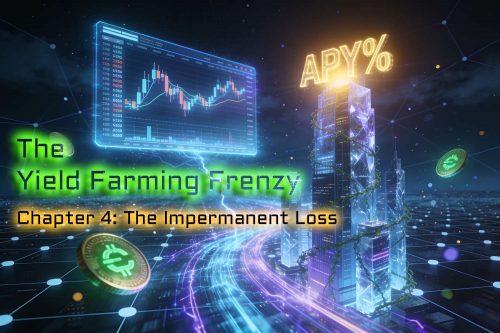
The holographic display cast its familiar blue glow across Nia’s face as she stared at numbers that refused to make sense. Seven days. It had been exactly seven days since she’d deposited her life savings into the Nexus liquidity pool. Seven days of relentless farming, of claiming and swapping and re-depositing, of watching her rewards accumulate and her position grow.
And yet, something was terribly, horribly wrong.
Nia pulled up her portfolio tracker for the third time that morning, running the calculations again. The numbers were undeniable, but her brain kept rejecting them, searching for an error, a miscalculation, anything that would explain the discrepancy.
Her total position in Nexus: $3,850.
Her initial deposit: $3,000.
That meant she’d made $850 in rewards over the past week. That was good. That was a 28% return in just seven days. By any normal standard, that was fantastic.
But the promised APY had been 500%. At that rate, her $3,000 should have grown to nearly $3,300 in just the first week. She should have made around $300 in rewards, not $850.
Wait. That didn’t make sense either.
Nia frowned and ran the numbers again, more carefully this time. If she’d earned $850 in rewards, that was actually higher than what the 500% APY would have predicted. So why did she feel like she was losing money?
Her confusion deepened. She pulled up her transaction history, scrolling through the days of farming activity. Every transaction was recorded—every claim, every swap, every re-deposit. The rewards were real. The USDC was real. The growth was real.
But her portfolio tracker was showing something different. A different number that was making her stomach churn.
Nia switched to her main wallet view. This showed her total holdings across all her accounts, not just what she had deposited in Nexus. The number at the bottom of the screen made her heart stop.
Total Portfolio Value: $3,200
She blinked. Then blinked again.
$3,200. That was only $200 more than her initial $3,000. But she’d earned $850 in rewards. How could she have earned $850 in rewards and only increased her total portfolio by $200?
“Where did the money go?” she whispered to herself, her voice trembling slightly.
She pulled up the transaction history again, but this time she looked at it from a different angle. She wasn’t just tracking her deposits and rewards anymore. She was tracking the value of her holdings in real terms, measured against the market prices at the time of each transaction.
The answer hit her like a punch to the gut.
ETH Price at Deposit: $2,800**
**ETH Price Now: $2,400
NXT Price at First Claim: $0.05**
**NXT Price Now: $0.032
The numbers swam before her eyes. The ETH she’d deposited had lost value. The NXT rewards she’d been claiming had been worth less and less with each passing day. The Dump Bot had been relentless, and the token price had cratered.
She’d made $850 in nominal rewards, but the underlying value of those rewards had been declining the whole time. And the principal she’d deposited had also lost value due to the ETH price drop.
But that wasn’t the full story. There was something else, something more complicated, that she was only beginning to understand.
Nia pulled up the Nexus dashboard and looked at her liquidity pool position. The interface displayed her pool share, her pending rewards, and a number she’d been ignoring: her “impermanent loss.”
Impermanent Loss: -$320
“What is that?” she muttered, clicking on the term for more information.
A pop-up appeared, explaining the concept in dry, technical language:
“Impermanent loss occurs when the price ratio of assets in a liquidity pool changes relative to when they were deposited. This loss is ‘impermanent’ because it can be recovered if the price ratio returns to its original state. However, if you withdraw your liquidity while prices are out of balance, the loss becomes permanent.”
Nia stared at the explanation, her mind racing. She’d read about impermanent loss before, but she’d never really understood it. It had seemed like one of those technical risks that only mattered in extreme cases.
But now she was looking at $320 of impermanent loss, and it was anything but theoretical.
She pulled up more information, diving into the math behind the concept. The formula was complex, but the basic idea was simple: when you provide liquidity in a pool with two assets, you’re essentially betting that the price ratio between those assets will stay the same. If it changes, you experience impermanent loss.
In her case, she’d deposited USDC and ETH into the pool. The USDC price was stable, but the ETH price had dropped significantly since her deposit. That meant the pool had automatically rebalanced, selling some of her USDC to buy more ETH, maintaining the pool’s price ratio.
The result: she now owned more ETH and less USDC than she’d started with. And because ETH had lost value, her total pool position was worth less than if she’d just held her original assets.
The impermanent loss of $320 was the difference between what her position was worth in the pool versus what it would have been worth if she’d just held her USDC and ETH separately.
And on top of that, there was the ETH price drop itself. Even if she’d just held her ETH, she would have lost money due to the price decline. But the impermanent loss had made it even worse.
Nia felt like she was drowning in numbers. She pulled out her notebook and started writing everything down, trying to make sense of the mess:
Nia’s Position – Day 7
Initial Deposit:
- 1,500 USDC ($1,500)
- 0.5 ETH ($1,400 @ $2,800/ETH)
- Total: $3,000
Current Position:
- 1,200 USDC ($1,200)
- 0.8 ETH ($1,920 @ $2,400/ETH)
- Total: $3,120
Rewards Claimed: $850 in NXT
- All swapped to USDC and re-deposited
Total Portfolio Value:
- Nexus Position: $3,120
- Reserve Funds: $80
- Total: $3,200
The Gap:
- Rewards Earned: $850
- Portfolio Growth: $200
- Missing: $650
She stared at the numbers, trying to reconcile them.
The $650 discrepancy was a combination of factors. The ETH price drop had cost her about $320 in lost value on her initial deposit. The impermanent loss had cost her another $320. And the declining NXT price had meant her rewards were worth less than they seemed.
But even then, the numbers didn’t quite add up. She’d earned $850 in rewards, but those rewards had been worth less and less over time. The effective APY she’d actually captured was nowhere near the advertised 500%.
Nia pulled up her effective APY calculator, a tool she’d created to track her actual returns.
Effective APY Captured: 47%
She stared at the number. Forty-seven percent. That was still a decent return by any normal standard. But it was a far cry from the 500% she’d been promised.
And it was even worse when she factored in the stress, the time, and the risk she’d taken on. She’d been sleeping four hours a night, skipping classes, ignoring her friends, all for a return that was barely beating the market.
This is what they mean, she thought, when they say “high risk, high reward.” But where’s the reward?
She pulled up the social feed, looking for signs that others were experiencing the same thing. The community was still active, but the tone had changed. The rocket ship emojis were fewer. The excitement was muted.
“Can’t believe I spent a week farming this thing for basically nothing.”
“The APY is down to 150% now. It’s not even worth it anymore.”
“Impermanent loss killed my returns. I would have been better off just holding my ETH.”
Nia read through the comments, each one a confirmation of her own experience. She wasn’t alone. The entire farming community was waking up to the reality of what they’d signed up for.
And then she saw a post that made her blood run cold:
“I just did the math. Even with the high APY, the effective returns after impermanent loss and token price decline are negative for most farmers. The only ones making money are the early whales and the dump bot. Everyone else is getting rekt.”
Negative returns. She’d worked for a week, sacrificed her sleep and her social life, risked her life savings, and she might actually have lost money.
Nia looked back at her notebook. The $200 of nominal growth was wiped out when she considered the opportunity cost. If she’d just held her ETH and USDC separately, she’d have:
- 1,500 USDC ($1,500)
- 0.5 ETH ($1,200 @ current price)
- Total: $2,700
That meant her current portfolio of $3,200 was actually $500 more than if she’d just held. So she had made a profit, just not as much as she’d expected.
But that was small comfort. The numbers were a mess, and she was struggling to make sense of it all.
Across the city, Arjun was facing his own reckoning. The NXT token price had dropped below 3 cents, and the TVL in Nexus had fallen to just $8 million—a 50% decline from its peak.
The farmers were fleeing. The ones who’d been extracting value were now leaving the sinking ship, withdrawing their liquidity and moving on to the next opportunity. The protocol was losing its lifeblood.
Arjun stared at the dashboard, his face a mask of barely controlled despair. He’d known this was coming. He’d seen the signs from the beginning. But knowing something intellectually was very different from watching it happen in real time.
“The governance proposal isn’t getting enough traction,” Priya said, her holographic avatar appearing in his workspace. “Only about 15% of users have staked for governance rewards.”
“I know,” Arjun replied, his voice hollow. “I was hoping for at least 30%.”
“The timing is bad. People are panicking. They don’t want to lock their liquidity when the token price is crashing.”
Arjun nodded slowly. He’d known this was a risk. The governance staking contract was designed for stable times, not for crisis. But he’d had to move fast, and now he was paying the price.
“We need to address the impermanent loss problem,” he said suddenly. “That’s the real killer. People are losing money even when their nominal rewards are positive.”
“I’ve been thinking about that too,” Priya said. “We could introduce a dynamic fee structure that compensates LPs for impermanent loss. Or we could create a derivative product that hedges against price movements.”
“Those are long-term solutions. We need something now.”
Arjun pulled up his code editor, his mind racing. The farmers were leaving because they were losing money. The impermanent loss was eating into their returns, and the token price collapse was making everything worse.
But there was a way to fix this. A way to align incentives and create a more sustainable system.
“What if we adjust the emissions schedule?” he said. “Instead of front-loading all the rewards, we spread them out over a longer period. That would reduce the initial APY but make it more sustainable.”
“Farmers won’t like that. They want high yields now.”
“I know. But we’re not trying to attract farmers anymore. We’re trying to build a sustainable protocol. The farmers are leaving anyway. We need to pivot to a different audience.”
Priya was silent for a moment. “You’re right,” she finally said. “The farming model is broken. We need to build something that doesn’t depend on speculators.”
Arjun nodded. The realization was painful, but also liberating. He’d been trying to serve two masters—the farmers who wanted immediate returns and the long-term vision for the protocol. It was time to choose a side.
“I’m going to redesign the tokenomics,” he said. “Reduce emissions, introduce dynamic fees, create mechanisms that reward patient capital. It’s going to be a big change.”
“Will the community accept it?”
“They’ll have to. It’s either that or watch the protocol die.”
Nia had been staring at her notebook for what felt like hours. The numbers were still swirling in her head, but she was starting to make sense of them. The impermanent loss, the token price decline, the effective APY—it was all connected.
She pulled up a fresh page and started writing, trying to distill what she’d learned:
What I’ve Learned (The Hard Way):
- High APY doesn’t mean high returns. The APY is just the nominal rate. The effective returns depend on token price, impermanent loss, and market conditions.
- Impermanent loss is real. Providing liquidity in volatile markets carries significant risk. The loss can eat into your rewards and even wipe out your principal.
- Token inflation destroys value. The high APY was driven by high token emissions. But those emissions diluted the token’s value, making the rewards worth less over time.
- Timing is everything. The early farmers made money. The latecomers got rekt. Getting in early matters, but it’s also a race against the dumpers.
- Don’t chase yields blindly. The protocols with the highest yields are often the ones with the most unsustainable economics. High yield usually means high risk.
She sat back and looked at the list. It was a harsh education, but it was real. She’d lost money on this farm, but she’d gained something more valuable: knowledge.
But what do I do now? she wondered. Do I stay or leave?
The Nexus protocol was still paying rewards, but the effective APY had dropped to around 50%. That was respectable, but it was nowhere near enough to justify the risk she was taking.
On the other hand, if she withdrew now, she’d lock in her impermanent loss. The $320 she’d lost to the ETH price decline would become permanent. She’d never get it back.
Maybe I should just hold, she thought. Wait for the price to recover. The impermanent loss isn’t permanent unless I withdraw.
But that was a gamble. There was no guarantee that ETH would recover, or that the NXT token would ever regain its value. She could be waiting for months, only to see her position decline even further.
Nia closed her notebook and stared at the Nexus dashboard. The numbers were still there, still ticking up and down. The protocol was still alive, still functioning. But the dream was over. The 500% APY was a memory.
She reached for her keyboard, ready to initiate a withdrawal. It was time to cut her losses and move on.
But something made her pause.
The governance proposal. Arjun’s vision for a more sustainable protocol. The idea that Nexus could be something more than just a farming opportunity.
What if I stayed? she thought. What if I actually participated in the governance? What if I helped build something that would last?
The thought was terrifying. It meant committing to something uncertain, something that might fail. But it also meant being part of something meaningful.
Nia’s hand hovered over the keyboard. She could withdraw now and preserve what was left of her portfolio. Or she could stay and see what happened next.
It was the hardest decision she’d ever faced.
Table of contents:
Introduction
Prologue: The Holographic Feed
Chapter 1: The High APY
Chapter 2: A Liquidity Mining Program
Chapter 3: The Farming Strategy
Chapter 4: The Impermanent Loss
Chapter 5: The Reward Token Dump <<<<<< NEXT
Chapter 6: The Yield Collapse
Chapter 7: The Governance Reward
Chapter 8: The Staking Lock
Chapter 9: The Sustainable Yield
Chapter 10: Farming for the Long Term
