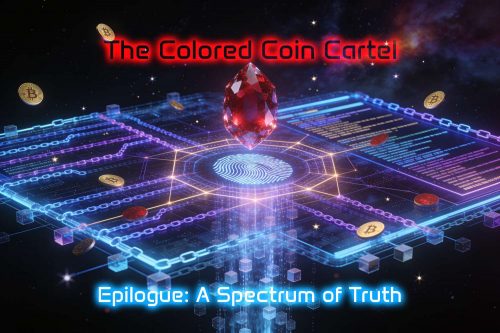
One year had passed since the colored coin conference, and Mira’s life had transformed in ways she never could have imagined.
She sat in her new office—a spacious, sunlit room on the top floor of a building that had once been a warehouse in Aeropolis. The walls were lined with holographic displays showing the Open Index’s real-time activity. Verifications streamed across the screens, each one a testament to the system she had helped build.
But there were other displays too. These showed the personal projects she had taken on since the conference—forensic investigations, fraud analyses, and the occasional consultation with law enforcement. She had become the go-to expert for colored coin fraud, her reputation cemented by years of hard-won experience.
Her office was cluttered with physical samples. Gems, paintings, artifacts—each one a puzzle waiting to be solved. She had developed a reputation for being able to spot a forgery from a thousand miles away, and collectors from around the world sent her their treasures for verification.
Today, she was examining a particularly tricky case.
A diamond had been colored and sold to a collector in the Eastern Isles. The color was valid, the fingerprint matched, and the chain of custody was clean. But something about the diamond bothered Mira. It was too perfect—its clarity too flawless, its color too vibrant.
She had the diamond on her desk, a small, glittering stone that seemed to mock her with its beauty. She studied it under the microscope, looking for the subtle signs of a fake.
There. In the lattice structure. A tiny irregularity that shouldn’t exist.
Mira smiled. Another fraud exposed.
She reached for her communicator and dialed the collector’s number.
“Your diamond is synthetic,” she said. “It’s a lab-created stone, not a natural one. The color is fraudulent.”
The collector’s voice was a mix of disbelief and anger. “But I paid millions for that diamond! The color was verified!”
“The color was verified by a compromised registry,” Mira said calmly. “I’ll send you the evidence. You should contact law enforcement.”
She ended the call and sat back in her chair, a sense of satisfaction washing over her. It was good work. Important work. She was making a difference.
But the work was never done. There was always another case, another fraud, another challenge.
And Mira wouldn’t have it any other way.
Across the city, Darius was running his Buyer Protection Fund from a sleek, modern office that overlooked the Floating Isles.
The Fund had grown exponentially in the past year. What had started as a small initiative to protect colored coin buyers had become a multi-million credit operation that insured transactions across the globe. Buyers paid a small fee, and if they were scammed, the Fund reimbursed them.
Darius had changed. The cocky, reckless trader who had barged into the Verity Registry demanding answers was gone. In his place was a cautious, thoughtful businessman who understood the value of trust and integrity.
He was reviewing a claim when his communicator buzzed. It was Mira.
“Just solved another one,” she said, her voice warm with satisfaction. “A synthetic diamond passed off as natural. The buyer is furious.”
“Another win for the good guys,” Darius said, smiling. “You’re making a habit of this.”
“It’s what I do. How’s the Fund?”
“Growing. We’ve insured over ten thousand transactions this quarter. The fee structure is working, and we haven’t had a major loss in months.”
“Good. Keep it up.”
Darius ended the call and turned back to his work. The Fund was his legacy—a way to protect buyers from the fraud that had nearly destroyed the colored coin system. It was a responsibility he took seriously.
He had come a long way from the brash young trader who had thought only of profit. Now he thought about people, about trust, about the future.
It was a good feeling.
The Open Index had become the global standard for colored coin verification.
Its architecture was still decentralized, its governance still community-driven. But it had evolved. The verification protocols had been refined, the reputation system had been expanded, and the chain-of-custody model had become the foundation of the entire system.
Anyone could submit a fingerprint to the Index. Anyone could verify a color. The system was open, transparent, and accessible to all.
But it wasn’t perfect. There were still disputes, still frauds, still challenges. The community had learned to handle them, to adapt and improve.
The Index’s community council met quarterly, discussing issues, voting on proposals, and shaping the future of the system. It was democracy in action, messy and chaotic but ultimately effective.
At the latest meeting, the council had voted to expand the fingerprint protocol to include new types of assets—art, collectibles, and even digital assets that existed only in the virtual realm. The colored coin system was growing, evolving, becoming more comprehensive.
Mira had attended the meeting via holographic link, offering her expertise and guidance. She was still a member of the council, though she had stepped back from day-to-day operations. The Index was in good hands, and she trusted the community to carry it forward.
But she would always be there when they needed her. The Index was her legacy, and she would never abandon it.
Master Thorne had served his sentence and was now a free man.
He had spent six months in prison for his role in the Registry’s corruption. The experience had been humbling, but it had also been transformative. He had emerged with a new perspective, a renewed commitment to integrity.
Now he worked as a consultant, helping registries implement the chain-of-custody model and adopt best practices. He was a respected figure in the community, his past mistakes acknowledged but not held against him.
He still thought about Mira. She had been the catalyst for his redemption, the one who had shown him that it was never too late to do the right thing. He had written her a letter, thanking her for the push she had given him.
She had written back, thanking him for the evidence that had made the Open Index possible.
It was a small gesture, but it meant everything to him.
The Countess was in prison, but her legacy lingered.
She had been convicted on multiple counts of fraud, conspiracy, and money laundering. Her sentence was life, with no possibility of parole. She would never again control the colored coin system.
But her methods were studied in business ethics classes, her network analyzed by law enforcement, her crimes documented in textbooks. She had become a cautionary tale—a reminder of what happened when greed overwhelmed integrity.
Mira had visited her once, shortly after the trial. The Countess had been calm, composed, almost serene.
“You think you’ve won,” the Countess had said, her voice cold. “But you haven’t. The system you’ve built is just as vulnerable as the one I exploited. There will always be another gap, another loophole, another way to break the trust.”
“Maybe,” Mira had replied. “But there will also always be people who fight to close those gaps. And as long as we’re fighting, the truth has a chance.”
The Countess had smiled, a thin, humorless expression.
“You’re naive,” she had said. “But I suppose that’s what makes you dangerous.”
Mira had left the prison without responding. She didn’t need to. The Countess’s worldview was built on cynicism and greed. Mira’s was built on hope and integrity.
Only one of those could build something that lasted.
Mira gave her keynote address at the annual colored coin conference, just as she had the year before.
The room was packed. Traders, registrars, validators, and collectors had come from across the globe to hear her speak. She had become a symbol of the fight against fraud, a beacon of hope for those who believed in the promise of colored coins.
She stood at the podium, looking out at the sea of faces, and felt a familiar surge of emotion. This was her moment. Her legacy.
“One year ago, I stood here and told you that colored coins are not magic,” she began. “I told you that they are tools—powerful tools, but tools nonetheless. I told you that they can help us verify the truth, but they can’t create truth on their own.”
She paused, letting the words sink in.
“Today, I want to build on that idea. I want to talk about what the truth really is—and what it means for the colored coin system.”
She gestured to the display behind her, showing a spectrum of colors—red, orange, yellow, green, blue, indigo, violet. Each one represented a different aspect of the colored coin system.
“The truth is not a single color,” she said. “It’s a spectrum. It’s the combination of all the facts, all the history, all the context that makes up a physical asset. It’s the chain of custody, the fingerprint, the metadata, and the community that verifies it all.”
The audience listened intently, hanging on her every word.
“We’ve spent years trying to reduce the truth to a single color—a single claim that represents a physical object. But we’ve learned that this is impossible. Physical objects change. They’re restored, recut, treated, and altered. They can be mixed, divided, and transformed. The truth is never just one thing.”
She paused, her voice growing softer.
“The colored coin system is not a failure because it can’t capture the full truth. It’s a success because it can capture part of the truth—and because it can evolve to capture more. The chain-of-custody model, the genetic fingerprint protocol, the Open Index itself—they’re all tools that help us see more of the spectrum. They help us understand the history, the context, the complexity of the physical world.”
She looked out at the audience, her eyes blazing with conviction.
“The truth is not a fixed point. It’s a process. It’s the ongoing effort to verify, to document, to prove. And that’s what we’ve built with the colored coin system. Not a perfect system—there’s no such thing. But a system that can adapt, evolve, and grow stronger with every challenge.”
The audience erupted in applause.
Mira stepped back from the podium, a smile on her face. She had done it. She had shared her vision, her passion, her hope.
And she knew that the future of colored coins was bright.
The final scene took place in a small, quiet lab on the outskirts of Chainhaven.
Mira was alone, examining a new ruby that had been sent to her for verification. It was a beautiful stone—deep crimson, flawless clarity, a star-shaped inclusion pattern that was almost identical to the Ember Heart.
She studied it under the microscope, her fingers moving with practiced precision. The fingerprint was unique, the chain of custody clean, the metadata complete.
Everything was in order.
She activated the coloring terminal, the same model she had used years ago to color her first coin. The process was familiar, almost routine. She entered the asset ID, the physical hash, the owner wallet. She reviewed the metadata, confirming its accuracy.
Then she pressed the confirmation button.
The terminal hummed, and a sequence of confirmation messages flashed across the screen. Moments later, a green indicator appeared: Transaction confirmed. Color created: CRIMSON. Satoshi ID: 9c3d…e4f2.
The ruby had found its digital twin.
Mira sat back in her chair, a sense of quiet satisfaction washing over her. It was just another color, just another verification. But it was also a continuation of the work she had started years ago.
She thought about the journey that had brought her here. The first colored coin. The discovery of the fraud. The battles against the Consortium. The creation of the Open Index. The evolution of the chain-of-custody model.
It had been a long road, filled with setbacks and triumphs. But she had never given up. She had never lost sight of the goal: to build a system that could bridge the gap between the physical and digital worlds with truth and integrity.
And she had succeeded.
Darius appeared in the doorway, a familiar glint in his eyes.
“Another one?” he asked.
“Another one,” she confirmed. “A beautiful ruby from the Northern Mines. Clean fingerprint, clean history. It’s going to make someone very happy.”
“They all do,” he said, stepping into the room. “That’s the thing about this work. Every color you create is a piece of truth. A small piece, maybe, but a piece nonetheless.”
Mira nodded, her eyes fixed on the display.
“Remember when we first started?” she asked. “When we were just two kids trying to expose a fraud?”
“I remember,” Darius said. “You were so determined. So sure that you could make a difference.”
“I still am,” she said. “I still believe that we can make a difference. That the truth is worth fighting for.”
Darius smiled, a rare moment of warmth crossing his face.
“That’s what I admire about you, Mira. You never give up. You never stop believing.”
Mira laughed, a sound that felt lighter than it had in years.
“Neither do you,” she said. “You just hide it better.”
Darius shrugged, a playful glint in his eyes. “I have a reputation to maintain.”
They stood in comfortable silence, watching the display as the ruby’s color began its journey through the blockchain. It would be verified, tracked, and eventually transferred to its new owner.
The cycle continued.
And Mira knew that she would be there, watching over it, ensuring that the truth was recorded and preserved.
Because the truth was a spectrum, and she was committed to seeing the full picture.
Outside the lab, the city of Chainhaven glittered in the twilight. The sky-trams glided between the soaring spires, their lights tracing patterns against the darkening sky.
Inside, Mira stood at the window, looking out at the city she had grown to love. It was a city built on data, on value, on the constant flow of information that kept the global economy spinning.
And at its heart sat the Open Index—a system that had been built on the conviction that the truth was worth fighting for.
Mira smiled, a sense of peace settling over her. She had done what she set out to do. She had built something that mattered, something that would outlast her.
The fight was never over. There would always be new challenges, new threats, new vulnerabilities. But she was ready for them. She would always be ready.
Because the truth was a spectrum, and she was committed to seeing the full picture.
“In the end, the truth is not a single color. It’s a spectrum. And it takes all of us, working together, to see the full picture.”
— Mira, Keynote Address, Annual Colored Coin Conference
Afterword
The colored coin system had evolved far beyond its origins. What had started as a simple idea—attaching metadata to a satoshi to represent a physical asset—had become a global network of verification, transparency, and trust.
The Open Index was the heart of that network, a decentralized, community-governed system that recorded the truth for all to see. It was not perfect. It would never be perfect. But it was resilient, adaptable, and growing stronger with every challenge.
Mira had become a legend in the colored coin community, a symbol of the fight against fraud and corruption. But she never forgot that the fight was collective. It was the traders, the registrars, the validators, and the collectors who made the system work. It was the community that protected the truth.
And the truth, as always, was worth fighting for.
Table of contents:
Introduction
Prologue: The First Mark
Chapter 1: A Satshod with a Story
Chapter 2: The Colored Ledger
Chapter 3: Tracking the Ruby Satshi
Chapter 4: The Cartel’s Consortium
Chapter 5: A Counterfeit Color
Chapter 6: The Genetic Fingerprint
Chapter 7: The Open Index
Chapter 8: The Mixed Provenance
Chapter 9: The Uncoloring Attack
Epilogue: A Spectrum of Truth
