The morning light filtered through the Archive’s crystalline windows, casting geometric patterns across the lecture hall floor. Anya stood at the podium, her hands resting on the cool surface, watching the trainees file in. There were twelve of them—bright-eyed recruits who had passed the initial aptitude tests and were now learning the sacred art of verification.
She had prepared this lecture weeks ago, before the boy with the data crystal had unsettled her. Before her grandmother had been evasive about District Seven. But she was a professional. She would not let one anomalous encounter shake her faith in the system she had devoted her life to.
“Today,” she began, activating the holographic display behind her, “we discuss the foundation of our civilization: the Merkle Tree.”
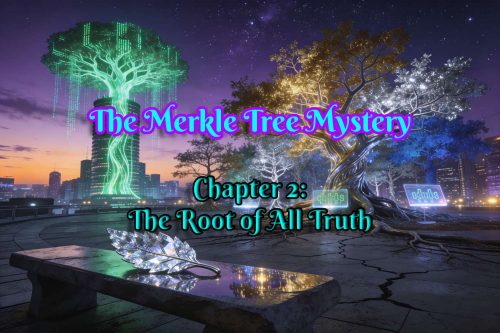
The display bloomed into life—a towering structure of light, its roots buried in the simulated past, its branches reaching toward the present. The trainees leaned forward, their faces illuminated by the soft glow.
Anya walked them through the mechanics with practiced ease. She added a new leaf—a simulated birth certificate—and the root hash shimmered, recomputing in real-time. She showed them what happened when someone tried to alter a leaf: the root changed completely, a cryptographic scream that announced tampering to anyone who cared to look.
“This is the genius of the system,” she said, her voice resonating in the quiet hall. “The root is the ultimate arbiter. If it’s not in the tree, it didn’t happen. This is how we avoid chaos. This is how we build certainty.”
A trainee in the front row raised her hand. “What about pruning? I’ve heard that some branches are… removed.”
Anya nodded. She had expected this question. “Pruning is essential maintenance. The tree grows constantly—billions of leaves, trillions of connections. Some branches become obsolete. Outdated records, resolved disputes, data that no longer serves the living city. The Archivist identifies these branches and removes them, consolidating what remains. It makes the tree faster, more efficient, more reliable.”
She called up a visualization of a pruning event: a branch of the tree fading, its leaves dissolving into light, the remaining structure tightening. It looked clean. Surgical. Humane, she thought, though she wasn’t sure that was the right word.
“But what about the people in those branches?” another trainee asked, a nervous boy named Corin. “Do they just… disappear?”
“Of course not,” Anya said, perhaps too quickly. “Pruned data is not destroyed. It’s moved to cold storage. The people themselves are integrated into the main tree through updated records. The pruning is administrative, not existential.” She paused, remembering the boy’s words. “They want their history back.” She pushed the thought aside. “Any other questions?”
No one raised their hand. Anya concluded the lecture with a summary of the day’s lesson, but her words felt hollow. The trainees scribbled notes, their faces earnest, and she wondered if they could see the cracks she was only beginning to feel.
The Undercroft was a wound in the city’s skin.
Anya had heard stories about it—places where the scanners didn’t reach, where Rootless traders bartered in data the Archive had deemed worthless, where the air tasted of dust and ozone and forgotten things. She had never expected to go there. But the boy’s words had lodged themselves in her chest like a splinter, and she could not remove them.
She wore a hooded coat she had bought from a market vendor who asked no questions. Her identity chip was wrapped in a signal-blocking sleeve she had fabricated in the Archive’s workshop. For the first time in her life, she was invisible to the system.
The entrance to the Undercroft was a maintenance shaft behind a decommissioned transport hub. Anya climbed down a rusted ladder, her boots echoing on metal rungs, and emerged into a labyrinth of tunnels. The walls were lined with physical archives—paper ledgers in glass cases, carved stone tablets, data crystals stacked in crates like ammunition. Rootless traders squatted at makeshift stalls, their faces half-lit by portable screens, their voices a low murmur of negotiation.
Anya moved through the crowds, trying not to look as out of place as she felt. She spotted the boy almost immediately—he was at a stall near the far wall, haggling with an old woman over a bundle of data crystals. His hair was even messier than she remembered, and his clothes were stained with what she hoped was dust.
She waited until he finished the transaction, then stepped forward. “We need to talk.”
He turned, and for a moment his expression was unreadable. Then recognition flickered in his eyes, followed by something that might have been amusement. “The verification clerk. I didn’t expect to see you down here. Slumming it?”
“I’m not slumming anything,” Anya said, keeping her voice low. “You mentioned District Seven. My grandmother. What do you know?”
The boy—Liam, she had learned from the Archive’s security logs—studied her for a long moment. Then he jerked his head toward a quieter alcove. “Walk with me.”
They moved through the Undercroft, past stalls selling everything from pre-pruning medical records to encrypted personal journals. Liam walked with the easy confidence of someone who belonged here, his sharp eyes scanning the crowds.
“Your grandmother,” he said finally. “Maeve. She lived in District Seven, didn’t she? Before it was pruned.”
Anya’s heart stuttered. “How do you know that?”
“I know a lot of things.” He stopped at a stall where an elderly man was carefully repairing a cracked data crystal. “This is Old Kael. He’s been trading in orphaned data since before you were born.”
The old man looked up, his eyes milky with age but still sharp. “Liam. Who’s your friend? She smells like the Archive.”
“She is the Archive,” Liam said. “Or she was. She’s questioning things now.”
Kael laughed, a dry, wheezing sound. “Questioning things. That’s how it starts.” He turned his gaze to Anya. “You want to know about pruning, girl? I’ll tell you. They call it efficiency. But a tree without deadwood has no compost. No soil for new growth. They prune the past, and the future grows thin.”
Anya frowned. “That’s poetic, but it’s not accurate. Pruned data is preserved. It’s just not active.”
“Preserved where?” Kael asked. “In cold storage? In a landfill of forgotten truth? The Archivist doesn’t prune to preserve. It prunes to control. To simplify. To make the story clean.”
Anya shook her head. “You don’t understand the system. The Merkle Tree is mathematical. It doesn’t have motives.”
“Doesn’t it?” Liam interjected. “Who built it? Who maintains it? Who decides what’s ‘obsolete’?” He pulled a data crystal from his pocket—the same one he had shown her at the Archive. “This is the District Seven branch. Before pruning. Your grandmother is in here. A whole life, reduced to ‘redundant data’ by an algorithm that was told to clean house.”
Anya stared at the crystal. Her grandmother’s life, compressed into a chip she could hold in her palm. “You’re lying.”
“Verify it yourself,” Liam said, tossing the crystal to her. She caught it reflexively. “You have the tools. You have the access. Go ahead. Prove me wrong.”
She wanted to throw it back at him, to walk away, to return to the clean certainty of the Archive. But her hand closed around the crystal, and she heard herself say, “If I do this, you stay away from my grandmother.”
Liam’s expression softened, just for a moment. “I’m not the threat here, clerk. The system that’s forgetting her is.”
Anya did not go straight to her grandmother’s apartment. She went back to the Archive first, to her station, and spent an hour running the District Seven crystal through every verification protocol she knew.
The data was genuine. She could see it in the hash structures, the cryptographic signatures, the timestamps that aligned perfectly with the Archive’s own historical logs. The thirty-seven marriage certificates were real. The deeds, the birth records, the cultural artifacts—all of it was authentic, and all of it had been pruned.
She sat in the dim light of her station, the crystal resting on the desk before her, and tried to reconcile what she had found with what she had been taught. The pruning had been administrative, they said. A consolidation. But the data in front of her was not consolidated. It was separate. It was a branch that had been severed from the tree and left to rot in cold storage.
Her hands were shaking when she finally left the Archive.
Her grandmother’s apartment building was quiet when she arrived, the evening light casting long shadows across the lobby. Anya walked to the door, pressed her palm to the scanner, and waited.
The scanner hummed, its light cycling through colors. Green for verified, red for denied. But today, the light flickered—yellow, then amber, then a hesitant green. The door clicked open, and a soft chime announced: “Identity Confidence: 67%. Partial match. Please proceed to verification desk for assistance.”
Anya’s breath caught. She stepped inside and found her grandmother in the kitchen, stirring a pot of soup. Maeve looked up and smiled, but there was something different about her. The edges of her face seemed slightly soft, as if the resolution of her existence had been dialed back.
“Grandma,” Anya said, forcing her voice to remain steady. “The scanner. It said—”
“I know.” Maeve set down her spoon and leaned against the counter. “It’s been doing that for weeks. Shopkeepers don’t recognize me anymore. My pension auto-verification failed twice this month. I’ve been using cash.”
Anya’s stomach dropped. “Why didn’t you tell me?”
“I didn’t want to worry you.” Maeve moved to the table, and Anya noticed that her steps were slower than usual, her movements less distinct. “I thought it was a glitch. But it’s getting worse.”
Anya reached out and took her grandmother’s hand. It was solid, warm, real. But when she looked at Maeve’s face, she could have sworn she saw the wallpaper pattern through her grandmother’s cheek. Just for a moment. Just a flicker.
“The Fading,” she whispered, the words tasting like ash.
Maeve squeezed her hand. “That’s what the Rootless call it. When the system forgets you, you start to… go. Like a photograph left in the sun.”
“No.” Anya shook her head, her mind racing. “No, I won’t let that happen. There has to be a way to prove you exist. To make the system remember.”
Maeve was quiet for a moment. Then she looked at Anya with eyes that held a lifetime of secrets. “The boy who came to the Archive. He was right, wasn’t he? About District Seven.”
Anya nodded slowly.
“Then maybe,” Maeve said, “it’s time you learned what really happened there.”
She told Anya about the artists’ district, the musicians and painters and poets who had made the city vibrant and strange. She told her about the Directorate’s growing discomfort with voices that could not be controlled, with histories that did not fit the official narrative. And she told her about the pruning—not a clean, administrative process, but a deliberate erasure.
“They cut us out,” Maeve said, her voice hollow. “They said we were redundant. Non-essential. And one by one, we started to fade.”
Anya sat at her grandmother’s table, the data crystal in her pocket burning like a brand. She thought of Liam, the Rootless boy who traded in orphaned data, who had warned her without knowing why. She thought of her lecture that morning, her certainty that the tree was perfect.
She pulled out her communicator and typed a message to the only person who might help.
I need to see the branch. All of it.
The response came a minute later.
Meet me at the Undercroft entrance. Midnight. Don’t tell anyone.
Anya put away the communicator and looked at her grandmother. Maeve’s form was flickering now, the edges of her body losing definition, the wallpaper behind her becoming visible through her shoulders.
“I’m going to fix this,” Anya said. “I promise.”
Maeve smiled, but it was a fading thing. “I know, love. I know.”
The city’s screens still displayed the current root hash as Anya walked through the dark streets, but for the first time, she did not find comfort in its glow. The root was a single point of truth, a beacon of certainty in a chaotic world. But standing at the edge of the Undercroft, watching the shadows shift and stir, she wondered if certainty was worth the price.
Liam was waiting at the entrance, a battered lantern casting weak light on his face. He said nothing as she approached, simply turned and led her down into the dark.
Behind them, the city hummed with the quiet certainty of a system that did not know it was breaking.
Ahead, the truth waited.
Table of contents:
Introduction
Chapter 1: Leaves on the Wind
Chapter 2: The Root of All Truth
Chapter 3: A Forgotten Branch <<<<<< NEXT
Chapter 4: Hashing the Past
Chapter 5: The Incremental Proof
Chapter 6: The Pruned History
Chapter 7: The Ghost Root
Chapter 8: A Forest, Not a Tree
Chapter 9: Verifying the Unprovable
Chapter 10: New Growth
