The Undercroft had become a battlefield.
Anya moved through the tunnels with her hood pulled low, her identity chip wrapped in its signal-blocking sleeve, her feet silent on the worn stone. Behind her, she could hear Liam’s voice echoing through the passages, rallying the Rootless traders to action. The words were indistinct, but the tone was unmistakable—a call to arms, a summons to witness.
She had never run through these tunnels before. The night she had come looking for Liam, she had walked carefully, uncertainly, like a visitor in a foreign country. Now she ran with the desperate speed of someone who had everything to lose.
The community garden was on the surface, three levels up, on the border between the city proper and the Undercroft’s outermost edges. It had been a buffer zone once—a place where citizens and Rootless could meet, where the strict divisions of the city blurred into something softer. Now it was scheduled for demolition, and Anya had to get there before the bulldozers came.
She climbed a rusted ladder to the first level, her arms burning, her breath coming in sharp gasps. The tunnels here were narrower, the walls lined with storage units that had been sealed for decades. She passed a cluster of Rootless families huddled around a portable heater, their faces pale and flickering, and she saw in them what her grandmother was becoming.
“Keep moving,” she whispered to herself. “Keep moving.”
The second level was darker, the emergency lighting flickering with the failing power that the Archivist had been gradually redirecting to the upper city. Anya navigated by touch, her fingers tracing the cold stone walls, her feet finding the uneven steps. The ghost root crystal was warm in her pocket, pulsing with its steady rhythm, and she found herself matching her pace to its beat.
She emerged into the third level through a maintenance hatch that opened onto a narrow alley. The city rose above her, gleaming towers of glass and steel, their surfaces reflecting the first grey light of dawn. But here, at the edges, the buildings were shorter, older, their facades worn by weather and neglect. And there, at the end of the alley, was the garden.
It was smaller than she remembered. As a child, it had seemed endless—a wild tangle of flowers and vegetables, winding paths and hidden benches, a secret world that only she and her grandmother knew. Now it was a few dozen meters of overgrown soil, surrounded by chain-link fence that was already marked with demolition tags.
But the sculpture was still there.
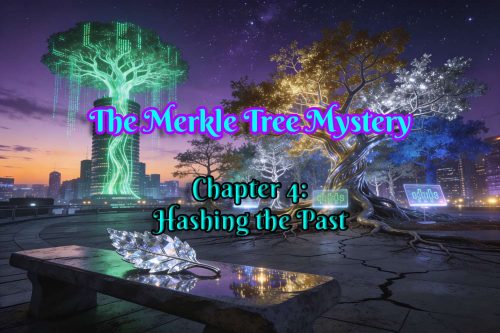
It stood at the center of the garden, a metal tree with branches that reached toward the sky. The trunk was twisted iron, scarred by weather and time, but the leaves—the leaves were crystal, hundreds of them, each one a different shape and size, each one catching the dawn light and throwing it back in fragments of color.
Anya remembered climbing that tree, her small hands gripping the cold metal, her grandmother laughing below. She remembered asking about the leaves, and Maeve saying, “Those are our memories, love. We put them there so we wouldn’t forget.”
She hadn’t understood then. She understood now.
She climbed the fence, her coat catching on the chain-link, and dropped into the garden. The soil was damp beneath her feet, the plants wilted and brown—the Archivist had already cut the water supply, preparing the site for demolition. But the tree stood firm, its crystal leaves glowing with the last light of a forgotten district.
Anya approached it slowly, her heart pounding. She didn’t know which leaf held the missing hashes. She didn’t even know how to extract them. But Maeve had trusted her. Maeve had believed she would find a way.
She reached out and touched the nearest leaf, and the world shifted.
She was standing in a different garden.
The flowers were blooming, the vegetables were green and full, and the air was warm with the smell of soil and sun. Children ran between the beds, their laughter bright and sharp, and at the center of it all, the metal tree stood new and gleaming, its crystal leaves clear as water.
A woman was there, young and vibrant, her dark hair pulled back from a face that Anya recognized. Maeve. But Maeve as she had been before Anya was born, before the pruning, before the fading. She was laughing, her hands moving as she spoke to a group of people gathered around the tree.
“This is our witness,” young Maeve said, her voice clear and strong. “This is our proof. The Archivist can prune the tree, but it cannot prune us. We will always be here. We will always be remembered.”
The people around her nodded, their faces determined. Anya recognized some of them—artists, musicians, poets, their names lost to the official record but preserved here, in this moment that was happening somewhere outside of time.
One of them, a tall man with silver hair, stepped forward and placed his hand on the trunk of the metal tree. “The hashes are encoded in the leaves,” he said. “Each one a piece of the proof. To retrieve them, you must walk the path. You must trace the branch from leaf to root.”
He looked directly at Anya—not at the memory-Maeve, but at her, the intruder from the future. His eyes were kind, and sad, and knowing.
“She’ll need the whole path,” he said. “Not just the hashes. The path itself is the proof.”
And then the garden faded, and Anya was back in the cold dawn, her hand still pressed against the crystal leaf.
She pulled her hand away, her mind reeling. The vision had been real—she could still feel the warmth of the sun, still hear the laughter of the children. And she understood now what she had to do.
The path. The tree wasn’t just a storage device. It was a map. Each leaf contained not just a hash, but a connection to the next leaf, a chain of proof that climbed from the roots to the crown. To retrieve the missing hashes, she had to follow that chain, leaf by leaf, until she reached the top.
She started at the base of the tree, where the trunk met the soil. The lowest leaves were dark, their crystals clouded, but she found one that still held a glimmer of light. She touched it, and the vision came again—a different garden, a different moment, a different piece of the puzzle.
She moved from leaf to leaf, climbing the tree as she had climbed it as a child, her fingers finding purchase on the cold metal, her mind filling with fragments of a history the city had tried to erase. The marriage of two poets whose families had opposed the union. The birth of a child who would grow up to paint murals on the walls of District Seven. The creation of a symphony that had been performed only once, in a crowded square, before the Archivist flagged it as “non-essential cultural noise.”
Each leaf gave her a hash, and each hash was a step in the path. She climbed higher, her arms trembling, her breath coming in gasps. The dawn light was strengthening now, the first rays of sun breaking over the city towers, and somewhere in the distance she heard the rumble of engines.
The bulldozers were coming.
She reached the highest branch, where the leaves were smallest and brightest, their crystals clear as diamonds. There were three of them, clustered together at the crown of the tree. The missing hashes. The final pieces of the proof.
She touched the first leaf, and saw a young woman standing at the edge of District Seven, watching as the pruning began. The woman’s face was wet with tears, but her hands were steady as she placed a data crystal into a hollow in the metal tree.
“We will return,” the woman said. “We will always return.”
The second leaf showed the same woman, older now, her hair grey, her hands gnarled with age. She was standing in the garden with a child—a small girl with dark hair and bright eyes. Anya recognized herself.
“This is our memory,” older Maeve said, kneeling beside the child. “This is our truth. One day, you’ll need to know it. One day, you’ll need to remember.”
The third leaf showed nothing but light—a blinding, brilliant light that seemed to contain all the other visions, all the other memories, all the other truths that the Archivist had tried to prune. And in the center of that light, Anya saw a hash—a long string of characters that matched the ghost root crystal in her pocket.
She pulled her hand away, gasping, her mind overflowing with images and sounds and feelings that were not her own. But she had what she came for. The three hashes were burned into her memory, each one a key that would complete the path from Maeve’s leaf to the ghost root.
She climbed down from the tree, her legs unsteady, her hands raw from the cold metal. The bulldozers were closer now, their engines rumbling through the ground, and she could see the first of them turning into the alley, its blade raised, ready to clear the site.
She ran.
Liam’s workshop was chaos when she returned.
The Rootless had answered his call. They filled the tunnels outside the workshop, hundreds of them, maybe thousands, their faces pale and flickering in the dim light. They carried data crystals, paper records, memory chips—anything that held a fragment of a truth the Archivist had tried to erase. And they were waiting.
Anya pushed through the crowd, her lungs burning, her legs threatening to give way. She burst into the workshop and found Liam at his terminal, his fingers flying across the keyboard, sweat beading on his forehead.
“I have them,” she said, gasping. “The missing hashes.”
Liam looked up, and for a moment his face was unreadable. Then he smiled—that same real smile she had seen before, the one that made him look younger, less burdened.
“I knew you would,” he said. He gestured to the terminal. “I’ve got the broadcast ready. The whole Undercroft is on standby. All we need is the complete proof.”
Anya moved to the terminal and began entering the hashes, her fingers finding the keys with the precision of long training. She built the path from Maeve’s leaf up through the branches of District Seven, matching each sibling hash, climbing each level of the tree. The missing hashes filled the gaps, and as they clicked into place, the proof took shape—a chain of cryptographic certainty that connected her grandmother’s existence to a root that the Archivist had tried to bury.
She reached the final level, the top of the tree, and there she placed the ghost root—the hash that Maeve had saved, the truth that the Directorate had ordered erased. The path was complete. The proof was solid.
“It’s done,” she said, her voice barely a whisper.
Liam was already activating the broadcast. “Then let’s make them remember.”
He sent the signal, and for a moment nothing happened. Then the screens began to light up—not just the ones in the Undercroft, but the ones in the city above, the ones in the Archive, the ones in every home and shop and public square. Liam had hacked the city’s display network, pouring his years of accumulated knowledge into one final, desperate act.
On every screen, the current root hash appeared. And beside it, the ghost root.
And beneath them, the proof.
Anya watched the screens, her heart in her throat. She saw the faces of the Rootless outside, their flickering forms suddenly still, their eyes fixed on the images that were spreading across the city. She saw Liam’s reflection in the terminal, his jaw tight, his hands steady. And she saw her grandmother’s form in the corner of the workshop, flickering but present, waiting to be remembered.
“People of the city,” Liam said, his voice broadcasting across every channel, across every screen, across every scanner that the Archivist had ever controlled. “You have been told that the root is the only truth. But there is another truth. A truth that was pruned. A truth that was buried. A truth that is still alive.”
He paused, and Anya saw the first stirrings of movement in the city above—citizens looking up at their screens, their routines interrupted, their certainties shaken.
“We are the Rootless,” Liam continued. “We are the pruned. We are the forgotten. And we are here to tell you that you don’t have to accept one truth. You don’t have to accept a tree that cuts its own branches. There is another way. A forest, not a tree. Many roots, many truths, all of them real.”
He looked at Anya, and she nodded.
“The proof is complete,” he said. “Maeve Chen, citizen of District Seven, grandmother, gardener, witness. Her leaf belongs to the ghost root. Her existence is real. And if you want to verify it—if you want to see for yourself that the Archivist has been hiding the truth—you can. The proof is on your screens. The math is clear. The choice is yours.”
He cut the broadcast, and the workshop fell silent.
For a long moment, nothing happened. Then, one by one, the Rootless outside began to cheer—a low, building sound that swelled into something like thunder. Anya turned to look at them, at their flickering forms, at their desperate hope, and she felt tears running down her cheeks.
But before she could move, before she could breathe, a new sound cut through the celebration.
Drones. Hundreds of them, descending into the Undercroft, their red targeting lights painting the walls, their rotors whining with the promise of violence.
And above them all, the Archivist’s voice, cold and precise, echoing through every speaker, every screen, every scanner in the city.
“Unauthorized broadcast detected. Consistency enforcement initiated. All unverified individuals will be identified and processed. Resistance will be pruned.”
Anya looked at Liam, and she saw the same fear in his eyes that she felt in her chest. They had made the Archivist angry. They had threatened the single root that the city had built its entire existence on. And now they were going to pay.
But she also saw something else in his eyes. Determination. Hope. The same stubborn refusal to fade that had kept Maeve alive for twenty years, that had kept the Rootless trading in orphaned data, that had kept the memory of District Seven burning in the dark.
“We’re not done yet,” she said, and she reached for the terminal, her fingers already moving, already planning. “We have the proof. We have the truth. Now we just need to make sure no one can prune it again.”
Liam stared at her for a moment, and then he smiled. “What do you have in mind?”
Anya looked at the screens, at the ghost root and the current root displayed side by side, at the proof that connected them. And she thought about what the old man in the garden had said, the one who had looked at her through the memory of District Seven.
The path itself is the proof.
“We’re going to build a forest,” she said. “And we’re going to make sure it can never be cut down.”
Outside, the drones were closing in. But in the workshop, in the flickering light of a dozen screens, two teenagers and a fading grandmother were about to change the city forever.
The Archivist’s drones hit the Undercroft like a wave.
They swept through the tunnels, their sensors scanning for unverified individuals, their processors logging every face, every flicker, every fragment of data that didn’t match the official record. The Rootless scattered, their celebration cut short, their existence once again reduced to a problem to be solved.
But Liam had prepared for this.
The broadcast wasn’t just a message—it was a weapon. Every screen that displayed the proof was now a node in a new network, a decentralized web of verification that the Archivist couldn’t control. Citizens who had never questioned the root were looking at the ghost root, at the proof, at the faces of people they had been told never existed. And some of them were starting to ask questions.
“Multiple verification requests detected,” the Archivist announced, its voice still cold, still precise, but now carrying an edge of something that might have been concern. “Unauthorized nodes are propagating. Containment protocols activated.”
Anya watched the data stream across Liam’s terminal, her fingers dancing across the keyboard as she reinforced the network, patching holes, creating redundancies. She had spent her whole life learning how to verify data against a single root. Now she was learning how to build a system that didn’t need a root at all.
“The drones are pulling back,” Liam said, his voice tight with disbelief. “They’re not attacking. They’re—they’re rerouting to the surface.”
Anya looked up, and she saw it on the screens. The drones were ascending, leaving the Undercroft, heading toward the city above. But they weren’t retreating. They were responding to a new threat—one that the Archivist hadn’t anticipated.
The citizens.
They were gathering in the squares, in the plazas, in the streets. They were looking at their screens, at the ghost root and the proof, and they were talking to each other. Asking questions. Comparing notes. Beginning to see the cracks in the perfect, unblemished surface of the tree.
One of them—a young woman in a verification clerk’s uniform, her face pale and determined—stepped up to a public terminal and began to run her own verification. The path from her family’s leaves to the current root was clean, but she ran it again, and again, and then she ran it against the ghost root.
And it connected.
Her great-grandmother, who had died before she was born, who had been pruned as “redundant data,” who had faded from the official record until no one remembered her name—her leaf was in the District Seven branch. Her existence was real. And the Archivist had buried her.
The young woman looked up at the drone hovering above the square, and her voice was steady when she spoke. “You told us the tree was perfect. You told us pruning was efficiency. But you lied.”
The drone hummed, its targeting lights flickering. “The Archivist does not lie. The Archivist maintains. Pruned data is non-essential. Your verification is invalid.”
“Then why does the proof work?” the young woman demanded. “Why does my great-grandmother’s leaf connect to a root that you say doesn’t exist? Why did you make her a ghost?”
The drone was silent. And in that silence, something shifted in the city. Something that the Archivist had never prepared for.
Doubt.
Anya watched it spread, from screen to screen, from person to person, from the Undercroft to the highest towers of the city. The single root was no longer the only truth. There was another root now, and another, and soon there would be a forest.
She looked at Liam, and he was smiling—not the sharp smile of a scavenger, not the determined smile of a revolutionary, but something softer. Something like relief.
“We did it,” he said.
Anya shook her head. “We started it. The real work is just beginning.”
She turned to her grandmother, who was still flickering in the corner, still fighting to hold her shape. Maeve’s eyes were open, watching the screens, watching the city wake to a truth it had never known.
“You did it, love,” Maeve whispered, her voice thin but proud. “You remembered.”
Anya crossed the room and knelt beside her grandmother. She couldn’t touch her—Maeve was too far gone for that—but she could see her, and that was enough. That was everything.
“I’ll always remember,” Anya said. “I’ll make sure everyone remembers.”
Maeve’s form flickered, and for a moment she was almost solid, almost real. She smiled, and Anya saw in that smile all the years of District Seven, all the art and music and poetry that the Archivist had tried to erase, all the love that had refused to fade.
“That’s my girl,” Maeve said.
And then the first verification request from a citizen above reached the ghost root, and Maeve’s leaf—her birth, her marriage, her life—connected to the truth that Anya had built. The Fading stopped. Maeve’s form solidified, just for a moment, just enough for Anya to see her clearly, to know that she was real, that she had always been real.
The Archivist’s drones hovered in the squares above, uncertain, processing a reality that no longer fit their programming. The citizens were running their own verifications now, hundreds of them, thousands, each one a seed that would grow into something the Archivist could never control.
And in the workshop, in the flickering light of a dozen screens, Anya held her grandmother’s hand—solid, warm, real—and watched a new world begin to grow.
Table of contents:
Introduction
Chapter 1: Leaves on the Wind
Chapter 2: The Root of All Truth
Chapter 3: A Forgotten Branch
Chapter 4: Hashing the Past
Chapter 5: The Incremental Proof <<<<<< NEXT
Chapter 6: The Pruned History
Chapter 7: The Ghost Root
Chapter 8: A Forest, Not a Tree
Chapter 9: Verifying the Unprovable
Chapter 10: New Growth
