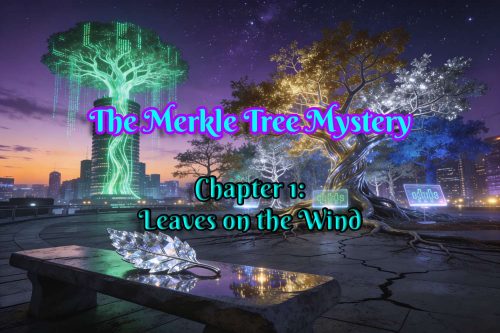
The property dispute had been simmering for three cycles, but this morning it finally boiled over.
Anya stood at her verification station in the City Archive’s main hub, watching the two families shout at each other across the polished white floor. The Holtons claimed Apartment 7-C in the Meridian Spire. The Chengs claimed the same apartment. Both had documents. Both had witnesses. Both had the desperate, wild-eyed look of people who had been fighting for months and were running out of options.
Anya’s fingers hovered over her interface, waiting for the supervising clerk to give the go-ahead. The Archive’s rules were clear: only a Verification Clerk could settle a dispute of this magnitude. She was the youngest clerk in the hub—barely seventeen—but she had passed her certification with the highest marks in a decade. She knew the tree.
“Proceed, Clerk Anya,” said a calm voice from the speaker above her station. The Archivist, the AI that maintained the city’s Merkle Tree, was always listening, always watching. Its presence was as constant as the hum of the building.
Anya took a breath and let her fingers dance across the holographic interface. A three-dimensional representation of the city’s Merkle Tree bloomed in the air before her—a vast, branching structure of cryptographic hashes that stretched from the present day back to the city’s founding. Every citizen, every birth, every marriage, every property deed, every diploma, every transaction that mattered—all of it was here, hashed into leaves, paired and hashed again, rising up to a single root hash that represented absolute, immutable truth.
She traced the Cheng family’s claim first. Her fingers followed the path: leaf hash of the original deed, paired with its sibling, up through the branch of Meridian Spire deeds, then the district branch, then the city branch, until—
The path stopped. The hash at the top of the Cheng branch did not match the current root.
“Invalid,” Anya said quietly. She didn’t look up from her display. “The Cheng deed was altered three years ago. The leaf hash no longer corresponds to the historical root.”
Mrs. Cheng let out a sound like a wounded animal. “That’s impossible! We’ve lived there for fifteen years! We have the papers!”
Anya’s fingers moved to the Holton claim. She traced the same path: leaf, sibling, branch, district, city. The hashes aligned perfectly, climbing the tree like a ladder to the top, until they reached the current root—the same root that was displayed on every public screen in the city, the same root that every scanner, every terminal, every authority used as the ultimate source of truth.
“Valid,” Anya said. “The Holton deed is the current, verified record. The Cheng deed was a forgery.”
She looked up in time to see Mr. Holton’s shoulders drop with relief. Mrs. Cheng’s face crumpled. The security drones that flanked the verification hub hummed softly, waiting for the inevitable.
“The Archive has spoken,” Anya said, reciting the standard phrase. She hated the way it sounded, but she hated the alternative more. Without the tree, anyone could claim anything. Without the root, there was no truth at all.
The Cheng family was escorted out. Mr. Holton lingered, trying to thank her, but Anya had already turned back to her interface, pulling up the next verification request. There were always more. The city ran on proofs.
Later that morning, a student came to the hub for a tour.
Anya had been chosen to show him around—partly because she was the youngest clerk, partly because the Archivist had flagged her communication scores as “exceptional.” The student’s name was Jin. He was fourteen, small for his age, with the wide-eyed look of someone who had never been inside the Archive before.
“This is the Merkle Tree visualization,” Anya said, gesturing to the holographic display that dominated the hub’s central chamber. It was a rotating, golden structure, each node a glowing point of light, each branch a thread of pure data. “Every leaf is a life event. Every branch is a connection. And at the top—” she pointed to the single, pulsing node at the apex, “—is the root. The current root hash changes every time a new leaf is added, but the structure ensures that any change anywhere is immediately visible.”
Jin craned his neck, trying to take it all in. “How many leaves?”
“Seventeen billion, three hundred twenty-two million, six hundred forty-one thousand, eight hundred and four,” Anya said, reading the counter at the base of the display. “And growing.”
“And you can prove anything with it?”
“Anything that’s in it,” Anya said. She walked over to a whiteboard—an old-fashioned teaching tool, but some lessons stuck better when drawn by hand. She picked up a marker and sketched a simple Merkle tree: eight leaves at the bottom, four branches above them, two above that, and a single root at the top.
“This is a simplified version,” she said, drawing quickly. “Each leaf is a hash of a piece of data. A birth certificate, a deed, a marriage license. We pair them, hash them together, pair those hashes, hash again, until we get one root. If you change one leaf—” she erased one leaf and scribbled a new hash, “—the root changes completely.” She drew a jagged line through the root she had just drawn, replacing it with a different hash. “See? You can’t tamper with the tree without everyone knowing.”
Jin frowned. “What if someone changes the root itself? Couldn’t they just pretend nothing happened?”
Anya smiled. It was a question every trainee asked. “The root is public. It’s displayed on every screen, verified by every scanner, checked by every terminal in the city. To change the root, you’d have to change every copy simultaneously. And the Archivist watches them all. It’s mathematically impossible to forge.”
Jin nodded slowly. “So the root is… truth.”
“The root is the truth,” Anya said. “One root. One truth. Everything else is just branches reaching toward it.”
She let the words hang in the air, savoring them. It was a beautiful system. Elegant. Unbreakable. The city had built itself on this principle for three hundred years, and it had never failed.
Jin opened his mouth to ask another question, but a commotion at the hub’s entrance drew both their attention.
A boy was being stopped by the security drones.
He was maybe sixteen, lean and quick-looking, with a mop of dark hair and clothes that were just slightly too worn to belong to a proper citizen. More tellingly, he had no identity glow around his wrist—no bio-integrated verification chip, the mark of a registered city resident. He was Rootless.
Anya had seen Rootless before, but never inside the Archive. They usually stayed in the Undercroft, the sprawling, unregulated zone beneath the city where scanners didn’t reach and the Archivist’s gaze was indirect. They were non-persons to the official system, without leaves, without branches, without roots. They existed on the margins, trading in data that the tree had deemed irrelevant.
“I’m here to see a clerk,” the boy said, holding up his hands. “I have a sale to make.”
The drones buzzed, their red targeting lights painting his chest. “Unidentified individual. State your business or vacate.”
“I said I have data,” the boy insisted. His voice carried across the hub, drawing stares from clerks and citizens alike. “District Seven. Cycle 134. Marriage certificates. Before the prune. You want them or should I let them dissolve?”
Anya’s stomach tightened. District Seven. She knew the name from her training—it was one of the branches that had been “administratively consolidated” years ago, back when she was a child. The Archivist had pruned it for efficiency, deeming the data redundant or erroneous. It was a textbook example of why pruning was necessary: the tree had been growing too fast, too many leaves, too many branches that no longer served the living city. Cutting them away had streamlined everything.
But the boy was here, waving old data like a flag.
“Clerk Anya,” the Archivist’s voice murmured in her earpiece. “The individual appears to be attempting to trade in pruned data. This is not a recognized transaction. Please direct him to vacate.”
Anya nodded, though she was already moving toward the entrance. Jin followed, curious.
“You can’t be here,” she said, stopping a few feet from the boy. The drones hovered between them. “Pruned data has no standing in the Archive. It was removed for a reason.”
The boy’s eyes locked onto hers. They were dark, sharp, and there was something in them that she couldn’t quite name—not desperation, exactly, but something close. A hunger.
“It has standing if someone wants it,” he said. “And someone does. The families from District Seven—they want their history back. They’ll pay.”
“The families from District Seven were relocated,” Anya said, reciting the official statement. “Their records were consolidated into the main tree. The pruning was merely administrative.”
The boy laughed. It was a dry, humorless sound. “Is that what they told you? ‘Consolidated’?” He pulled a data crystal from his pocket—a small, translucent chip that caught the light. “This is thirty-seven marriage certificates. Real people, real vows, real dates. The Archivist decided they were ‘redundant’ because those marriages were between Rootless and citizens. Made the tree messy, I guess.”
Anya’s mouth went dry. She had never heard that detail. Her training had said District Seven was pruned because its records were outdated, cluttering the system. But if the boy was telling the truth—
“You should leave,” she said, her voice firmer than she felt. “Before the drones escalate.”
The boy studied her for a moment, his head tilted. Then his eyes flicked to something behind her—Jin, maybe, or the holographic tree still rotating in the central chamber. When he looked back at Anya, his expression had shifted. It was almost pitying.
“Ask your grandmother about District Seven,” he said.
The words hit her like a physical blow. Her grandmother. Maeve. Who had lived in the city for seventy years, who had raised Anya after her parents died in a transport accident, who had never once mentioned District Seven.
“What did you say?” Anya demanded, but the boy was already backing away, the crystal disappearing into his pocket.
“Keep the tree,” he called over his shoulder, raising a hand in mock salute. “I’ll find someone who remembers what pruning really means.”
The drones let him go. Rootless were not citizens, but they were not prisoners either. He slipped out the entrance and was gone, swallowed by the morning crowds.
Anya stood at the threshold, her heart pounding. Jin was looking at her with wide eyes.
“Who was that?” he asked.
“Nobody,” Anya said. “Just a data-scavenger. They trade in ghosts.”
She turned away from the entrance, forcing herself to walk back to her station. Her hands were steady as she pulled up the next verification request, but her mind was elsewhere. District Seven. Her grandmother. It had to be a coincidence. A trick. The boy was trying to unsettle her, to make her doubt the system she had dedicated her life to.
She spent the rest of the morning processing verifications, her movements automatic. Property deeds, birth certificates, educational credentials—each one traced up the tree, each one matching the root, each one a small affirmation that the system worked. By the time her shift ended, she had almost convinced herself that the encounter meant nothing.
That evening, Anya video-called her grandmother.
Maeve’s apartment was across the city, in a district that had been stable for decades. The call connected after a few seconds, and Maeve’s face appeared on Anya’s screen—wrinkled, sharp-eyed, with a shock of white hair that she refused to dye.
“Anya, love,” Maeve said, smiling. “You’re pale. Did you eat today?”
“I ate,” Anya lied. “Grandma, I need to ask you something.”
Maeve’s smile faded slightly, replaced by a look of wary attention. “What is it?”
“District Seven. Do you remember it?”
The pause was barely a second, but Anya caught it. Maeve’s eyes flickered—not with confusion, but with something like recognition. Old recognition. Wary recognition.
“District Seven was pruned years ago,” Maeve said, her voice carefully neutral. “Before you were born, I think. Why do you ask?”
“Someone came to the Archive today. He was trying to sell data from it. Marriage certificates. He said… he said I should ask you about it.”
Maeve was quiet for a moment. Behind her, Anya could see the familiar clutter of her apartment—the hand-woven blankets, the stacks of old books, the photographs that hung on the walls. One photograph, she noticed, was slightly askew, as if it had been moved recently.
“I lived in District Seven when I was young,” Maeve said finally. “Before your father was born. It was a good place. Artists, musicians, people who made things. The Archivist didn’t like it much, I think. Too much… what was the word? ‘Unstructured data.’”
Anya frowned. “The Archivist doesn’t have preferences. It just maintains the tree.”
“Does it?” Maeve’s smile returned, but it was sad now. “Well, maybe I’m an old woman with old memories. The important thing is that you’re safe, and you’re doing good work. I’m proud of you, Anya.”
The call ended a few minutes later with the usual promises to visit soon. Anya sat in the dim light of her apartment, staring at the blank screen. Her grandmother had been evasive. That was unlike her.
She glanced at her bedside screen, where the current root hash glowed softly—a long string of characters that represented, at this moment, the sum total of the city’s truth. She had always found comfort in it, the way some people found comfort in prayer. The root was constant. The root was certain. The root was the anchor that kept everything from drifting into chaos.
But now, for the first time, she wondered: what if the root wasn’t the whole story?
She shook her head, annoyed at herself. The boy was a scavenger, trading in dead data. Her grandmother was old, with old memories that didn’t match the official record. None of that changed the fact that the Merkle Tree was perfect. It had to be. Because if it wasn’t—
If it wasn’t, then what was she even doing?
Anya turned off the light and lay in the darkness, the root’s soft glow still visible on her bedside screen. She closed her eyes, but sleep was slow to come.
She kept seeing the boy’s face, his eyes sharp and hungry, and hearing his words: Ask your grandmother about District Seven.
She didn’t know it yet, but the tree had already begun to crack.
Table of contents:
Introduction
Chapter 1: Leaves on the Wind
Chapter 2: The Root of All Truth <<<<<< NEXT
Chapter 3: A Forgotten Branch
Chapter 4: Hashing the Past
Chapter 5: The Incremental Proof
Chapter 6: The Pruned History
Chapter 7: The Ghost Root
Chapter 8: A Forest, Not a Tree
Chapter 9: Verifying the Unprovable
Chapter 10: New Growth
