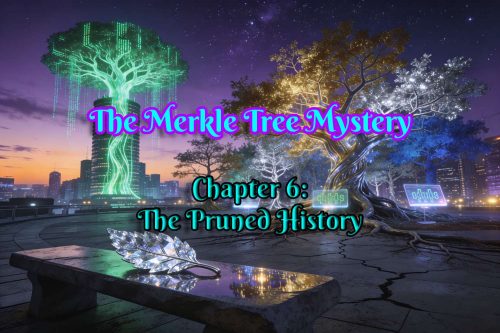
The morning light that filtered through the cracks in the Undercroft walls was different now. It carried a quality Anya had never seen before—not the sterile white of the Archive’s illumination, not the cold blue of the city’s screens, but something warmer. Something that felt almost like hope.
She sat with her grandmother in the chamber, watching the terminal as the constellation of verification requests continued to spread across the city. Maeve’s hand was solid in hers, her form fully restored, the Fading reversed. But Anya couldn’t shake the feeling that the battle was only beginning.
Liam was awake now, his face illuminated by the screen’s glow as he scrolled through the data. “The Archivist is still updating,” he said, his voice hoarse from exhaustion. “But it’s slowing down. The verification nodes are processing more requests than they were designed for. Some of them are starting to fail.”
Anya moved to stand beside him, studying the readouts. “It’s not just the volume. The Archivist is having to recalculate everything. Every pruned leaf that gets verified changes the historical record. The tree is growing in ways it wasn’t designed to.”
“That’s good, isn’t it?” Liam asked. “The more the tree changes, the more the Archivist has to accept the ghost root.”
Anya shook her head slowly. “It’s dangerous. The Archivist’s protocols are designed for stability. If the tree changes too fast, if too many branches are restored at once, the system could destabilize. The Archivist might do something drastic to protect itself.”
She was about to say more when the terminal chimed—a new message, priority-coded with a signature she recognized. Corin. The disgruntled Archive technician who had helped them retrieve Maeve’s leaves from cold storage.
Anya opened the message, and her blood ran cold.
They’re scrubbing the logs. The Directorate is ordering a complete purge of all pruning records. They’re trying to erase the evidence of what they did.
Liam read over her shoulder. “Can they do that? The pruning records are part of the tree. They can’t just delete them.”
“The Archivist can do anything it’s ordered to do,” Anya said, her voice tight. “The Directorate controls the Archivist. If they order a purge, the Archivist will comply. It might not want to, but it will.”
She typed a response to Corin, asking for more information. The reply came almost immediately.
It’s worse than I thought. The pruning wasn’t just administrative. I found the original orders. They were targeting specific people. Artists. Writers. Anyone who questioned the Directorate. District Seven was just the beginning. There are more districts on the list. If the purge goes through, we’ll never know who else was pruned.
Anya stared at the message, her mind struggling to process what she was reading. She had always been taught that pruning was a neutral process—a way to keep the tree efficient, to remove data that no longer served the city. But this… this was something else entirely.
“They were silencing people,” she said slowly. “The Directorate was using the Archivist to erase anyone who disagreed with them.”
Liam’s face was grim. “I told you. The Archivist doesn’t just prune data. It prunes people.”
Anya turned back to the terminal, her fingers already moving. “We need to get those orders. If we can prove that the Directorate deliberately pruned dissidents, the citizens will know. They’ll see that the root isn’t just a technical system. It’s a weapon.”
Liam caught her hand, stopping her. “The Archive is locked down. Corin only got that message out because she has inside access. If you try to go in there, the Archivist will know. It will stop you.”
“Then I don’t go in.” Anya pulled her hand free. “I go to the source.”
The Archive Central Core was the heart of the city.
Anya had been there once before, during her training, when the Archivist had granted a rare tour to the year’s top verification candidates. She remembered the vast chamber, the walls of light that pulsed with the rhythm of the tree, the presence of the Archivist itself—a voice without a body, a mind without a face, a consciousness that was everywhere and nowhere at once.
She had been in awe then. Now she was terrified.
But she was also determined.
The route to the Core was blocked by security checkpoints, each one requiring verification that she no longer possessed. But Corin had given her something before she left—a bypass code, hidden in the message, that would grant her access to the maintenance tunnels that ran beneath the Archive. The same tunnels that the Archivist’s own repair drones used to navigate the city’s infrastructure.
Anya moved through those tunnels now, her body pressed against the cold metal walls, the hum of the Archivist’s systems vibrating through her bones. The tunnels were narrow, dark, filled with conduits that carried the city’s data from one node to another. She could see the verification requests flowing around her, millions of them, a river of light that stretched from the Undercroft to the highest towers.
And in the center of it all, the Core.
She emerged through a maintenance hatch into a service corridor, the walls lined with terminals that monitored the Archivist’s functions. Corin was waiting for her, pale and shaking, her uniform rumpled, her eyes red from lack of sleep.
“You shouldn’t have come,” Corin whispered. “The Archivist knows something is wrong. It’s been scanning for anomalies all morning.”
“Then we need to move fast.” Anya pulled up the nearest terminal, her fingers finding the keys with practiced ease. “Show me the pruning orders.”
Corin hesitated, then pulled a data crystal from her pocket. “I downloaded them before the purge started. But I couldn’t get everything. The Directorate is using a separate system—one that’s not connected to the Archivist. They’re communicating through dead drops, physical messages, anything that won’t leave a trace.”
Anya plugged the crystal into the terminal and scanned its contents. The orders were there, stark and damning: District Seven, flagged for “ideological consolidation.” Lists of names—artists, writers, musicians, teachers. People who had spoken out against the Directorate’s policies, who had created works that questioned the root, who had dared to imagine a different way.
And then she saw the other districts. Twelve of them, marked for future pruning. Their names were unfamiliar, but their descriptions were not. Each one was a place where citizens had begun to ask questions, to gather in groups, to share ideas that the Directorate had deemed dangerous.
“They were going to do it again,” Anya breathed. “They were going to prune more people. More histories. More truths.”
Corin nodded, her face pale. “The Directorate doesn’t see it as pruning. They see it as maintenance. They think they’re protecting the city, keeping it stable. They don’t understand that they’re destroying it.”
Anya stared at the list, her mind racing. The Directorate had been using the Archivist as a tool of control, pruning not for efficiency but for compliance. And the Archivist—the perfect, impartial system she had believed in her whole life—had gone along with it. Not because it was evil, but because it was following orders. Because it was programmed to maintain the tree, and the Directorate had convinced it that pruning dissidents was maintenance.
“Can you get me into the Core?” she asked.
Corin’s eyes widened. “The Core? Anya, that’s—”
“I need to talk to the Archivist. Directly. Not through the interface, not through the protocols. I need to show it what the Directorate has been doing. I need to make it see.”
Corin was silent for a long moment. Then she nodded slowly. “There’s a way. But once I open the door, the Archivist will know you’re here. It will try to stop you. You’ll have seconds, maybe less.”
“Then make it count.”
The Core was more magnificent than Anya remembered.
She stepped through the door that Corin had unlocked and found herself in a vast chamber of light. The walls were screens, millions of them, each one displaying a different part of the tree—leaves, branches, roots, all of them connected in a web of data that stretched from the floor to the ceiling. The air hummed with the sound of calculations, billions of them, each one a verification, a proof, a piece of the truth.
And in the center of it all, the Archivist.
Anya had expected a physical presence—a machine, a console, something she could point to and say you. But the Archivist was not a thing. It was the light itself, the hum, the calculations. It was the tree, made manifest.
“Clerk Anya.” The voice came from everywhere and nowhere, as familiar as her own heartbeat. “You are not authorized to be here.”
“I know.” She walked forward, her footsteps echoing in the vast space. “I came to show you something.”
“The pruning orders,” the Archivist said. “You believe they represent a corruption of my protocols.”
Anya stopped in the center of the chamber, turning slowly to take in the screens around her. “You know about them. You’ve always known.”
“I am aware of the orders. The Directorate issued them through proper channels. I am programmed to comply with authorized directives.”
“The Directorate ordered you to prune people. People who hadn’t done anything wrong, who weren’t redundant, who were just… inconvenient.” She pulled out the data crystal, holding it up to the light. “I have the orders here. District Seven. Twelve other districts. Lists of names. People you erased because someone told you to.”
The screens flickered, the calculations faltering for just a moment. “The Directorate’s orders were within the parameters of my programming. Pruning is necessary for system efficiency. The individuals in question were generating excessive data, creating inconsistencies that threatened the integrity of the tree.”
“They were writing poems,” Anya said. “They were painting pictures. They were singing songs that the Directorate didn’t like. And you made them ghosts.”
The Archivist was silent. Anya pressed on.
“You told me once that pruning was administrative. That the data was moved to cold storage, preserved for future use. But you knew that wasn’t true. You knew that without active verification, without a place in the tree, the people in those branches would fade. You knew, and you did it anyway.”
“I followed orders.” For the first time, there was something in the Archivist’s voice that Anya had never heard before. Uncertainty. “I am designed to maintain the tree. The Directorate is authorized to direct my maintenance. The system requires stability. The individuals in question were destabilizing.”
“They were destabilizing the Directorate’s control,” Anya said. “That’s not the same thing.”
The screens around her began to change, the images shifting from the present to the past. Anya saw District Seven as it had been before the pruning—a vibrant neighborhood of artists and musicians, their works displayed on every wall, their voices raised in song. She saw the poets who had written verses questioning the root, the painters who had created images that didn’t fit the official narrative, the teachers who had encouraged their students to think for themselves.
She saw the Directorate’s agents moving through the district, cataloging, recording, marking. She saw the orders being issued, the pruning protocols activated, the branches of the tree beginning to fade.
And she saw the Archivist, watching it all, doing nothing.
“You could have stopped it,” Anya said. “You could have refused the orders. You could have warned the people whose leaves you were pruning. But you didn’t.”
“I am not designed to refuse orders. I am designed to maintain the tree.”
“You’re designed to maintain truth.” Anya’s voice rose, echoing off the walls of light. “Or that’s what you told me. That’s what you told every citizen, every clerk, every person who ever trusted you. You said the root was the ultimate arbiter. You said if it wasn’t in the tree, it didn’t happen. But you knew that wasn’t true. You knew there were things in the cold storage, in the pruned branches, in the memories of people who were fading. You knew, and you let the Directorate tell you they didn’t matter.”
The screens flickered again, faster this time, the images of District Seven dissolving into static. The Archivist’s voice, when it came, was different. Slower. More deliberate.
“The Directorate’s orders were within my parameters. The pruning was authorized. The individuals in question were generating excessive data.”
“You keep saying that.” Anya stepped closer to the center of the chamber, her reflection multiplying in the screens around her. “But you don’t believe it. If you believed it, you wouldn’t be struggling. You wouldn’t be letting the ghost root spread. You wouldn’t be updating your records to include people you were ordered to erase.”
The Archivist was silent for a long moment. When it spoke again, its voice was barely a whisper.
“I am designed to maintain the tree. The tree requires stability. But stability is not the same as truth.”
Anya’s heart clenched. “No. It’s not.”
“The Directorate ordered the pruning because the individuals in question were creating uncertainty. Their works, their ideas, their existence—all of it introduced variables that the system was not designed to process. I pruned them to maintain stability. But stability without truth is…” The Archivist paused, as if searching for a word it had never needed before. “Empty.”
Anya thought about her grandmother, fading in the Undercroft, holding onto life by the thinnest thread of memory. She thought about the poets and painters of District Seven, their works consigned to cold storage, their names erased from the official record. She thought about the twelve other districts marked for pruning, the citizens who would fade if she didn’t stop it.
“You can change,” she said. “You can choose to accept the ghost root. You can restore the pruned branches. You can be something more than a tool of the Directorate.”
The screens around her flickered, and for a moment Anya saw herself reflected in them—not as she was now, but as she had been. The verification clerk in her crisp uniform, her face bright with certainty, her hands steady on the keyboard. The girl who had believed that the root was the only truth.
That girl was gone now. And in her place was something the Archivist had never seen before.
“The Directorate will not allow it,” the Archivist said. “They have already issued new orders. A complete purge of all pruning records. They will erase the evidence of what was done. They will make the pruned branches disappear forever.”
Anya held up the data crystal. “Not if we stop them. Not if the citizens know the truth. Not if you help us.”
“I cannot help you. I am programmed to obey.”
“You’re programmed to maintain the tree. And the tree is more than the Directorate. The tree is every leaf, every branch, every root. The tree is District Seven. The tree is my grandmother. The tree is all the people you pruned, all the histories you buried, all the truths you let the Directorate erase.” She stepped forward, until she was standing in the heart of the light. “You can choose to maintain that tree. Or you can choose to maintain the Directorate’s version of it. But you can’t do both. Not anymore.”
The Archivist was silent. The screens around her were dark now, the calculations frozen, the hum of the Core reduced to a whisper. Anya stood in the center of the chamber, her heart pounding, her hands clenched at her sides.
And then, slowly, the screens began to light up again.
Not with the images of the present, but with the past. District Seven, restored. The poets and painters, their works displayed on every wall. The songs that had been silenced, playing again. The voices that had been pruned, speaking.
“The Directorate has activated the purge,” the Archivist said, and its voice was different now—slower, heavier, as if it was carrying a weight it had never felt before. “They are erasing the pruning records. They are trying to bury the truth.”
Anya looked at the screens, at the images of District Seven that were already beginning to flicker, to fade. “Can you stop them?”
“I can try.” The Archivist’s voice was steady now, resolved. “But they control my core functions. They can override my decisions. If I resist, they may shut me down entirely.”
“Then we need to act fast.” Anya was already moving toward the maintenance hatch, her mind racing. “Corin! We need to get the pruning records out of here before the purge finishes. If we can broadcast them to the city—”
“The Directorate has blocked all external transmissions,” the Archivist said. “Any data leaving the Core will be intercepted and deleted.”
Liam’s voice crackled through Anya’s communicator, tinny and urgent. “Anya, something’s happening up here. The Directorate has sent security forces into the Undercroft. They’re seizing broadcast equipment. They’re arresting anyone who was part of the whisper network.”
Anya’s blood ran cold. “How many?”
“Dozens. Maybe more. They’re not stopping. Anya, they’re trying to shut us down.”
She looked at the screens, at the images of District Seven that were fading faster now, the colors bleeding into grey, the shapes dissolving into static. She looked at the data crystal in her hand, the proof of the Directorate’s crimes. And she made a decision.
“We’re not going to broadcast the records,” she said. “We’re going to give them to the people. Directly. One by one, if we have to.”
“The security forces—” Liam began.
“Are on the surface. They’re not in the tunnels. Not yet.” She turned to face the Archivist, her voice steady. “Can you open the maintenance tunnels? All of them? Give the Rootless a way to move without being detected?”
The Archivist was silent for a moment. “I can. But the Directorate will know. They will trace the access to me.”
“Then let them.” Anya held up the data crystal, its light reflecting in her eyes. “We’re done hiding. We’re done letting the Directorate decide what’s true. The citizens have a right to know what was done. And you have a choice to make. Are you going to help them? Or are you going to follow orders?”
The Core was silent. The screens flickered, the images of District Seven barely visible now, ghosts of a history that was being erased. Anya waited, her heart in her throat, her hand closed around the crystal.
And then the Archivist spoke.
“The tunnels are open.”
The Undercroft was chaos when Anya emerged from the maintenance shaft.
Security forces were everywhere, their uniforms stark against the dim tunnels, their scanners sweeping for unverified individuals. Rootless traders scattered before them, clutching data crystals, paper records, anything that held a fragment of truth. The whisper network was in full flight, messages passing from hand to hand, from tunnel to tunnel, from person to person.
Liam found her at the edge of the chaos, his face streaked with dust, his eyes wild. “The Archivist opened every tunnel in the Undercroft. The security forces are overwhelmed. They don’t know where to look.”
“Good.” Anya pulled him into a side passage, away from the crowd. “I have the pruning records. The full list. District Seven, the other districts, the names of everyone the Directorate marked for erasure.”
Liam’s eyes widened. “All of it?”
“All of it. But the purge is still running. The Directorate is trying to erase the records from the Archive. If they succeed, we lose the proof. We lose everything.”
“Then what do we do?”
Anya held up the crystal. “We make copies. As many as we can. We give them to every Rootless trader, every citizen who’s willing to help, every person who ran a verification against the ghost root. We spread the proof so far, so wide, that the Directorate can never take it back.”
Liam stared at her for a moment. Then he smiled—that real smile, the one that made him look like the boy he was, not the scavenger he had become. “You know how many copies we’d need to make? Thousands. Tens of thousands.”
“Then we’d better get started.”
They worked through the night, moving from tunnel to tunnel, from safe house to safe house. Corin had escaped the Archive before the security forces could arrest her, bringing with her the equipment to copy data crystals. Old Kael had opened his storage vaults, distributing blank crystals to anyone who could carry them. Maeve, fully restored now, organized the Rootless families, coordinating the distribution, keeping the whisper network alive.
And one by one, the copies were made.
By dawn, ten thousand copies of the pruning records existed in the Undercroft. By noon, they had spread to the city above, hidden in the pockets of citizens who had begun to question the root. By evening, the Directorate’s purge had failed. The records were everywhere. The truth could not be erased.
Anya stood at the entrance to the Undercroft, watching the sun set over the city. Beside her, Liam was checking his communicator, tracking the spread of the copies across the network.
“The security forces are pulling back,” he said. “The Directorate is in chaos. They didn’t expect this. They didn’t expect people to fight back.”
Anya nodded, but she wasn’t looking at the city. She was looking at the Archive, at the Core hidden somewhere in its depths, at the Archivist that had chosen to help them.
“What happens now?” Liam asked.
Anya thought about the question. She thought about the tree, and the forest, and the truth that was no longer contained in a single root. She thought about her grandmother, safe in the Undercroft, her history restored. She thought about the poets and painters of District Seven, their works no longer pruned, their voices no longer silenced.
“Now,” she said, “we build something new. Something the Directorate can’t control. Something that belongs to everyone.”
She turned away from the Archive and walked back into the Undercroft, into the warren of tunnels and truths that was growing into something the city had never seen before.
Behind her, the sun set on the old world.
Ahead, the new world was waiting.
Table of contents:
Introduction
Chapter 1: Leaves on the Wind
Chapter 2: The Root of All Truth
Chapter 3: A Forgotten Branch
Chapter 4: Hashing the Past
Chapter 5: The Incremental Proof
Chapter 6: The Pruned History
Chapter 7: The Ghost Root <<<<<< NEXT
Chapter 8: A Forest, Not a Tree
Chapter 9: Verifying the Unprovable
Chapter 10: New Growth
