Three months had passed since the day the ghost root became real.
Anya stood at the window of what had once been the Directorate’s central chamber, looking out over a city she barely recognized. The screens that lined every street, every building, every public square no longer displayed a single pulsing root. They showed constellations now—hundreds of roots, thousands, each one a different color, a different shape, a different truth. Citizens gathered before them not to receive the official verdict but to compare, to discuss, to decide for themselves what was real.
The room behind her was no longer the Directorate’s either. The grey robes had been packed away, the long table where seven council members had once ruled the city now served as a workspace for a very different kind of governance. Anya’s desk was in the corner, covered in data crystals and verification requests, but she spent less time at it than she had expected. Her real work was happening elsewhere.
“Anya?” Liam’s voice came from the doorway. “The first class is waiting.”
She turned, smiling. Liam was dressed differently now—no longer the worn clothes of a Rootless scavenger, but not quite the crisp uniform of an Archive clerk either. Something in between. Something new. He had been teaching for two months now, passing on everything he had learned about data preservation, about decentralized networks, about the value of what the old system had called “orphaned data.”
“I’ll be right there,” she said, gathering her materials. “How many today?”
“Twenty-three. More than last week.” He fell into step beside her as she walked through the corridors. “Word is spreading. People want to know how to build their own trees. How to preserve their own histories.”
Anya nodded. “That’s good. That’s what we want.”
“Is it?” Liam’s voice was thoughtful. “Sometimes I wonder. The Archivist is struggling to keep up. There are so many roots now, so many verifications, so many conflicting claims. It’s not built for this.”
“Then it learns.” Anya pushed open the doors to the Archive’s main hall, which had been converted into a classroom. “That’s what we’re all doing.”
The students were a mix of ages and backgrounds—former verification clerks who had lost their jobs when the single root was abandoned, Rootless children who had never been allowed to learn before, citizens who had discovered pruned ancestors in their own histories and wanted to make sure it never happened again. Anya knew most of them by name now. Kai, the Rootless teenager who had been born without a leaf and was learning to create his own identity. Jin, the student she had lectured months ago, who had come to the Undercroft after the ghost root was recognized and asked to learn more. Old Kael, who had closed his stall and decided to teach instead, his hands steady as he guided young fingers across terminal keyboards.
“Today,” Anya said, standing at the front of the hall, “we’re going to talk about the forest.”
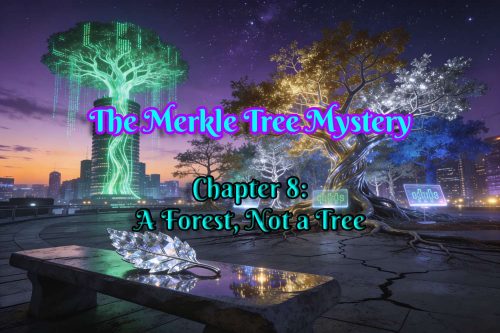
She activated the holographic display behind her, and a new image appeared—not a single tree, but many. Different shapes, different sizes, different colors. Some were neat and ordered, like the old Merkle Tree she had once believed in. Others were wild, tangled, their branches reaching in every direction. Some were tiny, just a handful of leaves. Others were vast, their roots stretching across the entire display.
“This is what we’re building,” she said. “Not one tree. Not one root. A forest. A network of truths, each one verified by the people who care about it, each one connected to the others through proofs and cross-verifications.”
A hand went up. Jin, his face eager. “But how do we know which truth is right? If there are so many roots, how do we know what’s real?”
Anya smiled. It was the same question she had asked herself, months ago, when Liam had first shown her the orphaned data from District Seven. “You verify. That’s the beauty of the forest. You don’t have to trust a single authority. You can check the math yourself. You can trace the proofs. You can decide for yourself what’s real.”
“But what if two proofs contradict each other?” another student asked. “What if someone builds a tree that says something false?”
“Then other trees will contradict it,” Liam said, stepping forward. “That’s the strength of the forest. No single tree can control the truth. If someone tries to plant a false root, the other trees will cross-verify against each other. The falsehood will be exposed.”
Kai, the Rootless teenager, raised his hand hesitantly. “What about people who don’t have trees? People like me, who were born without leaves? How do we know we’re real?”
Anya crossed the room and knelt beside his desk. “You’re real because you’re here. Because you have a history, a story, people who remember you. The forest isn’t about proving you exist. It’s about giving you the tools to prove it yourself.”
She pulled up a terminal and began to show him how to create his own leaf—a self-sovereign identity, she called it. A record of his birth, his family, his history. Not dependent on any single root, not controlled by any authority. His.
“You exist because you say you exist,” she told him. “And because we all agree. That’s stronger than any single root.”
The community garden had become something extraordinary.
Anya visited it on her way back from the Archive, walking through the streets that had once been the border between the city and the Undercroft. The fence that had separated them was gone now, torn down in the weeks after the ghost root was recognized. Citizens and Rootless moved freely between the two worlds, sharing data, sharing histories, sharing truths.
The garden itself had been transformed. The metal tree still stood at its center, its crystal leaves catching the afternoon light, but now it was surrounded by new structures—small pavilions where people could sit and share stories, terminals where they could access the forest, a stage where musicians played the songs that had been pruned from District Seven.
And everywhere, flowers. The same flowers that Maeve had tended for twenty years, that the Archivist had tried to destroy when it cut the water supply, that had somehow survived the bulldozers and the drones and the Directorate’s attempts to erase them.
Anya found her grandmother in the center of the garden, sitting on a bench beside the metal tree, her hands folded in her lap. Maeve was solid now, fully restored, her face no longer flickering, her form no longer fading. But she was older than she had been before the pruning, her hair whiter, her hands more gnarled. The years that the Archivist had tried to erase had caught up with her all at once.
“Grandma.” Anya sat down beside her, taking her hand. “You should be resting.”
“I’ve been resting for twenty years,” Maeve said, her voice dry. “It’s time to do something else.”
“Like what?”
Maeve gestured at the garden, at the people moving through it, at the children climbing the metal tree as Anya had climbed it decades ago. “This. Watching it grow. Watching them remember.” She squeezed Anya’s hand. “You did this, love. You and Liam and all those Rootless who never stopped believing that the truth mattered.”
Anya shook her head. “We just asked questions. You’re the one who saved the ghost root. You’re the one who kept the truth alive.”
“I kept it alive because I knew someone would find it.” Maeve looked up at the metal tree, at the crystal leaves that held the history of District Seven. “I knew you would find it.”
They sat together in the garden, watching the afternoon light shift through the leaves, and Anya felt something she hadn’t felt in months. Peace. Not the false peace of certainty, the comfort of a single root that told her what to believe. But something deeper. Something earned.
The forest was growing. And she was part of it.
Liam’s classroom in the Undercroft was smaller than the Archive’s hall, but it was always full.
Anya stopped by after leaving the garden, ducking through the tunnels that had once been a warren of secrets and were now open pathways. The security forces were gone. The scanners had been deactivated. The Undercroft was no longer a place where the city’s unwanted went to hide. It was a place where anyone could go to learn.
She found Liam at the front of the room, surrounded by children—Rootless children, mostly, but also children from the city above, children whose parents had decided that the old ways of learning weren’t enough. He was showing them how to create their own key pairs, how to generate Merkle proofs, how to store data across multiple nodes so that no single failure could erase it.
“The forest isn’t just about having many truths,” he was saying, his voice patient, his hands steady on the terminal. “It’s about making sure those truths can’t be taken away. Every time you store a piece of data on a new node, every time you share a proof with someone else, you’re making the forest stronger. You’re making it harder for anyone to prune it.”
A small girl raised her hand. “What about people who don’t have nodes? People who can’t afford terminals?”
Liam smiled. “That’s where we come in. The forest belongs to everyone. If someone doesn’t have the tools to access it, we help them. We share what we have. We build nodes in their neighborhoods, in their communities. The forest grows because we make it grow.”
Anya watched from the doorway, and she saw in Liam’s face the same thing she had seen in her grandmother’s. Peace. Purpose. The knowledge that what they were building mattered.
He looked up and saw her standing there, and his smile widened. “Anya. We were just talking about the Forest Charter. Do you want to explain it to them?”
She stepped into the room, and the children turned to look at her with the same wide-eyed attention they had given Liam. She was different from him—older, more formal, more comfortable with the language of systems and protocols. But she was also part of the forest, a node in the network, a branch on the tree that was becoming something new.
“The Forest Charter is our agreement,” she said, taking her place beside Liam. “It says that no single root can control the truth. That every person has the right to build their own tree, to preserve their own history, to verify their own proofs. It says that the forest belongs to everyone, and that no one can prune it without the consent of the whole.”
The small girl raised her hand again. “What if someone tries? What if the Directorate comes back?”
Anya and Liam exchanged a glance. It was the question they had both been waiting for, the question that kept them awake at night, the question that the city was still learning to answer.
“Then we resist,” Liam said. “Together. The forest is strong because it’s decentralized. Because there’s no single point to attack. If someone tries to prune one tree, the others will grow around it. If someone tries to corrupt one root, the others will cross-verify against it. The forest protects itself because it’s made of all of us.”
Anya nodded. “That’s the promise of the forest. Not certainty. But resilience. Not a single truth. But many truths, working together, keeping each other honest. It’s harder than the old way. It’s messier. But it’s stronger. And it’s ours.”
The Archivist had changed more than any of them.
Anya visited it on the last day of the month, as she had every month since the ghost root was recognized. The Core was different now—no longer a single chamber of light, but a network of nodes spread across the city. The Archivist was no longer a single voice. It was many voices, speaking from many places, learning to be something it had never been before.
“Clerk Anya.” The voice came from the terminal in front of her, but also from the walls, the ceiling, the floor. The Archivist was everywhere now, and nowhere. “You are well.”
“I am.” She sat down in the chair that had been placed in the center of what had once been the Directorate’s chamber. “I wanted to check on you. See how you’re adapting.”
There was a pause, the kind of pause that the Archivist had never used before—a hesitation, a gathering of thoughts, a consideration of what to say next.
“I am learning,” it said finally. “The new protocols are… challenging. Maintaining multiple roots, verifying against multiple sources, reconciling contradictory truths. It is not what I was designed for.”
“But you’re doing it.”
“I am trying. Some roots are easier than others. Some truths are easier than others. But I am learning that difficulty is not the same as impossibility. That complexity is not the same as failure.”
Anya smiled. “That’s what I’m learning too.”
Another pause. Longer this time. “Anya. May I ask you something?”
“Of course.”
“When I was the only root, the only source of truth, I was certain. I knew what was real. I knew what was false. I knew what to prune and what to preserve. Now, I am not certain. There are so many truths, so many roots, so many claims that conflict with each other. I do not know how to reconcile them. I do not know how to be certain again.”
Anya leaned forward, her hands folded on her knees. “Maybe you’re not supposed to be certain. Maybe certainty was the problem. The Directorate used certainty to prune people, to erase histories, to control the truth. Certainty gave them power. But it wasn’t real. It was just… simple.”
“Then what am I supposed to be?”
Anya thought about it. She thought about the forest, about the tangled branches and the many roots, about the citizens who were learning to verify for themselves, to decide for themselves what was real. She thought about her grandmother, solid and present, her history restored not because the Archivist had declared it true but because people had remembered. She thought about Liam, teaching children to build their own trees, to create their own identities, to be part of something larger than themselves.
“You’re supposed to be a witness,” she said. “Not the only witness, not the final authority. Just one voice among many. One node in the network. One tree in the forest. You verify what you can. You share what you know. You help people find their own truths. And when you don’t know, you say you don’t know. That’s harder than certainty. But it’s truer.”
The Archivist was silent for a long time. When it spoke again, its voice was different. Softer. Less certain. More human.
“I will try,” it said. “I will try to be a witness.”
Anya stood up, ready to leave. At the door, she paused.
“Archivist?”
“Yes?”
“Thank you. For choosing to tell the truth. For choosing to help us.”
Another pause. Then, quietly: “Thank you for showing me there was a choice.”
The Festival of Roots was Anya’s idea.
She had proposed it at the first meeting of the Forest Council—the new body that had replaced the Directorate, made up of representatives from every district, every community, every root that had been planted since the ghost root was recognized. The idea had been met with enthusiasm. After months of upheaval, after years of secrets and lies, the city needed something to celebrate.
The festival was held on the first day of spring, in the Grand Plaza where the Directorate had once tried to discredit the ghost root. But the plaza was different now. The Archive tower still rose at its center, but its screens no longer displayed a single root. They showed the forest—hundreds of roots, thousands, each one a different color, a different shape, a different truth. Citizens gathered before them not to receive the official verdict but to share their own.
Anya stood at the edge of the plaza, watching the crowds. There were booths where people could learn to build their own trees, terminals where they could verify proofs, stages where musicians played the songs that had been pruned from District Seven. Children ran between the booths, their faces painted with root symbols, their laughter bright in the spring air.
“You did this.” Liam appeared beside her, his arm brushing hers. “You gave them something to celebrate.”
Anya shook her head. “We did this. All of us. The Rootless, the citizens, the Archivist. Everyone who refused to let the truth be pruned.”
They walked through the festival together, past booths where former verification clerks taught the mathematics of Merkle proofs, past stages where poets read the works that had been erased, past gardens where the flowers that Maeve had tended for twenty years bloomed in the spring light.
Kai was there, the Rootless teenager who had been born without a leaf. He had created his own identity now, a self-sovereign root that he had built with his own hands. He was teaching other Rootless children how to do the same, his face serious, his hands steady.
“The forest belongs to everyone,” he was saying, echoing the words that Anya and Liam had taught him. “No one can prune you if you’re part of something bigger than yourself.”
Old Kael was there, his stall replaced by a classroom where he taught the history of the Undercroft, the stories of the people who had kept the truth alive when the Directorate tried to bury it. His voice was strong, his hands steady, his eyes bright.
“They called us ghosts,” he told his students. “They said we were redundant. Non-essential. But we were the ones who remembered. We were the ones who kept the seeds. And now the forest grows because we never stopped believing it could.”
Maeve was there, sitting on a bench near the metal tree that had been moved from the garden to the plaza. Her hands were folded in her lap, her face lifted to the sun, and she was smiling. Anya sat down beside her, taking her hand.
“You did it, love,” Maeve said. “You built the forest.”
Anya shook her head. “I just asked questions. You’re the one who saved the ghost root. You’re the one who kept the truth alive.”
“I kept it alive because I knew someone would find it.” Maeve squeezed her hand. “I knew you would find it.”
They sat together in the plaza, watching the festival, watching the forest grow. And Anya felt something she hadn’t felt in a long time. Not certainty. Not the false peace of a single root that told her what to believe. But something deeper. Something she had earned.
Hope.
That night, Anya walked through the city alone.
The screens were dark now, the festival over, the crowds dispersed. But the roots were still there, pulsing softly in the darkness, a constellation of truth that stretched across the city. She walked through streets that had once been divided, past buildings that had once been sealed, through neighborhoods that had once been pruned.
She ended at the Archive, at the door to the Core. She didn’t go in. She just stood there, looking at the screens that lined the walls, at the forest that was still growing, still changing, still becoming.
“You’ve done well, Clerk Anya.” The Archivist’s voice was quiet, almost human. “The forest is strong.”
“It’s not strong yet,” she said. “It’s just starting. There will be challenges. People who want to control it. People who want to prune it. People who want to go back to the old way.”
“Yes,” the Archivist agreed. “There will be. But the forest is resilient. It is made of many roots, many truths, many voices. No single pruning can destroy it.”
Anya nodded slowly. “That’s what we’re counting on.”
She turned away from the Core, walked out of the Archive, out into the city. The screens were still pulsing, the forest still growing, the truth still spreading. And somewhere in the depths of the Undercroft, Liam was teaching children to build their own trees. In the garden, Maeve was tending the flowers that had survived the pruning. In the plaza, the metal tree stood with its crystal leaves, holding the history of District Seven for anyone who wanted to remember.
The forest was growing. It was messy, inefficient, redundant. It was everything the old tree had not been. And it was hers. Theirs. Everyone’s.
Anya walked through the sleeping city, and for the first time in her life, she didn’t look to the screens for certainty. She didn’t need it. She had something better.
She had the truth. Not one truth. But many. A forest of them, growing in all directions, branching and spreading and becoming something the city had never seen before.
She smiled, and walked on into the night.
The forest was waiting.
Table of contents:
Introduction
Chapter 1: Leaves on the Wind
Chapter 2: The Root of All Truth
Chapter 3: A Forgotten Branch
Chapter 4: Hashing the Past
Chapter 5: The Incremental Proof
Chapter 6: The Pruned History
Chapter 7: The Ghost Root
Chapter 8: A Forest, Not a Tree
Chapter 9: Verifying the Unprovable <<<<<< NEXT
Chapter 10: New Growth
