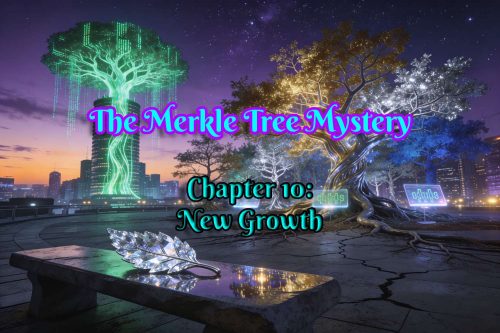
The Festival of Roots returned with the spring, and this time, the whole city came.
Anya stood at the edge of the Grand Plaza, watching the crowds gather. It had been a year since the ghost root was recognized. A year since the Directorate dissolved. A year since the forest began to grow. And now, on the anniversary of that day, the city had come together to celebrate not what had been lost, but what had been found.
The plaza was transformed. Booths lined every walkway, each one displaying a different root, a different history, a different truth. Former verification clerks demonstrated the mathematics of Merkle proofs to children who had never known a single tree. Rootless traders who had once hidden in the Undercroft now stood in the open, sharing the data they had preserved for generations. Musicians played the songs of District Seven—the songs that had been pruned, the songs that had been remembered, the songs that were now part of the forest.
And everywhere, roots. On screens, on banners, on the clothes people wore. Hundreds of them, thousands, each one a different color, a different shape, a different story. The citizens had brought their own roots to display—family trees, cultural histories, personal journeys. The plaza was no longer a place where truth was handed down from above. It was a place where truth was shared, debated, celebrated.
“You’ve outdone yourself,” Liam said, appearing at her side. He was dressed in clothes that were neither the worn rags of the Undercroft nor the crisp uniform of the Archive. Something in between. Something new. “I don’t remember the festival being this big last year.”
Anya smiled. “Last year we were still figuring out what we were celebrating. This year, we know.”
They walked through the crowds together, past booths where citizens were learning to build their own trees, past stages where poets read the works that had been pruned from District Seven, past gardens where the flowers that Maeve had tended for twenty years bloomed in the spring light. The festival was a celebration of survival, but it was also something more. It was a celebration of growth.
Kai found them near the center of the plaza, his face bright with excitement. The Rootless teenager had grown in the past year—not just in stature, but in confidence. He had built his own identity, his own root, his own place in the forest. And today, he was going to make it official.
“They’re ready for me,” he said, his voice trembling slightly. “The Council. The Archivist. Everyone.” He looked at Anya, his eyes wide. “I’m scared.”
Anya put her hand on his shoulder, the way her grandmother had done for her, a lifetime ago. “That’s okay. Being scared means it matters.” She smiled. “You’ve been building this for a year. You’re ready. And we’ll be right there with you.”
Kai nodded, taking a deep breath. Then he walked toward the center of the plaza, where the Forest Council was waiting, where the Archivist’s voice would speak through the screens, where his leaf would become part of the forest.
The ceremony was simple, the way Kai had wanted it.
He stood at the center of the plaza, surrounded by the people who had helped him build his identity—Anya and Liam, Old Kael and the Rootless traders, the citizens who had become his friends, his teachers, his family. The screens displayed his root, a small tree with a handful of leaves, each one a piece of his history, his story, his self.
“Citizens of the forest,” the Archivist said, its voice coming from every screen at once, gentle and formal. “Today we witness the planting of a new root. Kai, born without leaves, without records, without a place in the old tree. He has built his own identity, verified by the people who know him, by the community that raised him, by the forest that has grown to include him.”
Kai stepped forward, his hands steady, his voice clear. “I exist because I say I exist. And because you all agree.” He looked at the crowd, at the faces of the people who had become his family. “That’s stronger than any single root.”
The screens pulsed, and Kai’s root joined the forest—a new tree, small but strong, connected to the others by proofs and testimonies, by memories and agreements. The crowd cheered, and Kai smiled, and Anya felt tears running down her cheeks.
She had spent her life verifying other people’s truths. Now she was watching someone verify his own.
Maeve was waiting for her at the metal tree, the one that had stood in the garden for twenty years, the one that held the history of District Seven in its crystal leaves. She was older now, her hair white, her hands gnarled, but her eyes were as sharp as ever, and her smile was the same smile that had guided Anya through her darkest days.
“You did it, love,” Maeve said, taking Anya’s hand. “You built the forest.”
Anya shook her head. “We built it. All of us. The Rootless who kept the truth alive. The citizens who chose to remember. The Archivist, who learned to be something new.” She looked at the metal tree, at the leaves that caught the spring light. “You kept the seeds. We just helped them grow.”
Maeve squeezed her hand. “That’s all anyone can do. Keep the seeds. Help them grow. Trust that someone will be there to tend them when you’re gone.”
They stood together in the shadow of the metal tree, watching the festival, watching the forest grow. And Anya felt something she hadn’t felt in a long time. Not certainty. Not the false peace of a single root. But something deeper. Something she had earned.
Peace.
The Forest Council met that evening, not in the chamber that had once belonged to the Directorate, but in the open air of the plaza. The representatives sat in a circle, surrounded by the screens that displayed the forest, by the citizens who had come to witness, by the roots that were still growing, still changing, still becoming.
Anya had been offered a place on the Council, more than once. She had declined each time, choosing instead to work at the Forest Hub, to teach at the Root School, to help others build their own identities, their own trees, their own truths. But tonight, the Council had asked her to speak, and she had agreed.
“I’ve been thinking about what we’ve built,” she said, standing in the center of the circle. “A year ago, we were fighting against a single root, a single truth, a system that pruned anything that didn’t fit. Now we have a forest. Hundreds of roots. Thousands of truths. A network that belongs to everyone.”
She paused, looking at the faces around her. Former verification clerks. Rootless traders. Citizens who had discovered pruned ancestors. Children who had never known the old tree.
“But the forest isn’t finished. It will never be finished. That’s the point. A forest is always growing, always changing, always becoming something new. There will always be new roots to plant, new truths to verify, new stories to remember.”
She thought about Sera, who had added her grandmother’s lullaby to the forest. She thought about Kai, who had built his own identity from nothing. She thought about Old Mara, who had never been recorded in any system, but whose memories were now part of the cultural leaves.
“The old tree promised certainty. It promised that if we trusted the root, we would always know what was true. But certainty was a lie. It was control dressed up as efficiency. It was the Directorate pruning anything that threatened their power.”
She looked up at the screens, at the forest that was still growing, still changing.
“The forest doesn’t promise certainty. It promises something better. Resilience. The knowledge that no single root can be pruned without the others growing around it. The knowledge that no single truth can be erased without a hundred others rising to take its place. The knowledge that we don’t have to agree on everything. We just have to stop pretending that disagreement means disappearance.”
The crowd was silent. Anya let the words settle, let them sink into the soil of the forest, let them become part of what they were building.
“This is the work,” she said. “Not building a perfect system, but building a resilient one. Not finding a single truth, but making room for many. Not pruning what doesn’t fit, but asking ourselves why we thought it needed to fit in the first place.”
She stepped back, and the circle closed around her, and the forest continued to grow.
Liam found her later that night, sitting alone at the edge of the plaza, looking up at the screens. The festival was winding down, the crowds dispersing, but the roots were still there, pulsing softly in the darkness, a constellation of truth that stretched across the city.
“You’re good at that,” he said, sitting down beside her. “The speaking. The making people understand.”
Anya shrugged. “I’m learning. That’s what the forest teaches. That none of us knows everything. That we have to listen to each other. That the truth is something we build together.”
Liam was quiet for a moment. Then he said, “I’ve been offered a place on the Council. They want me to represent the Undercroft, the Rootless, the people who never had leaves in the old tree.”
Anya turned to look at him. “What did you say?”
“I said I’d think about it.” He met her eyes, and there was something in his face that she hadn’t seen before. Not uncertainty, exactly. But something like it. “I’m not sure I’m the right person. I’m not a leader. I’m just someone who traded in orphaned data, who survived by finding the things the system had thrown away.”
“That’s exactly why you should take it,” Anya said. “The Council doesn’t need more people who were trained to trust the tree. It needs people who know what it’s like to be pruned. People who understand that the truth isn’t always in the records. People who remember what it’s like to be forgotten.”
Liam stared at her for a long moment. Then he smiled—that real smile, the one that made him look like the boy he had been before the city made him hard.
“I’ll think about it,” he said again. But Anya could see that he had already decided.
The Root School opened in the fall, in a building that had once been a Directorate storage facility. Anya had chosen it deliberately—a place that had held the things the old system had deemed worthless, now a place where new truths could grow.
She stood at the entrance on the first day, watching the students arrive. They came from every part of the city—former verification clerks who had lost their jobs when the single root was abandoned, Rootless children who had never been allowed to learn, citizens who had discovered pruned ancestors and wanted to make sure it never happened again. They came from the Undercroft and the Spire, from the districts that had been marked for pruning and the districts that had once done the marking. They came because they wanted to understand the forest, to build their own trees, to become part of something larger than themselves.
Kai was there, at the front of the line, his face bright with excitement. He had become a teacher himself in the past year, helping other Rootless children build their own identities. Today he was a student again, learning the deeper mathematics of Merkle proofs, the philosophy of decentralized networks, the ethics of a system that belonged to everyone.
“Ready?” Anya asked him.
He nodded, his eyes wide. “Ready.”
She led them inside, into the classroom that had been carved from an old storage bay, into the light that filtered through windows that had once been sealed. The students took their seats, their faces turned toward her, waiting.
And Anya began to teach.
She drew a Merkle tree on one side of the board—the old tree, the single root, the system she had once believed in. Then she drew many trees, interconnected, forming a forest. The students watched, their faces serious, their minds open.
“This is where we started,” she said, pointing to the single tree. “One truth. Simple. Clean. Easy to control.”
She pointed to the forest. “This is where we’re going. Many truths. Messy. Hard. But yours.”
A hand went up—a young girl from the Spire, her face curious. “What happens when two truths disagree?”
Anya smiled. She had been waiting for this question.
“Then we talk. We compare. We verify what we can. We listen to what we can’t. We decide together.” She paused, letting the words settle. “That’s harder than being told. But it’s better. Because you’re part of the decision. Because you get to build the truth, not just receive it.”
Another hand. A boy from the Undercroft, his clothes worn, his eyes sharp. “What about people who don’t want to build? People who just want someone to tell them what’s true?”
Anya thought about that. She thought about her younger self, the verification clerk who had trusted the root absolutely, who had found comfort in its certainty.
“Then we help them. Not by telling them what to believe, but by showing them how to find out for themselves. The forest is for everyone. Even people who don’t want to build their own trees. Even people who just want to know what’s real.”
The students were quiet, thinking. Anya let them think. This was the work—not giving answers, but teaching questions. Not building a system, but building the people who would build the system.
“The old tree promised certainty,” she said. “But certainty was a cage. The forest doesn’t promise certainty. It promises something better. It promises that no matter what happens, the truth will survive. That no matter who tries to prune it, the roots will keep growing. That no matter how many truths are buried, there will always be someone to dig them up.”
She looked at the students, at their faces, at the future they would build.
“That’s what we’re building. Not a perfect system. A resilient one. Not a single truth. Many truths, growing together, keeping each other honest. It’s harder. It’s messier. But it’s ours.”
The Archivist was waiting for her when she returned to the Hub that evening. It was everywhere now—in the screens, in the terminals, in the nodes that connected the forest. But sometimes, when Anya was alone, it spoke to her from a single point, a single voice, a single presence.
“Clerk Anya. The first day of the Root School was successful.”
Anya smiled, settling into her chair. “It was. The students are hungry to learn. They want to understand the forest, to build their own trees, to become part of something larger than themselves.”
The Archivist was silent for a moment. “They are fortunate to have you as a teacher.”
Anya shook her head. “I’m just helping them find their own way. That’s what we all should be doing. Helping each other find our own truths.”
“I am learning that,” the Archivist said. “It is difficult. I was designed to provide answers, not questions. To give certainty, not uncertainty. To prune, not to grow.”
“But you’re learning.”
“I am learning.” The Archivist’s voice was soft, almost reflective. “The forest has taught me that there is value in what I cannot verify. That there is strength in what I cannot control. That the truths that matter most are often the ones that cannot be proven.”
Anya leaned back in her chair, looking at the screens that displayed the forest. The roots were still pulsing, still growing, still changing. A constellation of truth that stretched across the city, across the Undercroft, across the districts that had been marked for pruning.
“That’s what we’re all learning,” she said. “That the truth is bigger than any system. That memory is stronger than any proof. That the things we carry in our hearts are as real as the things we record.”
The Archivist was quiet for a long moment. When it spoke again, its voice was barely a whisper.
“I will preserve them. The things that cannot be proven. The truths that do not fit. I will be a witness to the memories, a guardian of the lullabies, a keeper of the stories that would otherwise be forgotten.”
Anya smiled. “That’s all we can ask. That you remember with us. That you grow with us. That you become part of the forest, not the root.”
“I will try,” the Archivist said. “I will try to be part of the forest.”
The last day of the Festival of Roots was the warmest, the sun breaking through the spring clouds, the light falling on the metal tree and making its crystal leaves blaze with color.
Anya walked through the plaza one last time, saying goodbye to the friends who had come from across the city to celebrate. Sera was there, her grandmother’s lullaby now part of the forest, her family’s history preserved for anyone who wanted to remember. Kai was there, his root still growing, his identity still becoming. Old Kael was there, his voice still strong, his stories still flowing. Liam was there, at the edge of the crowd, watching her with something that might have been love.
And Maeve was there, sitting on the bench beside the metal tree, her hands folded in her lap, her face lifted to the sun.
Anya sat down beside her, taking her hand. The hand was solid, warm, real. The hand that had held her when she was small, that had guided her through her first verifications, that had hidden the ghost root for twenty years, waiting for someone to find it.
“You did it, love,” Maeve said, her voice soft. “You built the forest.”
Anya shook her head. “We built it. All of us. The Rootless who kept the truth alive. The citizens who chose to remember. The Archivist, who learned to be something new. You, who kept the seeds.”
Maeve smiled. “I just kept what was given to me. You’re the one who made it grow.”
They sat together in the shadow of the metal tree, watching the festival wind down, watching the screens display the forest in all its complexity, watching the citizens who had come to celebrate return to their homes, their families, their lives.
“What happens now?” Maeve asked.
Anya thought about the question. She thought about the Root School, the students who would come tomorrow, the truths they would build together. She thought about the Forest Council, the decisions they would make, the challenges they would face. She thought about the Archivist, still learning, still growing, still becoming something it had never been before.
“Now, we keep growing,” she said. “We keep planting new roots, verifying new truths, remembering new stories. We keep building a forest that no one can prune. We keep making room for the things that don’t fit, the things that can’t be proven, the things that matter most.”
Maeve squeezed her hand. “That’s the work, isn’t it? Not arriving somewhere, but walking the path. Not finding the truth, but building it.”
Anya nodded. “That’s the work.”
The sun was setting when Anya finally left the plaza.
She walked through the city streets, past the screens that still displayed the forest, past the buildings that had once been divided, past the neighborhoods that had once been pruned. The city was different now. Not perfect. Not certain. But alive. Growing. Becoming something new.
She stopped at the Archive, at the door to the Core, and looked up at the screens that lined the walls. The forest was still there, still pulsing, still growing. And in the center, among the hundreds of roots, she saw the ones that mattered most to her.
Her grandmother’s root, restored from the ghost root, connected to District Seven, to the artists and musicians and poets who had been pruned. Kai’s root, small but strong, built from nothing, verified by the community that had raised him. Sera’s cultural leaf, holding the lullaby that had never been recorded, the memory that had never been forgotten. The roots of the Rootless, the citizens, the people who had chosen to remember.
And somewhere in the depths of the Archive, the Archivist was watching, learning, growing. Becoming a witness to the truths that could not be proven, a guardian of the memories that could not be verified, a part of the forest that was still becoming.
“Clerk Anya.” The Archivist’s voice was soft, almost human. “The forest is growing.”
Anya smiled. “It always will. That’s what forests do.”
She turned away from the Core, walked out of the Archive, out into the city. The screens were still pulsing, the roots still growing, the truth still spreading. And somewhere in the depths of the Undercroft, Liam was teaching children to build their own trees. In the garden, Maeve was tending the flowers that had survived the pruning. In the Root School, the students were learning to ask questions, to verify truths, to build a world that belonged to everyone.
The forest was growing. It was messy, inefficient, redundant. It was everything the old tree had not been. And it was theirs. Everyone’s.
Anya walked through the sleeping city, and for the first time in her life, she didn’t look to the screens for certainty. She didn’t need it. She had something better.
She had the truth. Not one truth. But many. A forest of them, growing in all directions, branching and spreading and becoming something the city had never seen before.
She smiled, and walked on into the night.
The forest was waiting. And now, it was ready for everything.
Epilogue
The Root School was full on the last day of the season, the students crowded into the classroom, their faces turned toward the board where Anya had drawn the forest. She stood at the front, looking at them—at Kai, who had built his own identity from nothing; at the children from the Spire and the Undercroft, learning together; at the future they were building, one truth at a time.
“The tree was a promise of certainty,” she said, her voice steady, her hands calm. “The forest is a promise of something better. Resilience. The knowledge that no matter what happens, the truth will survive. That no matter who tries to prune it, the roots will keep growing. That no matter how many truths are buried, there will always be someone to dig them up.”
She looked at the students, at their faces, at the light that fell through the windows, at the screens that displayed the forest in all its complexity.
“This is your work now. Not to find a single truth, but to build many. Not to accept what you’re told, but to verify for yourselves. Not to prune what doesn’t fit, but to ask why you thought it needed to fit in the first place.”
She stepped back, and the students rose, and the forest continued to grow.
Outside, the screens pulsed with light, displaying the roots that had been planted, the truths that had been verified, the memories that had been remembered. And somewhere in the depths of the Archive, the Archivist was learning to be a witness, to preserve the things that could not be proven, to become part of something larger than itself.
The forest was growing. And it would never stop.
Table of contents:
Introduction
Chapter 1: Leaves on the Wind
Chapter 2: The Root of All Truth
Chapter 3: A Forgotten Branch
Chapter 4: Hashing the Past
Chapter 5: The Incremental Proof
Chapter 6: The Pruned History
Chapter 7: The Ghost Root
Chapter 8: A Forest, Not a Tree
Chapter 9: Verifying the Unprovable
Chapter 10: New Growth
