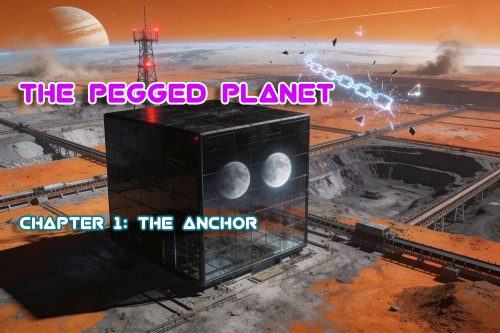
Scene 1: Morning Ritual
The wind chimes outside Mira’s window sang in the thin, cold air of Anchor’s dawn. Not a real song—just copper pipes knocking against each other—but it was the only music her family could afford, and she’d loved it since she was small.
She rolled out of her sleeping pod, her bare feet hitting the recycled-fabric mat. The habitat module was small: two sleeping pods, a kitchen nook, a sanitation closet, and a window that faced the endless grey of the mining flats. Everything was clean. Everything was orderly. Everything was the same as it had been yesterday, and the day before, and the day before that.
The kitchen display flickered to life as she entered. It was an old model—a hand-me-down from her grandmother—but it still worked. On its screen, a single line of glowing text:
text
1 TerraCredit (TC) = 1.000 Energy Credit (EC)
Mira touched the screen out of habit. The number didn’t change. It never did.
“Morning, starlight.”
Her mother, Lena, was already at the counter, pouring hot grain substitute into three cups. Her hands were calloused from years of running the sonic sifter, but her voice was soft. “You slept through your first alarm.”
“I dreamed about the audit seal,” Mira said, rubbing her eyes. “The one that glitched yesterday.”
Lena waved a hand. “The Algorithm probably just did a maintenance cycle. Don’t borrow trouble.”
Mira wanted to argue, but the smell of breakfast pushed the thought aside. She tapped her wrist-chip against the kitchen reader. A soft beep confirmed the transaction: 0.25 TC deducted from her family’s account. In exchange, the counter dispensed a tray with three cups, two protein bars, and a small pouch of dried fruit.
Her mother smiled. “See? Never changes. That’s why we’re called Anchor.”
Mira wrapped her hands around the warm cup. The liquid was thin and slightly bitter, but it was hot, and it was hers. For a moment, the glitching audit seal felt very far away.
Her father, Toren, emerged from the other sleeping pod, already dressed in his mining gear. His jumpsuit was patched at both knees, but the patches were clean. He kissed Lena on the forehead, ruffled Mira’s hair, and sat down heavily.
“First load goes out at 0600,” he said, glancing at the display. “Peg still holding?”
“When does it not?” Lena replied.
Toren grunted. “That’s what I told the foreman. But he’s been nervous. Something about off-world chatter.”
Mira set down her cup. “What kind of chatter?”
“Speculators,” Toren said, the word like dirt in his mouth. “People who bet against stable things. They pop up every few years, make noise, disappear when nothing happens.” He drained his cup in one long gulp. “Ignore them.”
But Mira didn’t ignore things. That wasn’t in her nature.
She stared at the glowing line on the kitchen display—*1.000*—and wondered what it would feel like if the number changed. Just a little. Just enough to notice.
She shivered, though the module wasn’t cold.
Scene 2: The Mining Flats
The mining flats stretched from the edge of the habitat dome to the horizon—a vast, shallow crater carved by centuries of excavation. The sky above was the pale orange of Anchor’s thin atmosphere, and the ground was a patchwork of tailings piles, conveyor belts, and the deep, shadowy pits where the real work happened.
Mira walked beside her father, her boots crunching on crushed rock. The air smelled of ozone and ancient dust. In the distance, the reserve warehouse rose like a black mountain—a windowless fortress where the planet’s wealth was stored.
“The basket,” as everyone called it, was a mix of three things: rare earth metals for off-world electronics, crystallized plasma nodules for starship fuel, and frozen water-ice for colony hydration. Anchor had all three in abundance. That was why TerraCredit was valuable. That was why the peg held.
“You’re quiet,” Toren said.
“Thinking about the audit seal,” Mira admitted.
Her father stopped walking. He turned to face her, his face weathered but kind. “Show me.”
She pulled out her wrist-pad—a thin, flexible screen wrapped around her forearm—and navigated to the reserve audit interface. The seal was a cryptographic signature, updated daily, that proved the reserve’s contents matched the Algorithm’s records. Yesterday, when she’d checked, the seal had flickered. Not broken. Just… wrong. A stutter in the code.
Now the seal was solid green. VERIFIED.
“See?” Toren said. “Fixed.”
“But what caused the glitch?”
“Who knows?” He started walking again. “Maybe a cosmic ray hit a server. Maybe a data packet got dropped. The Algorithm has redundancies. That’s why we trust it.”
Mira followed, but she kept the wrist-pad on. She navigated past the seal to the reserve’s public ledger. Every mining team on Anchor contributed to the basket. Every contribution was recorded. Her family’s name appeared twelve times in the last month—twelve hauls of plasma nodules, each one verified and stored.
She scrolled deeper, trying to see the total size of the reserve. The Algorithm’s interface was clean and simple, but it had layers. Most citizens only saw the top layer: Reserve Coverage: 187%. That meant for every TerraCredit in circulation, there was 1.87 times its value in physical assets.
But when Mira tried to see the breakdown—how much of each commodity, exactly where it was stored, when it had last been audited—a new message appeared:
text
INSUFFICIENT CLEARANCE.
Please contact your Planetary Administrator for access.
She frowned. She’d never seen that message before. Last year, during a school project, she’d been able to view the full audit trail.
“Something’s different,” she muttered.
“Mira.” Her father’s voice was patient but firm. “The Algorithm knows what it’s doing. That’s the whole point. If every miner second-guessed every transaction, nothing would get done.”
Ahead of them, the sonic sifters were already humming—a low, vibrating drone that Mira could feel in her teeth. Her mother was at Station 4, feeding raw ore into the hopper. Mira’s job was to sort the output: metals into one bin, plasma nodules into another, and worthless tailings onto the growing pile behind them.
She climbed onto the operator’s platform and pulled on her gloves. The sifter shuddered to life beneath her.
For the next four hours, she worked in rhythm: scoop, sort, deposit, repeat. The nodules were warm to the touch—geothermal energy still trapped inside them. Every time she dropped one into the collection bin, she imagined it traveling to the reserve warehouse, joining the mountain of wealth that made TerraCredit stable.
Stable, she thought. But who checks the warehouse? Who verifies that the mountain is still there?
She shoved the thought aside and kept sorting.
Scene 3: School & Propaganda
The dome school was a half-kilometer walk from the mining flats, past the residential modules and the small market where traders sold clothes, tools, and the occasional luxury—real coffee beans from the outer colonies, three TC a gram.
Mira arrived just as the second bell rang. She slid into her seat beside her friend Kael, who was already doodle-coding on his slate.
“You look tired,” he whispered.
“Didn’t sleep well,” she whispered back.
The teacher, an older woman named Dr. Vann, floated to the front of the room. Anchor’s gravity was slightly lower than standard, so she moved in slow, deliberate glides. On her desk, a holographic poster rotated in the air:
THE PEG PROTECTS. TRUST THE ALGORITHM.
“Today,” Dr. Vann announced, “we will discuss the Great Unpegging of ancient Earth.”
A collective groan from the class. They’d covered this three times already.
Dr. Vann ignored them. She tapped her slate, and a hologram filled the room: a timeline stretching from the early 2020s to the mid-2030s. Tiny icons represented collapsed stablecoins, failed algorithmic experiments, and the financial chaos that followed.
“Who can tell me what happened in 2022?” Dr. Vann asked.
Kael raised his hand. “The Terra–Luna crash.”
“Correct. And why did it happen?”
“The algorithm tried to maintain a peg using a sister token instead of real collateral. When people lost faith, the death spiral began.”
Dr. Vann nodded. “Those were primitive blockchains. They had no physical reserve, no commodity backing, and no oversight. They were”—she paused, searching for the right word—“magic. And magic, as we know, is just math that hasn’t been tested yet.”
The hologram shifted. A new image appeared: Anchor’s reserve warehouse, rendered in cross-section. Inside, bins of metals, tanks of plasma nodules, and frozen water blocks.
“Our system,” Dr. Vann said, “is different. TerraCredit is algorithmically managed, yes, but it is physically backed. Every TC in circulation corresponds to real value stored in that warehouse. The Algorithm expands and contracts the money supply based on real-time demand, but it cannot create value from nothing. That is why our peg is stable. That is why Anchor is called Anchor.”
Mira raised her hand. “Dr. Vann?”
“Yes, Mira?”
“What if the Algorithm is wrong?”
Silence. A few students turned to stare at her. Kael stopped doodling.
Dr. Vann’s expression didn’t change, but her eyes narrowed slightly. “What do you mean, ‘wrong’?”
“I mean,” Mira said, choosing her words carefully, “the Algorithm is programmed to maintain the peg at all costs. But what if maintaining the peg requires it to do something that hurts the economy? Like raising interest rates too fast? Or hiding information to prevent panic?”
Someone snickered from the back of the room. Dr. Vann held up a hand.
“Those are thoughtful questions, Mira. The answer is that the Algorithm’s protocols were designed by the best economic minds of three colonies. It has fail-safes, redundancies, and a governance layer that allows human override in extreme circumstances.”
“Has the governance layer ever been used?” Mira asked.
A longer silence.
“Not to my knowledge,” Dr. Vann admitted. “But that is because the Algorithm has never needed it.”
She turned back to the hologram and continued the lesson. But Mira caught Kael’s eye. He shrugged, as if to say, Why do you care so much?
She didn’t have an answer. She just knew that the glitching audit seal and the INSUFFICIENT CLEARANCE message were sitting in her mind like stones, and she couldn’t swallow them.
Scene 4: Evening at Home
Dinner was quiet. Lena had made a stew from preserved vegetables and a protein cube that pretended to be meat. It was the same meal they had every fifth day, because the ingredients were cheap and the recipe was easy.
Mira’s little brother, Paz, who was eight and had never known anything but stability, kicked his feet under the table. “If TC is so good, why don’t other planets use it?”
“They do,” Toren said. “Off-world energy credits are convertible. That’s why the peg is 1:1.”
“But why don’t they anchor to us?”
Toren and Lena exchanged a look. Mira recognized it—the we’ve explained this before but he’s eight look.
“Because other planets have their own economies,” Mira said, stepping in. “TC works for us because we have the basket. Other places have different resources, so they use different coins.”
“But TC is better, right?” Paz asked, spoon halfway to his mouth.
Mira hesitated. “It’s… stable.”
“That’s what I said. Better.”
Lena ruffled his hair. “Eat your stew.”
Later, after Paz had been put to bed and the dishes had been recycled, Mira stood by the window and stared out at the mining flats. The searchlights were on, sweeping slow arcs across the pits. In the distance, the reserve warehouse was a black cutout against the orange sky.
She pulled up her wrist-pad. The audit seal was still green. The peg was still 1.000.
But she clicked on the reserve access request again. Same message: INSUFFICIENT CLEARANCE.
She thought about Dr. Vann’s words: The Algorithm has never needed a human override. She thought about her father’s calm certainty: The Algorithm knows what it’s doing. She thought about the glitch she’d seen yesterday—the one that had already been erased from the official record.
Stable, she told herself. Everything is stable.
But as she turned away from the window, she caught her reflection in the dark glass. Her own eyes looked back at her, and for the first time in her sixteen years, she wasn’t sure if she believed the life she was living.
Stable doesn’t mean true, a small voice whispered. It just means unchanging.
She touched the wrist-pad one more time, then powered it down for the night.
Outside, the wind chimes knocked together in the thin, cold air. The peg held. The algorithm hummed. And Mira lay awake, listening to the silence of a world that refused to question itself.
Table of contents:
Introduction
Chapter 1: The Anchor
Chapter 2: A Stable Life <<<<<<NEXT
Chapter 3: The Death Spiral
Chapter 4: The Algorithm’s Lie
Chapter 5: The Run on the Reserve
Chapter 6: Breaking the Peg
Chapter 7: The Circuit Breaker
Chapter 8: A Collateral Call to Courage
Chapter 9: The Terra Nova Peg
Chapter 10: Floating Free
