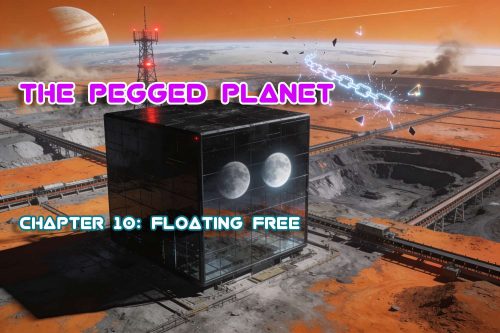
Scene 1: Eli’s Reckoning
The warehouse was quiet at night.
Eli liked it that way. After weeks of crowds and chaos and constant noise, the silence felt like a gift. He sat on an empty cargo crate, his data-slate in his lap, staring at a number he’d been avoiding for days.
Off-world credit balance: 12,400 EC.
It wasn’t the fortune he’d once had—the short position he’d deactivated had been worth hundreds of thousands. But it was real. Liquid. Untouched.
He hadn’t told Mira about it.
During the collateral call, he’d pledged his savings—the 15,000 EC he’d accumulated over three years of speculating. But that wasn’t everything. He’d also held back a safety net. A hidden account, known only to himself. Enough to buy a ship. Enough to leave Anchor. Enough to never look back.
You’re not a hero, he told himself. You’re a survivor. Heroes stay. Survivors run.
But he was still here.
The warehouse door slid open. Mira walked in, her footsteps echoing in the vast space. She was carrying two cups of spiced tea—the same bitter drink she’d bought on the first day of the Terra Nova Peg.
“Kael said I’d find you here,” she said, handing him a cup. “You’ve been avoiding everyone.”
“I’ve been thinking.”
“Dangerous habit.”
Eli smiled—a weak, tired smile. “I have a confession.”
Mira sat beside him. “I’m listening.”
He pulled up his hidden balance on the data-slate. “I didn’t pledge everything. I kept a reserve. An escape fund.”
Mira looked at the number. Her expression didn’t change. “How much?”
“Twelve thousand four hundred EC. Enough to buy a small ship. Enough to leave and never come back.”
“Are you going to?”
Eli was silent for a long moment. He thought about Helix-9. His mother’s death. The years he’d spent profiting from other people’s pain. Then he thought about the town hall, the collateral call, the moment he’d watched Mira pledge her grandfather’s rig.
“No,” he said. “But I thought about it.”
“That’s honest.”
“That’s the problem. I’m not sure I know how to be anything except a survivor. And survivors don’t build. They just… endure.”
Mira took a sip of her tea. “You taught me to read the blockchain. You stood beside me when the Whale attacked. You gave up a fortune to help us start over. That’s not enduring. That’s building.”
“I kept a secret fund.”
“You kept a safety net. There’s a difference.” She set down her cup. “What are you going to do with the money?”
Eli had been asking himself that question for days. Now, finally, he had an answer.
“There are a dozen damaged mining rigs in the equipment sheds. They were abandoned during the crash—people couldn’t afford to repair them. I can buy them cheap, fix them up, and return them to the families who lost them.”
“That’s generous.”
“It’s fair.” Eli stood up. “I came to Anchor to profit from your pain. I can’t undo that. But I can make sure that someone else doesn’t have to lose their rig the way my mother lost her farm.”
Mira stood too. “No interest?”
“No interest. Just a note: ‘Pay it forward.’”
“That’s not how speculators think.”
“I’m not a speculator anymore.” Eli looked at the hidden balance one last time, then closed the account. The funds would transfer to the repair shop in the morning. “I’m just a guy with a data-slate and a lot of guilt.”
Mira touched his arm. “That’s a good start.”
They stood together in the quiet warehouse, surrounded by the collateral that had saved their planet. The plaque on the wall—the one that would be installed tomorrow—was still just a draft. But Eli could already read it in his mind:
Stability is not a promise from above. It is a promise we keep to each other, every single day.
“I’ll stay,” he said. “If you’ll have me.”
“Anchor could use more people who know how to survive,” Mira said. “And maybe a few who are learning how to live.”
Scene 2: The New Normal
Three months later, Anchor was not the same planet—but it was still standing.
The DAO met every week in the converted town hall, now called the Anchor Forum. The meetings were messy. Arguments broke out over interest rates, reserve composition, and the proper definition of “floating band.” Some sessions ended in shouting. A few ended in laughter.
But every meeting ended with a vote. And every vote was recorded, published, and auditable by any citizen with a wrist-pad.
Mira attended as Keeper of the Reserve, but she spoke less than she had during the crisis. The DAO didn’t need a leader. It needed a facilitator. Someone to ask the right questions, not provide the right answers.
“What does the sensor data show?” she’d ask when someone claimed the reserve was shrinking.
“Can we see the raw transaction logs?” she’d ask when someone suspected manipulation.
“Who hasn’t spoken yet?” she’d ask when the same voices dominated the conversation.
The system wasn’t efficient. It wasn’t elegant. But it was transparent, and that made all the difference.
Eli’s Stability School opened in an abandoned warehouse near the mining flats. He taught kids—and a surprising number of adults—how to read the blockchain, how to spot market manipulation, and how to design resilient economic systems.
“The goal isn’t to make you all speculators,” he told his first class. “The goal is to make sure no one can ever lie to you about your money again.”
The class was small: twelve students, ranging in age from fourteen to sixty. But they were attentive. And by the end of the first month, two of them had spotted a minor accounting error in the reserve audit that saved the DAO from a small but embarrassing discrepancy.
Mira’s family slowly rebuilt. Her mother, Lena, still didn’t fully trust the new system. She kept most of her savings in physical goods—dried food, spare parts, a second plasma stove “just in case.” But she no longer argued with Mira about the peg. She even attended a DAO meeting once, though she left halfway through, muttering about “too much talking.”
Her father, Toren, returned to mining with a quiet determination. The secondary sifter—the one Mira hadn’t pledged—was back in operation, pulling plasma nodules from the deep pits. It wasn’t as profitable as before the crash. But it was stable. And stability, Toren had learned, was not a number. It was the ability to keep working, keep hoping, keep showing up.
Paz, now nine, had mostly forgotten the crash. He was more interested in the new pets—a pair of protein chickens that had been pledged during the collateral call and never reclaimed. He named them Peg and Nova.
Governor Rook retired six weeks after the launch of the Terra Nova Peg. His farewell speech was short: “I spent twelve years managing a system I didn’t fully understand. The DAO is not perfect. But it’s honest. And honesty is the only thing that lasts.”
The Whale’s consortium was investigated by off-world regulators following a tip from Eli’s Stability School. The investigation was ongoing, but several of the Whale’s wallets had been frozen. No one expected a full recovery of the stolen assets—but the fact that the Whale was facing consequences was enough to give Anchor a small, collective satisfaction.
And the peg?
The TNC rate had settled at 1.02 EC—slightly above the old 1:1, but comfortably inside the floating band. For the first time in Anchor’s history, the currency was worth more than its peg target. Not because of algorithmic manipulation, but because the community’s collateral had grown.
People were pledging new assets every week. Mining rigs that had been abandoned were repaired and added to the reserve. Water rights that had been hoarded were donated. Even the protein chickens—Peg and Nova—were listed on the registry, though their appraised value was mostly sentimental.
“We’re at 112% coverage,” Mira announced at the weekly DAO meeting. “Higher than the old Algorithm’s lies.”
The room burst into applause.
Scene 3: Final Conversation
The mine at sunset was beautiful—if you knew where to look.
Mira sat on a pile of tailings at the edge of the main pit, her feet dangling over the edge. The sky was a deep orange, streaked with purple clouds. Below her, the mining equipment hummed—not at full capacity, but steadily. Enough.
Eli climbed up beside her, brushing dust from his jacket. He’d been teaching all day and looked exhausted, but his eyes were clear.
“You called the meeting adjourned early,” he said.
“I needed a break.” Mira pulled out a plasma nodule—a small one, warm in her palm. “Sometimes I still can’t believe it worked.”
“It’s still working,” Eli said. “That doesn’t mean it will keep working.”
“You always have to add the warning, don’t you?”
“It’s my job.” He took the nodule from her, turning it over in his hands. “You know this could still fail, right? A bad vote. A coordinated attack. A solar flare that wipes the servers. Any of it could bring us down.”
“Yep.”
“Doesn’t scare you?”
Mira thought about it. Three months ago, that question would have sent a chill down her spine. Now, it felt almost comforting.
“Of course it scares me,” she said. “But the Algorithm promised no fear. That was the lie. Real stability includes fear. And hope. And arguing about water rights at 2 a.m. because someone’s irrigation sensor is glitching.”
Eli laughed—a real laugh, not the bitter one he’d worn when they first met. “That’s the worst economic model I’ve ever heard.”
“It’s ours.”
They sat in silence for a while, watching the sunset paint the mining flats in shades of gold and red. Below them, the reserve warehouse’s new glass walls gleamed—a monument to transparency, open to anyone who wanted to see.
“Do you miss it?” Mira asked. “The old life. Speculating. Never staying in one place.”
Eli took a long time to answer. “I miss not being afraid of attachment. When you’re always leaving, you never have to worry about losing anything. But you also never have anything worth keeping.”
“And now?”
“Now I have a school. And students who argue with me about blockchain protocols. And a planet that might fail tomorrow—but might also succeed.” He looked at her. “And I have a friend who taught me that courage isn’t about not being scared. It’s about being scared and doing it anyway.”
Mira bumped her shoulder against his. “That’s the sappiest thing you’ve ever said.”
“Don’t tell anyone. I have a reputation.”
“Your reputation is that you’re a reformed speculator who once shorted a stablecoin and now teaches old miners how to read transaction logs. I think the sappy ship has sailed.”
Eli groaned. But he was smiling.
Scene 4: Closing Image
The new reserve vault was not a vault at all.
It was a community center—a wide, bright space with glass walls that looked out onto the mining flats. Inside, the collateral was displayed like a museum. Mining rigs stood on pedestals, polished and gleaming. Land deeds were framed on the walls. Water rights were engraved on metal plaques.
And in the center of the room, under a soft spotlight, stood a small wooden table. On it were two objects: a plasma nodule, warm to the touch, and a child’s painting of a coin labeled “My first TC.”
Mira visited the vault every morning before her shift. She didn’t have to—the DAO had hired auditors to monitor the reserve—but she liked the quiet. It reminded her of why she’d fought.
Today, she walked to the far wall, where a new plaque had been installed the night before. The words were engraved in simple, blocky letters—no holograms, no animations. Just the truth:
text
THIS PEG IS NOT GUARANTEED BY AN ALGORITHM.
IT IS GUARANTEED BY 487 FAMILIES WHO CHOSE EACH OTHER OVER CHAOS.

STABILITY IS NOT A PROMISE FROM ABOVE.
IT IS A PROMISE WE KEEP TO EACH OTHER, EVERY SINGLE DAY.

— THE CITIZENS OF ANCHOR
Mira touched the cold metal of the plaque. Her fingers traced the letters. Four hundred eighty-seven families. Her family was one of them. Eli was another. Mrs. Chen. Dr. Vann. The woman with the plasma stove. The old miner named Terak.
All of them. All of us.
She heard footsteps behind her. Her mother, Lena, carrying a basket of fresh bread.
“The baker sent this over. He says it’s for the Keeper.”
Mira took the bread. It was still warm. “He didn’t have to.”
“He wanted to.” Lena looked at the plaque. “Four hundred eighty-seven. That’s more than I thought.”
“It’s less than we need.”
“It’s a start.” Her mother surprised her with a hug. “I’m proud of you. Even when I was angry, I was proud.”
Mira hugged her back. “Thanks, Mom.”
Lena left to deliver the rest of the bread. Mira stood alone in the vault for a moment longer, looking at the collateral, the painting, the plaque.
Then she walked home.
The habitat module was the same as it had always been—small, clean, a little worn. But the kitchen display was different now. Instead of the Algorithm’s flat line, it showed a gentle wave:
text
1 Terra Nova Credit (TNC) = 1.02 Energy Credits (EC)
Floating band: 0.95 – 1.05 EC
Stable didn’t mean still. The line moved. It breathed. It lived.
Paz was at the table, drawing another picture. Peg and Nova, the protein chickens, pecked at crumbs on the floor. Toren was sharpening a tool, his hands steady.
Mira sat down. She pulled out her wrist-pad and checked the DAO agenda for tomorrow’s meeting: *“Discussion: Should we expand the floating band to 0.90-1.10 EC?”*
“Proposal: Add a new validator position for youth representatives.”
“Emergency item: Someone’s chicken got into the reserve warehouse again.”
She smiled. This was stability. Not a perfect, frozen moment—but a living, breathing thing. Messy. Complicated. Theirs.
She set down the wrist-pad and picked up a piece of bread.
“Dinner in twenty,” Lena called from the kitchen.
“I’ll be there,” Mira said.
Outside, the wind chimes sang in the thin, cold air. The peg held—not because a machine forced it to, but because four hundred eighty-seven families had chosen to hold it together.
And that, Mira had learned, was the only kind of stability that ever really lasted.
Table of contents:
Introduction
Chapter 1: The Anchor
Chapter 2: A Stable Life
Chapter 3: The Death Spiral
Chapter 4: The Algorithm’s Lie
Chapter 5: The Run on the Reserve
Chapter 6: Breaking the Peg
Chapter 7: The Circuit Breaker
Chapter 8: A Collateral Call to Courage
Chapter 9: The Terra Nova Peg
Chapter 10: Floating Free
