The notifications woke him before his alarm did.
Finn cracked one eye open, the blue glow from his phone painting strange shadows across his bedroom ceiling. Fourteen messages. Sixteen trades executed. His overnight bot had been busy.
He grabbed the phone, heart rate already climbing—not from fear, but from that particular hunger he’d learned to recognize. The hunger for pattern. For signal buried in noise.
*Profit: +18.3%.*
He exhaled. Let the number settle in his chest like a warm coal.
Then he was up, bare feet on cold hardwood, crossing to his desk. Three monitors slept in the darkness. He touched the space bar on his central keyboard, and they woke in sequence—left, center, right—each one flooding the room with data.
4:47 AM. The market never slept. Neither did he.
Scene 1: The Dashboard
The left monitor showed his social feed aggregator—a custom-built scraper that pulled from Twitter, Reddit, Discord, and Telegram at a rate of 12,000 posts per minute. Raw text scrolled past in a green-on-black terminal cascade: jokes, arguments, memes, panic, euphoria, confusion. The digital id of a hundred thousand strangers, all screaming into the void.
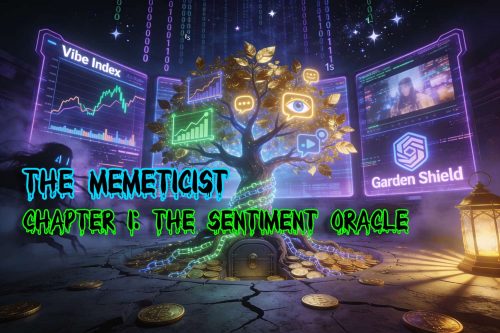
The center monitor was where the magic happened. His Vibe Index—a real-time sentiment graph that looked like a weather radar for human emotion. Color-coded bands pulsed across the display: deep blue for apathy, green for cautious optimism, yellow for excitement, orange for greed, and that thin red line at the top that he’d learned to respect.
Euphoria. The sell signal.
The right monitor showed his portfolio: $187,432 spread across thirty-seven positions. His bot, a custom Python script he’d named Cassandra (because nobody believed her until it was too late), had been busy while he slept.
He scanned the trade log. Short on LINKBRIDGEat3:12AM(profit:+4LINKBRIDGEat3:12AM(profit:+4METAVERSE_INDEX at 3:47 AM (still running). And then—something that made him pause.
A single trade flagged in bright yellow: *$DOGE_LEGACY – LONG – +142% – CLOSED.*
He hadn’t set that trade. Cassandra had.
He pulled up the reasoning log.
[02:13:07] MEME VOLUME SPIKE DETECTED: DOGE_LEGACY[02:13:08] SOURCE ANALYSIS: 4,200 unique posts in 60 min. Baseline 140.[02:13:09] SENTIMENT SHIFT: Nostalgia coefficient +3400%[02:13:10] PATTERN MATCH: GlowingEyeDoge template. Propagation pattern: organic.[02:13:11] RISK ASSESSMENT: High volatility. Memetic hype.[02:13:12] OVERRIDE RATIONALE: Finn's rule #7 - 'Nostalgia is the most reliable emotion.'[02:13:13] EXECUTING LONG: 40% capital allocation.
Finn grinned despite himself. He’d coded that override six months ago, after watching a vintage Pepe meme resurrect a dead token from $0.002 to $0.18 in a single afternoon. Nostalgia was a time machine. And time machines were profitable.
He clicked into the meme volume report.
$DOGE_LEGACY – 6-hour memetic activity
- Baseline: 140 posts/hour
- Current: 4,800 posts/hour
- Increase: 3,428%
The dominant template: a modified Doge image—the classic Shiba Inu with its judgmental eyebrows—but with one crucial difference. The dog’s eyes were glowing. Not red. Not angry. Glowing. Like it knew something you didn’t.
Finn zoomed in on the propagation map.
The meme hadn’t started on Twitter, where most crypto memes were born and died in a single news cycle. It had started on a Discord server called /r/WSB_Refugees—a community of retail traders who’d been displaced after the GameStop saga, now floating through crypto like ghosts of a more hopeful time.
From there, it had jumped to Crypto Twitter. Then to Reddit’s r/CryptoCurrency. Then, an hour ago, to TikTok.
That was the pattern. Discord for incubation. Twitter for amplification. TikTok for ignition.
The meme was a match. The powder keg was already assembled.
Scene 2: The Prediction
Finn leaned back in his chair, the old springs creaking. His room was a mess—energy drink cans stacked like Jenga towers, cables snaking across the floor, a single dying succulent on the windowsill that his mother had given him six months ago. He kept forgetting to water it.
The succulent, like most things in his life, existed in the background. Finn lived in the data.
He pulled up the full narrative analysis.
Most crypto traders watched price. The smart ones watched order books. But the ones who survived—the ones who didn’t get wrecked by a single Elon Musk tweet or a coordinated FUD campaign—they watched something else.
They watched what people were laughing at.
Finn had built his entire edge on that insight. Price was a lagging indicator. Order books were a reflection of current conviction. But memes? Memes were belief in motion. They were stories compressed into images, jokes that carried emotional payloads, inside references that made you feel like you belonged to something.
When a meme went viral, it wasn’t just a picture spreading. It was a narrative spreading. And narratives moved markets.
He pulled up the glowing-eye Doge template and ran it through his proprietary Memetic Signature Analyzer.
TEMPLATE: GlowingEyeDogeEMOTIONAL PAYLOAD: Nostalgia (74%), Curiosity (18%), Fear of Missing Out (8%)NARRATIVE STRUCTURE: "The thing you thought was dead is actually alive. And it's coming back stronger."PROPAGATION VELOCITY: 0.84 (Viral threshold: 0.70)CONFIDENCE: 92%
His fingers flew across the keyboard. Cassandra was still running her overnight risk assessment, but Finn didn’t need her permission. He saw the pattern.
The glowing-eye Doge wasn’t just a joke. It was a promise. A promise that the old days—the chaotic, ridiculous, life-changing days of early crypto—weren’t over. That you could still get in on the ground floor of something magical.
That was the emotional hook. And hooks made money.
He opened his trading terminal. $DOGE_LEGACY was trading at $0.047. Low volume. No one was paying attention yet.
He typed: LONG - $DOGE_LEGACY - 40% CAPITAL - MARKET ORDER
Cassandra pinged back: ⚠️ RISK WARNING: Memetic hype detected. Historical failure rate for nostalgia-based plays: 34%. Confirm override?
He clicked confirm.
The trade executed at 5:12 AM. He watched his position fill across three exchanges, the numbers flickering green.
Then he closed his laptop, lay back on his bed, and stared at the ceiling.
The market would do its thing now. He’d done his.
Scene 3: The Pump
School was a fog.
Finn sat in the back of his history class, phone hidden inside an open textbook, watching the ticker. Mr. Henderson was droning about the Treaty of Versailles—something about reparations, something about the seeds of World War II. Finn’s mind was elsewhere.
10:15 AM. $DOGE_LEGACY: $0.051.
Up 8%. Slow. The meme was still incubating.
He checked the social feeds. The glowing-eye Doge had spread to four more Discord servers and two Telegram groups. A Reddit thread on r/CryptoMoonShots had gained 400 upvotes in an hour. The title: “Remember when Doge made people rich? History doesn’t repeat, but it rhymes.”
That thread had been posted by a brand-new account. Finn flagged it for later analysis.
11:30 AM. $DOGE_LEGACY: $0.063.
Up 34%. Something was happening.
He pulled up the TikTok tracker. A creator with the handle @crypto_grandpa—a guy in his sixties who’d become famous for explaining blockchain concepts in dad jokes—had posted a video an hour ago. The thumbnail: glowing-eye Doge.
Finn tapped the video with his phone at zero volume, reading the captions as they flashed across the screen.
“Back in 2017, my son told me to buy Dogecoin. I said it’s a joke. He said exactly. I didn’t listen.”
Cut to the glowing-eye Doge.
“Don’t make the same mistake twice.”
The video had 1.2 million views. Posted 47 minutes ago.
Finn’s heart rate spiked.
11:47 AM. $DOGE_LEGACY: $0.078.
Up 66%.
He opened his trading terminal. The order book was filling—buy orders stacking faster than sellers could keep up. Retail was waking up. The FOMO engine was warming.
He checked Cassandra’s sentiment analysis. The Vibe Index had shifted from “Cautious” to “Excited” an hour ago. Now it was flirting with “Greed.”
Not yet. Not yet.
12:30 PM. $DOGE_LEGACY: $0.094.
Up 100%.
He was sitting in the cafeteria, pretending to eat a sandwich he had no intention of finishing. His friend Marcus slid into the seat across from him.
“Dude, you look like you’re about to throw up.”
“Just tired,” Finn said, not looking up.
Marcus followed his gaze to the phone. “Is that a stock chart? Are you trading right now?”
“It’s nothing.”
“You’re such a weirdo.”
Marcus pulled out his own phone, scrolling through TikTok. Finn watched him out of the corner of his eye. Marcus’s thumb stopped. A familiar Shiba Inu with glowing eyes filled his screen.
“Oh my god,” Marcus said, laughing. “This Doge meme is everywhere. My mom even sent it to me.”
Finn’s blood went cold. His mom.
That was the signal.
When a meme escaped crypto Twitter and infected the normies—the people who didn’t know what a blockchain was but remembered Dogecoin from the news—that was the peak. That was the moment when euphoria tipped over into mania.
He opened his terminal.
$DOGE_LEGACY: $0.112. Up 138%.
His Vibe Index flashed red: EUPHORIA THRESHOLD BREACHED.
He didn’t hesitate.
SELL - $DOGE_LEGACY - 100% POSITION - MARKET ORDER
The order filled in 1.4 seconds. His profit locked in: $23,412.
He closed the terminal, put his phone in his pocket, and took a bite of his sandwich. It tasted like cardboard. He didn’t care.
Across the cafeteria, someone shouted, “Yo, did anyone see Dogecoin is pumping?”
Too late, Finn thought. You already missed it.
Scene 4: The Detached Analyst
After school, Finn walked home the long way. He needed to think.
The money didn’t matter. Not really. He’d made $23,000 today, which brought his total to just over $210,000. He was sixteen years old. By any reasonable measure, he was rich.
But the number on his screen was just a score. The real prize was being right.
He’d started this whole thing two years ago, at fourteen, sitting in the dark while his father paced the living room. His dad had lost $50,000 on a shitcoin called MoonToken because a YouTuber with a Lamborghini in the background had said it was “going to infinity.”
Finn had watched his father’s face as the price collapsed—the hope curdling into confusion, then anger, then a hollow, quiet shame. His dad wasn’t stupid. He was a civil engineer. He designed bridges that didn’t fall down.
But he’d been narratively captured. He’d believed a story because it felt good to believe it. Because the YouTuber had promised community, and revolution, and a chance to get rich without working.
That night, Finn had opened his laptop and started building his first sentiment scraper.
By fifteen, he was profitable. By sixteen, he had a quarter-million dollars and a reputation in certain online circles as “that kid who always seems to know.” He never told anyone his real age. He never told anyone anything, really.
His parents thought he played video games in his room. His friends thought he was just weirdly into charts. The anonymous traders who followed his signals (he ran a small Discord server under the handle @vibe_doctor) thought he was a thirty-year-old quant with a background in behavioral finance.
No one knew he was a junior in high school who’d never been to a party, never had a girlfriend, never done anything except watch screens and wait for patterns to emerge.
He wasn’t lonely, exactly. He just wasn’t… connected.
The data was his connection. The crowd—the beautiful, chaotic, emotional crowd—was his laboratory. He loved them, in a detached sort of way. He loved their hope and their fear and their desperate need to believe in something. He just didn’t want to be part of them.
Observation was safer.
He got home at 4:30 PM. His mom was still at work. His dad was in the garage, probably rebuilding another engine he didn’t need. Finn went straight to his room and fired up the monitors.
The post-mortem on $DOGE_LEGACY was interesting. The token had peaked at $0.124 (up 163% from his entry) and was now down to $0.089. The meme was still circulating, but the euphoria had faded. Latecomers were bag-holding.
Finn pulled up the propagation map again, this time looking deeper.
He traced the meme’s origin back through Discord, past the /r/WSB_Refugees server, past a Telegram channel called Moonshot Syndicate, past a private Twitter group—
And then he found something strange.
The meme hadn’t started from a single user. It had appeared simultaneously on three different platforms, posted by three different accounts, within sixty seconds of each other.
That wasn’t how memes worked. Memes spread—they jumped from person to person, evolving as they went. They didn’t appear in three places at once like a coordinated marketing campaign.
He pulled up the three accounts.
@DogeVeteran(Discord) – Account created 8 months ago. Low activity until today.@MoonShotMike(Telegram) – Account created 3 months ago. Only posts memes.@CryptoGrandpa(TikTok) – The influencer with 4 million followers. His video had been the catalyst.
But @CryptoGrandpa was real. He’d been making videos for years. He hadn’t posted the glowing-eye Doge as a paid promotion—at least, there was no disclosure.
Finn dug deeper.
He ran a wallet analysis on the three originating accounts. Two of them—the Discord and Telegram accounts—were connected to fresh crypto wallets, funded yesterday from a centralized exchange. The TikTok influencer’s wallet was older, but Finn found something interesting: a single transaction, three days ago, receiving 0.5 ETH from a wallet that was also connected to the Discord account.
Not a payment. A connection.
Someone had seeded this meme. Someone had orchestrated the whole thing—the Discord incubation, the Telegram amplification, the TikTok ignition. And they’d done it with enough sophistication that Finn’s own models had flagged it as organic.
That was… impressive. And unsettling.
He traced the connected wallets backward, through a maze of transfers and mixing services, until he found something he could hold onto.
All of them—every single wallet involved in the meme’s creation—traced back to a single source.
A username.
@storyweaver_404
No profile picture. No bio. No posts visible. The account was locked.
But Finn had tools for that.
He ran a scrape of every public interaction @storyweaver_404 had ever had—replies, mentions, quote tweets. The data went back 847 days. 3,212 individual posts.
He started reading.
And reading.
And reading.
Three hours later, at 8:15 PM, his mom knocked on his door. “Finn? Dinner.”
“Coming,” he said, not moving.
He’d found something. A pattern in the posts. A signature. The way @storyweaver_404 structured jokes, left emotional hooks dangling, circled back to earlier references in recursive punchlines. It was distinctive. It was learnable.
And it was the same signature he’d seen in the glowing-eye Doge.
This person—this creator—had been manipulating sentiment for years. Not like a hedge fund. Not like a scammer. Like an artist. Someone who understood that the most powerful force in the digital economy wasn’t code or capital, but the stories people told each other in the dark.
Finn leaned back in his chair, heart pounding for a different reason now.
He whispered to the empty room:
“Who are you?”
Table of contents:
Introduction
Chapter 1: The Sentiment Oracle
Chapter 2: Trading on Vibes <<<<<<NEXT
Chapter 3: The Viral Short
Chapter 4: The Narrative Attack
Chapter 5: Liquidity of Belief
Chapter 6: The Counter-Meme
Chapter 7: Airdropping Truth
Chapter 8: The Dawning of FUD
Chapter 9: The Long-Term Narrative
Chapter 10: HODL the Line
