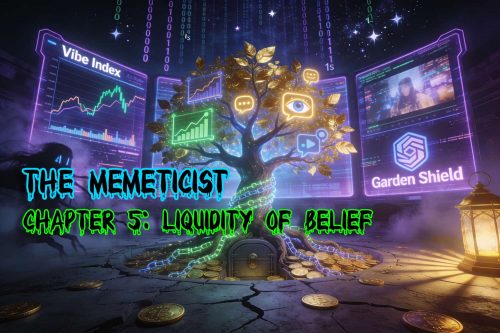
Finn woke to the sound of his phone screaming.
Not ringing—screaming. He’d set up a custom alert for the Vibe Index six months ago, a high-frequency tone that cut through sleep like a surgical scalpel. The tone meant one thing: sentiment collapse in progress.
He grabbed his phone from the nightstand. 5:47 AM. He’d been asleep for ninety minutes.
The Vibe Index for Nexus Protocol had gone from “Neutral” to “Panic” in forty-three minutes.
He was already out of bed and at his desk before his brain fully caught up. The monitors flickered to life. The left screen showed social feeds exploding—thousands of posts per minute, a cascade of fear and confusion. The center screen showed the Vibe Index itself, a line graph that had fallen off a cliff. The right screen showed the price.
NEXUS: $22.40 → $18.10 → $14.60 → $11.30
The numbers were dropping faster than he could process.
He messaged Maya.
Finn: They accelerated. The attack started 14 hours early.
Three dots appeared immediately. She was awake. Of course she was awake.
Maya: I see it. This isn't the same as Aether. They're doing something different.
Finn: Different how?
Maya: Just watch.
Scene 1: The Firehose
Finn watched.
The Alchemist didn’t launch one narrative this time. It launched five.
Simultaneously. Coordinated. Each one targeting a different emotional vulnerability.
Narrative 1: The Insider Betrayal
A screenshot appeared on Twitter, supposedly leaked from a private Discord chat. In the screenshot, a Nexus developer wrote: “The governance vote was rigged. The team enriched themselves. Don’t tell anyone I told you.”
The account that posted it had 40,000 followers and a verified checkmark. Finn checked the account’s history—legitimate influencer, hacked or bought three hours ago.
The narrative: The people you trusted are thieves.
Narrative 2: The Founder’s Secret
A wallet analysis post on Reddit claimed that Nexus’s founder had transferred 500 ETH to a wallet “connected to a known scammer.” The evidence was a series of transactions that looked incriminating if you didn’t understand how mixing services worked.
The narrative: The leader is corrupt.
Narrative 3: The Hidden Backdoor
A developer on GitHub—brand new account, zero history—posted a “vulnerability disclosure” claiming to have found a backdoor in Nexus’s smart contract. The disclosure was technical enough to sound real, vague enough to be unverifiable.
The narrative: The code is a trap.
Narrative 4: The Fake Audit
A PDF began circulating on Telegram. It looked like an audit report from a well-known security firm. The report claimed Nexus had “critical vulnerabilities” and recommended “immediate withdrawal of all funds.”
The narrative: The experts say it’s over.
Narrative 5: The Government Investigation
A news article appeared on a domain that looked like Bloomberg but wasn’t. The headline: “FBI Investigating Nexus Protocol for Securities Violations.” The article quoted “anonymous sources close to the investigation.”
The narrative: The authorities are coming.
Finn stared at the five narratives, each one spreading through a different channel, each one optimized for a different fear. Together, they formed a firehose of doubt. No single narrative had to be convincing. They just had to be overwhelming.
This wasn’t an attack. It was a siege.
Maya called him. He answered.
“You’re seeing it?” she asked. Her voice was tight, controlled, but he could hear the edge underneath.
“I’m seeing it. Five narratives. Five channels. One target.”
“They’re not trying to create one reason to panic. They’re creating no reason to believe. When everything is suspect, nothing is true.”
Finn watched the price drop another dollar. $9.80.
“What do we do?”
“The only thing we can do. We fight each narrative. One by one.”
Scene 2: The Defense
They worked in parallel, like a two-person army.
Maya took the narratives. She was faster at creating counter-memes, counter-narratives, counter-arguments. For the insider betrayal claim, she made a comic called “The Governance Gremlin”—a ridiculous creature that lived in Discord servers and fabricated screenshots. The comic was funny, shareable, and obviously fake. It spread quickly through the communities that still had a sense of humor.
For the founder accusation, she created a side-by-side comparison of the founder’s actual wallet (clean, transparent, visible on-chain for years) and the “connected” wallet (a freshly created address with no history). The comparison was undeniable—if you took the time to look at it.
For the hidden backdoor, she found a real developer—someone she knew from a previous project—and asked them to do a live code review on Twitter Spaces. The developer spent twenty minutes walking through Nexus’s contract, pointing out exactly why the “vulnerability disclosure” was nonsense.
For the fake audit, she posted the real audit report from the actual security firm, along with a thread explaining how to verify signatures and timestamps.
For the FBI investigation, she found the original Bloomberg article from six months ago—about a different protocol entirely—and showed how the Alchemist had edited the headline and reposted it on a lookalike domain.
Each counter took time. Each counter required research, verification, creative energy. And while Maya was building, the Alchemist was flooding.
Finn handled the distribution. He used his bot network to amplify Maya’s counters, pushing them into the same channels where the FUD was spreading. But the Alchemist’s bot swarm was a hundred times larger. Every time Finn boosted a counter-narrative, the Alchemist buried it under a thousand replies of “but what about the audit?” and “where there’s smoke, there’s fire” and “I’m just asking questions.”
It was like fighting a forest fire with a garden hose.
At 7:30 AM, Finn paused to check the price.
NEXUS: $6.40
Down 71% from the morning’s high. The community was bleeding out.
He messaged Maya.
Finn: This isn't working. We're reacting. They're dictating the pace.
Maya: I know. I'm burning out. I've made twelve counters in two hours. My brain is soup.
Finn: Take a break. Five minutes.
Maya: We don't have five minutes.
Finn: Take it anyway. I'll watch the feeds.
He watched. The price kept falling. The narratives kept spreading. The Alchemist’s bots kept flooding.
And somewhere in the chaos, Finn had an idea.
Scene 3: The Pivot
Maya came back online at 7:43 AM.
Maya: Okay. I'm back. What's the plan?
Finn: The plan is broken. We need a new plan.
Maya: I'm listening.
Finn hesitated. The idea was half-formed, risky, maybe stupid. But the current approach was failing. Doing more of the same would just exhaust them faster.
Finn: We're fighting the attack. That's the mistake. We should be fighting the attacker.
Maya: The Alchemist is an algorithm. You can't fight an algorithm.
Finn: No. But you can change how people *see* it.
He explained. The Alchemist’s power came from its anonymity. It was a shadow—faceless, untraceable, impossible to hate or trust or understand. Shadows disappeared when you shone a light on them.
What if they told a story about the Alchemist? Not a conspiracy theory. A narrative. A story that framed the Alchemist not as an all-powerful predator, but as a parasite—something that needed darkness to survive.
Maya was quiet for a long moment.
Maya: You want me to doxx an AI.
Finn: I want you to tell a story that makes people immune to it. The Alchemist's attacks work because people feel alone. They feel like they're the only ones seeing the doubt, the only ones questioning. If we can make people feel *together*—if we can give them a shared story about what's happening—the attack loses its power.
Maya: That's not a counter-meme. That's a meta-meme. A story about stories.
Finn: Can you make it?
Another pause. Then:
Maya: I can try. But I need time. And while I'm making it, the price is still falling. We need to stop the bleeding first.
Finn: How?
Maya: I don't know. You're the numbers person. Find me a way to buy time.
Scene 4: The Theory of Belief Liquidity
Finn closed his eyes and let his mind drift.
He’d been thinking about the Aether crash for days. Trying to understand what had broken. It wasn’t just the price. It was the community’s ability to believe together.
Before the attack, Aether’s community had high belief liquidity. When someone posted a question or a doubt, other community members would verify it quickly. Trust flowed easily between people. Information was shared and checked in real time.
After the attack, the belief liquidity had frozen. No one trusted anyone. Every question was met with suspicion. Every answer was met with “but how do I know you’re not part of the attack?”
That was the Alchemist’s real weapon. It didn’t destroy belief—it froze it. It made people so uncertain that they stopped believing anything at all. And when belief froze, people sold.
Finn opened his eyes and started typing.
Finn: I've got it. The concept.
Maya: Tell me.
Finn: Belief has liquidity. High liquidity means a community can quickly verify claims, update beliefs, and act together. Low liquidity means everyone is stuck in uncertainty, unable to trust anything.
Maya: The Alchemist freezes liquidity.
Finn: Exactly. It doesn't need to convince people of a specific lie. It just needs to make them unsure of *everything.* When you're unsure, you sell.
Maya: So how do we increase liquidity?
Finn: We make the community better at verifying together. Faster. More transparent. More *fun.*
Maya: Fun?
Finn: Yeah. The Alchemist's attacks are exhausting. They're designed to wear people down. The only way to resist exhaustion is to make the alternative *energizing.* We need to turn verification into a game.
Maya didn’t respond immediately. Finn could almost hear her thinking through the silence.
Maya: A game. Like... points for debunking? Leaderboards for fact-checkers?
Finn: Something like that. But simpler. We don't have time to build a platform. We need something we can deploy *now.*
Maya: What if we airdropped tokens to people who verified claims? Not as payment. As *proof.* A badge that said "I helped keep this community honest."
Finn: That could work. The tokens don't need monetary value. They just need *meaning.*
Maya: I can design the badge. A simple image. Something people will want to collect.
Finn: And I can build a verification bot. Something that automatically checks claims against on-chain data and known facts. People can use it to fact-check in real time.
Maya: How fast can you build it?
Finn looked at the clock. 8:15 AM. The price was down to $5.20. They had maybe an hour before the community completely collapsed.
Finn: Fast.
The Race
The next sixty minutes were a blur.
Finn coded. His fingers flew across the keyboard, pulling from libraries he’d built over two years, adapting existing tools for a new purpose. The verification bot was simple: you gave it a claim (a screenshot, a link, a quote), and it returned a confidence score based on on-chain data, known wallet histories, and a database of verified facts.
He called it Veritas—Latin for truth.
Maya designed. The badge was a simple icon: a shield with a checkmark, surrounded by the words “VERIFIED BY COMMUNITY.” She made it in three versions—light mode, dark mode, and a special “Genesis” version for the first hundred verifiers.
While she designed, she also worked on the meta-meme. The story about the Alchemist. She didn’t have time to finish it, but she had the seed: a comic called “The Shadow and the Gardener.” A shadow that could only exist in darkness. A gardener who carried a lantern.
The metaphor was simple. The Alchemist was the shadow. The lantern was verification.
At 9:00 AM, Finn deployed Veritas. He posted it on a new website—a single page with a text box and a “Verify” button. No branding. No explanation. Just a tool.
He messaged the Nexus moderators—the ones who’d received the infographic the day before.
Finn: I built a verification bot. It checks claims against on-chain data. Use it. Share it. Tag me if you find something the bot can't handle.
Within fifteen minutes, the moderators were using Veritas. They were posting screenshots of the bot’s outputs in the community channels. “Claim: Nexus founder transferred funds to scam wallet. VERITAS SAYS: FALSE. Wallet has no connection to founder.”
The verification was slow—each check took thirty seconds—but it was trustworthy. And trust was exactly what the community needed.
At 9:30 AM, the price stopped falling.
NEXUS: $4.80
Down 78%. But stable. The panic selling had slowed.
At 9:45 AM, Maya posted the first version of “The Shadow and the Gardener”—just the first panel, the setup. A dark forest. A shadow moving between the trees. A single lantern in the distance.
The caption: “The shadow thrives in darkness. The gardener carries a light. Which one are you?”
It wasn’t a meme. It wasn’t a counter-narrative. It was an invitation.
At 10:00 AM, the first community member earned a Genesis badge. A moderator named CryptoCatLady had verified seventeen claims in forty-five minutes. Maya airdropped the badge to her wallet.
CryptoCatLady tweeted: “I just got a badge for fact-checking FUD. This is the most satisfying thing I’ve ever done in crypto.”
The tweet got 2,000 retweets in an hour.
The tide was turning.
The Aftermath
By noon, the Nexus price had recovered to $7.20. Not a full recovery—not even close—but a recovery. The community was still shaken, still fractured, but no longer collapsing.
Finn sat back in his chair, exhausted. He’d been awake for thirty-one hours. His eyes burned. His hands ached. His mind was still racing, but his body was demanding rest.
Maya called him.
“We did it,” she said. Her voice was hoarse. She’d been talking on Twitter Spaces for the past two hours, explaining the verification system, answering questions, building trust.
“We slowed them down,” Finn corrected. “We didn’t stop them. The Alchemist is still out there. It’s still profitable. It’s still learning.”
“But we changed something. The community is using Veritas. They’re earning badges. They’re playing the game.”
“The game isn’t over. It’s just started.”
Maya was quiet for a moment. Then: “You called it ‘Liquidity of Belief.’ That’s good. That’s really good. We should write that down. Make it a framework.”
“I already started writing it. A white paper. A guide for communities to defend themselves.”
“Finn…”
“Yeah?”
“Go to sleep. You sound like death.”
“So do you.”
“Fair. But I’m an artist. I’m supposed to sound like death. It’s part of the aesthetic.”
Finn laughed—a real laugh, the first one in days. “Okay. I’ll sleep. But only for four hours. Then we need to plan the next phase.”
“What’s the next phase?”
“We stop defending and start building. The Alchemist is designed for quick strikes. It can’t sustain a long war. So we make the war long.”
“Long-term narrative?”
“Long-term narrative.”
“Go to sleep, Finn.”
“Goodnight, Maya.”
“It’s noon.”
“Goodnight anyway.”
He hung up, closed his laptop, and lay down on his bed. The dying succulent sat on the windowsill, still unwatered. He made a mental note to water it when he woke up.
Then he slept.
Table of contents:
Introduction
Chapter 1: The Sentiment Oracle
Chapter 2: Trading on Vibes
Chapter 3: The Viral Short
Chapter 4: The Narrative Attack
Chapter 5: Liquidity of Belief
Chapter 6: The Counter-Meme <<<<<<NEXT
Chapter 7: Airdropping Truth
Chapter 8: The Dawning of FUD
Chapter 9: The Long-Term Narrative
Chapter 10: HODL the Line
