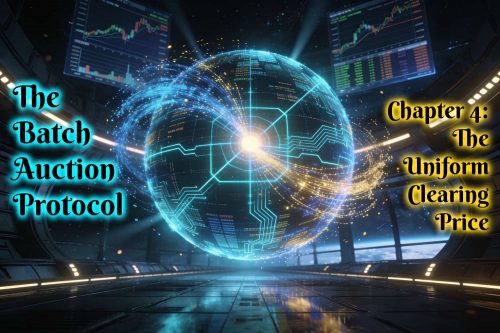
The virtual auction clearinghouse materialized around Ria like a digital cathedral. She’d been invited to observe the settlement process from Arnav’s terminal in the engineering deck, and what she saw took her breath away.
Holographic displays surrounded them on all sides, each one showing a different aspect of the batch auction in progress. The main display dominated the center of the room—a massive, three-dimensional visualization of the order aggregation pool that Arnav had designed to help traders understand the mechanics of the system.
“Welcome to the clearinghouse,” Arnav said, his voice carrying a hint of theatrical pride. “This is where the magic happens.”
Ria stepped closer to the central display, her eyes wide. The visualization was breathtaking—a swirling vortex of blue and gold light, representing the buy and sell orders that had been submitted during the aggregation period. The blue points (buys) clustered on the left side of the display, while the gold points (sells) gathered on the right. Between them, a shimmering line pulsed with energy, shifting and adjusting as the algorithm processed the data.
“This is… incredible,” Ria breathed. “It’s like watching a galaxy being born.”
Arnav grinned. “That’s kind of what it is, actually. A galaxy of market participants, each with their own desires and strategies, all coming together to find a single point of agreement.”
The countdown timer at the top of the display read 00:00:45. Forty-five seconds until the settlement.
“Can you show me how it works?” Ria asked. “I understand the concept, but I want to see the mechanics.”
Arnav nodded, pulling up a secondary display. “Of course. Let me walk you through it.”
He zoomed in on the blue cluster—the buy orders. Each individual point represented a trader who wanted to purchase shares. Hovering over each point revealed the trader’s maximum price, the quantity they wanted, and the time they’d submitted their order.
“This is the demand side of the market,” Arnav explained. “Every trader here is saying, ‘I want to buy shares, and I’m willing to pay up to X credits per share.’ The maximum price varies from trader to trader. Some are willing to pay more than others.”
Ria leaned in, studying the blue points. She could see the variation clearly—some traders had set their maximum price as high as 16.00 credits, while others were more conservative at 14.50. Her own order was somewhere in the middle, a small blue point with a maximum of 15.00.
“Now look at the sell side,” Arnav continued, zooming in on the gold cluster. “These traders are saying, ‘I want to sell shares, and I’m willing to accept as low as Y credits per share.’ Again, the minimum acceptable price varies from trader to trader.”
The gold points were similarly diverse. Some sellers were demanding 15.50 or higher, while others were willing to accept as little as 13.75. The overlap between the two clusters—where a buyer’s maximum met a seller’s minimum—was the key to the entire process.
“The uniform clearing price is the price where the most shares can be exchanged,” Arnav said. “It’s the point where the supply curve and demand curve intersect. At that price, every buyer who is willing to pay that much or more gets their order filled. Every seller who is willing to accept that much or less gets their order filled.”
Ria nodded slowly. “And everyone pays the same price? Even if they were willing to pay more?”
“That’s the beauty of it,” Arnav confirmed. “If you were willing to pay up to 15.00, and the clearing price is 14.72, you pay 14.72. You get a better deal than your maximum. If a seller was willing to accept as little as 14.50, and the clearing price is 14.72, they get 14.72. They get a better deal than their minimum. Everyone wins.”
“But what about the traders who set their limits outside the clearing price?” Ria asked. “What happens to them?”
Arnav zoomed out, showing the full distribution of orders. “If a buyer’s maximum price is below the clearing price, they don’t get their order filled. They weren’t willing to pay enough. If a seller’s minimum price is above the clearing price, they don’t get their order filled. They were demanding too much. The algorithm finds the price that satisfies the most traders while clearing the maximum number of shares.”
The countdown timer read 00:00:10.
“Here we go,” Arnav said, his voice tense with anticipation. “Watch closely.”
The display began to pulse with energy. The blue and gold points started to move, shifting and clustering as the algorithm processed the data. A brilliant line of white light appeared, cutting through the center of the visualization—the emerging clearing price.
“Five seconds,” Arnav announced. “Four. Three. Two. One.”
The display flashed. A massive graphic appeared, filling the entire visualization: SETTLEMENT IN PROGRESS.
Ria held her breath. The algorithm was running, processing all the orders, finding the single price that would maximize the number of shares exchanged. She could see the computational process in real time—the blue and gold points converging, the white line stabilizing, the entire system crystallizing into a single, unified outcome.
Then the display flashed again. A new window appeared, crisp and clear.
SETTLEMENT COMPLETE
UNIFORM CLEARING PRICE: 14.72 CREDITS
SHARES EXECUTED: 1,847
BUY ORDERS FILLED: 23
SELL ORDERS FILLED: 19
Ria stared at the numbers. 14.72. The same price as her first trade. But now she could see the entire picture—all the orders that had gone into making that price possible, all the traders who had participated in the process.
“Look,” Arnav said, pointing to a detailed breakdown of the orders. “Your order is here.”
Ria found her order in the list: RIA_167_TEST: BUY 100 SFE @ MAX 15.00 – FILLED AT 14.72. Next to it were dozens of other orders, each one filled at the same uniform price.
“Every single one of these traders paid the same price,” Arnav said. “No one got a better deal because they were faster. No one got a worse deal because they were slower. Everyone paid exactly the same.”
Ria scrolled through the list, her heart swelling with each entry she read. There were traders who had been willing to pay 15.50, getting their shares at 14.72. Traders who had been willing to pay 14.80, getting their shares at 14.72. Traders who had been willing to pay exactly 14.72, getting their shares at the price they’d specified.
And on the sell side, the same pattern. Sellers who had been willing to accept 14.50 got 14.72. Sellers who had been willing to accept 14.60 got 14.72. Sellers who had been willing to accept 14.72 got exactly what they’d asked for.
“Uniform clearing price,” Ria murmured. “Everyone pays the same. Everyone receives the same. No special treatment. No front-running. No advantages for being faster or better connected.”
“Exactly,” Arnav confirmed. “The system is fair by design. The math doesn’t discriminate. It simply finds the price that clears the market in the most efficient way possible.”
Ria pulled up a comparison between this trade and the last trade she’d made on the continuous market. The difference was stark. On the continuous market, she’d paid 14.75 for shares that were trading at 14.20 when she’d submitted her order. The predator bot had inserted itself into the transaction, buying ahead of her and selling at an inflated price.
In the batch auction, she’d paid 14.72 for shares whose true market value was essentially the same as the clearing price. No one had front-run her. No one had manipulated the price. She’d paid exactly what the market had determined she should pay, based on the collective supply and demand of all participants.
“This is what fairness looks like,” Arnav said, reading her expression. “This is what happens when you take speed out of the equation and let the aggregate decide.”
Ria nodded slowly. “It feels different. I can’t explain it, but it feels… clean. Honest. Like the system is working the way it’s supposed to work.”
“That’s because it is,” Arnav replied. “The continuous market is designed to reward speed above all else. The batch auction is designed to reward fairness above all else. The two systems produce fundamentally different outcomes.”
A new display appeared—a simple table showing the distribution of trades at the clearing price. Ria studied it closely, trying to understand the mechanics at a deeper level.
BUY ORDERS FILLED AT 14.72:
- TRADER A: 500 shares @ MAX 15.50 → 500 @ 14.72
- TRADER B: 200 shares @ MAX 15.00 → 200 @ 14.72
- RIA_167: 100 shares @ MAX 15.00 → 100 @ 14.72
- TRADER D: 150 shares @ MAX 14.80 → 150 @ 14.72
- TRADER E: 50 shares @ MAX 14.72 → 50 @ 14.72
SELL ORDERS FILLED AT 14.72:
- TRADER F: 300 shares @ MIN 14.50 → 300 @ 14.72
- TRADER G: 400 shares @ MIN 14.60 → 400 @ 14.72
- TRADER H: 100 shares @ MIN 14.70 → 100 @ 14.72
- TRADER I: 200 shares @ MIN 14.72 → 200 @ 14.72
Ria noticed something interesting. The buyers with the highest maximum prices weren’t getting better prices than anyone else. Trader A, who’d been willing to pay 15.50, got the same price as Trader E, who’d only been willing to pay 14.72. The same pattern held true for the sellers. The trader willing to accept 14.50 got the same price as the trader holding out for 14.72.
“Everyone gets the same price regardless of their limit,” Ria observed. “That’s what makes it uniform.”
“Exactly,” Arnav said. “The uniform clearing price means that everyone who participates in the batch is treated equally. There’s no discrimination based on how aggressive or conservative you were with your limit. Everyone pays the same price for the same asset in the same time period.”
Ria felt a warmth spreading through her chest. It was satisfaction, she realized. The deep, genuine satisfaction of participating in a system that felt fundamentally right. She’d spent so long fighting against an unfair system that she’d almost forgotten what fairness felt like.
“I think I understand now,” she said slowly. “The uniform clearing price isn’t just a number. It’s a philosophy. It’s the idea that everyone deserves the same deal, regardless of how fast or slow they are, how wealthy or poor, how connected or isolated. We’re all equal in the batch.”
Arnav smiled—a genuine smile that reached his eyes. “That’s exactly right. The uniform clearing price is the embodiment of fairness in the market. It’s the single point where the interests of all participants converge. It’s the closest thing we have to a perfect market.”
Ria turned back to the display, studying the settlement results one more time. The numbers were clear and unambiguous. No hidden fees. No preferential treatment. No last-minute manipulation. Just a clean, transparent transaction where everyone got exactly what they’d bargained for.
“I want to do this again,” she said. “I want to keep trading on the batch auction. I want to see if the fairness holds up over time.”
Arnav nodded. “It will. The math doesn’t change. But we should talk about what happens next.”
Ria looked at him, her expression questioning. “What do you mean?”
“The predator bot,” Arnav said. “It didn’t just disappear. It’s still out there, still analyzing the batch auction, still looking for ways to exploit it. The uniform clearing price makes it impossible to front-run, but that doesn’t mean the bots will give up.”
Ria felt a chill run down her spine. “What else can they do?”
“Lots of things,” Arnav admitted. “They can try to manipulate the clearing price by flooding the batch with orders. They can try to game the timing of their submissions. They can try to collude with other bots to influence the outcome. The batch auction is fair, but it’s not immune to attack.”
Ria squared her shoulders. “Then we’ll fight them. We’ll find ways to defend the system. I’ve been on the losing side of the continuous market for too long. I’m not going to let the bots win here.”
Arnav’s grin returned. “That’s exactly what I was hoping you’d say. Because I have some ideas about how to strengthen the system. And I’m going to need your help to implement them.”
Ria extended her hand. “I’m in. Whatever it takes.”
They shook on it—a simple gesture of mutual trust and shared purpose.
“Welcome to the team,” Arnav said. “Now let’s go build a fairer market.”
Table of contents:
Introduction
Chapter 1: The Continuous Market
Chapter 2: A Front-Running Victim
Chapter 3: The Batch Auction Solution
Chapter 4: The Uniform Clearing Price
Chapter 5: The Order Aggregation <<<<<< NEXT
Chapter 6: The Time-Weighted Batch
Chapter 7: The Priority Queue
Chapter 8: The Manipulation Attempt
Chapter 9: The Periodic Settlement
Chapter 10: Fairness in Batches
