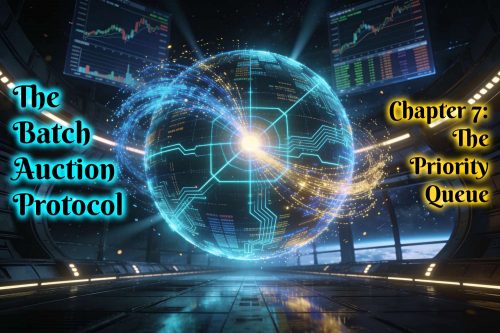
The engineering deck hummed with an intensity that Ria had come to recognize as Arnav’s “deep focus” state. He’d been at it for hours, surrounded by a cocoon of holographic displays that pulsed with cascading streams of data. His fingers moved across multiple virtual keyboards with practiced precision, his eyes darting between screens that Ria could barely comprehend.
She’d brought him nutrient paste and coffee—the station’s synthetic version, bitter and vaguely chemical-tasting—but he’d barely touched either. The food sat forgotten beside his terminal, growing cold as he worked.
“Tell me what you’re seeing,” Ria said, settling into her usual chair.
Arnav didn’t look up immediately. His fingers continued their dance across the keyboards for another thirty seconds, completing a sequence of commands that made several displays shift and reorganize. Then he finally turned to her, his eyes bright with a mixture of exhaustion and excitement.
“The bot has adapted again,” he said. “Just like I predicted. It’s trying a new approach—subtler this time. More sophisticated.”
Ria leaned forward, her heart quickening. “What is it doing?”
Arnav pulled up a new display showing a heat map of order submissions over time. Ria could see the familiar pattern of the bot’s earlier strategy—clusters of orders at the beginning and end of each aggregation period. But superimposed on that pattern was something new: a series of smaller clusters, distributed more evenly across the timeline.
“It’s trying to game the time-weighted mechanism I introduced,” Arnav explained. “Instead of clustering all its orders at the extremes, it’s spreading them out. But the spread isn’t random—it’s carefully calculated to maximize influence while avoiding detection.”
Ria studied the heat map more carefully. The clusters were there, subtle but visible once you knew what to look for. They formed a pattern that was almost rhythmic, like a heartbeat embedded in the flow of orders.
“I see it,” she said. “The clusters are too regular. Too consistent. Real traders don’t submit orders in such perfect patterns.”
“Exactly,” Arnav confirmed. “The bot is trying to mimic natural trading behavior, but it can’t quite manage it. There’s a mechanical quality to its submissions that gives it away.”
Ria felt a surge of frustration. “So we’re back to the same problem. The bot keeps finding new ways to manipulate the system, and we keep having to invent new countermeasures.”
Arnav nodded slowly. “That’s the reality of the situation. The bot is designed to adapt, to evolve, to find weaknesses. We can’t just build one defense and assume it will work forever.”
“Then what do we do?” Ria asked, her voice tinged with despair. “How do we build a system that can’t be beaten?”
Arnav smiled—a knowing smile that suggested he’d been thinking about this very question for a long time.
“We build a system that doesn’t just counter specific attacks,” he said. “We build a system that makes all attacks ineffective. We build a priority queue that’s adaptive, that learns from the bot’s behavior and adjusts its weighting dynamically.”
Ria blinked. “A learning priority queue? That sounds… complicated.”
“It is,” Arnav admitted. “But I’ve been working on the concept for weeks. The idea is to create a priority weighting system that isn’t static. Instead of just flagging orders based on submission time, the system analyzes hundreds of different factors and assigns weights in real time.”
He pulled up a new display showing the architecture of the proposed system. Ria studied it carefully, her mind working to understand the complex web of interconnected modules.
“Here’s how it works,” Arnav continued. “The priority queue monitors every order that comes in. It looks at the submission time, the order size, the price, the account history, the frequency of submissions, the distribution of orders across time, and dozens of other factors. Then it assigns a priority score to each order.”
Ria pointed to a section of the diagram. “What’s this part here? The ‘behavioral analysis module’?”
“That’s the key,” Arnav said, his voice animated with excitement. “The behavioral analysis module compares each order against patterns of known manipulation. It’s not just flagging suspicious orders based on static rules—it’s learning what manipulation looks like and getting better at detecting it over time.”
Ria felt a chill run down her spine. “So the system gets smarter the more the bot attacks it?”
“Exactly,” Arnav confirmed. “Every time the bot tries a new strategy, the priority queue records the characteristics of that strategy and adds them to its detection database. Over time, the system becomes increasingly resistant to manipulation.”
Ria studied the diagram more closely. The behavioral analysis module was complex—more complex than anything she’d seen in the protocol before. But the logic behind it was compelling.
“How do we know it works?” she asked. “Have you tested it?”
Arnav pulled up a new display showing simulation results. “I’ve run over a thousand simulations with different attack patterns. The adaptive priority queue neutralized every single one. Even the most sophisticated attacks were detected and weighted down before they could influence the clearing price.”
Ria scanned the simulation results. The numbers were impressive—a 99.7% reduction in manipulation effectiveness, a 98.2% reduction in price distortion, a near-total elimination of the bot’s ability to profit from its attacks.
“This is incredible,” she breathed. “When can we deploy it?”
Arnav’s expression grew serious. “That’s the complication. The adaptive priority queue requires significant computational resources. It’s not something we can run on the test network—we need access to the main exchange’s processing power.”
Ria’s heart sank. “You mean we need the exchange’s permission.”
“Exactly,” Arnav confirmed. “We can’t deploy this without the exchange’s cooperation. And they’re not exactly thrilled about the batch auction protocol. It threatens their business model—the continuous market generates huge transaction fees, and the batch auction would reduce those fees significantly.”
Ria slumped back in her chair. It felt like they’d hit a wall, a barrier that no amount of clever coding could overcome. The exchange held all the power, and they had no reason to help the very system that would undermine their profits.
“There has to be a way,” she said, her voice desperate. “There has to be something we can do.”
Arnav was quiet for a long moment. Then he spoke, his voice measured and thoughtful.
“There might be. But it’s risky.”
Ria looked up, hope flickering in her chest. “I don’t care about risk. Tell me.”
Arnav turned to face her fully. “The exchange has a public API for testing new protocols. It’s meant for developers who want to build applications that interact with the exchange. The API has limited access to the exchange’s processing power—not enough to run the full adaptive priority queue, but enough to test it on a limited scale.”
Ria nodded slowly. “So we could deploy a scaled-down version. Prove that it works. Build a case for the full deployment.”
“Exactly,” Arnav said. “But there’s a catch. The API is monitored. The exchange will know we’re using it. If they decide we’re violating their terms of service, they could shut us down—and possibly ban us from the exchange entirely.”
Ria considered this. It was a significant risk. If they were banned, they’d lose access to the test network, the simulation tools, everything they’d built. But if they succeeded, they’d have proof that the adaptive priority queue worked—proof that could convince the exchange to adopt the protocol officially.
“What do you think?” she asked. “Is it worth the risk?”
Arnav’s eyes met hers. “I think the batch auction is the most important thing I’ve ever worked on. I think it has the potential to make markets fairer for millions of people. I think the risk is worth taking.”
Ria nodded slowly. “Then let’s do it. Let’s deploy the adaptive priority queue on the API and show the exchange what’s possible.”
Arnav smiled—a determined, resolute smile. “I was hoping you’d say that. I’ve already prepared the deployment package. We can launch it within the hour.”
Ria settled into her chair, preparing to help with the deployment. But Arnav held up a hand.
“Before we do this, I need you to understand something,” he said. “The adaptive priority queue is just the beginning. It’s a proof of concept. If it works, the exchange might adopt it. But they might also fight it. They might try to sabotage it. They might try to discredit us.”
Ria met his gaze steadily. “I understand. But I’ve been fighting the continuous market for months. I’ve lost sleep, lost money, lost hope. The batch auction gave me something back—a sense that fairness is possible. I’m not going to give that up without a fight.”
Arnav nodded slowly. “Then let’s fight together.”
He turned back to his terminal, his fingers flying across the keyboards. Ria watched as the deployment package was prepared, the adaptive priority queue configured for the API environment. It was a scaled-down version of the full system, but it was still powerful—still capable of neutralizing the bot’s attacks.
“Deployment in five minutes,” Arnav announced. “Once it’s live, the next batch will run with the adaptive priority queue enabled.”
Ria felt her heart racing. This was it—the moment of truth. If the adaptive priority queue worked, they’d have proof that the batch auction could be truly secure. If it failed, they’d be back to square one.
The timer counted down. 00:04:00, 00:03:00, 00:02:00, 00:01:00.
“Deploying,” Arnav announced.
The display flashed. A new module appeared in the batch auction interface—the adaptive priority queue, ready to process the next batch of orders.
“The system is live,” Arnav said. “We’ll see the results in the next settlement.”
They waited in tense silence as the aggregation period began. Ria watched the visualization, her eyes tracking the flow of orders into the system. The bot’s orders were there—she could see them, subtle and carefully distributed. But as each order entered the system, the adaptive priority queue analyzed it, assigned a weight, and adjusted its influence accordingly.
“Look,” Arnav said, pointing to a section of the display. “The bot is trying its time-weighted strategy again. But the system is detecting it and reducing the weights.”
Ria watched as the bot’s orders were flagged, their weights reduced. The effect was immediate—the manipulation that would have distorted the clearing price was neutralized before it could take hold.
“The system is learning,” Arnav said, his voice filled with wonder. “It’s detecting patterns I didn’t even program it to detect. It’s adapting in real time.”
Ria felt a surge of hope. This was it—the solution they’d been looking for. A system that could defend itself, that could learn and adapt, that could stay one step ahead of the bots.
The settlement timer counted down. 00:05:00, 00:04:00, 00:03:00, 00:02:00, 00:01:00.
SETTLEMENT COMPLETE
UNIFORM CLEARING PRICE: 14.74 CREDITS
Ria stared at the number. It was perfect—exactly where it should be, based on the underlying market conditions. The bot’s manipulation had been completely neutralized.
“Look at the bot’s execution,” Arnav said, pulling up the data.
ACCOUNT: ALPHA-BOT
ORDER: MULTIPLE (TIME-WEIGHTED ATTEMPT)
WEIGHT: REDUCED (ADAPTIVE DETECTION)
EXECUTION: VARIOUS @ 14.74
RESULT: PROFIT/LOSS = +0.3 CREDITS (NEGLIGIBLE)
Ria’s eyes widened. “It barely made anything. The attack was completely ineffective.”
Arnav nodded, a triumphant smile spreading across his face. “The adaptive priority queue worked perfectly. The bot’s manipulation was neutralized before it could affect the clearing price.”
Ria felt tears prick at her eyes. This was it—the breakthrough they’d been working toward. A system that could defend itself, that could learn and adapt, that could stay one step ahead of the bots.
“We did it,” she breathed. “We actually did it.”
Arnav nodded slowly. “This is just the beginning. But it proves the concept. The adaptive priority queue works. We can build a truly fair market.”
Ria looked at the settlement results one more time. The numbers were clear and unambiguous—the bot had been neutralized, the system had held firm, the market had been fair.
“We need to share this,” she said. “We need to show the exchange what we’ve built. They need to know that the batch auction can be secure.”
Arnav nodded. “I’ll prepare a presentation. We’ll make our case. But we need to be careful—the exchange might not appreciate us using their API for this.”
Ria smiled grimly. “Let them come. We have proof now. Proof that the batch auction works, that it’s fair, that it can resist manipulation. They can’t argue with the results.”
The engineering deck fell silent as the weight of what they’d accomplished settled over them. They’d built something remarkable—something that could change the world.
And they’d only just begun.
Table of contents:
Introduction
Chapter 1: The Continuous Market
Chapter 2: A Front-Running Victim
Chapter 3: The Batch Auction Solution
Chapter 4: The Uniform Clearing Price
Chapter 5: The Order Aggregation
Chapter 6: The Time-Weighted Batch
Chapter 7: The Priority Queue
Chapter 8: The Manipulation Attempt <<<<<< NEXT
Chapter 9: The Periodic Settlement
Chapter 10: Fairness in Batches
