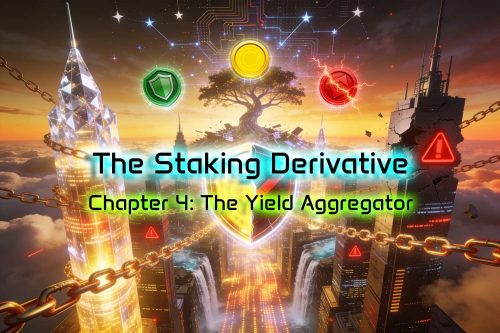
The Hydra Protocol awakened with a hunger that was almost alive.
Dara didn’t know it was happening at first. She was at the clinic, sitting beside her mother’s bed as the second infusion of the new treatment dripped slowly into Elara’s veins. The regenerative agents were working—the doctors had confirmed it that morning. The corrupted cells were retreating, and healthy tissue was beginning to regenerate. Elara’s color was better, her breathing easier.
For the first time in weeks, Dara felt something that might have been hope.
She checked her wrist-comm out of habit, glancing at the derivative token balance. Her eyes widened. The number was higher than it had been yesterday. Significantly higher.
1,247.83 → 1,389.42
“What the—” Dara bit off the exclamation before she could wake her mother. She tapped the token icon, bringing up the Volta Exchange listing, and her breath caught in her throat.
Derivative Token (LSD): 1.11
The discount had vanished. The derivative token was trading at a premium—an 11% premium above the underlying asset. The entire system had been flipped on its head.
Dara stared at the screen, not daring to believe what she was seeing. Her remaining 60% of derivative tokens, which had been worth approximately 700 tokens just yesterday, were now worth over 770 tokens. The value of her holdings had increased by nearly 10% overnight. And the 40% she’d sold to pay for her mother’s treatment—if she’d waited just one more day, she could have sold them for far more.
But she pushed that thought away. Her mother was getting the treatment she needed. That was what mattered. The extra value was just… unexpected.
She checked the exchange again, trying to understand what was happening. The order book was a frenzy of activity. Buy orders stacked high above the current price, each one larger than the last. Sell orders were thin, almost nonexistent. Everyone wanted to buy. No one wanted to sell.
Dara felt a wild, giddy surge of excitement. Her tokens were worth more than she’d ever dreamed. If this continued, she might be able to pay for the entire treatment and still have funds left over for her mother’s recovery. They might even be able to move to a better apartment, one with cleaner air and more space.
She pulled up Sol’s contact and typed a message: What’s happening? The derivative token is trading at a premium. Did something change?
The response came almost instantly: I know! It’s incredible! The Hydra Protocol just integrated with SolVault. They’re buying up all the derivative tokens. This is the future, Dara. We’re making history!
The Hydra Protocol. Dara had heard the name before—a yield aggregator, one of the largest in the Nexus. It was an automated system that scoured the financial landscape for the highest returns, deploying capital across hundreds of different protocols to maximize yield.
And now it had discovered SolVault.
The virtual office of the Hydra Protocol was unlike anything Dara had ever seen.
Where the Agora was classical and the SolVault office was sleek, the Hydra space was a vast, pulsating network of interconnected nodes, each one representing a different protocol or financial instrument. Data streams flowed between the nodes like blood through veins, carrying value from one system to another in a constant cycle of growth and extraction.
Dara’s avatar stood in the center of this digital ecosystem, her head spinning as she tried to comprehend the scale of what she was witnessing. The Hydra Protocol wasn’t just a single entity—it was a collective, a swarm of automated strategies working in concert to extract value from every corner of the financial system.
Sol appeared beside her, his avatar practically vibrating with excitement. “Incredible, isn’t it? The Hydra team reached out to me yesterday. They’ve been monitoring SolVault since launch, and their algorithms identified a yield opportunity that was too good to pass up.”
“What kind of opportunity?” Dara asked, still struggling to process the information.
Sol called up a holographic diagram. The image showed the derivative token on one side and the underlying staked asset on the other. Between them, a complex web of arrows and equations illustrated the flow of value.
“The Hydra Protocol deposits assets into SolVault,” Sol explained, his voice rapid with enthusiasm. “They receive derivative tokens in return. Then they take those derivative tokens and use them as collateral in other protocols to earn additional yield. On top of that, they’re earning the staking rewards from the underlying assets. It’s a triple return strategy—staking rewards, derivative trading, and yield farming all at once.”
Dara studied the diagram, trying to follow the logic. “So they’re getting paid three different ways from the same assets?”
“Exactly!” Sol beamed. “And the more derivative tokens they buy, the higher the demand, and the higher the price. It’s a feedback loop. The Hydra Protocol’s activity is pushing the derivative token to a premium, which attracts even more attention, which drives the price even higher.”
“And that’s good for me?” Dara asked. “Because my tokens are worth more?”
“It’s good for everyone who holds derivative tokens,” Sol confirmed. “You’re seeing the value of your holdings increase in real time. This is the power of financial innovation, Dara. This is what I’ve been working toward.”
Dara watched the data streams flowing between the nodes, the constant pulse of value extraction. It was beautiful in its complexity, almost hypnotic. But something about it made her uneasy. The system seemed too perfect, too efficient. There was no room for error, no margin for unexpected events.
“What happens if something goes wrong?” she asked. “If the Hydra Protocol decides to leave, or if one of their strategies fails—”
“The probability is extremely low,” Sol interrupted smoothly. “The Hydra Protocol is one of the most sophisticated automated systems in the Nexus. Their risk management is second to none. They wouldn’t be here if they didn’t have complete confidence in SolVault.”
“But you said yourself that the market can be unpredictable—”
“Dara.” Sol’s voice was patient, but there was a hint of condescension beneath it. “The derivative token is backed by real, valuable assets. The underlying staking pool is secure. The rewards are real. The premium is a reflection of that value. There’s no reason to worry.”
Dara fell silent, not convinced but lacking the knowledge to argue further. Sol was the expert, after all. He’d created the protocol. He understood the mechanics far better than she did.
Still, the unease lingered, a faint tremor at the edge of her awareness.
Over the following days, the derivative token’s price continued to climb.
Dara watched the Volta Exchange obsessively, tracking every tick of the price. 1.11 became 1.13, then 1.15, then 1.18. The premium grew to nearly 20% above the underlying asset. Her remaining holdings were now worth over 800 tokens—more than she’d ever had in her life.
The clinic visits became easier. Elara’s recovery was steady, the treatment taking hold as the doctors had promised. She was eating more, sleeping better, and the coughing had all but stopped. The color had returned to her cheeks, and she was even starting to joke again, teasing Dara about her constant obsession with the wrist-comm.
“You’re going to wear that thing out,” Elara said one evening, gesturing at Dara’s glowing interface. “What’s so important that you have to check it every five minutes?”
Dara laughed, trying to deflect. “Just my portfolio. It’s doing really well right now.”
“Portfolio?” Elara’s eyebrows rose. “Since when do you have a portfolio?”
“Since I figured out a way to unlock my staked tokens,” Dara admitted. “It’s a new protocol. It’s been working really well.”
Elara studied her for a moment, her eyes sharp despite her illness. “Is it safe? These new protocols can be risky, Dara. I’ve seen the warnings on the data-streams.”
“Sol says it’s completely safe,” Dara assured her. “He’s the creator. He knows what he’s doing.”
“Sol?” Elara’s expression flickered with something Dara couldn’t quite read. “Is that the young man you’ve been talking to?”
“Just about the protocol,” Dara said quickly. “He’s been very helpful.”
Elara didn’t press further, but Dara could see the concern in her mother’s eyes. It was the same look she’d worn when Dara was small and getting into trouble—a mixture of love and worry that had always made Dara feel both comforted and guilty.
Later that night, Dara lay in bed and stared at the ceiling. Her wrist-comm glowed with the latest price: 1.21. The derivative token was at a 21% premium. Her holdings were now worth over 840 tokens. She’d never imagined such wealth.
But the unease was still there, a persistent whisper in the back of her mind. She’d read about bubbles in the financial history lessons at school—periods when asset prices rose far beyond their intrinsic value, driven by speculation and greed. When the bubbles burst, fortunes were destroyed, and everyone who’d been caught up in the excitement was left with nothing.
Was this a bubble? Was the derivative token’s premium sustainable, or was it just a temporary surge driven by the Hydra Protocol’s automated buying?
Dara pulled up the underlying asset price. It hadn’t moved. While the derivative token was trading at a 21% premium, the staked asset itself was exactly where it had been when she’d first minted her tokens. The derivative token had disconnected from its underlying value, floating upward on a tide of speculation.
Dara remembered the Arbitrageur’s words, weeks ago: “The discount exists because there’s a cost to liquidity. People who hold the derivative tokens are providing a service—they’re taking on the risk of the redemption delay, and they’re compensated by buying at a discount.”
If the discount was the cost of liquidity, what was the premium? Was it a reward for taking on risk? Or was it something else—a distortion of the market, a temporary imbalance that would inevitably correct itself?
Dara closed the interface and tried to sleep. But the questions followed her into her dreams, swirling and twisting like the data streams of the Hydra Protocol, pulling her down into a maze of uncertainty.
She saw Sol again at a virtual event hosted by the Hydra Protocol. The space was filled with avatars—traders, investors, and curious onlookers, all drawn by the spectacle of the rising derivative token.
Sol was at the center of the attention, his avatar glowing with confidence as he fielded questions from the audience. Dara stood at the back, watching, trying to understand what was happening.
“The Hydra Protocol’s integration with SolVault has been a resounding success,” Sol announced, his voice carrying across the virtual space. “We’ve demonstrated that liquid staking derivatives can create significant value for users and protocols alike. The premium we’re seeing is a testament to the strength of the underlying system.”
A trader in the front row raised a hand. “What about the risk of a depeg? If the Hydra Protocol’s algorithms identify a better opportunity elsewhere, what happens to the derivative token’s price?”
Sol’s smile didn’t waver. “The Hydra Protocol is committed to long-term value extraction. Their strategies are designed for stability, not short-term gains. And even if they did rebalance their holdings, the derivative token’s value is backed by real assets. There’s no reason for a depeg.”
Another voice from the crowd: “What about the recent volatility in the staking pool? There were rumors of a validator with poor uptime.”
“Rumors are just rumors,” Sol said smoothly. “Our monitoring systems show no signs of any validator misbehavior. The staking pool is as secure as ever.”
Dara listened, her unease growing with every word. Sol was smooth, confident, reassuring—but he was also avoiding the questions. He was presenting the derivative token as a sure thing, a risk-free opportunity. And that, Dara knew from everything she’d read, was a red flag.
She raised her own hand, and Sol’s eyes found her in the crowd. “Yes, Dara? You have a question?”
“Will you ever post a risk disclosure on the SolVault site?” Dara asked. “Something that explains the potential downsides as clearly as the benefits?”
The virtual space went quiet. Sol’s smile flickered—just for a moment, but Dara caught it.
“We already have detailed documentation on the protocol’s mechanics,” Sol said carefully. “Every user has access to that information before they mint.”
“That’s not the same as a risk disclosure,” Dara pressed. “A risk disclosure would tell people what could go wrong. It would be transparent about the downside.”
Sol’s expression hardened slightly. “Dara, I understand your concerns, but SolVault is a cutting-edge protocol. The risks are minimal. Overemphasizing them would only scare users away from a valuable financial tool.”
“Scaring users away might not be a bad thing,” Dara said quietly. “If they can’t handle the risks, they shouldn’t be in the market.”
The crowd murmured. Dara could feel eyes on her—some curious, some hostile, some simply confused. She’d stepped over a line, and she knew it. But the questions needed to be asked.
Sol took a breath, visibly composing himself. “I appreciate your concern,” he said, his voice measured. “And I promise you, the SolVault protocol is as safe as any financial instrument in the Nexus. Now, if there are no more questions, I’d like to move on to the next topic.”
The event continued, but Dara’s focus had shattered. She watched the data streams flowing through the Hydra Protocol’s virtual space, saw the derivative token’s price continuing to climb on the exchange, and felt a cold certainty settling in her chest.
Something was wrong. She didn’t know what, and she didn’t know when it would happen, but she could feel it in her bones.
The derivative token’s premium was a mirage. And when the desert winds of market reality inevitably blew through, the mirage would vanish, leaving behind only the harsh truth beneath.
Dara’s mother was discharged from the clinic three weeks after the treatment began. The doctors were optimistic—Elara’s recovery was proceeding at an exceptional pace, and the cellular degeneration had been halted entirely. With continued monitoring and a healthy lifestyle, she could expect a full recovery.
Dara wept with relief when she heard the news. She held her mother close, burying her face in Elara’s shoulder, and let the tears flow freely. The fear, the worry, the sleepless nights—it was all over. Her mother was going to live.
“Thank you,” Elara whispered, stroking Dara’s hair. “For everything. I don’t know how you managed it, but you saved me.”
“I promised I would,” Dara said, her voice thick with emotion. “I told you I’d find a way.”
They walked home together, arm in arm, through the crowded streets of the Nexus. The air was still thick with the familiar smells of the lower sectors, but it seemed different now—brighter, cleaner, full of possibilities.
When they reached the apartment, Dara helped her mother to the couch and prepared a small celebratory meal. They ate together, talking and laughing, and for the first time in months, the apartment felt like home.
But when Elara finally retired to her room, Dara’s smile faded. She checked her wrist-comm, her hand trembling slightly.
Derivative Token (LSD): 1.28
The premium had grown to 28%. Her holdings were now worth over 900 tokens. More money than she’d ever dreamed of.
And yet.
Dara pulled up the underlying asset price. Still unchanged. Still exactly where it had been when she’d first minted her tokens. The derivative token was floating high above its anchor, tethered by nothing but market sentiment and the Hydra Protocol’s automated buying.
Dara thought about the Arbitrageur. She thought about his cold certainty, his dismissal of her concerns. She thought about the gap between the derivative token’s price and its underlying value—a gap that seemed to grow wider every day.
And then, before she could stop herself, she typed a message to Sol:
I’m worried about the premium. It’s getting too high. What happens when it corrects?
The response came quickly: Don’t worry so much, Dara! This is what success looks like. The market is recognizing the value of the protocol. Enjoy it!
Dara read the message three times. Then she closed the interface and lay back on her bed, staring at the ceiling.
She thought about the financial history she’d studied in school. The bubbles that had inflated and burst, destroying fortunes and lives. The warning signs that had been ignored. The voices that had been silenced.
She looked at her wrist-comm one more time. The derivative token glowed, silver and beautiful, promising wealth and security.
But Dara had learned a hard lesson over the past few weeks. Promises were just words. And financial systems were built on trust—a trust that could evaporate in an instant.
She closed her eyes and tried to sleep. But in her dreams, the derivative token’s price kept rising, higher and higher, until it was a distant star in a dark sky—too bright, too beautiful, too far away to be real.
And somewhere in the darkness, a countdown had begun.
Table of contents:
Introduction
Chapter 1: The Locked Fortune
Chapter 2: A Liquid Staking Token
Chapter 3: The Derivative Discount
Chapter 4: The Yield Aggregator
Chapter 5: The Depeg Panic <<<<<< NEXT
Chapter 6: The Slashing Event
Chapter 7: The Derivative Collapse
Chapter 8: The Underlying Emergency
Chapter 9: The Re-staking Protocol
Chapter 10: Unlocking Value, Unlocking Risk
