The airport was the kind of place where time went to die.
Sam had been there for three hours already, waiting for a connecting flight to the small regional airport that would get him within a day’s walk of Kirema. He’d eaten a stale pretzel, drunk two overpriced coffees, and paced the length of the gate area seventeen times. His phone was at forty-three percent battery, and he had just found an outlet near a pillar when the notifications started.
Not a trickle. A flood.
His phone vibrated so violently it nearly jumped out of his hand. Discord. Twitter. Telegram. Email. A cascade of pings that sounded like a machine gun. He unlocked the screen and the headlines hit him like a physical blow.
CHARITY TOKEN ‘HOPEFORALL’ EXPOSED AS $40 MILLION RUG PULL
FOUNDERS VANISH WITH DONOR FUNDS
CRYPTO CHARITY IN CRISIS: HOW GOOD INTENTIONS BECAME THE BIGGEST SCAM OF THE YEAR
Sam’s thumb trembled as he scrolled.
HopeForAll. He knew them. Everyone knew them. They’d launched six months after Phoenix Coin, raised forty million dollars in three months, promised to build schools in Uganda. Their founder—a guy named Ethan with perfect hair and a better smile than Sam could ever hope for—had been on magazine covers. Forbes 30 Under 30. Crypto’s Conscience. The whole package.
Now Ethan was gone. The wallets were empty. The schools didn’t exist. The photos on their website were stock images, reverse-image-searched by a journalist who’d gotten curious about why the same smiling child appeared in three different countries.
Sam read the exposé with growing horror. The details were damning. HopeForAll’s “transparent treasury” had been a shell. Their “community verification” had been a single intern with a spreadsheet. Their “partnerships” had been forged signatures.
And now every crypto charity was guilty by association.
He scrolled to the comments on the first article:
All crypto charity is a scam.
Phoenix Coin next?
Sam Chen is probably packing his bags right now.
Burn them all.
His phone buzzed with a direct message from a stranger: Where’s our money, fraud?
Another: I donated $500 to Phoenix Coin. Should I call the FBI?
Another: Explain yourself.
Sam’s hands were shaking. He opened the Phoenix Coin dashboard. The treasury graph looked like a cliff. In the two hours since the news broke, donors had withdrawn $180,000. The total treasury had dropped from $420,000 to $240,000. It was still falling. Every refresh brought a lower number.
$235,000.
$228,000.
$219,000.
He thought about Leyla. About the hill pump. About the forty-dollar seal and The Builder’s calloused hand. About the notebook with its blue entries and the seventeen other broken things. If Phoenix Coin collapsed, none of that would get fixed. Not because the money wasn’t there—it was, for now—but because no one would trust it. The collapse of HopeForAll would poison the well for everyone.
The announcement came over the loudspeaker. His flight was boarding.
Sam stood up. His legs felt like they belonged to someone else. He walked toward the gate, phone still buzzing, and showed his boarding pass to the agent. She smiled at him—a generic airport smile—and waved him through.
He found his seat. Window. Last row. He put his bag under the seat in front of him and stared out at the tarmac.
His phone buzzed again. He turned it to airplane mode.
Silence.
The plane taxied. Took off. Climbed through clouds into a sky so blue it looked fake. Sam pressed his forehead against the window and tried to breathe.
All crypto charity is a scam.
He knew he wasn’t a scam. He had sent the money. He had the receipts. The collapsed well wasn’t fraud—it was incompetence, maybe, and naivety, definitely, but not malice. He hadn’t stolen anything. He’d just… failed. Failed to verify. Failed to ask the right questions. Failed to notice that a forty-dollar pump seal mattered more than a ninety-thousand-dollar well.
But the donors didn’t know that. All they saw was another teenage founder, another crypto project, another promise that turned to dust.
Mid-flight, somewhere over an ocean he couldn’t name, Sam opened the notes app on his phone. He stared at the blinking cursor for a long time. Then he wrote:
What if we validated the wrong thing the whole time?
He wrote until his thumb cramped. He wrote about the hill pump and the notebook and the difference between moving money and making change. He wrote about The Builder and the council and the forty-dollar seal. He wrote about a new model, one where verification wasn’t a 20% fee to a distant company but a photo taken by a local mechanic on a cracked phone.
He didn’t know if it would work. He didn’t know if anyone would believe him. But he knew—with a certainty that felt like the first real thing he’d felt in weeks—that he couldn’t go back to the old way.
The old way had built a collapsed well.
The new way would have to be built from scratch.
Four thousand miles away, Leyla watched the same news unfold on the cracked tablet.
The internet café was crowded today—market day, which meant farmers and traders and anyone with something to sell. Leyla had squeezed into a corner, the tablet balanced on her knees, and opened the crypto news site she’d bookmarked after Sam’s first video.
The headline was impossible to miss.
HOPEFORALL RUG PULL: $40M VANISHED
She read the article quickly, then again more slowly. The details were sickening. The founders had cashed out everything three weeks ago, converting the charity’s Ether to a privacy coin that couldn’t be traced. They’d left behind a website, a few fake testimonials, and thousands of donors who had believed they were helping children go to school.
Leyla felt a cold anger settle in her chest. Not at the donors—they had been naive, but not malicious. Not even at the founders, really, though they deserved whatever was coming to them. The anger was at the system. The way it rewarded spectacle over substance. The way a smooth-talking founder with a good website could raise forty million dollars while a village mechanic couldn’t get forty dollars for a pump seal.
She scrolled to the comments. Most were furious. Some were despairing. A few mentioned Phoenix Coin by name.
First Phoenix Coin’s well collapses, now HopeForAll steals everything. Crypto charity is dead.
Sam Chen is probably next. Watch him disappear.
I’m pulling everything I have left.
Leyla closed the article. Opened her messaging app. No new messages from Sam. She checked his last seen—he’d been active hours ago, before the news broke. She typed:
Are you still coming?
No reply.
She waited five minutes. Then ten. The tablet’s battery dropped to twelve percent.
She typed again: Sam. The news. Are you okay?
Nothing.
The café owner tapped her shoulder. “Time’s up.”
Leyla handed back the tablet. Walked outside into the afternoon heat. The village looked the same as always—the market bustling, the children playing, the collapsed well standing like a monument to broken promises. But something felt different. The air was heavier. The future felt shakier.
She walked to the council building. The door was open, and she could hear voices inside. She stood near the window, hidden by a bush, and listened.
“We need to freeze the funds,” the council chair was saying. “Until this blows over.”
“Freeze them how?” someone else asked. “The wallet doesn’t have a freeze function. That’s the point of crypto.”
“Then we don’t spend anything. We tell the village the market is too volatile. We wait.”
“And the well?”
“What well? The last one collapsed. The next one can wait.”
Leyla’s fists clenched. They were going to sit on the money. The $144,000 that remained after VerifyTrust’s cut. The money that could have fixed the hill pump nine hundred times over. They were going to let it sit in a digital wallet while the village boiled river water.
She walked away before she did something she’d regret.
That evening, Leyla sat under the acacia tree with her notebook.
She had added three new blue entries since Sam’s visit. The first was the bridge to the next village—rotting planks, dangerous for children. The second was the school’s roof—leaking in three places. The third was the council’s laptop—broken screen, ironic, but also a barrier to communication.
She looked at the total cost of all ten blue entries: $320.
Three hundred and twenty dollars. That was less than what some donors had spent on a single transaction fee. That was less than what the VerifyTrust agent had charged for a single hour of his time. That was less than what Sam had probably paid for his plane ticket.
And yet none of it would get fixed. Because the money was frozen. Because the council was scared. Because a scam on the other side of the world had poisoned the well of trust for everyone.
Her mother appeared beside her. “You’ve been out here for two hours.”
“I’m thinking.”
“About the boy?”
Leyla looked up. “How do you know about him?”
“Everyone knows. The stranger who came to see the pump. The one who walked through the village with you.” Her mother sat down on the ground next to her. “He left. Did he say when he’d return?”
“He’s coming back. I think. He said he would.”
“And if he doesn’t?”
Leyla closed her notebook. “Then nothing changes. The pump stays broken. The council keeps the money. And we keep boiling water.”
Her mother was quiet for a long moment. Then she said, “You’ve been keeping that notebook for two years. You’ve cataloged every broken thing. You’ve found solutions and prices and people who can do the work. But nothing has changed yet, Leyla. Maybe because you’re waiting for someone else to fix it.”
“I’m not waiting.”
“You’re waiting for Sam. For his money. For his permission.”
Leyla wanted to argue. But her mother wasn’t wrong. She had been waiting. Waiting for the council to act. Waiting for the NGOs to notice. Waiting for a boy with a laptop to understand.
“What else can I do?” Leyla asked. “I don’t have money. I don’t have a platform. I have a notebook and a voice that no one listens to.”
Her mother reached over and touched the notebook. “This is more than most people have. A record of the truth. That matters.”
“Truth doesn’t fix pumps.”
“No. But it finds the people who can.”
They sat together under the acacia tree until the stars came out. Leyla’s phone—the cheap one, screen cracked, held together with tape—buzzed in her pocket.
She pulled it out.
Sam: I’m here.
She stared at the message. Then typed back: Where?
Sam: At the crossroads. The taxi dropped me. I’m walking.
Leyla stood up so fast she nearly dropped her notebook.
Her mother looked at her. “He came?”
“He came.”
“Then go.”
Leyla ran.
The village was dark by the time she reached the edge.
The moon was half-full, casting enough light to see the road. She stood under the acacia tree, the same one where the elders met, and waited. Listened. The night sounds of insects and the occasional goat.
Then she heard footsteps.
A figure emerged from the darkness. Taller than she remembered. Carrying a bag. Walking slowly, like someone who had been traveling for twenty hours and hadn’t slept in at least ten of them.
Sam stopped when he saw her.
“You came,” she said.
He looked different than he had on the video. Thinner. Darker circles under his eyes. His clothes were wrinkled from the flight, and there was a smudge of dirt on his cheek. But his eyes were the same. Certain. Desperate. Hoping.
“I didn’t know what else to do,” he said.
Leyla stepped closer. “Did you see the news?”
“On my phone. At the airport. Before I boarded.”
“Donors are pulling out.”
“I know.”
“The council froze the funds.”
Sam closed his eyes. “I know.”
Leyla waited. She wanted to be angry at him. He had come to her village, seen the problems, promised to help. And now his whole world was collapsing because some骗子 on the other side of the world had ruined everything. But the anger wouldn’t come. All she felt was tired. Tired of waiting. Tired of hoping. Tired of watching good intentions turn to dust.
“Show me,” Sam said.
“Show you what?”
“The pump. The notebook. Everything. Show me again. I need to see it.”
Leyla studied his face. He wasn’t asking because he had forgotten. He was asking because he needed to remember. Because the news and the donors and the collapsing treasury had filled his head with noise, and the only way to clear it was to look at something real.
She turned and started walking.
He followed.
They walked past the market, closed for the night. Past the school, dark and silent. Up the hill to the pump. The moon illuminated the crack in the base, the rusted handle, the dry rot of the missing seal.
Leyla sat down on the rock where she’d sat before. Sam put down his bag and knelt beside the pump.
“Forty dollars,” he said. “Two hours. One mechanic.”
“Yes.”
“The Builder.”
“Yes.”
“And the school tank?”
“Twenty-five dollars. Amina’s uncle. A weld. One hour.”
Sam traced the crack in the pump with his finger. “Ten blue entries. Three hundred and twenty dollars. That’s what you said.”
“That’s what I wrote.”
“And the council has a hundred and forty-four thousand dollars frozen in a wallet.”
“Yes.”
Sam sat back on his heels. Looked up at the moon. “This is insane.”
“You’re just realizing that?”
“No. I mean—” He shook his head. “The system. All of it. We raised three hundred and forty thousand dollars. Three hundred and forty thousand. And the only thing that actually needs fixing right now—the only thing that would actually help real people tonight—costs three hundred and twenty dollars. Less than one percent of what we raised.”
Leyla nodded slowly. “That’s what I’ve been trying to tell you.”
“I know. I just—” Sam put his head in his hands. “I was so focused on the big thing. The well. The ceremony. The transaction. I thought that was what donors wanted. Something big enough to feel like change.”
“And now?”
Sam looked up. His eyes were wet. “Now I think donors want to see a child drink clean water. And they don’t care if it comes from a new well or a forty-dollar repair. They just want it to be real.”
Leyla didn’t say anything. She just sat on the rock and let him think.
The insects sang. The moon moved behind a cloud. Somewhere in the village, a dog barked.
“What do we do?” Sam asked finally.
Leyla opened her notebook. The pages glowed faintly in the moonlight. She flipped to the blue entries.
“We start here,” she said. “We fix the pump. Then the tank. Then the market well. One thing at a time. Small enough to verify. Small enough to trust.”
“And the council?”
“The council can keep their frozen money. We’ll find our own.”
Sam stood up. Brushed the dirt from his knees. “I have twelve thousand dollars left. Personal savings. Not Phoenix treasury. Not donor money. Mine. I can use it.”
Leyla looked at him sharply. “That’s your money.”
“It’s just money. The pump needs a seal.”
She held his gaze for a long moment. Then she nodded. “Tomorrow. We talk to The Builder.”
“Tomorrow,” Sam agreed.
They stood together in the moonlight, two teenagers who had inherited a broken system and were trying to figure out how to build a new one. Sam’s phone was still off. The donor dashboard was still crashing. The headlines were still screaming. But here, on a small hill next to a broken pump, none of that mattered.
What mattered was the forty-dollar seal.
What mattered was tomorrow.
Leyla closed her notebook. “You should sleep. The guest hut is empty.”
“I’m not tired.”
“Liar.”
Sam almost laughed. It was the first time he’d almost laughed in days.
They walked back to the village together. The acacia tree loomed above them, its branches spreading like a roof. Leyla pointed to a small hut near the edge of the clearing.
“That one. There’s a mat. No electricity.”
“Better than the airport.”
Leyla nodded. Then she turned to go.
“Leyla?”
She looked back.
“Thank you,” Sam said. “For not giving up.”
She wanted to say something sharp. Something about how giving up wasn’t an option when the water was still dirty and the pump was still broken. But she was too tired for sharpness.
“Get some sleep,” she said. “Tomorrow, we work.”
She walked home through the dark, her notebook tucked under her arm. The stars were brighter here than anywhere else. She looked up at them and thought about the forty million dollars that had vanished into a scammer’s wallet. She thought about the forty dollars that would fix the hill pump. She thought about the difference between a transaction and a repair.
One was a movement of numbers.
The other was a change in the world.
Tomorrow, she would choose the change.
Table of contents:
Introduction
Chapter 1: The Charity Token
Chapter 2: The Overhead Paradox
Chapter 3: The Transparent Ledger of Need
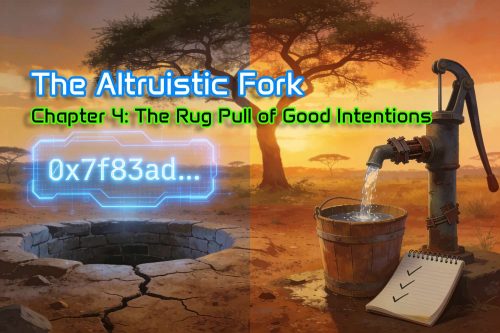
Chapter 4: The Rug Pull of Good Intentions
Chapter 5: Validating Impact <<<<<< NEXT
Chapter 6: The Hard Fork Decision
Chapter 7: Airdropping Agency
Chapter 8: The Return on Integrity
Chapter 9: The DAO of Hope
Chapter 10: Beyond the Transaction
