Sam woke to the sound of a rooster screaming directly outside his window.
For a disorienting moment, he didn’t know where he was. The ceiling was wrong—not the water-stained plaster of his apartment, but rough-hewn wooden beams and a thatched roof. The air smelled different. Smoke. Earth. Something cooking. Then the memories flooded back: the flight, the walk, the pump in the moonlight. Leyla. The notebook.
He sat up on the woven mat. His back ached. His neck ached. Every part of him ached. But the sun was streaming through the open doorway, and somewhere in the village, a woman was singing.
He pulled on yesterday’s clothes—they’d have to do—and stepped outside.
The village was already awake. Children ran past him, laughing. A woman balanced a basket of cassava on her head. The market was setting up, the first vendors spreading their wares on blankets. And there, sitting under the acacia tree with her notebook open on her lap, was Leyla.
She looked up when she saw him. “You slept late.”
“What time is it?”
“Almost seven.” She stood up. “Come on. We have a lot to see.”
The tour started at the collapsed well.
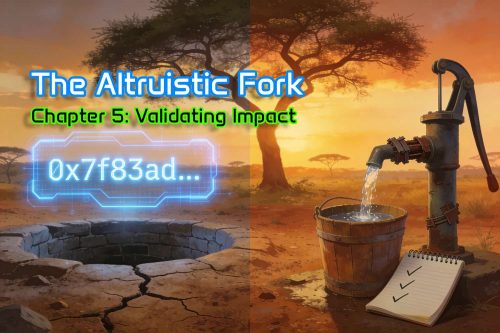
Sam had seen it in satellite images and in VerifyTrust’s photos. But seeing it in person was different. The ground was uneven, cracked like dried mud. The concrete basin had split into three pieces, one of them tilted at a forty-five-degree angle. The pump handle lay nearby, already stripped of anything valuable. A small child had drawn a hopscotch grid in the dust ten feet away, completely unconcerned.
“The council’s nephew built this,” Leyla said. “He’d built one well before. It was for his aunt’s goats.”
Sam knelt down. Touched the cracked concrete. “How much did this cost?”
“Ninety-two thousand dollars. The first Phoenix Coin donation.”
Sam closed his eyes. Ninety-two thousand dollars. His donors’ money. His promise. And this was what it had bought. A hole in the ground and a hopscotch grid.
“We’re not doing that again,” he said.
Leyla nodded. “Good. Now come. The pump is waiting.”
They walked to the hill pump first.
It was exactly as Sam remembered from the photos—the crack in the base, the dry-rotted seal, the handle that turned without moving water. But in the morning light, he could see more details. The rust that had spread from the crack like a disease. The faded stencil on the side that read “GIFT OF THE ROTARY CLUB, 2008.” The grass that had grown up around the base, undisturbed for months.
“This used to work?” Sam asked.
“For ten years. Then the seal cracked. The Rotary Club doesn’t exist anymore. The council said it was ‘legacy infrastructure’ and not a priority.”
“Legacy infrastructure.”
“That’s what they called it. A fancy way of saying ‘we don’t care.'”
Sam pulled out his phone. Took a photo. Then another. Then a close-up of the crack.
“Next,” he said.
The school tank was a fifty-gallon plastic cistern on a concrete stand. It was supposed to collect rainwater from the roof and provide drinking water for three hundred students. Instead, it leaked a steady stream from a crack in the bottom, creating a muddy puddle where mosquitoes bred.
“Amina’s uncle can weld this,” Leyla said. “Plastic welding. He learned it fixing motorcycle fairings. Twenty-five dollars for the rod. One hour of labor.”
Sam took photos. “And the school knows about him?”
“The school knows he exists. They don’t know he can weld plastic. No one asked.”
The market well was the most heartbreaking.
It was a hand pump, old but sturdy, mounted over a deep borehole that had provided clean water for a decade. The handle was broken—a simple metal joint that had snapped under years of use. Without it, the pump was useless. And right across the road, a newer well—the one the council had built after declaring the market well “obsolete”—charged five cents per bucket.
Leyla pointed at the newer well. “The council built that three years ago. It cost eighty thousand dollars. They charge five cents because they say it ‘encourages responsible usage.'”
“And the old well?”
“Fifteen-dollar part. The Builder can install it in twenty minutes. But the council won’t pay for it because they want people to use the new well.”
Sam did the math. “Five cents per bucket. How many buckets a day?”
“A hundred? Maybe more.”
“That’s five dollars a day. A hundred and fifty dollars a month. Almost two thousand dollars a year.”
Leyla nodded. “From a well we already had. A well that worked perfectly until the handle broke.”
Sam took more photos. His camera roll was filling up with broken things.
They passed the path to the river, where erosion had carved a gully that children had to jump across. They passed the generator that powered the internet café, its fuel line clogged with sediment. They passed the council’s laptop, sitting on a desk visible through an open window, its screen cracked diagonally from corner to corner.
“Thirty dollars,” Leyla said, pointing at the laptop. “There’s a repair shop two villages over. But the council won’t pay for it because it’s ‘not in the budget.'”
“The budget is a hundred and forty-four thousand dollars.”
“The budget is frozen.”
Sam stopped walking. He looked around at the village—the broken things everywhere, the solutions within reach, the money sitting useless in a digital wallet. “How many broken things did you say? In total?”
“Twenty-four, last count. Nineteen of them have local solutions. The other five need specialists from outside.”
“Nineteen.”
Leyla opened her notebook. Flipped to the red entries. “Nineteen things that could be fixed by people in this village, with parts and materials that are available locally, for a total cost of—” She did a quick calculation in her head. “Six hundred and eighty dollars.”
Sam stared at her. “Six hundred and eighty dollars.”
“Plus the five that need specialists. That would be more. I don’t have estimates for those.”
“Six hundred and eighty dollars,” Sam repeated. “That’s less than my plane ticket.”
Leyla closed her notebook. “Yes.”
“And we have twelve thousand dollars. My personal savings.”
“Yes.”
“So we could fix everything. All nineteen things. And still have money left over.”
“Yes.”
Sam sat down on a rock. Put his head in his hands. “This is insane. This is completely insane. I raised three hundred and forty thousand dollars. I spent thirty-six thousand on verification. The council has a hundred and forty-four thousand frozen. And the actual cost of fixing everything that’s broken in this village—everything that people actually need—is less than seven hundred dollars.”
Leyla sat down next to him. “You’re starting to understand.”
“The donors thought they were saving lives. They thought they were building wells and digging boreholes and doing big, important things. And they were. But the big, important thing was already here. It just needed a fifteen-dollar part and someone to install it.”
Leyla said nothing. She just let him process.
Sam looked up at the sky. The sun was high now, the heat pressing down on them. A woman walked by carrying a bucket of water from the paid well. She glanced at them curiously but didn’t stop.
“Show me The Builder,” Sam said.
The Builder’s workshop was behind his house, a lean-to of corrugated metal and wooden poles. It smelled of oil and gasoline and hot metal. Tools hung from nails on the wall—wrenches, hammers, screwdrivers, things Sam couldn’t name. In the corner, a motorcycle was disassembled, its engine spread across a tarp.
The Builder himself was a man in his late thirties, with arms that looked like they’d been carved from tree roots. His hands were black with grease, and his face was weathered from years of working outdoors. He was sitting on a wooden crate, eating a piece of bread, when Leyla and Sam appeared.
He looked up. His eyes moved from Leyla to Sam and back. “The coin boy,” he said.
Not hostile. Just factual.
“This is Sam,” Leyla said.
“I know who he is.” The Builder took a bite of bread. Chewed. Swallowed. “The one who sent money to the council. The one whose well collapsed.”
Sam flinched. “That’s… accurate.”
The Builder set down his bread. Wiped his hands on a rag. “Why are you here?”
Sam looked at Leyla. She gave him a small nod.
“Because I was wrong,” Sam said. “I sent money to people who don’t fix things. I should have sent it to people who do. People like you.”
The Builder’s expression didn’t change. “You think I haven’t heard that before? NGOs come. They take photos of me holding a wrench. They write reports about ‘local capacity building.’ Then they leave and nothing changes.”
Leyla stepped forward. “He’s different.”
“How?”
“He came back.”
The Builder looked at Sam. Really looked. The way you look at someone when you’re deciding whether to trust them with something that matters.
“Show me,” The Builder said.
Sam pulled out his phone. Opened his camera roll. Handed the phone to The Builder.
The Builder scrolled through the photos. The collapsed well. The hill pump. The school tank. The market well. The path. The generator. Each one, he studied for a moment, then scrolled to the next.
“You took these today,” he said.
“This morning.”
“And you saw the crack in the pump seal?”
“I saw it.”
“What did you see?”
Sam hesitated. He thought about the right answer—the technical answer, the one that would impress The Builder. But he didn’t know the technical answer. He only knew what he’d seen.
“I saw a problem that could be fixed,” Sam said. “I saw a forty-dollar part and two hours of labor. I saw someone who knows how to do it. And I saw that no one had asked him.”
The Builder handed back the phone. “The seal is twenty-two dollars at the market in town. The rest is labor. I can do it in two hours.”
“I know.”
“You know?”
“Leyla told me. She told me everything. The seal. The tank weld. The market well handle. The path gravel. The generator fuel line. All of it.”
The Builder looked at Leyla. “You showed him the notebook?”
“Every page.”
“And?”
Leyla smiled. A real smile, not the small one from before. “And he wants to fix it. Not with a big project. One thing at a time. Starting with the pump.”
The Builder stood up. Walked to his workbench. Pulled a drawer open and rummaged inside. After a moment, he produced a small rubber seal, still in its packaging. He held it up.
“I bought this three months ago,” he said. “Twenty-two dollars. I was going to fix the pump myself. But the council said I wasn’t ‘authorized.’ That I needed to be on their ‘approved vendor list.’ I don’t even know what that means.”
Sam took the seal. Turned it over in his hands. It was small. Unremarkable. A ring of black rubber that cost less than a pizza.
“How do I get you on the approved vendor list?” Sam asked.
The Builder laughed. A short, sharp sound. “You don’t. The list is for the council’s friends and family. I’m not their friend. I’m not their family. I’m just the man who fixes things.”
“Then we don’t use the list.”
“No?”
“No.” Sam put the seal on the workbench. “What if I sent you forty dollars right now? Not to the council. To you. Directly. And you fix the pump. And you send me a photo of it working. And then anyone in the world can see that photo and know that forty dollars bought clean water.”
The Builder stared at him. “You can do that?”
“It’s just a transaction. I have your wallet address?”
“My what?”
“Your crypto wallet. Where you receive payments.”
The Builder looked at Leyla. She shrugged.
“I don’t have one of those,” The Builder said. “I have a bank account. The one the council doesn’t use because I’m not ‘approved.'”
Sam’s heart sank. Then rose again. “We can fix that. A wallet is just an app on your phone. I can help you set it up.”
“My phone is from 2018. It doesn’t have apps.”
“It has a browser. We can use a web wallet.”
The Builder crossed his arms. “I don’t trust computers. I trust my hands.”
Leyla stepped between them. “What if I managed the wallet for you? For the first few repairs. Until you see how it works.”
The Builder considered this. Looked at Sam. Looked at Leyla. Looked at the pump seal on the workbench.
“One repair,” he said. “The hill pump. You send the money to Leyla. She gives it to me in cash. I fix the pump. If it works, we talk about wallets.”
Sam nodded. “Deal.”
The Builder picked up the seal. Tucked it into his pocket. “Tomorrow morning. Before the heat.”
He walked back to his crate, picked up his bread, and resumed eating. The conversation was over.
Sam and Leyla walked back toward the acacia tree.
“That went better than I expected,” Sam said.
“He doesn’t trust outsiders. But he trusts me.”
“Why?”
“Because I’ve been here. Because I’ve watched him work. Because I wrote down his name when no one else would.”
Sam thought about that. About the notebook. About the blue entries with their names and prices and solutions. About the way Leyla had built a system of record that was more honest than any blockchain.
“You’re not just a cataloger,” Sam said. “You’re the bridge.”
Leyla looked at him. “The bridge?”
“Between the people who need things fixed and the people who can fix them. The council doesn’t talk to The Builder. The donors don’t talk to either of them. But you do. You’re the only one who sees both sides.”
Leyla was quiet for a long moment. Then she said, “I never thought of it that way. I just… wrote things down.”
“You wrote down the right things. That’s more than anyone else did.”
They reached the acacia tree. The afternoon heat was intense, and Sam’s shirt was sticking to his back. He sat down in the shade and pulled out his phone. Opened the notes app.
“What are you doing?” Leyla asked.
“Writing something. A document. A plan.”
“A plan for what?”
Sam looked up at her. “For a hard fork.”
They sat under the acacia tree for three hours.
Leyla’s notebook was open between them. Sam’s phone was propped against a rock, its screen glowing in the shade. He had started a new document—blank except for a title: Phoenix Coin v2: Impact Validation Protocol.
“Tell me everything again,” he said. “Every broken thing. Every solution. Every person who can fix it.”
Leyla flipped through her notebook. “Hill pump. The Builder. Seal. $40. Photo verification: before and after with water flowing.”
“Write that down. The verification method.”
She wrote.
“School tank. Amina’s uncle. Weld. $25. Photo: crack before, sealed after.”
She wrote.
“Market well handle. The Builder. Replacement part. $15. Photo: handle before, attached after.”
She wrote.
They went through all nineteen blue entries. Each time, Sam asked for the same thing: the problem, the fixer, the cost, the proof. By the end, the notebook had a new section—a verification protocol for every repair.
“This is the problem with the old model,” Sam said, pointing at his phone. “We validated the wrong thing. The blockchain validates the transaction. It proves that money moved from point A to point B. But it doesn’t prove that anything changed on the ground.”
Leyla nodded slowly. “You’re saying we need to validate the impact. Not the transfer.”
“Exactly. The hill pump is the proof. The photo of water coming out is the proof. Not the transaction hash. Not the council’s receipt. The actual, physical, undeniable fact that the pump works.”
“And how do we know the photo is real? People can fake photos.”
Sam thought about this. “We need a second verification layer. Not a paid agent. Something cheaper. Something local.”
“The community,” Leyla said.
“What?”
“The people who live here. They know if the pump works. They drink the water. If someone posted a fake photo, they would know. They would say something.”
Sam’s eyes widened. “Community verification. Of course. Why pay a verification company when the people who benefit from the repair are right there? They have the strongest incentive to tell the truth.”
Leyla nodded. “Incentive?”
“If you lie about fixing the pump, the pump stays broken. And you’re the one who has to boil river water. So you don’t lie. You make sure the repair is real.”
Sam was typing furiously now. The document was growing. Sections on verification, on community oversight, on payment release conditions. He was building a new system from scratch, one repair at a time.
“This is a DAO,” he said. “A decentralized autonomous organization. But not like the ones in crypto—the ones that just manage money. This one manages impact. Anyone can propose a task. Anyone can complete a task. The community votes on whether the task was done correctly. Payment releases automatically.”
Leyla read over his shoulder. “And who builds this?”
“I do. I’m a coder. That’s what I do.”
“And who pays for it?”
“We have twelve thousand dollars. My savings. It’s enough to start. Enough to fix the nineteen things. Enough to prove that the model works.”
“And after that?”
Sam looked at her. “After that, we show the donors. We show them the before and after photos. We show them the cost. We show them the community votes. And we ask them: Is this worth more than a 98% efficiency number that meant nothing?”
Leyla leaned back against the tree. The sun was beginning to set, painting the sky in shades of orange and purple. The village was winding down—people heading home, children being called inside, the market folding up its blankets.
“You’re really going to do this,” she said. “A hard fork. Not of the software. Of everything.”
“I don’t know how else to fix it. The old model is broken. The council is frozen. The donors don’t trust anyone. The only way forward is to build something new. Something that validates the right thing.”
“And what is the right thing?”
Sam picked up Leyla’s notebook. Held it in both hands.
“This,” he said. “This is the right thing. A record of need. A record of solutions. A record of the people who can fix things. The blockchain doesn’t know any of this. The blockchain only knows transactions. But this—” He tapped the cover. “This knows the truth.”
Leyla took the notebook back. Held it against her chest.
“Then we build it,” she said. “Together.”
“Together.”
They sat in silence as the stars came out. The insects sang. The acacia tree’s leaves rustled in the evening breeze. Somewhere in the village, a woman was singing the same song Sam had heard that morning. The world was broken in a thousand small ways. But for the first time, Sam thought it might be possible to fix it.
Not with a big project.
One small repair at a time.
Table of contents:
Introduction
Chapter 1: The Charity Token
Chapter 2: The Overhead Paradox
Chapter 3: The Transparent Ledger of Need
Chapter 4: The Rug Pull of Good Intentions
Chapter 5: Validating Impact
Chapter 6: The Hard Fork Decision <<<<<< NEXT
Chapter 7: Airdropping Agency
Chapter 8: The Return on Integrity
Chapter 9: The DAO of Hope
Chapter 10: Beyond the Transaction
