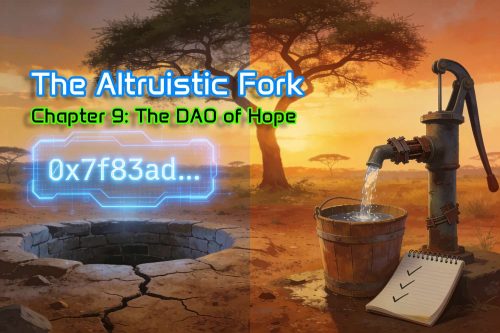
The delegation arrived on a Tuesday.
Three villages—Nafasi, Kiboko, and Tandale—sent representatives. Seven people in total, ranging from a teenage girl with a nose ring to a grandfather with a wooden cane. They had heard about the Phoenix DAO through WhatsApp, through word of mouth, through a cousin who knew someone who had seen the hill pump working.
Leyla met them at the edge of the village. Sam stood behind her, trying not to look as nervous as he felt.
“You’re the girl with the notebook,” the teenage girl said. Her name was Zuri. She was fifteen, maybe, with sharp eyes and a sharper tongue. “The one who fixed everything.”
“The community fixed everything,” Leyla said. “I just wrote it down.”
“Can you teach us?”
Leyla looked at Sam. He nodded.
“Come,” she said. “I’ll show you.”
The workshop lasted three days.
Leyla had prepared for it like an exam. She had copied pages from her notebook, printed screenshots of the DAO interface, drawn diagrams of how the verification system worked. She had even prepared a small test task—replacing a broken latch on the internet café door—to demonstrate the full cycle.
The seven visitors sat on wooden benches under the acacia tree, listening, asking questions, taking notes on their own phones.
“First,” Leyla said, “you need a notebook. Not a phone. A physical notebook. Because phones break and batteries die, but paper remembers.”
She held up her battered spiral-bound book, its cover now held together with duct tape.
“In this notebook, you write down everything that’s broken. Not what you think should be fixed. What people actually need. You ask everyone. The grandmothers. The children. The people who fetch water. The people who grow food. You write it all down.”
Zuri raised her hand. “What if the council gets angry?”
“The council will get angry. Let them. The water is more important than their anger.”
The grandfather—his name was Mosi, and he had been a village elder for forty years—stroked his chin. “And the money? Where does it come from?”
Leyla pointed at Sam. “He built the system. But the money comes from donors. People all over the world who want to see their donations actually work.”
“How do we trust them?”
“You don’t,” Sam said, stepping forward. “You trust the verification. Donors send money to the DAO treasury. The treasury only releases payment when the community votes that the work was done. You are in control. Not the donors. Not me. You.”
Mosi looked at him for a long moment. Then he nodded. “Show us.”
Leyla taught them how to catalog.
She walked them through the village—the pump, the tank, the market well, the path, the bridge. She showed them the before and after photos on the dashboard. She explained how each task had been proposed, funded, completed, and verified.
“You don’t have to do everything at once,” she said. “Start with one thing. The smallest thing. The thing that will make the biggest difference to the most people. Fix that. Prove that the system works. Then do the next thing.”
Zuri was taking furious notes on her phone. “How do we get people to vote?”
“You ask them. You show them the task. You show them the fix. You ask: does this work? They will tell you. People love to be asked.”
Mosi pointed at the hill pump. “That pump. How much?”
“Forty dollars.”
“And it took two hours?”
“Yes.”
“We have a pump like that. Broken for two years. The council says it needs a new well. The council is wrong.”
Leyla smiled. “The council is usually wrong.”
On the second day, Sam taught them the technology.
He had simplified the DAO interface since the early days. Now there was a mobile-friendly version that worked on slow connections and old phones. No wallet required to view tasks or vote—just a simple login with a phone number and a PIN.
“We had to make it easier,” Sam explained. “The Builder—our mechanic—almost quit because he didn’t want to learn crypto. So we built a layer on top. You don’t have to understand the blockchain. You just have to understand the task.”
He showed them how to post a task: description, budget, fixer, verification method.
He showed them how to vote: thumbs up or thumbs down, with an optional comment.
He showed them how to verify: upload a photo, enter the fixer’s phone number, confirm that the work was done.
Zuri raised her hand again. “What stops someone from uploading a fake photo?”
“The community,” Sam said. “If you post a photo of a different pump, someone will notice. If you post an old photo, someone will remember. The verification is human. That’s the point.”
“And if the community is corrupt?”
“Then the water stays dirty. And they have to live with that. No one is forcing them to use the system. But the alternative—the old system—left the pump broken for two years. So which corruption is worse?”
Zuri didn’t have an answer.
On the third day, the visitors posted their first tasks.
Zuri’s village had a broken borehole pump. She posted it for $50—a seal and a new handle, sourced from a market two towns over. Fixer: her uncle, who had been a plumber before the borehole company went out of business.
Mosi’s village had a collapsed bridge. Too big for a first task, so he posted a smaller one: repair the steps to the well. $30 in concrete and sand. Fixer: his grandson, a bricklayer.
The others posted similar tasks. Small things. Unsexy things. The kind of repairs that didn’t make headlines but changed lives.
Sam funded them all from the DAO treasury—$240 total. The donations had grown enough that he could afford it.
“These are tests,” he told them. “If they work, you’ll get more funding. If they fail, you’ll learn why. Either way, you’ll know more than you did yesterday.”
Mosi gripped his cane. “And if they work?”
“Then you come back. And you post the next task. And the next. And eventually, you won’t need me at all.”
The first tasks from the three villages were completed within two weeks.
Zuri sent photos of the borehole pump: before, the handle dangling; after, a bright stream of water arcing into a bucket. Her uncle stood next to it, grinning, his hands still greasy.
The community vote was unanimous. Payment released.
Mosi sent photos of the well steps: before, cracked and dangerous; after, smooth concrete with a handrail made from scrap metal. His grandson had done good work.
The vote passed. Payment released.
Sam watched the notifications roll in on his phone. Three villages. Three tasks. Three successes.
He sent a message to Leyla: It’s working.
She replied: Of course it is. They have notebooks now.
Sam’s role was changing, and he felt it.
In the early days of Phoenix Coin, he had been everything: founder, coder, marketer, spokesperson. Every decision ran through him. Every problem landed on his desk.
Now he was just… there.
The DAO didn’t need his approval. Tasks were posted without his input. Votes were cast without his participation. Payments were released without his signature. He had built a system that functioned perfectly well without him.
It was the hardest thing he had ever done.
Leyla found him sitting under the acacia tree one afternoon, staring at his phone.
“You look lost,” she said.
“I’m trying to figure out what I do now.”
“You code. You maintain the protocol. You help new villages get started.”
“That’s not full-time work anymore. The protocol is stable. The interface works. The donations are coming in on their own.”
Leyla sat down next to him. “You’re bored.”
“I’m useless.”
“You’re not useless. You’re just not in charge anymore. That’s different.”
Sam put his phone down. “I built a DAO to distribute power. But I didn’t realize how much I liked having power.”
Leyla laughed. “At least you’re honest.”
“I’m trying to be.”
She pulled out her notebook. Flipped to a page covered in new blue entries—tasks from the three villages, tasks from Kirema, tasks from places Sam hadn’t even heard of.
“Your job now is to make sure the DAO keeps working,” she said. “Not to control it. To maintain it. Like The Builder maintaining the pump. Boring. Invisible. Essential.”
Sam looked at the pump on the hill. It was still working. The Builder’s students checked it every week.
“The Builder doesn’t get applause,” Sam said.
“The Builder gets a working pump. That’s his applause.”
Sam was quiet for a long moment. Then he opened his laptop.
“There’s a bug in the voting contract,” he said. “If someone votes twice from the same phone, it doesn’t reject the second vote properly. I’ve been meaning to fix it.”
Leyla smiled. “There you go. Boring. Invisible. Essential.”
She walked away, her notebook tucked under her arm.
Sam fixed the bug. It took him two hours. No one would ever know. But the DAO would be a little bit stronger, a little bit more trustworthy.
That was enough.
The council chair’s nephew came to see Sam on a Friday afternoon.
He was seventeen—same age as Sam—but he looked younger. His hands were still greasy from The Builder’s workshop. His eyes were red, like he hadn’t slept.
“I want to rebuild the well,” he said.
Sam closed his laptop. “The collapsed one?”
“Yes.”
“That’s a big job.”
“I know.”
“The Builder would have to supervise.”
“He already said yes.”
Sam studied the nephew’s face. The arrogance was gone. The shame was still there, raw and visible. But beneath it, something else. Determination.
“Why?” Sam asked.
“Because I broke it. I built it wrong. I took shortcuts because I wanted to finish fast and get paid. I didn’t know what I was doing. But I know now. The Builder taught me.”
“How much will it cost?”
The nephew pulled a folded piece of paper from his pocket. It was covered in calculations—materials, labor, equipment rental. Sam recognized The Builder’s handwriting.
“Twelve thousand dollars,” the nephew said. “That’s what the first well cost. But this one won’t collapse.”
Sam looked at the paper. Twelve thousand dollars was almost all of the DAO treasury. If the well failed again, the money would be gone. Donors would lose faith. The whole experiment could collapse.
“Post the task,” Sam said. “The DAO will vote.”
The nephew nodded. He turned to go.
“Wait,” Sam said.
The nephew stopped.
“If this works,” Sam said, “you’ll have fixed something bigger than a well. You’ll have fixed your reputation.”
The nephew didn’t answer. He just walked away, toward The Builder’s workshop.
The DAO vote on the well rebuild was the most contentious in its short history.
Leyla called a community meeting under the acacia tree. Nearly a hundred people came—not just from Kirema, but from the three neighboring villages. Zuri was there. Mosi was there. Even the Auditor’s local agent showed up, taking notes in a small pad.
“The proposal,” Leyla announced, “is to rebuild the collapsed well. Cost: twelve thousand dollars. Fixer: the council chair’s nephew, supervised by The Builder. Verification: daily progress photos, community walkthrough at completion, and a final vote.”
Murmurs rippled through the crowd.
“The same boy who built the first well?” someone called out.
“The same boy,” Leyla said. “But he’s not the same builder. He’s been training with The Builder for three months. He’s fixed pumps, replaced seals, welded tanks. He knows what he’s doing now.”
“He should have known then.”
“Yes,” Leyla said. “He should have. But he didn’t. And the well collapsed. And now he wants to fix it. Not with council money. With DAO money. Money that the community controls.”
Mama Fatou stood up. “I remember when that boy was born. I held him in my arms. His mother cried because she was so happy.” She looked at the nephew, who stood at the edge of the crowd, pale and trembling. “He made a mistake. A terrible mistake. But he is not a mistake.”
She turned to face the crowd.
“The DAO is not about punishment. It’s about repair. We repair pumps. We repair tanks. We repair paths. And sometimes, we repair people. Let him rebuild the well. Watch him. Hold him accountable. But give him the chance.”
The crowd was silent.
The Builder stepped forward. “I’ll supervise every day. If he takes a shortcut, I’ll stop him. If the work is bad, I’ll reject it. I put my reputation on this.”
Leyla looked at Sam. Sam nodded.
“All in favor of funding the well rebuild, raise your hands.”
Hands went up. Slowly at first, then more quickly. Zuri raised her hand. Mosi raised his. Mama Fatou raised hers.
The council chair—who had been standing at the back, watching—raised his hand.
Leyla counted. “Seventy-three in favor. Twelve opposed. Six abstentions. The motion passes.”
The nephew buried his face in his hands. The Builder clapped him on the shoulder.
Sam watched the treasury balance drop by twelve thousand dollars. For a moment, he felt a flash of fear. Then he looked at the nephew—at the tears streaming down his face—and the fear turned into something else.
Hope.
The well rebuild took eighteen days.
The Builder showed up every morning at dawn with his toolbag and his critical eye. The nephew arrived fifteen minutes later, carrying materials, ready to work. They dug, they poured, they reinforced. They took photos at every stage: the foundation, the walls, the pump installation, the first flow of water.
Leyla posted the photos to the DAO every evening. Donors watched from around the world as the well rose from the rubble. Comments poured in:
This is incredible.
I donated to this well. I can see my money at work.
The nephew’s redemption arc.
Not redemption. Accountability.
On the seventeenth day, the pump was installed. On the eighteenth day, the first water flowed.
The Builder stood back, arms crossed, watching. The nephew turned the handle. Water streamed out—clean, cold, steady.
The Builder nodded. “Acceptable.”
It was the highest praise he had ever given.
The final vote was unanimous.
Every community member who had seen the well—and nearly everyone had—voted to approve. The before and after photos told the story: a rubble-filled crater transformed into a working well, surrounded by a clean concrete apron, with a pump that turned smoothly.
The payment released. Twelve thousand dollars transferred to the nephew’s wallet.
He stared at his phone, at the balance, at the green confirmation banner.
“I don’t deserve this,” he said.
“You fixed the well,” The Builder said. “You deserve to be paid.”
“No. I mean—I don’t deserve the second chance.”
The Builder was quiet for a moment. Then: “No one deserves a second chance. That’s why they’re called second chances.”
The nephew looked at the well. A line of women was already forming, buckets in hand. A child was drinking from the spout, just like at the hill pump.
“What do I do now?” the nephew asked.
The Builder pointed at the well. “You maintain it. You check the seal every month. You replace it when it wears out. You keep it working. That’s the job.”
“That’s not a job. That’s just… taking care of things.”
“Yes,” The Builder said. “That’s the job.”
Sam stood on the hill, next to the original pump, and watched the sun set behind the new well.
From this angle, he could see both—the small pump that had started everything, and the large well that represented everything they had built. Forty dollars and twelve thousand dollars. One mechanic and a community. A notebook and a blockchain.
His phone buzzed. A message from Leyla.
The DAO is expanding. Three more villages want to join. Can you help them set up?
He typed back: I’ll build a template. They can set up themselves.
Good. That’s the point.
He put his phone away. The stars were coming out. The pump creaked softly. Somewhere in the village, someone was singing.
The DAO of hope. That’s what Zuri had called it. Not a decentralized autonomous organization—just a group of people who had decided to trust each other enough to fix things.
It wasn’t perfect. Nothing ever was. But it was working. One repair at a time.
Sam walked down the hill, toward the guest hut, toward another day of coding and teaching and letting go.
The well was fixed.
The work would never be done.
That was the point.
Table of contents:
Introduction
Chapter 1: The Charity Token
Chapter 2: The Overhead Paradox
Chapter 3: The Transparent Ledger of Need
Chapter 4: The Rug Pull of Good Intentions
Chapter 5: Validating Impact
Chapter 6: The Hard Fork Decision
Chapter 7: Airdropping Agency
Chapter 8: The Return on Integrity
Chapter 9: The DAO of Hope
Chapter 10: Beyond the Transaction <<<<<< NEXT
