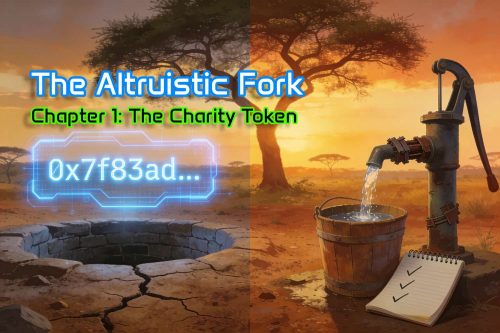
The glow of three monitors washed over Sam’s face as he leaned into his microphone. Behind him, a bookshelf held exactly one book—Mastering Ethereum—and a small bronze coin that someone had given him as a joke. The coin read “WORLD’S OKAYEST FOUNDER.” Sam kept it because it reminded him he wasn’t done yet.
“And that’s the moment,” Sam said, his voice steady despite his racing heart. “Three, two, one—”
The transaction confirmed.
On his center screen, the blockchain explorer refreshed. A green banner appeared: Transaction Confirmed. The numbers glowed like neon: 100 ETH. $184,742.63. From the Phoenix Coin Treasury Wallet to the Kirema Village Council Wallet. Every step visible. Every decimal traceable. Anyone in the world could click that link and see exactly where the money went.
Sam exhaled.
“It’s done,” he said into the mic. “One hundred Ethereum. One hundred eighty-four thousand dollars. Sent directly to the village of Kirema for clean water infrastructure. No banks. No middlemen. No hidden fees. Just code, trust, and the power of the blockchain.”
The chat exploded.
Crypto4Good: THIS IS THE FUTURE 🚀
WaterForAll: 98% efficiency is INSANE.
EthBoy2024: Sam for President tbh.
AnonymousDonor: Just sent 5 ETH. Keep going.
Sam watched the donation counter tick upward. $340 in the last sixty seconds. $1,200. $3,400. The Phoenix Coin model was simple: ninety-eight percent of every transaction fee went directly to water projects. Two percent covered servers, marketing, and Sam’s ramen budget. Donors loved it. They posted screenshots of the efficiency ratio on social media like trophies.
“For those just joining,” Sam continued, pulling up a satellite image of Kirema on his second monitor, “this is the village. About three hundred people. Right now, the nearest clean water is two miles away. The existing well collapsed last year. But today, that changes. We’ve partnered with the village council, and construction starts next week.”
He didn’t mention that he’d never met the council. That the “partnership” was a single DM on a messaging app. That the only verification he had was a wallet address and a promise.
Those details didn’t fit the narrative.
“What’s next?” he read from the chat. “Great question. Next, we scale. More villages. More wells. More proof that crypto can do what traditional aid never could—be transparent, efficient, and trustless.”
He checked his reflection in the dark monitor. Seventeen years old. Dark circles under his eyes. He’d dropped out of high school six months ago to build Phoenix Coin full-time. His parents had stopped asking when he’d go back. They’d stopped asking a lot of things.
“That’s all for today,” Sam said. “Thanks for believing in this. Thanks for believing that technology can change lives. Go build something that matters.”
He ended the stream.
The donation counter kept ticking. $8,200. $11,500. Sam let himself smile. He pulled up the transaction again. 100 ETH. Green banner. Confirmed.
He messaged the council wallet: Funds sent. Please confirm receipt and share construction timeline.
Three dots appeared. Then: Received. Thank you for support. Progress will be shared.
Sam screenshotted the message. Posted it to the Phoenix Coin Discord. Twenty-seven heart reacts in three minutes.
He closed his laptop, lay back on his dorm-room-turned-office bed, and stared at the ceiling. A water stain spread across the plaster like a map of somewhere he’d never been. He wondered what Kirema looked like. Whether the sky was the same shade of blue. Whether anyone there was staring at their own ceiling, thinking about the stranger who’d just sent them a small fortune.
He hoped they were celebrating. He hoped they were already digging.
Four thousand miles away, Leyla wiped sweat from her forehead and pushed open the door to the internet café.
The room was smaller than her family’s sleeping hut and smelled of diesel from the generator out back. Five people sat on wooden benches, waiting for the single shared tablet. A baby cried somewhere in the corner. A man spoke loudly into a phone about cassava prices.
The tablet was free for the first fifteen minutes, paid for by a nonprofit that had visited two years ago, taken photos with the children, and never returned. Leyla used it to check school assignments when the connection worked. Today, it worked.
She sat down. The screen was already open to a video. Someone had been watching a cryptocurrency stream.
She almost closed it. Crypto was for rich people in rich countries who wanted to feel like revolutionaries while sitting in air-conditioned rooms. But then she saw the name on the screen: Kirema.
She turned up the volume.
“One hundred Ethereum. One hundred eighty-four thousand dollars. Sent directly to the village of Kirema…”
Leyla’s stomach tightened.
She watched the boy on the screen—seventeen, maybe, with a face that hadn’t yet learned how to be wrong—gesture at a satellite image of her home. He pronounced Kirema wrong. Keer-ee-mah instead of Kee-reh-mah. A small thing. A thing that told her everything.
The video continued. The boy talked about transparency, about the blockchain, about how anyone could see exactly where the money went. He showed the transaction. Green banner. Confirmed.
Leyla recognized the receiving address.
It was the village council wallet.
She knew because she’d looked it up six months ago, when the first Phoenix Coin donation arrived. Fifty ETH. Ninety-two thousand dollars. Meant for a well. The council had announced it proudly at a town meeting. The chair’s nephew had been awarded the construction contract. He’d never built a well before. He’d built a chicken coop once.
The well had collapsed after three weeks.
Not dramatically—not in a landslide or a catastrophe. Just a slow, grinding failure. The walls weren’t reinforced properly. The pump was installed on unstable ground. One morning, Leyla’s mother went to fetch water and found the handle dangling at a wrong angle, the pipe cracked, the basin flooded with mud.
The council said they would fix it. Then they said they were investigating. Then they said nothing.
The nephew bought a motorcycle.
Leyla watched the boy on the screen celebrate. He looked so certain. So proud. He had no idea that his 100 ETH was about to vanish into the same black hole as the first fifty. He had no idea that the council chair was already planning a “community center” with the new funds. He had no idea that the well on the hill—the one that needed a forty-dollar pump seal and a local mechanic who’d been fixing things for fifteen years—was still broken.
She reached to close the video. The person behind her tapped her shoulder impatiently. She ignored them.
The boy was saying something about scaling. More villages. More wells. More proof that crypto could save the world.
Leyla thought: You don’t even know my name.
She closed the tablet. Stood up. Walked past the waiting people and out into the afternoon heat.
The walk home took twenty minutes. Past the market where women sold tomatoes from woven baskets. Past the school where the water tank leaked a slow silver thread down the wall. Past the collapsed well.
She stopped at the well.
It looked worse than last week. The pump handle had been removed entirely—probably stolen for scrap metal. The concrete basin was cracked, and weeds grew through the gaps. A toddler was playing near the rubble, stacking small stones into a tower. His mother sat ten feet away, fanning herself with a piece of cardboard, not watching.
Leyla walked over and gently pulled the toddler away from the well. He didn’t protest. He just looked up at her with wide, curious eyes.
“Not there,” she said softly. “Dangerous.”
The mother glanced up, nodded tiredly, and went back to fanning herself.
Leyla continued home.
Her family’s hut was at the edge of the village, near the acacia tree where the elders met to settle disputes. The roof was corrugated metal, rusted in patches. The door was a sheet of plywood that stuck in humidity. Her mother was boiling water over a charcoal stove, feeding twigs into the flame.
“You’re back early,” her mother said.
“Internet café was crowded.”
Her mother lifted the pot. Steam rose in a thick cloud. “Three more hours until this is safe to drink.”
Leyla watched the bubbles rise. The water had come from the river, brown and silty, full of things she tried not to think about. Her mother boiled it every morning. Every afternoon. Every evening. Three hours of fuel, three hours of waiting, three hours of her mother’s life given to something that should come from a tap.
“The council got more money,” Leyla said.
Her mother didn’t look up. “From the coin?”
“Yes.”
“Maybe this time they’ll fix the well.”
Leyla sat down on a wooden stool. “They didn’t fix it last time.”
“At least they tried.”
“Did they?” Leyla’s voice came out sharper than she intended. “Whose cousin built that well? Who approved the contract? Who bought a motorcycle instead of a pump seal?”
Her mother set down the pot. She looked at Leyla with an expression that was not anger but exhaustion. The exhaustion of a woman who had been asking those same questions for twenty years.
“What would you have me do?” her mother asked. “March to the council? Refuse to boil water? The money came. The well will be built. Maybe it works. Maybe it doesn’t. Either way, I still have to cook dinner.”
She turned back to the stove.
Leyla wanted to argue. She wanted to explain that it didn’t have to be this way—that the well on the hill could be fixed for forty dollars by a man who lived ten minutes away, that the school tank could be welded by Amina’s uncle, that every broken thing in the village had a solution that didn’t require a council, a contract, or a cryptocurrency founder who’d never seen mud on his shoes.
But her mother was right about one thing. Dinner still needed cooking. The water still needed boiling. The toddler still needed pulling away from collapsed wells.
Leyla went to her corner of the hut and pulled out her notebook.
It was battered, spiral-bound, with a cover that had once been blue and was now mostly gray. She’d started it two years ago, after the first NGO came through with clipboards and cameras and promises. They’d asked the council what the village needed. The council said a well. The NGO built a well. The well broke.
Leyla had wondered: What if someone asked everyone else?
So she started asking.
She talked to the women who spent three hours fetching water. She talked to the farmers whose irrigation ditches were clogged. She talked to The Builder, who fixed motorcycles and generators and could probably fix a well if anyone ever asked him. She wrote everything down.
Page after page. Red ink for broken things. Green ink for fixed things. Blue ink for things that could be fixed right now with the right amount of money.
She flipped to the most recent entry.
March 15: Council announced “major water initiative.” No one asked about the hill pump. No one asked The Builder. Projected cost: $90,000. Estimated completion: never.
She turned to a fresh page. Picked up her pen. Wrote the date.
April 2. Rich boy on internet sent $180k to council. No one asked us anything.
She stared at the words. They felt insufficient. How could a sentence capture the gap between a green transaction banner on a screen and a toddler playing in rubble? How could she explain to someone four thousand miles away that transparency wasn’t the same as truth?
She closed the notebook. Tucked it under her mattress.
Outside, the sun was setting. The generator at the internet café would shut off soon. The tablet would go dark. The video of the boy celebrating would still exist somewhere in the cloud, accumulating views and likes and donations.
Leyla lay down on her mat. Through the window, she could see the acacia tree where the elders met. No one was meeting tonight. Everyone was waiting. Waiting for the council to act. Waiting for the well to be built. Waiting for someone else to fix things.
She closed her eyes.
She thought about the forty-dollar pump seal. About The Builder, who had the part in his workshop but couldn’t afford to give it away. About the five families who were boiling river water right now because no one had asked the right question.
She thought about the boy on the screen. His certainty. His pride. His complete, absolute ignorance of her existence.
She wondered if he would ever know.
Four thousand miles away, Sam woke to the sound of his phone vibrating off the nightstand.
He grabbed it. Twenty-three Discord notifications. Eleven emails. A DM from someone who claimed to be a “blockchain impact specialist” offering consulting services for only 5 ETH.
The donation counter had stopped at $24,800. Not bad for a single stream.
He opened the chat with the Kirema council. No new messages. He typed: Any updates on construction start date?
He waited. One minute. Five. The three dots appeared, vanished, appeared again.
Council meeting tomorrow. Will share details.
Sam nodded. That was fine. Things moved slower in the real world. He’d learned that. You couldn’t expect a village to operate at crypto speed.
He rolled out of bed and walked to his makeshift desk. The bronze coin caught the morning light. WORLD’S OKAYEST FOUNDER.
He picked it up. Turned it over in his fingers.
Somewhere in a village he’d never seen, a well was going to be built. Children were going to drink clean water. A community was going to be transformed.
He believed that. He had to.
He set the coin down and opened his laptop. The green banner was still there. Transaction Confirmed.
It looked so final. So complete.
Sam had no idea that the real transaction—the one that mattered—hadn’t even started.
Table of contents:
Introduction
Chapter 1: The Charity Token
Chapter 2: The Overhead Paradox <<<<<< NEXT
Chapter 3: The Transparent Ledger of Need
Chapter 4: The Rug Pull of Good Intentions
Chapter 5: Validating Impact
Chapter 6: The Hard Fork Decision
Chapter 7: Airdropping Agency
Chapter 8: The Return on Integrity
Chapter 9: The DAO of Hope
Chapter 10: Beyond the Transaction
