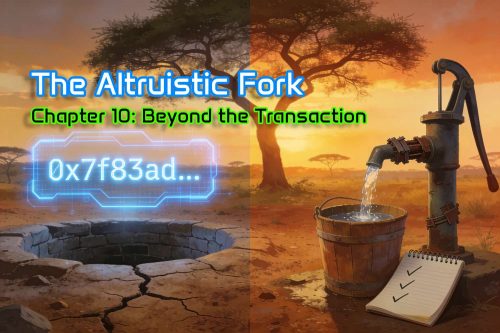
One year after the hard fork, Sam returned to Kirema for what he told himself was just a visit.
He had been traveling for months—helping new villages set up their own DAOs, speaking at conferences, fixing bugs in the protocol. His apartment was now a room in a shared house near the regional airport, chosen because it was close to the bus that went to Kirema. He had stopped counting the number of times he’d made that trip.
The bus dropped him at the crossroads. The same crossroads. The same two-mile walk. But everything else had changed.
The path to the village was paved now—not with asphalt, but with packed gravel, wide and smooth, the kind of path that didn’t turn to mud when it rained. A sign at the entrance read: Kirema — Phoenix DAO Community. Someone had painted a small green checkmark next to the name.
Sam walked past the market. The stalls were busier than he remembered, more vendors, more customers. A woman selling phone credit smiled at him and waved. He waved back.
The collapsed well was gone. In its place was a small garden—tomatoes, peppers, herbs—planted in the rich soil that had settled in the crater. A sign read: Grown by the women’s cooperative. Water from the new well.
And there, at the center of the village, stood the new well.
It was beautiful. Not in the way of architecture or design, but in the way of things that worked. The concrete apron was clean. The pump handle moved smoothly. A small solar panel powered a light that shone at night. A line of women filled their buckets, chatting and laughing.
Sam stood at the edge of the well and watched. A child—the same toddler who had been playing near the rubble, now three years old and sturdy—walked up to the pump, turned the handle, and drank directly from the spout.
Her mother didn’t pull her away. She just smiled.
Leyla found him at the well.
She was seventeen now, taller, her hair shorter. She carried her notebook—the same battered spiral-bound book, now held together with duct tape and string. But she also carried a tablet, a real one, donated by a supporter who had seen her work.
“You’re back,” she said.
“I never left.”
She smiled. “That’s what you always say.”
“It’s always true.”
They walked through the village together. Sam had seen the progress reports on the dashboard—forty-seven tasks had become a hundred and twelve—but seeing it in person was different.
The school tank was still holding. The weld mark was visible, a silver scar on the plastic, but no leaks. A new tank had been added next to it, funded by donations from a school in Canada that had found the DAO through Maya Chen’s video.
The market well handle was still turning. The Builder had trained a teenager to maintain it—not his son, but the council chair’s nephew, who had proven himself on the well rebuild. The nephew now ran a small repair business, serving three villages, paid entirely through the DAO.
The bridge to the next village had been rebuilt. Not with a single task, but with four: one for the planks, one for the railings, one for the concrete footings, and one for the ramp that made it accessible to wheelchairs. The before and after photos showed children crossing safely, no more jumps over the broken section.
“The bridge cost more than the well,” Leyla said, “if you add up all four tasks. But it was easier to fund, because donors could see the progress. Each task was a small win.”
Sam nodded. “Small wins add up.”
“Big wins are just small wins in a trench coat.”
He laughed. “Did you make that up?”
“Mama Fatou. She has a lot of sayings.”
They sat under the acacia tree. The bench where Sam had coded for hours was now joined by three more benches, arranged in a circle. A whiteboard stood on an easel, covered in notes about upcoming tasks. Someone had drawn a cartoon of a pump with a smiley face.
“The DAO meets here every Friday,” Leyla said. “Anyone can come. Anyone can propose a task. Anyone can vote. We’ve had to expand the whitelist to forty people. Some of them don’t have phones, so we have a paper ballot system. I scan the ballots and upload them.”
“Paper ballots. On a blockchain.”
“The blockchain doesn’t care. It just needs proof.”
Sam looked at her. She had changed. Not just physically—though she had grown into herself in ways that made her seem older than seventeen—but in her confidence. The girl who had hidden behind a notebook, who had spoken in careful, measured sentences, was gone. In her place was someone who ran meetings, who taught workshops, who had become the bridge she had always been.
“What’s next for you?” Sam asked.
Leyla pulled out her tablet. Opened an app Sam didn’t recognize. It was a coding environment—basic, mobile-friendly, designed for slow connections.
“I’m learning Solidity,” she said. “Smart contracts. Your code is good, but it’s not optimized for low-bandwidth environments. I’m building a new version that works entirely offline. Tasks can be proposed by SMS. Photos can be uploaded when the connection returns. Votes can be cached and synced later.”
Sam stared at her. “You’re coding?”
“I’m learning. The Builder isn’t the only one who can fix things.” She smiled. “Boring. Invisible. Essential.”
He felt a swell of pride so intense it almost hurt. “Leyla, that’s incredible.”
“It’s necessary. You won’t be here forever. Someone has to maintain the protocol.”
“I’ll always be here. Not physically, but—”
“I know.” She touched his arm. “But the goal is to need you less. That’s what partnership means. Not dependence. Independence.”
Sam was quiet for a moment. Then: “You sound like a founder.”
“I learned from one.”
The crypto conference was in Singapore, six thousand miles from Kirema.
Sam had been invited to give a keynote. He had almost said no—he didn’t like crowds anymore, didn’t like the performative energy of big events. But Leyla had pushed him.
“Go,” she said. “Tell them what we learned. Maybe they’ll listen.”
“Or maybe they’ll call me a scammer again.”
“Maybe. But you’re not a scammer. And the well is still working.”
So he went.
The conference hall was enormous, with a stage that looked like something from a science fiction movie. Five thousand people sat in rows of seats, their faces illuminated by the glow of their phones and laptops. Sam stood in the wings, his heart pounding, the same way it had pounded before his first livestream.
But he wasn’t the same person.
He walked onto the stage. The lights were bright, blinding. He couldn’t see the audience, but he could feel them—five thousand strangers, waiting to be convinced, waiting to be impressed, waiting to judge.
He didn’t have a slideshow. He didn’t have a demo. He had a single photo, projected on the massive screen behind him.
It was the hill pump. Before. Cracked, broken, useless.
“For two years,” Sam said, “I thought transparency meant showing the money move. I built a charity token with 98% efficiency. I celebrated every transaction. I posted green banners and cheered.”
He clicked to the next photo. The hill pump. After. Water streaming, a child drinking.
“But the money moving wasn’t the point. The water moving was the point.”
He walked to the edge of the stage.
“I raised three hundred and forty thousand dollars. I sent it to a village for a well. The well collapsed. The donors fled. The council froze the funds. I had failed—not because I didn’t try, but because I was validating the wrong thing.”
He clicked through more photos. The school tank, before and after. The market well handle. The path. The bridge. The well rebuild. A hundred and twelve tasks, each with its own before and after, each with its own verification.
“The blockchain is a tool for trust. But trust doesn’t come from code. It comes from proof. And proof is not a transaction hash. Proof is a photo of a child drinking clean water. Proof is a community vote. Proof is a pump that still works a year later.”
He paused. The audience was silent.
“I’m not here to sell you a token. I’m not here to ask for donations. I’m here to tell you that the metrics we’ve been using—efficiency, overhead, dollars raised—are meaningless if we can’t answer one question: Did the water flow?”
He clicked to a final photo. Not a repair. A dashboard. The Return on Integrity metric: 92% of donations to tasks. 8% to maintenance. 100% verified by community vote.
“We built a new metric. Return on Integrity. Not how little you spent, but how clearly you can prove what you bought. And we built a new model. Not a charity that sends money to councils, but a protocol that empowers communities to fix things themselves.”
He looked out at the audience. The lights had dimmed slightly; he could see faces now. Some were skeptical. Some were curious. A few were crying.
“The hard fork wasn’t a software update. It was me realizing that I don’t live in the village. Leyla does. The Builder does. The council chair’s nephew—who rebuilt the well, who now runs a repair business—does. My job is not to save them. My job is to build tools that let them save themselves. And then get out of the way.”
He stepped back from the edge of the stage.
“The code is open source. The model is free. Use it. Improve it. Fork it. Just remember: the transaction is not the impact. The impact is the water.”
He walked off the stage.
The applause was deafening.
After the conference, Sam didn’t go back to his shared house near the airport. He didn’t go to another village. He didn’t open his laptop.
He went to Kirema.
It was evening when he arrived. The sun was setting behind the hills, painting the sky in shades of orange and purple. The new well was quiet—the line of women had finished for the day. The pump handle glinted in the fading light.
He didn’t announce himself. He just walked to the well and sat on the concrete apron.
Leyla found him there, as she always did.
“You’re back,” she said.
“I never left.”
She sat down next to him. Her notebook was in her lap, open to a page covered in blue entries. But there were fewer blue entries now. More green. More fixed things.
“I watched your speech,” she said. “On the tablet. The connection was bad, but I saw most of it.”
“What did you think?”
“I think you’re learning to get out of your own way.”
Sam laughed. “That’s what you always say.”
“Because it’s always true.”
They sat in silence as the stars appeared. The pump creaked softly in the evening breeze. A child’s voice called out from somewhere in the village, then faded.
“The bridge to the next village needs a railing,” Leyla said. “One of the planks is loose. It’s a small task. Twenty dollars.”
“Post it.”
“I already did. The DAO voted this morning.”
“And?”
“Approved. The Builder’s nephew will fix it tomorrow.”
Sam nodded. He didn’t check his phone. He didn’t need to. The system was working. The community was in control. He was just a visitor now, a guest in a place that had once been his project.
That was the point.
Leyla’s notebook lay open on the ground between them.
Sam picked it up. The pages were worn, the ink fading in places. He flipped through—red entries from years ago, now mostly crossed out; green entries, page after page of fixed things; blue entries, fewer now, but still there, because the work never ended.
He stopped at a page near the back. A new entry, in green ink:
Well: working. Pump: working. Children: drinking.
Below it, in blue:
Next: Irrigation ditch. Community proposal. Estimated cost: $200. Waiting for vote.
He closed the notebook. Handed it back to Leyla.
“This is the real ledger,” he said.
She took it. Held it against her chest.
“Always was.”
The next morning, Sam woke early.
He walked to the hill pump. It was still working—the seal held, the handle turned, the water flowed. A young girl was filling a bucket, her little brother splashing in the puddle.
He walked to the school tank. The weld was still solid. A teacher was filling a bottle, smiling at something a student had said.
He walked to the market well. The handle was still attached. A woman paid five cents at the newer well—some habits were hard to break—but more people were using the old well now, the free one, the one that had been fixed for fifteen dollars.
He walked to the new well. The council chair’s nephew was there, checking the seal, wiping down the handle. His repair business had grown—he now had three employees, all trained by The Builder.
“The well looks good,” Sam said.
The nephew looked up. His face was no longer pale with shame. It was brown from the sun, lined with the early signs of hard work.
“It’s holding,” he said. “I check it every week.”
“You don’t have to do that. The DAO pays for maintenance.”
“I know. But it’s my well. I broke the first one. I’m not breaking this one.”
Sam nodded. “That’s the job.”
“Yes,” the nephew said. “That’s the job.”
Leyla was under the acacia tree, teaching a younger girl how to log a task on a phone.
The girl was maybe twelve, with braids and a serious expression. She held the phone carefully, like it was made of glass.
“First, you take a photo of the broken thing,” Leyla said. “Then you write a description. Then you enter the cost. Then you submit.”
“But what if I don’t know the cost?”
“Then you ask someone who does. The Builder. Your father. The market. Someone knows.”
The girl nodded. She typed slowly, her thumb uncertain.
Leyla looked up and saw Sam. She smiled.
“You’re leaving?”
“Later today. There’s a village three hours from here that wants to start a DAO. I’m going to help them set up.”
“Then come back?”
“Always.”
She stood up. The younger girl kept typing, absorbed in her task.
Leyla walked with Sam to the edge of the village. The same path he had walked that first night, exhausted and lost. Now it felt like home.
“The irrigation ditch task passed,” she said. “Two hundred dollars. The women’s cooperative is doing the work. They’ll post photos next week.”
“I’ll watch from wherever I am.”
“You always do.”
They stopped at the crossroads. The bus was already there, engine running, waiting.
Sam turned to face her. “Thank you,” he said.
“For what?”
“For teaching me that the notebook was more important than the blockchain.”
Leyla touched the cover of her notebook. “The blockchain is just a notebook that everyone can see. That’s all it ever was.”
“Then why did it take me so long to understand?”
“Because you were looking at the transaction. Not the thing being transacted.”
Sam smiled. “You should give the keynote next year.”
“I will. But not yet. I have too much to fix.”
She hugged him—quick, fierce, surprising. Then she stepped back.
“Go,” she said. “Fix other villages. We’ll be here when you come back.”
Sam climbed onto the bus. Found a seat by the window. The bus pulled away, dust rising behind it.
He looked out the window. Leyla was already walking back to the acacia tree, notebook in hand, the younger girl following her.
The pump was working. The well was working. The children were drinking.
The transaction was complete.
The partnership was just beginning.
Table of contents:
Introduction
Chapter 1: The Charity Token
Chapter 2: The Overhead Paradox
Chapter 3: The Transparent Ledger of Need
Chapter 4: The Rug Pull of Good Intentions
Chapter 5: Validating Impact
Chapter 6: The Hard Fork Decision
Chapter 7: Airdropping Agency
Chapter 8: The Return on Integrity
Chapter 9: The DAO of Hope
Chapter 10: Beyond the Transaction
