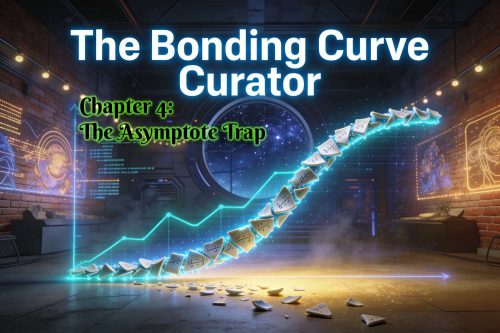
One month later, Arcadia Community Art Space had become a museum of its own lost promise.
The string lights still glowed, but they seemed dimmer now—or maybe that was just the weight of the silence. The folding chairs were still arranged in rows, but only twelve of them were occupied. The screen still displayed the bonding curve, but the curve had barely moved in weeks.
Kael sat in the front row, staring at the dashboard.
Supply: 1,520 tokens
Price: 0.231 units
Treasury: 342 units
Active holders: 23
The Whale hadn’t bought a single token since launch night. No one else had either. The price had flatlined at a level that was too high for new community members to afford, but not high enough for existing holders to justify selling.
Ria had a name for this. She’d called it the “asymptote trap”—a mathematical term for a curve that approaches a limit but never reaches it. In bonding curve terms, it meant the community was frozen. The price was stuck. The treasury was barely growing. And soon, the treasury would stop growing entirely.
Kael ran the numbers in his head. At current prices, a single new token cost 0.231 units. That was more than most people in the neighborhood could afford to spend on something speculative. The early buyers—the ones who’d gotten in at fractions of a cent—were sitting on paper profits, but they couldn’t cash out without crashing the price. The late buyers—the ones who’d bought near the top—were trapped. Everyone was waiting for something to change.
But nothing was changing.
Ms. Velen stood at the podium. She looked older than she had a month ago—the lines around her eyes deeper, the curve of her shoulders more defeated.
“I’ve called this emergency meeting because we have a problem,” she said. “The treasury has 342 units. That sounds like a lot, but it’s not. At our current burn rate—artist funding, operational costs, the floor price fund reserve—we have enough for maybe two more months. One more project. Then nothing.”
She looked at Kael. “Kael, can we lower the price? Mint new tokens at a discount to attract buyers?”
Kael shook his head. “The curve is the curve. The formula is fixed in the smart contract. If we mint tokens at a discount, we break the mathematical relationship between supply and price. The whole system falls apart.”
“So we’re stuck,” someone said. It wasn’t a question.
“We’re stuck,” Kael admitted.
The meeting limped through the agenda. The next artist proposal—a mural project by a local painter named Dara—was put to a vote.
Yes: 210 tokens
No: 450 tokens
Abstain: 860 tokens
The Whale had vetoed it.
No explanation. No message. Just a block of 450 tokens voting no, silencing the community’s voice as easily as turning off a switch.
Dara, a young woman with paint-stained fingers and hopeful eyes, looked like she’d been slapped. “Why?” she asked the room. No one had an answer.
Ms. Velen tried to salvage the meeting. “We can resubmit the proposal. Maybe if we adjust the funding amount—”
“The Whale controls thirty percent of the vote,” Ria interrupted. “They don’t have to explain. They don’t have to negotiate. They just have to say no. And they will keep saying no until they get what they want.”
“And what do they want?” someone asked.
Ria looked at Kael. “Maybe it’s time to find out.”
After the meeting, Kael walked to Zinn’s studio.
The Fracture Artist’s workspace was in a converted garage behind a row of townhouses. The door was unlocked—Zinn rarely bothered to lock it—and Kael let himself in.
The Fragmentation Machine was nearly complete.
It was beautiful in a terrible way—a constellation of ceramic shards suspended from the ceiling by thin electromagnets, each shard connected to a small receiver that pulled data from the bonding curve. When the curve moved, the shards were supposed to shift, rearranging themselves into new patterns. When the curve crashed, they were supposed to fall.
Right now, the shards were perfectly still.
Zinn sat on a stool in the middle of the room, staring up at their creation. They didn’t turn when Kael entered.
“It’s frozen,” Zinn said. “Just like the community. The curve hasn’t moved in weeks, so the shards haven’t moved either. The Fragmentation Machine is supposed to be about change—about breaking and reforming. But nothing is breaking. Nothing is reforming. It’s just… stuck.”
Kael sat on the floor, leaning against a stack of wooden crates. “I did this.”
Zinn finally looked at him. Their face was pale, their eyes tired. “You built the tool. You didn’t force the Whale to buy thirty percent. You didn’t force the price to spike. You didn’t force the community to freeze.”
“I could have designed it better. The cap should have been per transaction, not per wallet. The time-lock should have triggered on voting power, not just sells. I knew the risks. Ria told me the risks. I still launched.”
Zinn stood up and walked to the center of the room, reaching up to touch one of the ceramic shards. It didn’t move—the magnets held it in place, but just barely.
“The art reflects the community,” Zinn said quietly. “Right now, the community is frozen. So the art is frozen. That’s not your fault. That’s the Whale’s fault. And the Whale won’t tell us what they want.”
Kael pulled out his phone. The dashboard showed the same numbers. The same flatline. The same silence.
“Maybe it’s time to ask.”
The message arrived that evening.
Kael was at his desk, staring at the whiteboard—still covered in the safeguards he’d designed, still haunted by the patterns of failure Ria had shown him. His phone buzzed.
Collector.eth has sent you a message. Reply to this address to chat privately.
His heart hammered. He clicked the link.
The chat interface was anonymous—no video, no audio, just text. Kael typed:
Kael: Who are you?
Collector.eth: Someone who believes in Arcadia.
Kael: Then why did you veto Dara’s mural?
Collector.eth: I need to know that my investment is protected. Dara’s mural was good, but it wasn’t strategic. I want art that appreciates. Art that can be sold. Art that builds a brand.
Kael stared at the screen. Brand. The word felt like poison.
Kael: Arcadia isn’t a brand. It’s a community.
Collector.eth: Communities need funding. Funding comes from value. Value comes from art that people want to buy. I’m not your enemy, Kael. I’m your patron.
Kael: Patrons don’t veto community votes.
Collector.eth: Patrons protect their investments. Here’s my proposal. I will continue to support Arcadia—with my votes, with my capital, with my connections. In exchange, I want control of artist selection for the next three funding rounds. I want to hand-pick creators who will produce work that can be sold to collectors. This isn’t capture. This is curation.
Kael’s fingers trembled as he typed his response.
Kael: That’s exactly what capture is. You’re asking us to give up the one thing that makes Arcadia Arcadia. Community choice.
Collector.eth: Community choice got you a frozen curve and a dying treasury. My way gets you funding. Think about it. You have 48 hours.
The Whale went silent. Kael stared at the screen until it dimmed, then darkened.
He called Ria immediately.
She picked up on the first ring. “What happened?”
Kael told her everything. The proposal. The 48-hour deadline. The Whale’s calm, reasonable voice that made extortion sound like partnership.
When he finished, Ria was quiet for a long moment.
“They’re going to dump,” she said finally. “That’s the pattern. First the ask. Then the threat. They gave you 48 hours to accept their terms. When you refuse—and you’re going to refuse—they’ll sell everything.”
“The time-lock expired three days ago,” Kael said. “They can sell anytime.”
“Then we have 48 hours to figure out how to survive a collapse.”
Kael pulled up the contract on his laptop. He’d written every line. He knew it better than anyone. And he knew, with a sickening certainty, that the safeguards he’d added wouldn’t stop a coordinated sell-off.
“The floor price fund has 85 units,” he said. “That’s enough to buy back maybe 400 tokens at the current price. But if the Whale sells 450 tokens all at once, the price will drop so fast that the floor price fund will be buying at higher and higher prices while the Whale is selling at lower and lower prices. It’s a race to the bottom. And the Whale has more tokens.”
“How bad?”
Kael ran the simulation. “Current price: 0.231 units. After 450 tokens sold, the price will be approximately 0.034 units. That’s an 85 percent drop. The treasury will lose more than 90 percent of its value. Small holders who try to sell during the crash will get fractions of what they paid.”
“A death spiral.”
“A collapse spiral,” Kael corrected. “It’s not death. It’s worse. Death is quick. This is slow. The price will keep falling as long as people keep selling. And people will keep selling because they’re scared. By the time it’s over, the curve will be worthless. The treasury will be empty. Arcadia will be a hollow shell.”
Ria’s voice was barely a whisper. “And Zinn’s sculpture?”
Kael closed his eyes. He could see it already—the shards falling, shattering on the concrete floor, the magnets powerless to pull them back together.
“It will fragment,” he said. “And it won’t reassemble.”
Kael didn’t sleep that night.
He sat at his desk, staring at the whiteboard, at the beautiful curve, at the safeguards that weren’t enough. He thought about Ria’s father’s files—the twenty-three collapses, the patterns, the warnings he’d ignored. He thought about Ria’s mother, Lena, who had stopped painting because a bonding curve had stolen her belief.
He thought about the Whale’s calm voice. This isn’t capture. This is curation.
Was it? Was he any different? He’d built a system that rewarded early believers, and the earliest, richest believer had captured it. He’d added safeguards, and the Whale had circumvented them. He’d tried to create a community-owned funding machine, and he’d built a bomb instead.
His phone buzzed. A message from Ria.
Ria: I can’t sleep either. Meet me at Arcadia.
The warehouse was dark when Kael arrived. Ria had let herself in with a spare key—Ms. Velen trusted her, despite everything. She was sitting on the edge of the stage, legs dangling, staring at the blank screen.
Kael sat beside her.
“I built a bomb,” he said.
“I know.”
“I didn’t mean to.”
“No one ever does.”
They sat in silence. The string lights hummed faintly—a sound Kael had never noticed before, but now couldn’t unhear.
“The twenty-three collapses,” Ria said eventually. “My father’s files. You read them. You knew the patterns. But you still thought you could beat them.”
“I thought the safeguards would be enough.”
“The safeguards were never going to be enough. Not because you designed them badly—because you designed them reactively. You were always responding to the last attack, never anticipating the next one. The cap stopped a single wallet, so the Whale used multiple wallets. The time-lock stopped immediate sells, so the Whale waited. The floor price fund buffers crashes, but it can’t stop a coordinated dump. Every safeguard is just a speed bump. And speed bumps don’t stop trucks.”
Kael turned to look at her. “Then what does?”
Ria met his gaze. “Trucks stop when they run out of road. We need to change the road. Not add more bumps. Change the shape of the curve itself.”
“What do you mean?”
Ria pulled out her notebook—the worn, dog-eared one she always carried. She flipped to a page covered in diagrams.
“The quadratic curve—price equals supply squared over a constant—is beautiful, but it’s also dangerous. The slope increases linearly with supply. That means the price grows quadratically. Early buyers get exponential rewards. That’s what attracted the Whale. That’s what froze the community. The curve rewards concentration.”
She drew a new curve—flatter, less dramatic.
“What if we used a different exponent? Price equals supply to the power of one-point-five instead of two. The curve still rises, but more slowly. The rewards for early buyers are still real, but they’re not exponential. The price never goes vertical. And the asymptote trap—the point where new buyers can’t afford to join—happens much later, if at all.”
Kael studied the diagram. “A flatter curve means less funding for the treasury.”
“It means more sustainable funding. A curve that doesn’t price out the community is better than a curve that does, even if the treasury grows more slowly.”
Kael thought about the Whale. About the 30 percent ownership. About the veto power. About the threat of collapse.
“Can we change the curve?” he asked. “The contract is immutable.”
“We can’t change the existing contract. But we can create a new one. A migration. Anyone who wants to leave the old curve behind can swap their tokens for tokens on the new curve. The Whale won’t migrate—they have too much to lose. But the community can. We can leave them behind.”
Kael’s mind raced. A migration would require a new contract, new safeguards, new everything. It would require convincing the community to abandon the curve they’d already invested in. It would require trust.
“Do you think they’ll do it?” he asked.
Ria looked out at the empty room. The folding chairs. The dimming string lights. The ghost of what Arcadia had been.
“I think they’re scared,” she said. “And scared people will do almost anything to feel safe. We just have to give them a way.”
Kael walked home as the sun rose. The sky was pale orange, streaked with clouds that looked like brushstrokes. Somewhere, a bird was singing.
He pulled out his phone and opened the dashboard.
The curve was still flat. The price was still 0.231 units. The treasury was still 342 units. The Whale’s 450 tokens were still sitting in their wallets, waiting.
But Kael wasn’t looking at the numbers anymore. He was looking at the shape of the curve itself—the beautiful, seductive, dangerous shape that had brought them here.
He thought about Ria’s flatter curve. Less beautiful. Less seductive. But more sustainable.
He thought about the Whale’s calm voice. This isn’t capture. This is curation.
He thought about his own voice, from the very first meeting: The curve is a tool. The community is the goal.
He had forgotten that. Somewhere between the code and the launch and the Whale’s arrival, he had fallen in love with the tool and forgotten the goal.
But now, in the light of a new morning, he remembered.
The curve was a bomb. But bombs could be defused. Communities could be saved. Art could be protected.
He just had to build a better tool.
He started walking faster.
Table of contents:
Introduction
Chapter 1: The Community Vault
Chapter 2: A Curve in the Code
Chapter 3: The First Mint
Chapter 4: The Asymptote Trap
Chapter 5: The Collapse Spiral <<<<<< NEXT
Chapter 6: Curating Not Speculating
Chapter 7: The Continuous Auction
Chapter 8: A Floor Price for Dreams
Chapter 9: The Curve Flattens
Chapter 10: A Sustainable Arc
