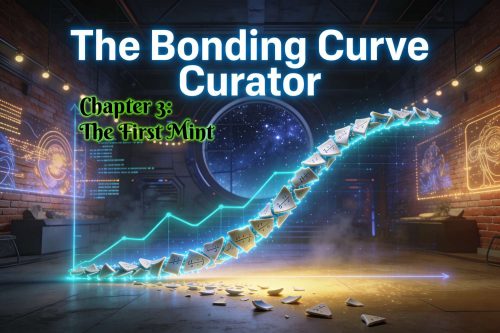
The string lights were new.
Kael noticed them the moment he walked into Arcadia on launch night. Ms. Velen had replaced the old ones—the ones that had been flickering for years, the ones held together by electrical tape and stubbornness. The new lights were brighter, whiter, casting the exposed brick in a glow that made the warehouse feel less like a relic and more like a beginning.
There were fifty people in the room. Fifty. That was more than double the attendance of the first meeting. Word had spread. The idea of a bonding curve—a community-owned funding machine—had captured something in the neighborhood. Artists who hadn’t shown up for anything in years were here. Donors who’d written off Arcadia as a lost cause had returned. Even a local journalist had come, notebook in hand, looking for a story about teenagers and blockchain and the future of art.
Kael stood behind the podium, the same podium from two weeks ago, but everything else was different. The screen behind him was live—not a slideshow, but a real dashboard connected to the smart contract he’d deployed that morning. The curve was there, empty and waiting. Price: 0.000001 units. Supply: 0 tokens. Treasury: 0 units.
Beside him stood Ms. Velen, wearing a dress he’d never seen before—deep blue, professional, the kind of thing you wore when you wanted to be taken seriously. She’d been running Arcadia for eight years. She’d seen grants come and go, donors rise and fall, artists succeed and disappear. Tonight, she was putting her faith in a sixteen-year-old and a mathematical formula.
“Are you ready?” she asked quietly.
Kael’s throat was dry. His hands were shaking slightly—not from fear, exactly, but from the weight of the moment. Fifty people were waiting for him to speak. Fifty people had shown up because they believed, or wanted to believe, that something could be saved.
“Yeah,” he said. “I’m ready.”
Ms. Velen stepped to the podium. The crowd quieted.
“Thank you all for coming,” she said. Her voice was steady, warm, practiced. “Eight years ago, I opened Arcadia’s doors for the first time. I had no money, no plan, no backup. Just a warehouse and a dream. You all helped me turn that dream into something real. We’ve survived funding cuts, economic downturns, and a pandemic. But this past year has been the hardest. Our largest donor pulled out. Our grants got rejected. For the first time, I started to believe that Arcadia might not make it.”
She paused, looking around the room. Kael could see her eyes glisten.
“But then Kael came to me with an idea. A strange idea. An idea that I didn’t fully understand at first. He talked about bonding curves and continuous auctions and formulas that sounded like alien languages. And I almost said no. Almost. But then he said something that made me listen. He said: ‘What if the people who love Arcadia could own it? Not just donate to it, but own it. What if every person in this room had a stake in our survival?'”
She turned to Kael and nodded.
“So tonight, we find out if that idea works. Kael?”
The crowd applauded—politely, nervously. Kael stepped forward.
He looked out at the fifty faces. He saw Ria near the back, arms crossed, watching. He saw Corin beside her, calm and curious. He saw artists he admired, donors he’d never met, neighbors who’d walked past Arcadia for years without ever coming inside. All of them waiting.
“Thank you, Ms. Velen,” he said. “And thank you all for being here.”
He turned to the screen. The curve was still empty.
“Two weeks ago, I showed you a bonding curve. A mathematical formula that turns belief into funding. Today, I’m showing you something different. Something safer. Over the past two weeks, I’ve added safeguards to the original design. Per-wallet caps. Time-locks. A floor price fund. And a participation token called Shards—you earn them by contributing to Arcadia, and you need them to buy the main token.”
He saw Ria’s expression shift—surprise, then approval. He hadn’t told her he was going to explain the safeguards first. He’d wanted her to see that he’d listened.
“This isn’t the simple, beautiful curve I showed you before,” Kael continued. “It’s uglier. More complicated. But it’s also stronger. It’s designed to survive the kinds of attacks that killed twenty-three other bonding curve communities. I know because I read every one of those case studies. I know because I spent the past two weeks learning from other people’s failures.”
He clicked a button. The dashboard refreshed.
“The contract is live. The treasury is empty. The first mint starts now.”
He pulled out his phone, opened his wallet, and confirmed the transaction.
The screen updated.
Token #1 minted by 0xKael
Price: 0.000001 units
Supply: 1
Treasury: 0.000001 units
The curve drew its first point—a tiny dot at the bottom left corner, almost invisible against the grid.
Someone in the crowd laughed. Not meanly—with delight. A single token. A single dot. The beginning of something.
“Token #1 is mine,” Kael said. “I’m not selling it. Ever. Consider it my promise to this community.”
He stepped back from the podium. “Now it’s your turn.”
The first to move was a woman Kael didn’t recognize—gray-haired, wearing a paint-stained smock, probably in her sixties. She walked to the laptop set up near the podium and handed her phone to a volunteer.
“I’ve been coming to Arcadia since the first year,” she said. “I’ve seen every show, attended every workshop, donated every time I could. But I’ve never owned a piece of it. Until now.”
The volunteer helped her connect her wallet. She bought token #2.
Token #2 minted by 0xElena
Price: 0.000002 units
Supply: 2
Treasury: 0.000003 units
The curve ticked upward—barely visible, but real. A second dot appeared, slightly higher than the first.
Then Corin stood up.
Kael watched as Ria’s father walked to the laptop with the unhurried pace of someone who’d made a decision long ago and was only now executing it. He bought token #3.
Token #3 minted by 0xCorin
Price: 0.000005 units
Supply: 3
Treasury: 0.000008 units
Corin turned to the crowd. “I’ve studied bonding curves for five years,” he said. “I’ve seen them fail. I’ve seen them succeed. I’ve seen them destroy communities and empower them. This one—” he pointed at the screen, “—this one is different. It has safeguards the others didn’t. It has a curator who listens. It has a community that cares. I’m buying not because I expect to get rich. I’m buying because I believe in second chances.”
He returned to his seat. Ria didn’t look at him, but Kael saw her hand reach over and squeeze his arm.
More people came forward. Token #4. Token #5. Token #6. Small amounts. Symbolic purchases. A teenager who’d saved her allowance. A retired teacher who wanted to support the arts. A local business owner who’d been priced out of every other funding model.
The curve rose gently—each new token costing slightly more than the last, but not so much that anyone felt excluded. The mood in the room was light, hopeful. People were smiling. This was working.
Supply: 15
Price: 0.000225 units
Treasury: 0.0017 units
Kael allowed himself to relax. Maybe Ria’s fears were overblown. Maybe the safeguards were enough. Maybe—
The dashboard changed.
A new wallet appeared. Not a person at the laptop—a remote connection. The wallet was labeled only with a string of numbers and letters, but Kael had seen enough blockchain explorers to recognize a pattern. This wasn’t a casual buyer. This was someone who knew what they were doing.
Collector.eth bought 50 tokens (Token #16 through #65)
Price increased from 0.000256 to 0.004225 units
The curve on the screen lurched upward. A sharp vertical spike.
The room went quiet.
Kael stared at the dashboard. Fifty tokens in a single transaction. That wasn’t a purchase. That was a statement.
Before he could react, another transaction appeared.
Collector.eth bought 50 tokens (Token #66 through #115)
Price increased from 0.004225 to 0.013225 units
The curve climbed again. People in the crowd started murmuring. Someone pulled out their phone to check their own wallet. Someone else stood up, as if ready to leave.
Kael looked at Ria. She was already on her feet, her face pale.
“Kael,” she said, her voice cutting through the noise. “The cap. Is it working?”
He checked the contract. The per-wallet cap was ten percent of total supply. Total supply was now 115 tokens, which meant the cap was 11.5 tokens. But Collector.eth was buying in blocks that exceeded the cap.
“The cap applies to holdings, not purchases,” Kael said, his mind racing. “They can buy as many as they want in a single transaction, as long as they don’t exceed the cap after the transaction. But the cap is based on total supply after the mint. So if they buy fifty tokens and total supply goes from 65 to 115, their percentage might still be under ten percent.”
He did the math. Collector.eth now held 100 tokens out of 115 total supply. That was 87 percent.
“The cap failed,” he said. “The cap failed because I didn’t anticipate someone buying in such large blocks that they’d overwhelm the supply in a single transaction. The cap checks after the mint, but by then it’s too late. They already own everything.”
Ria was at his side now. “Shut it down.”
“I can’t. The contract is immutable. That’s the whole point.”
“Then we watch.”
More transactions.
Collector.eth bought 35 tokens (Token #116 through #150)
Collector.eth bought 50 tokens (Token #151 through #200)
Collector.eth bought 100 tokens (Token #201 through #300)
Collector.eth bought 150 tokens (Token #301 through #450)
The curve went vertical. The price climbed from fractions of a unit to tenths. The treasury swelled—thousands of units flowing into Arcadia’s coffers—but no one in the room was celebrating.
Final: Collector.eth holds 450 tokens
Total supply: 1,500 tokens
Collector’s percentage: 30%
Price: 0.225 units
The dashboard stabilized. The curve flattened—not because buying had stopped, but because Collector.eth had stopped buying. Exactly 30 percent. Exactly the threshold that gave them veto power without majority control.
Kael felt sick.
The room was silent. Then someone spoke—a young artist Kael had seen at open mics, her voice trembling.
“Who can afford that? The price is point two two five units per token now. I can’t even buy one. None of us can.”
She was right. The price had risen from fractions of a cent to nearly a quarter of a unit per token. A single token now cost more than most people in the room could afford to spend on a gamble.
The beautiful, inclusive curve had become an exclusive club. And the person who owned the most seats wasn’t even in the room.
Ms. Velen took the podium. Her face was composed, but Kael could see her hands gripping the wood.
“We don’t know who Collector.eth is,” she said. “It could be a wealthy patron who believes in Arcadia. It could be a speculator. It could be someone who wants to help. We don’t know. So we’re not going to panic. We’re going to continue with the evening as planned. The next item on the agenda is artist proposals.”
She looked at Kael. He nodded, though his mind was still reeling.
The first proposal came from Zinn—the Fracture Artist. Kael had seen their work before: sculptures that seemed to defy physics, fragments held together by magnets and tension, pieces that looked broken but weren’t. Zinn was standing at the back of the room, hood pulled up, face half-hidden in shadow.
“I need five hundred units,” Zinn said, their voice soft but clear. “For a piece called ‘The Fragmentation Machine.’ It’s a sculpture that physically breaks apart whenever the bonding curve experiences a sudden drop. The shards fall. Then, when confidence returns, the magnets pull them back together. It’s about trust. About how communities break and reform. About how the curve is not just math—it’s a mirror.”
The room considered this. Five hundred units was a significant amount—nearly a third of the current treasury. But the treasury had just grown enormously from the Whale’s purchases. They could afford it.
“We vote,” Ms. Velen said. “Token holders only. One token, one vote.”
The dashboard updated with a voting interface. Kael watched as votes came in.
Yes: 520 tokens
No: 30 tokens
Abstain: 950 tokens
The Whale had voted yes. All 450 of their tokens, cast in favor of Zinn’s proposal.
Kael didn’t know whether to be relieved or terrified. The Whale was supporting the art. For now.
The proposal passed. The treasury sent 500 units to Zinn’s wallet. Zinn nodded once, then slipped out the back door.
The rest of the meeting was a blur. Two more artist proposals were presented—smaller projects, smaller funding requests. Both passed, both with the Whale’s tacit approval. The Whale didn’t speak, didn’t identify themselves, didn’t explain why they were there or what they wanted.
People started leaving early. The hopeful energy from the beginning of the night had curdled into something else—suspicion, fear, resignation. The journalist packed up their notebook and left without asking for an interview.
By 10 PM, only a handful of people remained. Ms. Velen. Corin. A few artists. And Ria.
Kael stood at the podium, staring at the dashboard. The curve was still there—a gentle slope that turned into a cliff, flattened at the top. 1,500 tokens. 0.225 units per token. A treasury that could fund art for months.
But at what cost?
“Thirty percent,” Ria said, walking up beside him. “Exactly the amount needed to veto any proposal they don’t like. Not enough to pass something alone, but enough to block anything the community wants that they don’t.”
“I know,” Kael said.
“They voted yes on Zinn’s proposal. That’s not nothing.”
“It’s also not trust. They’re buying goodwill. Or they’re testing us. Or they’re waiting.”
Ria leaned against the podium. “The time-lock. It applies to sells, right? They can’t dump for fourteen days?”
Kael checked the contract. “The time-lock triggers on any purchase over five percent of supply. Their first purchase was fifty tokens—that was over five percent at the time. So yes, they’re locked. Fourteen days from tonight.”
“Fourteen days to figure out who they are and what they want.”
“Or fourteen days for them to figure out what they want from us.”
They stood in silence, watching the curve. It was beautiful—mathematically perfect, visually striking, a monument to the power of exponential growth. But Kael couldn’t see beauty anymore. All he could see was the trap.
Kael and Ria walked home together, the way they had after the first meeting. The night was colder now—autumn creeping in, the kind of chill that made you pull your jacket tighter and walk faster.
“You were right,” Kael said eventually.
“About what?”
“About the cap. It was too weak. I should have made it a hard limit per transaction, not per wallet. I should have anticipated someone buying in blocks.”
Ria shook her head. “You couldn’t have anticipated everything. No one can. That’s the point of curation—not to predict every attack, but to respond when they happen.”
“And how do we respond to this?”
Ria was quiet for a long moment. “We wait. We watch. We learn. And we prepare for whatever comes next.”
Kael kicked a loose stone on the sidewalk. It skittered into the street and disappeared.
“Your father said you see enemies everywhere,” he said.
“I see patterns,” Ria replied. “The pattern of a benevolent whale who turns malevolent. The pattern of a community that gives away too much power too quickly. The pattern of a curator who trusts the math more than the people.”
“Is that what I did?”
Ria stopped walking. They were in front of her house now—the same modest porch, the same overgrown garden, the same single light glowing in the window.
“You trusted the math to protect the community,” she said. “The math didn’t. But you did. You added safeguards. You listened to me. You didn’t panic when the Whale appeared. That’s not nothing.”
“It doesn’t feel like enough.”
“It’s never enough. That’s the job. You don’t get to be done. You don’t get to declare victory. You just keep curating, keep adjusting, keep showing up. That’s what it means to be a curator. Not to build something perfect—to care for something imperfect.”
Kael looked up at the stars. Still faint. Still beautiful.
“I should have listened to you from the beginning,” he said.
“You’re listening now. That’s what matters.”
Ria opened her front door. The light from inside spilled out onto the porch, warm and welcoming.
“Goodnight, Kael.”
“Goodnight, Ria.”
She closed the door. Kael stood there for a moment longer, then turned and walked home.
Behind him, in the darkness of his pocket, his phone buzzed. A notification from the dashboard.
Collector.eth has transferred 100 tokens to a new wallet: Collector2.eth
Kael’s stomach dropped. Multiple wallets. Coordinated holdings. The per-wallet cap was useless if the Whale could just create new wallets and split their holdings.
He pulled out his phone and stared at the screen.
Collector.eth: 350 tokens (23.3%)
Collector2.eth: 100 tokens (6.7%)
Total controlled: 450 tokens (30%)
Exactly the same percentage. Exactly the same control. The cap hadn’t stopped them. It had just made them more creative.
Kael put his phone away and kept walking.
The curve was beautiful. The safeguards were flawed. The Whale was patient.
And the night was only getting started.
Table of contents:
Introduction
Chapter 1: The Community Vault
Chapter 2: A Curve in the Code
Chapter 3: The First Mint
Chapter 4: The Asymptote Trap <<<<<< NEXT
Chapter 5: The Collapse Spiral
Chapter 6: Curating Not Speculating
Chapter 7: The Continuous Auction
Chapter 8: A Floor Price for Dreams
Chapter 9: The Curve Flattens
Chapter 10: A Sustainable Arc
