The warehouse smelled of old paint and newer hope.
Kael stood behind the podium, his palms slick against the wood. Above him, exposed brick walls caught the glow of string lights that had been strung across the ceiling five years ago and never taken down. Folding chairs formed uneven rows on the concrete floor. Twenty people sat in them—artists, volunteers, donors, believers. Their faces were familiar but expectant, the way crowds get when they know something important is about to happen but aren’t sure whether to be excited or afraid.
Ms. Velen, the founder of Arcadia Community Art Space, had given the opening speech. She’d talked about survival, about the grant that had fallen through, about the donor who had pulled out, about the creeping sense that the place she’d built with her own hands was running out of time. Then she’d introduced Kael. “He has an idea,” she’d said. “A strange one. But strange might be what we need.”
So here he was. Seventeen years old—no, sixteen, he reminded himself, his birthday was still two months away—standing in front of an audience of adults who were trusting him to save their community.
The screen behind him was dark. He took a breath and pressed a key on the laptop.
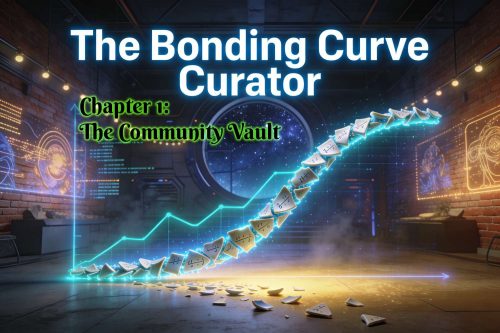
A curve appeared.
It started at the bottom left corner of the screen, hugging the horizontal axis. Then it rose—gently at first, almost lazily, before curving upward like a playground slide flipped in reverse. The slope grew steeper, then steeper still, until the line shot toward the top right corner like a rocket.
Kael had drawn this curve a hundred times on whiteboards, on napkins, on the back of his hand during sleepless nights. But seeing it on the big screen, in front of all these people, made it feel real.
“This,” he said, and his voice cracked slightly. He cleared his throat. “This is a bonding curve.”
A woman in the third row raised her hand. “Is it a stock?”
“No,” Kael said.
“Is it a lottery?”
“No.”
“Then what is it?”
Kael smiled. That was exactly the right question. “It’s a promise written in code. A mathematical promise that says: the more people believe in something, the more it’s worth. But also—and this is important—the moment people stop believing, it’s worth less. No middlemen. No banks. No gatekeepers. Just math.”
He clicked to the next slide. The same curve, but now labeled. The horizontal axis read Token Supply. The vertical axis read Price.
“The formula is simple,” Kael said. He wrote it on the screen:
price = supply² / 1,000,000
“Every time someone buys a token, the supply goes up by one. The price goes up according to this formula. And the money they paid goes into a treasury—a pot of funds that belongs to the community.”
He let that sink in. Then he clicked again.
A cartoon vending machine appeared on the screen. Inside, rows of soda cans.
“Imagine a vending machine,” Kael said. “You put money in, you get a drink. But here’s the twist: every time someone buys a drink, the price goes up for the next person. The first can costs one dollar. The second costs one-oh-one. The hundredth costs two dollars. The thousandth costs ten dollars.”
A kid near the front—maybe twelve years old, here with an artist parent—raised a hand. “That’s not fair.”
Kael nodded. “It’s not fair if you think about fairness in terms of equal prices. But it’s fair if you think about it in terms of belief. The first person to believe in the vending machine takes a risk. They don’t know if anyone else will show up. They’re betting that the machine will succeed. So they get a reward for that risk.”
He clicked again. A crowdfunding bar appeared, the kind that fills up as donations come in.
“Or think about a crowdfunding campaign,” Kael said. “The first backers get the best rewards—early access, limited editions. Late backers just get the product. The bonding curve is like that, but automated. And continuous. You can buy a token at any time. You can sell at any time. There’s no closing date, no auction, no waiting for a big platform to release your funds.”
He stepped out from behind the podium, walking slowly along the front row so he could make eye contact with different people.
“Here’s what this means for Arcadia,” he said. “Right now, artists submit proposals. The community votes. If an artist is approved, they get paid from the treasury. Not a grant that runs out. Not a donation that depends on one rich person’s mood. A continuous stream of funding that grows as more people buy tokens.”
He pointed at the curve. “As the community grows, the price rises. As the price rises, the treasury grows. As the treasury grows, we can fund more artists. Better artists. Bigger projects. It’s a loop. A virtuous cycle.”
“And if people leave?” That was Ria.
Kael hadn’t noticed her until now. She was sitting in the back row, arms crossed, legs extended. Seventeen, like him. He’d seen her around the neighborhood but never spoken to her. She had dark hair pulled back in a loose ponytail and the kind of face that looked like it was always calculating something.
He’d heard rumors about her father—an economist who studied market crashes, the kind of person who showed up on local news segments with titles like “Is the Boom About to Bust?” Ria, apparently, had inherited his skepticism.
“If people leave,” Kael said carefully, “they sell their tokens. The supply goes down. The price goes down. The treasury shrinks.”
“And then artists stop getting funded.”
“Then artists stop getting funded,” Kael agreed. “But that’s honest. That’s real. Right now, Arcadia gets donations from people who may not even live in this neighborhood anymore. Grants from foundations that have never set foot in this building. The bond between the community and the art is broken. The curve fixes that. You buy a token, you’re not just donating. You’re owning. You’re saying: I believe in this place, and I want a stake in its future.”
He paused.
“Or,” he said, “you sell your token, and you’re saying: I don’t believe anymore. And that’s okay too. The curve doesn’t punish you for leaving. It just adjusts.”
The room was quiet. Kael could feel the weight of twenty people trying to understand something that didn’t fit into their normal categories. It wasn’t a bank account. It wasn’t a stock portfolio. It wasn’t a charity drive. It was something else.
Ms. Velen nodded at him from the side of the room. Encouragement.
“Any questions?” Kael asked.
A dozen hands went up.
He answered them one by one. Yes, the code was open-source—anyone could audit it. No, there was no central authority controlling the treasury—the smart contract did that automatically. Yes, the price could go down—that was a feature, not a bug. No, there was no limit on how many tokens one person could buy—the contract was permissionless, which meant anyone could participate.
That last answer made Ria uncross her arms.
“Permissionless,” she repeated. Not a question. A statement.
“Yes,” Kael said.
“Meaning,” Ria said, standing up, “that one person could buy thirty percent of the supply if they had enough money.”
Kael hesitated. “Theoretically, yes.”
“Practically,” Ria said, walking down the aisle toward him, “what happens when they do?”
Kael had prepared for this question. He’d anticipated skepticism. But something about the way Ria moved—deliberate, unhurried, like a prosecutor approaching a witness—made his prepared answers feel flimsy.
“The price would rise,” he said. “That person would pay more for each subsequent token. The treasury would grow from their purchases. The curve would reflect the increased demand.”
“And then,” Ria said, stopping a few feet from him, “that person would control thirty percent of the governance votes. Thirty percent of the say in which artists get funded. Thirty percent of the power to shape Arcadia’s future.”
Kael opened his mouth. Closed it.
“That’s not in your slides,” Ria said.
“No,” Kael admitted. “It’s not.”
Ria turned to face the room. Her voice was calm but carried easily. “I’m not here to attack Kael’s idea. I think bonding curves are mathematically beautiful. I think they solve real problems—gatekeeping, middlemen, trust. But I also think they’re dangerous in ways that aren’t obvious when you’re just looking at the formula.”
She walked back to the screen, pointing at the curve. “Do you see how steep this gets? At low supply, the slope is gentle. Early buyers pay almost nothing. But as supply grows, the slope increases. The hundredth buyer pays more than the tenth. The thousandth pays more than the hundredth. The curve doesn’t just reward early believers—it rewards them exponentially. And the people who come later? The ones who discover Arcadia after it’s already successful? They get priced out.”
She turned to Kael. “What’s the slope at ten thousand tokens?”
Kael did the math in his head. “Two hundred units per token.”
“And at twenty thousand?”
“Eight hundred units per token.”
Ria nodded. “So someone who discovers Arcadia when it’s already thriving would have to pay four times as much as someone who discovered it earlier. Is that fair?”
Kael felt the room’s attention shift. He was no longer the expert. He was the student.
“The early believers take a risk,” he said. “They should be rewarded.”
“They should be rewarded,” Ria agreed. “But should they be rewarded so much that new people can’t afford to join? Because if new people can’t afford to join, the community stops growing. And if the community stops growing, the curve flattens. And if the curve flattens, the treasury stops growing. And if the treasury stops growing—”
“Arcadia dies,” Kael finished.
“Arcadia dies,” Ria said. “Not from a whale attack. Not from a crash. From something worse. From stagnation.”
She returned to her seat. The room was silent for a long moment.
Then someone else raised a hand. “So what do we do? Just give up?”
Kael looked at Ms. Velen. She gave him a small nod—not encouragement this time, but permission. Permission to be honest.
“No,” Kael said. “We don’t give up. But Ria is right. The curve isn’t a magic wand. It’s a tool. And like any tool, it can be used well or badly. My job—if you’ll let me do it—is to make sure we use it well.”
He clicked to a new slide. A list of safeguards.
“We can add caps,” he said. “Limits on how many tokens one wallet can hold. We can add time-locks—if someone buys a large percentage, they can’t sell for a certain period. We can create a reserve fund that automatically buys tokens if the price falls too low. The math is flexible. The curve can be curated.”
Ria’s eyebrows rose slightly. She hadn’t expected him to agree with her.
“I’ve read the case studies,” Kael said, looking directly at her. “Twenty-three bonding curve communities that collapsed. I know the patterns. The whale who buys too much. The crash that happens too fast. The slow death of a community that priced out its own future supporters. I know.”
“Then why are you still proposing this?” someone asked.
Kael took a breath. “Because the alternative is worse. Right now, Arcadia is dying slowly. Grants get rejected. Donors move on. The art keeps getting made, but the funding gets harder. The curve isn’t a guarantee. But it’s a chance. A chance to build something that isn’t dependent on one rich person’s mood or one foundation’s priorities. A chance to let the community decide—with their wallets, with their participation, with their belief—what Arcadia is worth.”
He looked around the room. Twenty faces. Some skeptical. Some hopeful. Most somewhere in between.
“I’m not asking you to trust the math,” he said. “I’m asking you to trust each other. The curve is just the tool. You’re the ones who decide how to use it.”
Ms. Velen stood up. “We’ll vote on this tomorrow night. Read the materials Kael has prepared. Talk to each other. Think about what Arcadia means to you, and what you’re willing to risk to save it.”
The meeting ended. People stood, stretched, formed small groups of conversation. Kael stayed at the podium, watching, waiting for someone to come tell him he was crazy.
Ria was the first.
She walked up to him, hands in the pockets of her jacket. Up close, he could see that she wasn’t angry. She was something else—focused, maybe. Or wary.
“I’m not against you,” she said quietly. “I’m against surprise.”
“I didn’t expect you to—”
“I know. That’s the problem.” She pulled a folded piece of paper from her pocket and pressed it into his hand. “My father has files on those twenty-three collapses. Interviews with the people who lived through them. Spreadsheets showing exactly where each curve went wrong. Read them before you launch. Please.”
Kael looked at the paper. An address. A time. Tomorrow evening.
Ria was already walking away. She paused at the door, looking back over her shoulder.
“The curve is beautiful,” she said. “But beauty isn’t safety. And safety is what Arcadia needs.”
Then she was gone.
Kael stood there for a long moment, the paper crumpled in his fist. Outside, through the warehouse’s high windows, the first stars were appearing. The curve on the screen behind him had gone dark, but he could still see it in his mind—rising, steepening, promising everything.
He thought about Ria’s words. Beauty isn’t safety.
She was right. But she was also wrong.
Beauty wasn’t safety. But maybe, with the right care, it could be something better. Something worth building.
He folded the paper carefully and put it in his pocket.
Tomorrow, he would read the files. Tomorrow, he would learn from other people’s failures.
Tonight, he let himself believe that his own story would end differently.
Table of contents:
Introduction
Chapter 1: The Community Vault
Chapter 2: A Curve in the Code <<<<<< NEXT
Chapter 3: The First Mint
Chapter 4: The Asymptote Trap
Chapter 5: The Collapse Spiral
Chapter 6: Curating Not Speculating
Chapter 7: The Continuous Auction
Chapter 8: A Floor Price for Dreams
Chapter 9: The Curve Flattens
Chapter 10: A Sustainable Arc
