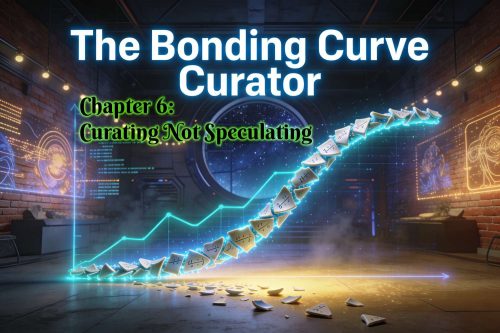
The crash was still happening.
Kael stood in the middle of the chaos, his voice hoarse from shouting. “Stop selling! Please! Every sale makes the price lower!”
But no one was listening. They couldn’t. Fear had taken over, the way fear always did when people watched their money disappear in real time.
The grandmother who had bought tokens at the peak—the one who had invested her retirement fund because she believed in art—was tapping frantically on her phone, trying to sell before her tokens became worthless. The student who had put their savings into the curve was already in tears, watching the price drop faster than they could complete a transaction. A man Kael didn’t recognize was yelling at the screen, demanding to know who had let this happen.
I let this happen, Kael thought. I built the bomb. I handed the Whale the match.
But there was no time for guilt. The dashboard showed the old curve’s price falling like a stone: 0.041 → 0.038 → 0.035 → 0.032. The floor price fund was exhausted. The treasury was hemorrhaging. And the migration contract—the rescue curve he’d deployed in desperation—was processing swaps, but slowly. Too slowly.
Ria grabbed his arm, pulling him away from the podium. Her face was pale but her eyes were sharp. “You can’t talk them out of panic. Fear doesn’t listen to reason. We need to deploy the new curve as an overlay. Right now.”
“That’s not how smart contracts work,” Kael said. “The old curve is still running. The new curve is separate. People have to choose to migrate. We can’t force them.”
“Then we make the migration the only sensible choice. We create a rescue curve that exists alongside the old one. Anyone who swaps gets immediate protection. Anyone who stays gets crushed.”
Kael shook his head. “That’s coercion.”
“That’s triage. We have maybe thirty minutes before the old curve is completely worthless. The Whale has already sold everything. The only people left are small holders—the ones who believed in us. We have to save as many as we can.”
She pulled out her phone, showing him a message from her father. Corin had been monitoring the crash from home. His advice was short and brutal: Migrate or die. There’s no third option.
Kael looked around the room. People were crying. Someone had dropped their phone and was crawling on the floor trying to find it. A volunteer was trying to comfort a teenager who had just lost two years of savings.
He made a decision.
“Help me code,” he said.
They worked on a laptop propped on the podium, surrounded by chaos.
The rescue curve needed to be simple. No complex Shard system yet—that could come later. Right now, they needed a safe harbor: a new bonding curve with a fixed swap rate from old tokens, a per-wallet cap, a time-lock, and a floor price fund seeded from the remnants of the old treasury.
Kael typed. Ria checked his math. Corin, on a video call from his home office, advised on the economic parameters.
“The swap rate should be 1:1,” Corin said. “One old token for one new token. No premium, no discount. That’s the only fair way.”
“But the old tokens are almost worthless,” Ria said. “People will be swapping trash for treasure.”
“They’ll be swapping hope for safety. That’s the point.”
Kael implemented the swap function. He added a cap: no wallet could hold more than 10% of the new supply. He added a time-lock: any purchase over 5% of supply would lock both buys and sells for fourteen days. He added a floor price fund: 20% of all minting proceeds would go into a reserve that automatically bought tokens if the price fell below 0.05 units.
The code wasn’t beautiful. It was rushed, patched together, full of compromises. But it was functional.
He deployed the rescue curve to the main network.
Rescue Curve live at 0xRescueArcadia
“Listen to me!” Kael shouted over the noise. “The rescue curve is live! Anyone who swaps their old tokens for new tokens gets a 1:1 exchange rate, plus all the new safeguards! The old curve is dying! Come to the new one!”
People looked up from their phones. Some of them had already sold their old tokens for pennies. Some of them had held on, hoping for a miracle. Some of them didn’t understand what Kael was saying.
But enough did.
The first swap came from the grandmother. She had been trying to sell her old tokens for fifteen minutes, watching the price drop from 0.04 to 0.01. She had almost given up. But now, with trembling fingers, she connected her wallet to the rescue curve and swapped her remaining tokens.
0xElena swapped 2 old tokens for 2 new tokens.
New curve supply: 2. Price: 0.000004 units.
The grandmother looked at her phone. Her new tokens were worth almost nothing—the new curve’s price was starting from zero, just like the old curve had. But the new curve had a floor price fund. It had a cap. It had a time-lock. It had a chance.
She looked at Kael and nodded. “I’m staying.”
Then the student swapped. Then the volunteer. Then the artist who had shown up to every open mic for three years.
Swap after swap. The migration wasn’t fast, but it was steady. The old curve’s price continued to fall—0.009, 0.006, 0.003—but fewer and fewer people were left to care. They had already left.
Within an hour, sixty percent of the old token holders had migrated to the rescue curve.
The Whale was gone. Their wallets were empty, their influence terminated. The old curve was a ghost town—a few dozen tokens held by people who hadn’t heard about the migration, or who had given up entirely.
Kael stood in front of the screen, watching the new curve’s dashboard populate. The price was 0.000021 units. The supply was 912 tokens. The treasury held 19 units—a pittance compared to what the old treasury had been, but real. Owned. Protected.
“The new rules are active,” he announced to the remaining crowd—maybe thirty people, all exhausted, all shell-shocked. “Here’s what that means.”
He walked through the safeguards.
The Per-Wallet Cap: No one could hold more than 10% of total supply. The Whale’s trick of using multiple wallets was now detectable—the contract monitored for coordinated behavior and could freeze suspicious accounts pending a community vote.
The Two-Way Time-Lock: Any purchase exceeding 5% of total supply triggered a fourteen-day lock on both buying and selling. No more rapid accumulation followed by a sudden dump.
The Floor Price Fund: Twenty percent of every mint went into a reserve. That reserve was programmed to buy tokens automatically if the price dropped below 0.05 units. It wasn’t a guarantee against crashes, but it was a buffer—a speed bump for anyone trying to drive the price down.
The Shard System (coming soon): In the next version, tokens would be tied to participation. You would need to earn Shards by contributing to Arcadia before you could buy. The Shards weren’t ready yet—that would take another week of coding—but the community had voted to include them in the roadmap.
“This curve isn’t beautiful,” Kael said. “It’s not simple. It won’t make anyone rich overnight. But it might survive. And survival is what we need right now.”
A woman in the back raised her hand. “What about the artists who were funded by the old curve? Zinn got five hundred units. That money came from the Whale’s purchases. Is it still valid?”
Kael had been dreading this question. The old treasury had been drained to pay the Whale during the crash. The 500 units Zinn had received had come from the Whale’s initial purchases, but those purchases had been funded by the Whale’s own money. Legally, ethically, the money was Zinn’s.
“Zinn’s funding is secure,” Kael said. “The Whale bought those tokens willingly. The treasury paid Zinn. That transaction is final.”
“But the Whale’s money—”
“The Whale’s money is gone. They sold everything. They made a profit on the crash—that’s how bonding curve attacks work. But the money they paid into the treasury? That money funded art. That art belongs to Arcadia. Zinn has already offered to donate a portion of any future sales back to the community. That’s their choice, not the Whale’s.”
He looked at Zinn, who was sitting on the floor near the back, surrounded by boxes of ceramic shards. Zinn nodded once.
“The sculpture is destroyed,” Zinn said quietly. “But I’ll rebuild it. And when it sells—if it sells—half the proceeds go to the new treasury. That’s my promise.”
The room was silent. Then someone started clapping. Then someone else. Soon, the applause filled the warehouse—not joyful, but grateful. The kind of applause that said: We’re still here. We’re still trying.
Later that night, after the crowd had dispersed and the volunteers had finished sweeping, Kael found Ria sitting on the roof of Arcadia.
There was a narrow ladder at the back of the warehouse that led to a flat section of roof—a place where Ms. Velen sometimes went to smoke and think. Kael had never been up there before. He climbed the ladder now, his hands sore from typing, his eyes burning from staring at screens.
Ria was sitting with her back against a ventilation unit, looking up at the stars. The city lights made the sky a washed-out gray, but a few bright points still pierced through.
“Can I sit?” Kael asked.
Ria patted the tar paper beside her.
He sat. For a while, neither of them spoke. Below them, the warehouse was quiet. The string lights had been turned off. The only sound was the distant hum of traffic and the occasional siren.
“My mother stopped painting because of a curve,” Ria said finally.
Kael turned to look at her. Her face was half in shadow.
“She was part of a bonding curve community—one of the first. An art collective in another city. They raised money to fund experimental work. The curve was beautiful, simple, elegant. Everyone believed in it. My mother believed in it so much that she invested everything she had. Not just money—her time, her energy, her art.”
Ria’s voice was steady, but Kael could hear the pain underneath.
“For two years, it worked. The curve rose. The treasury grew. Artists got funded. My mother’s work was shown in galleries she’d only dreamed about. Then a whale appeared—someone with enough capital to buy thirty percent of the supply. They seemed benevolent at first. They supported the art. They voted with the community. Everyone trusted them.”
She paused.
“Then they sold everything in one night. The crash was fast—faster than the old Arcadia crash. My mother lost everything. Not just her investment. Her belief. She stopped painting the next day. She hasn’t painted since.”
Kael thought about the photograph on Corin’s table. The woman with Ria’s eyes, standing in front of a gallery wall, smiling.
“I’m sorry,” he said.
“I’m not telling you this for sympathy. I’m telling you because I’ve been trying to protect you from making the same mistakes. My mother’s community didn’t have a curator. They had a curve. And the curve didn’t care about them. It just executed the math.”
Ria turned to face him. Her eyes were wet, but she wasn’t crying.
“When you showed up at the first meeting, so passionate, so sure that the math would save Arcadia… I saw my mother’s community all over again. The same hope. The same blindness. I wanted to warn you, but I didn’t know how. So I sent you my father’s files. I showed up at your door. I pushed you to add safeguards. Because I didn’t want Arcadia to become another collapse story.”
Kael nodded slowly. “You were right. About everything. The curve was dangerous. The Whale came. The crash happened. I didn’t listen enough.”
“You listened enough to add the safeguards. You listened enough to build the rescue curve. You listened enough to save sixty percent of the community.” She reached over and put her hand on his arm. “That’s more than my mother’s curator ever did.”
“What happened to their curator?”
Ria’s mouth tightened. “He blamed the math. Said there was nothing he could have done. He walked away and never looked back.”
Kael looked down at his hands. They were still shaking—from adrenaline, from exhaustion, from the weight of everything that had happened.
“I’m not walking away,” he said.
“I know.”
“The new curve is just the beginning. I’m going to keep curating. Keep adding safeguards. Keep listening. Not because I think I can prevent every attack—but because I can be here when they happen. I can respond. I can help rebuild.”
Ria smiled—a real smile, the first Kael had seen from her since before the crash.
“That’s the difference,” she said. “My mother’s curator built a system and abandoned it. You’re building a garden and staying to weed it.”
Kael laughed—a dry, exhausted laugh. “A garden. I like that.”
They sat in silence for a while longer, watching the stars. Then Ria stood up.
“We should get some sleep. Tomorrow, we have a community to rebuild.”
Kael stood too. “The Shard system. I want to start coding it tomorrow.”
“One thing at a time. First, rest. Then, Shards.”
She walked to the ladder and climbed down. Kael lingered on the roof for a moment, looking out at the neighborhood. Somewhere below, Zinn was probably still in their studio, gluing ceramic shards back together. Somewhere else, the grandmother was checking her new token balance, still learning to trust again.
The old curve was dead. The Whale was gone. But Arcadia was alive.
Kael climbed down the ladder and went home to sleep.
The next morning, Kael woke to a message on the community chat.
It was from the grandmother—the one who had almost sold everything, who had swapped her old tokens for new ones at the last possible moment. She had written a long post, explaining why she had decided to stay.
“I’ve been coming to Arcadia since the first year. I’ve seen it survive eviction notices, funding cuts, and a pandemic. Last night, I almost lost everything. But I didn’t. Because Kael and Ria built a way out. A new curve. A new chance. I’m staying. Not because I believe in the math—I still don’t understand the math. I’m staying because I believe in the people.”
Kael read the post three times. Then he replied.
“Thank you. I’m staying too. We all are.”
Other messages followed. The student who had lost their savings but swapped anyway: “I’m staying.” The volunteer who had spent the night sweeping up ceramic shards: “I’m staying.” The artist who had never bought a token but had shown up to every meeting: “I’m staying.”
One by one, the community rebuilt itself—not around a curve, but around each other.
Kael closed his laptop and went to the window. The sun was rising over the neighborhood, painting the rooftops in shades of gold and pink.
The new curve was live. The Shard system was waiting. And the work was just beginning.
He smiled.
Curating not speculating, he thought. That’s the difference.
Table of contents:
Introduction
Chapter 1: The Community Vault
Chapter 2: A Curve in the Code
Chapter 3: The First Mint
Chapter 4: The Asymptote Trap
Chapter 5: The Collapse Spiral
Chapter 6: Curating Not Speculating
Chapter 7: The Continuous Auction <<<<<< NEXT
Chapter 8: A Floor Price for Dreams
Chapter 9: The Curve Flattens
Chapter 10: A Sustainable Arc
