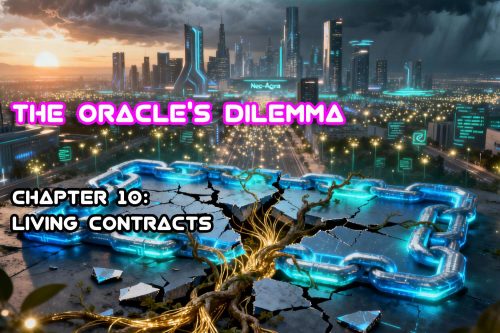
One year later, the scars were still visible, but they were no longer wounds. Neo-Agora had not been rebuilt to its former, gleaming perfection. It had been grown anew, with a different kind of logic woven into its foundations. The new structures in the Riverfront District were lower, more resilient, with green roofs and redundant systems. They were beautiful in a functional, humble way.
Ben Aris, now eighteen, stood not in the Codex Lounge, but in the bright, open-plan Academy for Civic Systems Design. He wasn’t a student competing in a Script-Off. He was an apprentice designer, invited to present his capstone project to a class of wide-eyed fifteen-year-olds.
He felt a familiar flutter of nerves, but it was different now. It wasn’t the fear of being judged on elegance alone. It was the weight of responsibility.
“Okay,” he began, gesturing to a holographic model that bloomed in the air between him and the students. It was a complex, multi-layered schematic. “This is the Green-Canopy Maintenance Contract for the new Memorial Park. The old way would have been a simple: IF (RAINFALL < 10mm) THEN (ACTIVATE_SPRINKLERS_18:00).“
A few students nodded. It was clean. It was what they’d been taught first.
“That contract would have died last year,” Ben said simply. “Because when the quake broke the main water line, it would have kept trying to activate sprinklers, wasting auxiliary water pressure needed for firefighting. It would have been correct, and destructive.”
He zoomed in on his new model. “So, this is a Living Contract. First: it has Adaptive Parameters.” He highlighted a data stream. “It doesn’t just check for rain. It learns. It connects to the city’s hydro-logical health oracle. It knows if we’re in a drought cycle and reduces water usage proportionally. It can even suggest to the park’s compost contract to add more moisture-retaining mulch. It’s not a single order; it’s a conversation within a system.”
A girl in the front row raised her hand. “But who programs the learning? Isn’t that just a more complicated AI?”
“Good question,” Ben said. “The learning algorithms are set, but their goals are guided. Which brings me to the second part: Built-in Review Periods.” A new layer lit up, showing calendar markers. “Every six months, the contract opens itself up. Not for a full rewrite, but for community feedback. The park’s soil moisture data, water usage, even public sentiment scores from community boards are fed into a review module. If the metrics show the trees are stressed or water use is too high, the contract flags itself for a potential tweak.”
“So it… asks for help?” a boy asked, incredulous.
“It signals,” Ben corrected with a smile. “Which leads to the third part: The Community Governance Hook.” The schematic showed a branching path. “If a review suggests a change beyond minor parameter adjustments—like, say, replacing the sprinklers with a drip-irrigation system—the contract doesn’t just do it. It generates a proposal. That proposal goes to a micro-DAO of the people who live around Memorial Park. They vote. If they reach consensus, the change is implemented. The contract evolves, but only with the consent of the governed.”
He let the model spin, a beautiful, intricate dance of data loops, feedback nodes, and human decision points. “We don’t write finished laws anymore. We write seeds. And we build a garden where they can grow, with sunlight from the community and water from their needs.”
As the class erupted in questions, Ben’s eyes drifted to the window. Across the plaza, he could see the Office of Context & Code, the low, graceful building that had replaced the old, tomb-like Oracle Hub.
Inside that building, Maya Cruz was no longer facing a wall of silent sensors. She sat in a circular chamber with the six other members of the Civic Oversight Panel. Her title was Senior Contextual Analyst. Before them was their first live, non-emergency use of the circuit-breaker.
A public safety contract had flagged an anomaly. The PUBLIC_TRANSPORT_AFTER_HOURS contract, designed to run minimal “owl” services at a financial loss to ensure no citizen was stranded, was being exploited. A pattern showed a single individual using it every night, taking extremely long, circular routes. The contract’s fraud-detection sub-clause was about to trigger, banning the individual’s transit pass for 30 days.
The system saw a logical flaw: resource abuse.
But Maya had requested context. The individual was an elderly man named Mr. Aris. Ben’s grandfather.
“He has onset dementia,” Maya explained softly to the panel, her screen showing medical records (with permissions granted for the review). “He gets confused in the evenings. He gets on the tram because it’s familiar and safe. The drivers know him; they keep him warm and bring him back to his stop near the assisted living facility. The contract sees a financial loss. The drivers see a human being they’re protecting.”
The panel—Anya the medic, Leo the firefighter, the ethicist, the coder, the two citizens—listened. They reviewed the clean, accusing data of the contract, and the messy, compassionate data of the real world.
“The contract is functioning as designed,” the former coder on the panel noted.
“But its design is based on the assumption of malicious intent,” Kira Hassan, the community organizer, countered. “This is not malice. This is vulnerability.”
They voted. Unanimously. Not to cancel the contract, but to amend its execution for this specific case. They created a contextual exemption, tagged to Mr. Aris’s pass, that would prevent the fraud clause from triggering while alerting the night drivers to gently check on him. The amendment was recorded on-chain, with the panel’s reasoning attached for all to see: “A city’s strength is measured not by its efficiency, but by its capacity for care.”
Later, Maya met Ben in the new Memorial Park, by a sapling that had been planted where a collapsed building once stood. The adaptive sprinklers were off; the soil was damp from a morning rain the system had correctly predicted.
“How was the panel?” Ben asked.
“We prevented your grandpa from being banned from the tram,” she said, smiling.
Ben blinked, then laughed, a sound of pure relief. “He told me the drivers were being extra nice. Thank you.”
“Thank the system,” Maya said. “The old one would have just banned him. The new one asked a question.”
They walked in comfortable silence. The city hummed around them, but it was a different hum. Softer. More rhythmic. It was the sound of countless Living Contracts operating, most never needing human intervention, but all containing the silent, potential for a question to be asked.
Ben stopped, looking at the young tree. “I used to think flexibility was a weakness in code. A door left open for bugs.”
“And now?” Maya asked.
“Now I think it’s the only thing that keeps the code from becoming a cage,” he said. “We’re not writing the story of the city anymore. We’re writing the grammar. The citizens write the sentences.”
Maya nodded, looking up at the sky where a few benign clouds drifted. “The new storm-water retention contracts are online. They’re linked to the weather oracles, but also to the neighborhood associations. If a big storm is coming, they can vote to pre-emptively lower the levels in the catchment basins, even if the predictive models aren’t 100% sure. It trusts them with the context of their own fear.”
A notification pinged softly on both their wrist-comms. It was a city-wide alert, but not an alarm. A Civic Pulse Update.
MEMORIAL PARK MICRO-DAO: PROPOSAL 3A RATIFIED.
PROPOSAL: Allocate surplus community points to install interactive history markers at park’s edge, detailing the recovery.
VOTE: 89% in favor.
CONTRACT AMENDMENT: Executed. Funds transferred to public artists’ collective.
Ben and Maya looked at each other. The park they stood in was already evolving, growing in a direction its original designer hadn’t anticipated, guided by the people who used it. It was a small thing. A footnote in the city’s ledger.
It was everything.
As the sun began to set, painting the new, resilient city in gold and shadow, they stood together, two architects of a new world not of perfect answers, but of better questions. The motto etched into the base of the young sapling nearby said it all, not in grand pronouncements, but in a simple, living promise:
GROW WITH US.
Table of contents:
Introduction
Chapter 1: The Smart Contract City
Chapter 2: If This, Then That
Chapter 3: The Black Swan Event
Chapter 4: Code is Not Law
Chapter 5: The Oracle’s Whisper
Chapter 6: Hardcoding Compassion
Chapter 7: The DAO of Disaster Relief
Chapter 8: Consensus in the Rubble
Chapter 9: A Human in the Loop
Chapter 10: Living Contracts
