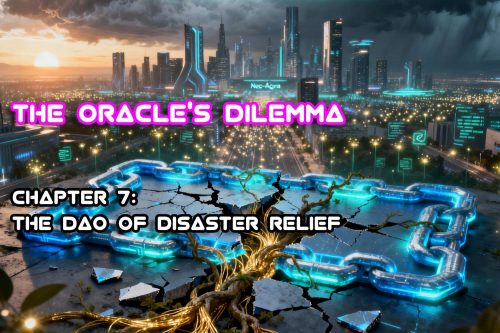
The air in the Oracle Hub had changed. The static of despair had been replaced by the crisp, focused energy of a moon-shot project. Ben and Maya worked side-by-side, their skillsets no longer clashing but interlocking like gears in a new, untested machine.
Ben’s world was a single terminal, its glow painting his face in shades of blue and green. He was building the skeleton of their lifeline. His fingers, which had once composed elegant symphonies of automated logic, now hammered out the pragmatic, robust code for the Neo-Agora Relief Cooperative (NRC) DAO.
“It has to be simple,” he muttered, more to himself than to Maya. “Simple to understand, simple to use. The voting mechanism… not proof-of-work, not proof-of-stake. Proof-of-presence. Proof-of-need.” He crafted a permissioned structure. A council of seven seats, each represented by a unique digital key. To propose a fund allocation: any council member. To vote: any council member. To execute: a 5/7 majority trigger.
“Five out of seven?” Maya asked, looking over from her own screen where she was drafting the governance charter. “That’s a high bar.”
“It has to be,” Ben said, his eyes never leaving the code. “This is a temporary government controlling what’s left of the city’s treasury. We need consensus, not just a simple majority. It prevents… well, it prevents someone like me from doing something stupid in a panic.” He typed a final line, a function that would render every proposal, every vote, every transaction onto a public, transparent ledger. “There. The contract is ready. It’s a blank vault with a very specific lock.”
Maya’s work was messier, human. She was identifying the first council members. Not by algorithm, but by intuition and desperate necessity. She compiled dossiers from the fractured city net: Anya Chen, the head medic at the drowning triage center. Leo Rostov, a fire captain whose team was operating out of a drowned firehouse. Kira Hassan, a community organizer from the undamaged but overwhelmed Ridge District, known for her fierce practicality. Mayor Silva would have a seat, as would Ben and Maya themselves. The seventh seat they left open, a wildcard for someone they’d meet on the ground.
“The council needs to see each other, hear each other,” Maya insisted. “This can’t be anonymous voting on a blockchain. Not now.”
Ben nodded, already on it. “I can rig a low-bandwidth, encrypted audio channel through the emergency mesh network. It’ll be patchy, but it’ll work. The votes themselves get recorded on-chain, but the debate… that’s human.”
Their final, and most daunting task, was the funding mechanism. Ben’s “splitter” contract was elegant in its simplicity. It was a voluntary opt-in. Any citizen, business, or municipal department could sign it with their private key, authorizing that a percentage of their next 30 days of scheduled payments to the city be redirected to the NRC DAO wallet instead. It was a trust exercise, coded in Solidity.
The stage was set. Now, they needed the conductor.
Mayor Silva stood before a shaky drone-camera in a semi-intact municipal studio. His face was gaunt, the confidence of the “Code is Law” evangelist utterly gone. In its place was a raw, startling honesty.
“Citizens of Neo-Agora,” he began, his voice raspy but clear. “Our systems have failed us. Not because they were hacked, but because they were perfect. They executed the logic we gave them, and that logic did not account for the chaos of reality. People are suffering because of this. That ends now.”
He held up a simple dataslate displaying a long, alphanumeric string—the public address of the NRC DAO.
“This is not a replacement for our government. It is a lifeboat. It is the Neo-Agora Relief Cooperative. A temporary, transparent fund controlled by a council of your fellow citizens who are on the front lines of this disaster: our rescuers, our medics, our neighbors.”
He explained the voluntary splitter contract. He appealed to the city’s spirit, to its will to survive. “If you have an automated payment scheduled to the city in the next month, and you have the ability to modify its destination, I am asking you, as your Mayor, to send it here instead. Every token will be used, in real-time, to save lives, as decided by people who can see what’s needed with their own eyes.”
It was a staggering request. He was asking the city to voluntarily bypass its own foundational financial infrastructure. For a moment, there was only static. Then, the first transaction appeared on the public ledger Ben and Maya were monitoring.
A trickle.
FROM: TRANSIT_AUTHORITY_CORE. AMOUNT: 5,000 Tokens. TO: NRC_DAO.
“They did it,” Maya breathed.
Another.
FROM: RIDGE_DISTRICT_PROPERTY_POOL. AMOUNT: 12,000 Tokens.
Then another, and another. Not a flood, but a steady stream. Small businesses, individuals using manual overrides on their personal accounts, the water authority from an intact sector. The vault was no longer blank. It was alive with the collective, fragile trust of a wounded city.
The first council convened an hour later, via Ben’s patched-together audio channel. The connection was laced with static and the distant sounds of chaos—sirens, shouts, the groan of metal.
“This is Anya Chen,” a woman’s voice came through, strained with exhaustion. “I have seventeen critical patients who need to be moved to the Ridge District med-center. The drones we have can’t carry the life-support units. We need two heavy-lift evacuation transports and the fuel to run them. Estimated cost: 8,000 tokens.”
“This is Leo Rostov,” a gravelly voice cut in. “My team is cut off at Firehouse 7. The water’s rising. We need inflatable rafts and outboard motors now, or we become part of the problem. Cost: 3,000 tokens.”
“We have 22,000 tokens in the DAO,” Ben’s voice reported, all business. “We can’t do both at full ask.”
A third voice, calm and firm: Kira Hassan. “Then we prioritize. Anya, can you stabilize your patients for six more hours if you get the fuel for your generators now? Leo, if we get you the rafts, can your team begin evacuating civilians from the collapsed building on your block while you wait for the water to recede?”
A tense, static-filled silence. Then, grudgingly:
“Yes,” said Anya.
“We can,” said Leo.
“Then I propose a split,” Kira said. “6,000 to Anya for generator fuel and a deposit on the transports. 2,000 to Leo for two rafts now. We reassess in four hours.”
“Second the proposal,” Maya’s voice came, soft but firm.
“Mayor?” Ben prompted.
“I concur,” Silva said, the weight of his old authority lending gravity to the new process.
“Ben, Maya?” Kira asked.
“Yes,” they said in unison.
“Five of seven,” Ben announced. “Proposal passed. Executing.”
On his terminal, he initiated the contract function. It checked the votes, verified the signatures, and with a final, irreversible click, the immutable ledger recorded:
NRC_DAO: TRANSFER 6,000 TOKENS TO [EVAC_TRANSPORT_VENDOR]
NRC_DAO: TRANSFER 2,000 TOKENS TO [MARINE_SUPPLY_DEPOT]
In the drowned triage center, Anya Chen watched on a battered tablet as the payment confirmation appeared. Minutes later, a heavy-lift transport drone, its contract with the vendor now fulfilled, descended through the broken roof of the hall, its winch cables dropping.
On a second-floor landing of Firehouse 7, Leo Rostov heard the buzz of delivery drones. Two bulky packages were dropped—self-inflating rescue rafts. His crew whooped, a raw sound of hope.
Back in the hub, Ben and Maya stared at the ledger. It had worked. It was messy, emotional, and agonizingly slow compared to the millisecond executions of the old system. But it had worked. A human consensus had been reached, and the unfeeling, perfect logic of the blockchain had carried it out with flawless efficiency.
“We built a bridge,” Maya whispered, watching the confirmations stack up.
Ben nodded, a profound, weary understanding settling over him. He hadn’t fixed the old code. He hadn’t needed to. He and Maya had written a new protocol altogether—one where the most important variable wasn’t in the code, but in the hearts and minds of the people voting. It was the DAO of Disaster Relief, and its first decree was not an algorithm, but an act of collective, hard-won mercy.
Table of contents:
Introduction
Chapter 1: The Smart Contract City
Chapter 2: If This, Then That
Chapter 3: The Black Swan Event
Chapter 4: Code is Not Law
Chapter 5: The Oracle’s Whisper
Chapter 6: Hardcoding Compassion
Chapter 7: The DAO of Disaster Relief
Chapter 8: Consensus in the Rubble <<<<<< NEXT
Chapter 9: A Human in the Loop
Chapter 10: Living Contracts
