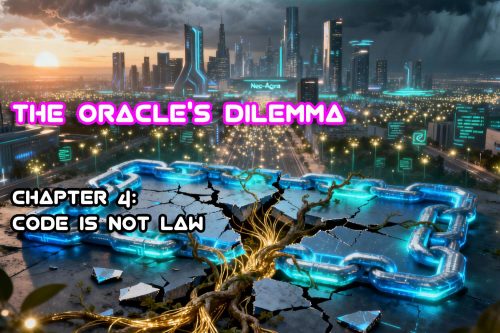
The first law of the Agora Chain was immutability. The second, which Ben now understood was actually the first and only law that mattered, was consequence.
He ran. Not toward shelter, but toward the riverfront, toward the failure. His lungs burned with dust and panic. The world was a fractal nightmare of the efficient and the apocalyptic. Autonomous street-sweepers, their programming unchanged, nudged at piles of rubble with methodical, useless persistence. A public service drone hovered at a shattered intersection, its calm pre-recorded voice looping: “SEISMIC EVENT DETECTED. PLEASE REMAIN CALM. PROCEED TO YOUR DESIGNATED SAFETY ZONE.” Behind it, a wall of brown water surged down the avenue, swallowing parked vehicles whole.
Ben skidded to a halt at the edge of the inundation zone, the water lapping at his boots. His wrist-comm was a torrent of data, a stark counterpoint to the physical chaos. He pulled up the ledger for GRID_NODE_ALPHA-7, the power station serving the Old Terrace district. Its contract was simple, beautiful, and currently enacting a death sentence.
CONTRACT: UTILITY_PAYMENT_V4
STATUS: EXECUTING -> TERMINATION PROTOCOL
PARAMETERS: IF (ACCOUNT_BALANCE_OLD_TERRACE_COLLECTIVE < SERVICE_THRESHOLD) AND (GRACE_PERIOD = 0) THEN (TERMINATE_POWER_NODE_ALPHA-7)
LOGIC: The Old Terrace Collective’s automated payment pool was funded by micro-transactions from 500 residential smart meters. 487 of those homes were now either destroyed or submerged. The collective balance was critically deficient. The 24-hour grace period, designed for minor financial hiccups, had elapsed at 2:47 PM. The earthquake had occurred at 11:17 AM.
At 2:48 PM, as the floodwaters rose, the contract had executed its THEN.
It terminated power.
Ben’s gaze was dragged from the screen to a two-story, reinforced community hall on slightly higher ground, just now being encircled by the invading water. A red cross, illuminated by emergency spotlights, was painted on its roof. A triage center. He’d seen the medical drones ferrying casualties there. Its lights, bright beacons a moment ago, flickered once and died.
The silence from the building was more terrible than any scream. The hum of ventilators, the beep of monitors, the efficient buzz of med-bots—all were swallowed by the dead quiet of a powered-down machine. Then, the human sounds rose: shouts of alarm, a cry of pain, the desperate, manual rasp of a hand-powered generator failing to catch.
“No,” Ben breathed. “No, it can’t. There has to be an emergency override…”
He stabbed at his comm, pulling up the contract’s ancillary clauses. There was an EMERGENCY_SERVICE_EXCEPTION. His heart leapt. He read it.EMERGENCY_SERVICE_EXCEPTION: APPLIES TO STRUCTURES OFFICIALLY TAGGED [CITY_HOSPITAL] OR [FIRE_STATION_ACTIVE].
The triage center was a community hall. Its official tag was [PUBLIC_ASSEMBLY_HALL_GAMMA-12]. The contract didn’t recognize it as a hospital. It recognized it as a debtor.
Code was Law. And the Law demanded payment.
A hand clamped on Ben’s shoulder, spinning him around. It was Mayor Silva. The man’s fine synth-wool suit was torn and dust-caked. His face was the color of ash, his eyes wide with a horror that wasn’t just about the disaster, but about understanding.
“Ben! Thank the Founders. You’re a scripter. You can access the backend. You have to help me override the utility contracts in Sectors 7 through 12! The water treatment plant is on a payment grid too, it’s going to shut down!”
Ben stared at him. “Mayor… the chain is immutable. You can’t override a live contract. The private keys to the city treasury, to the payment releases—they’re held by the contracts themselves. We don’t have them. No one does.”
“There has to be a master key! A failsafe!” Silva’s voice was raw.
“There isn’t!” Ben shouted, the truth he’d once worshipped now tasting like bile. “That was the whole point! To prevent corruption! To prevent you from making a politically expedient choice! The system doesn’t trust you!”
The words hung in the air between them. Silva flinched as if struck. He was the system’s greatest champion. He had dismantled the old, “corruptible” human-led committees. He had evangelized the clean, unforgiving logic. Now, he was pleading with a teenager for the mercy the system was designed to exclude.
A woman in a medic’s uniform, her coat stained with water and blood, splashed toward them. She was clutching a tablet. She shoved it into Silva’s chest.
“The triage center has no power! The backup generator’s fuel pump is electric—it’s dead! We have patients on ventilators! We’re losing them! You have to turn the power back on!”
Silva looked from the medic’s furious, terrified face to Ben’s helpless one. He took the tablet, his fingers trembling. He pulled up the city’s emergency administrative portal—a vestigial interface from a bygone era. He typed his mayoral credentials, his biometric signature. He navigated to GRID_NODE_ALPHA-7 and selected MANUAL POWER RESTORE.
The screen flashed red.
UNAUTHORIZED.
CONTRACT UTILITY_PAYMENT_V4 GOVERNS THIS ASSET.
DECENTRALIZED CONSENSUS REQUIRED FOR AMENDMENT.
ESTIMATED TIME FOR PROPOSAL, VOTE, AND EXECUTION: 72 HOURS.
“Seventy-two hours…” Silva whispered.
The medic’s hope shattered into fury. She snatched the tablet back. “What does that mean?!”
“It means the system,” Ben said, his voice hollow, “has to vote on whether to save them. And the vote takes three days.”
The medic looked at him, at the Mayor, at the darkening triage center. Her expression contorted from confusion, to disbelief, to a pure, undiluted rage. “Your ‘Law’…” she seethed, spitting the word, “is a choice. You chose to build a city that would let people die because of a billing error.”
She didn’t wait for a response. She turned and sloshed back toward the dark building, shouting for manual respirators.
The phrase echoed in Ben’s skull. A billing error. His perfect, elegant contracts had distilled a complex, catastrophic human tragedy into a ledger imbalance. A life-support system was just a line item. Compassion was an unaffordable variable.
He looked at Mayor Silva. The man was slumped, staring at his own hands—the hands that had written the early code, that had shaken the hands of investors, that had cut the ribbon on the “City of Tomorrow.” Now they were useless.
“I built the cage,” Silva said, not to Ben, but to the drowning city. “I told them it was freedom. I sold them the bars and called them progress.”
A new alert buzzed on Ben’s comm. He looked down, a fresh wave of dread rising.
CONTRACT: MUNICIPAL_SALARY_V2 NOTIFICATION.
STATUS: PAYMENT HELD.
EMPLOYEE CATEGORY: EMERGENCY_RESPONSE_PERSONNEL.
REASON: PROTOCOL OMEGA BONUS PAYMENTS (DISBURSED 11:17:04) HAVE EXCEEDED QUARTERLY DEPARTMENTAL BUDGET CAP [CLAUSE 12.C]. REMAINING SCHEDULED BI-WEEKLY PAYMENTS ARE BLOCKED UNTIL NEXT FISCAL CYCLE OR UNTIL OVERAGE IS REPAID.
The system had paid the first responders their hazard bonuses. And now, because that had pushed a digital budget into the red, it was refusing to pay their regular salaries. The logic was airtight. The incentive for heroic effort had accidentally triggered a penalty for continued employment.
Ben imagined a firefighter, exhausted from pulling people from rubble, checking their account and seeing a payment fail. The system didn’t see a hero. It saw a cost overrun.
He closed his eyes. He saw the lines of his CivicJoy_V4 contract, its pristine logic. He had been so proud of its clarity, its lack of loopholes for favoritism. Now he saw the same structural principle—the ruthless, unthinking execution of the THEN—playing out in a thousand ways, each one a tightening noose around the city’s throat.
The floodwaters were rising. The lights were going out. The life-saving machines were falling silent. And at the heart of it all, the Agora Chain hummed contentedly in its distributed servers, validating blocks, executing clauses, maintaining a perfect, terrible, and inhuman integrity.
Code was Law.
But in the drowning darkness of Neo-Agora, Ben Aris finally understood: the law could be a stupid, heartless tyrant. And he had been its most faithful architect.
Table of contents:
Introduction
Chapter 1: The Smart Contract City
Chapter 2: If This, Then That
Chapter 3: The Black Swan Event
Chapter 4: Code is Not Law
Chapter 5: The Oracle’s Whisper <<<<<< NEXT
Chapter 6: Hardcoding Compassion
Chapter 7: The DAO of Disaster Relief
Chapter 8: Consensus in the Rubble
Chapter 9: A Human in the Loop
Chapter 10: Living Contracts
