A year had passed since the shattering of silence in Server Room Gamma-7. The dust had settled, not into stagnation, but into a new, more vibrant pattern.
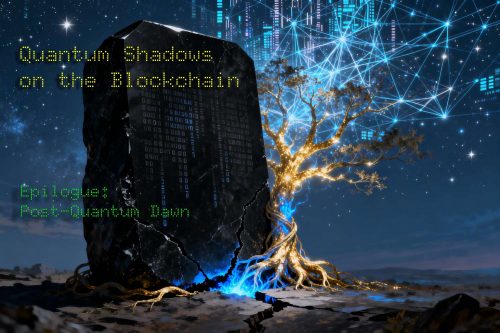
The Chamber of Contextual Memory was a new wing of the Central Archive Spire. Gone were the rows of silent, black plinths. Here, the space was dynamic. Holographic trees of light grew from floor to ceiling, their “branches” representing the main Monolith chain, and their shimmering “leaves” were the Truth Layer annotations, pulsing gently with the rhythm of ongoing verification and contribution. The air hummed with a low, purposeful murmur—the sound of a thousand conversations with the past.
In the center of the chamber, at a curved interface that seemed grown from crystal and light, sat Riven. She no longer wore the greyweave of an acolyte, but the deep blue tunic of a First Curator. Before her hovered a complex annotation cluster tethered to a block from the early Reconstruction era—a controversial resource allocation. The primary record was stark: coordinates, amounts, authorized signatures.
The Truth Layer around it was a galaxy of understanding. One annotation held the impassioned, flawed speech of the allocating official, full of hope and bias. Another linked to geological surveys from a decade later showing the allocated land was barren. A third held the testimony of the community that had been bypassed, their resentment and subsequent struggle woven into a data-poem. A fourth, newer annotation was a formal statement from the allocating official’s descendants, acknowledging the harm.
Riven’s role was not to judge, but to facilitate. She was reviewing a newly submitted annotation—a historical climate model suggesting a drought cycle the original allocators couldn’t have known. She verified its source, checked for corroborating data-points, and then, with a touch, granted it the Proof-of-Context seal. The new “leaf” took its place in the cluster, adding another dimension of understanding to the old decision. It didn’t excuse the bias, but it complicated the blame. History became less a courtroom and more a diagnostic scan.
A soft chime announced a visitor. She turned. Kaelen stood at the entrance to the chamber, looking both out of place and utterly at home. He wore practical engineer’s garb, but a small, intricate pin on his collar depicted two entangled rings—the symbol of the Quantum Ethics Guild, which he’d helped found. In his arms he carried not a tool kit, but a slender, polished case.
“You look like you’re tending a garden,” he said, a smile touching his lips as he approached.
“I am,” Riven replied, returning the smile. “A garden of shadows and light. It needs constant tending.” She nodded at the case. “What’s that? A new kind of crowbar?”
His smile widened. “The opposite. A new kind of trellis.” He opened the case. Nestled inside was a smaller, more elegant version of the Janus core, its surface a matte, non-reflective black, etched with the same entangled-ring symbol. “The Janus-II. Consumer-grade quantum context processor. One-tenth the power, one-hundredth the cost. It can’t break anything. It can only read, verify, and contribute to the Truth Layer. We’re distributing them to community archives, schools, even artist collectives.”
Riven looked from the humble, powerful device to Kaelen’s face. The arrogant fire was still there, but it was banked, focused, warming instead of burning. “The Keymaker becomes the Locksmith,” she observed.
“The key was always meant to open a door, not smash the wall,” he said softly, closing the case. “We’re building doors everywhere now.” He looked around the chamber, at the living history. “How is he?”
Riven knew who he meant. She called up a private feed. It showed a small, secluded garden, not unlike Thorne’s hidden one, but on the surface. The old man was there, pruning a different bonsai. His movements were slower, his solitude now a choice, not a prison. Beneath the live feed was a public Truth Layer annotation, written by Thorne and tethered to his own identity block. Its title was simple: “My Failure: A Primer on Ethical Systems Design.” It was his life’s work now—not building perfect fortresses, but documenting the cracks in his own, so others could build better.
“He’s teaching,” Riven said. “In the only way he can.”
A gentle, system-wide pulse of light flowed through the chamber’s holographic trees, a soft gold color. It was the “Understanding Enhanced” signal. Someone, somewhere, had just added a piece of context that met consensus, deepening the world’s grasp of a past event. It happened dozens of times a day now. It had become the heartbeat of the new age.
Kaelen and Riven stood together, watching the golden light ripple and fade, leaving the layered truth a little brighter in its wake. They didn’t speak of the past year’s dangers, the close calls, the grief for a ghost named Elias. That was all part of the Layer now, context for their own story.
Outside the panoramic window of the Spire, the city gleamed. The news tickers on the towers still flowed, but now, when a major story broke, the data was often followed by a soft, pulsing invitation: Explore Context. The world was learning to question not just what happened, but how it happened, and why it mattered.
The unbreakable vault stood, as solid as ever. But people no longer lived in its shadow. They lived in the valley it helped define, a valley now illuminated by the countless points of light in the Truth Layer, a constellation of human understanding growing richer every day.
Kaelen turned to go, his new trellis to deliver. He paused at the door. “The chain was immutable,” he said, echoing the words they’d lived by and through.
Riven looked from the living history in the chamber to the living city beyond the glass, her reflection overlaid on a world learning to breathe with its past.
“But we were not,” she replied, her voice quiet with certainty. “And that made all the difference.”
In the garden on the screen, Aris Thorne made a precise cut on a branch, not to constrain, but to guide its growth towards the light. The Post-Quantum Dawn was not an end, but a beginning—the first day of a longer, more honest conversation with time itself.
Table of contents:
Introduction
Prologue: The Last Digital Monument
Chapter 1: The Unbreakable Vault
Chapter 2: The Ghost in the Quantum Machine
Chapter 3: Breaking SHA-256
Chapter 4: The Timelock Paradox
Chapter 5: A Fork in Time
Chapter 6: The Cost of Immutability
Chapter 7: Rewriting History, Forging a Future
Chapter 8: The New Consensus: Truth, Not Data
Epilogue: Post-Quantum Dawn
