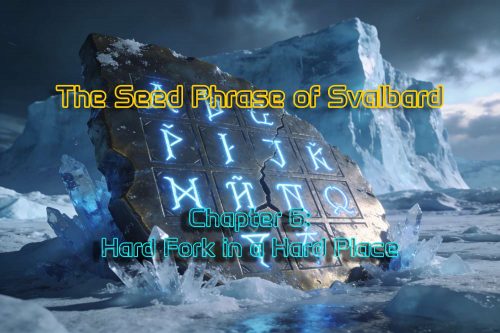
The detention cell was a storage closet before it was a prison.
Kiran sat on a crate of dried peas, his back against a wall of stacked ration boxes, and stared at the locked door. The room was small, cold, and smelled of old vegetables. It was not designed for holding prisoners—the vault had never needed a prison before—but it served its purpose. The door was steel, the lock was biometric, and the guards who had put him here had made it clear that he was not to leave until the elders decided what to do with him.
That had been three days ago.
He had been allowed visitors: Hana, the engineer who had served as arbitrator at the Audit, who brought him food and water and avoided his eyes. A medic, who asked questions about Talia’s wound and left without saying anything else. And once, briefly, Aris, who had stood in the doorway and looked at him with an expression he could not read.
“The Keepers want you banished,” Aris had said. “The Guardians want you stripped of your words and given to a replacement. There is talk of making an example. Of showing what happens to Stewards who betray their oath.”
Kiran had looked up at his grandparent, at the face that had guided him since childhood, and had felt something harden in his chest. “And what do you want?”
Aris had not answered. They had stood in the doorway for a long moment, their ancient eyes fixed on some point beyond Kiran’s shoulder, and then they had left. The door had locked behind them with a sound that echoed in the small room, and Kiran had been alone again.
He spent the days thinking. He thought about Talia, lying in the medical bay, her shoulder bandaged, her face pale. He thought about Dex, imprisoned somewhere else in the vault, his raid failed, his people scattered. He thought about the Frostbytes who had escaped, running back through the ventilation shaft with whatever they had managed to carry, returning to a warren that was colder and darker than before.
And he thought about the words. Whisper. Caldera. Nighthawk. Tethered. They were still there, in his mind, as clear as the day he had first seen them on the alloy plate. He had not spoken them aloud, not to the elders, not to the guards, not to anyone. They were his, still, and as long as he held them, he had power. The other clans could strip his title, could banish him, could lock him in this closet forever, but they could not take the words from his mind. They could only wait for him to die.
He was thinking about that—about death, about the words, about the future—when the lock clicked and the door opened.
Talia stood in the doorway.
She was pale, her arm in a sling, her coat stained with dried blood. But she was standing, her eyes clear, her jaw set. Behind her, the corridor was empty.
“How did you get out of medical?” Kiran asked.
“I walked.” She stepped into the room, and the door closed behind her. “The medic said I should rest. I told her I had something more important to do.”
Kiran stood up from the crate, his legs stiff from days of sitting. “You shouldn’t be here. If they find you—”
“They already found me.” Talia’s voice was flat. “Your elders came to see me this morning. They wanted to know who led the raid, who planned it, who gave the orders. They wanted me to name names.”
Kiran’s stomach clenched. “Did you?”
Talia met his eyes. “No. But I told them something else. I told them about you. About what you tried to do. The geothermal plant. The hard fork. The plan you’ve been working on for weeks.”
Kiran stared at her. “Why?”
“Because they need to know.” Talia moved further into the room, her steps careful, her injured arm held close to her body. “They need to know that there’s another way. A way that doesn’t end with raids and shootings and people dying in corridors.”
“The elders won’t listen,” Kiran said. “I tried. I talked to all of them. They said the protocol doesn’t permit deviation.”
“Then we make them listen.” Talia’s voice hardened. “The raid failed. Dex is in their prison. Half the Frostbytes who survived are talking about a second attack, something bigger, something that will end with bodies on both sides. If we don’t do something now—if we don’t find another way—this isn’t going to stop. It’s going to get worse.”
Kiran looked at her—at the bandage on her shoulder, the exhaustion in her face, the fire in her eyes. She had been shot three days ago. She should be in bed, recovering, letting others fight her battles. But she was here, in a storage closet that had become a prison, asking him to try again.
“What do you want me to do?” he asked.
Talia reached into her coat and pulled out a folded piece of paper. She spread it on the crate between them, and Kiran saw that it was a map—not of the vault, not of the warrens, but of the island itself. The mountains, the fjords, the glaciers. And marked in the center, circled in red, was a location he had seen in the old geological surveys.
“The geothermal vents,” he said.
“The elders won’t listen to you,” Talia said. “They won’t listen to me. But they might listen to the truth. The truth that the fund is dying. The truth that the Halving is just the beginning. The truth that if we don’t do something now—something real—there won’t be a future to save.”
Kiran studied the map, his mind racing. The geothermal vents were real. He had seen the surveys, read the reports, run the calculations a hundred times. The heat beneath the island was enough to power the vault and the warrens for decades, maybe centuries. The technology existed—old, but workable, salvaged from the ruins of the old world. All it required was investment. All it required was a decision.
“The other clans,” he said slowly. “They’re afraid. They’ve been guarding the words for so long that they’ve forgotten why. They think that if they open the fund, even a little, everything falls apart.”
“Then we show them it doesn’t.” Talia’s voice was steady. “We show them that a hard fork isn’t the end. It’s a beginning. A new chain, a new consensus, a new way of doing things. One that doesn’t let children freeze while the guardians wait.”
Kiran looked at her, at the map, at the crate of dried peas beneath it. He thought about the words in his mind, the promise he had made, the duty that had bound him to a future he would never see. He thought about Talia’s brother, coughing in the cold, and Dex, sitting in a cell somewhere in the vault, and the Frostbytes who had escaped with nothing but the clothes on their backs.
“You’re asking me to break my oath,” he said.
“I’m asking you to keep it.” Talia’s eyes met his. “Your oath was to protect the future. Not the fund. Not the words. The future. And the future is dying, Kiran. It’s dying in the warrens, in the cold, in the dark. If you don’t do something now, there won’t be anything left to save.”
Kiran stood in the small room, the map spread before him, the weight of the choice pressing down on him like the mountain above. He had been waiting for this moment for weeks—waiting for the right time, the right opportunity, the right consensus. But waiting was a luxury he no longer had.
“What do you need from me?” he asked.
Talia smiled, a thin expression that did not reach her eyes. “I need you to come with me. To the elders. To the Keepers and the Guardians and everyone else who thinks that the only way to save the future is to let the present burn. I need you to stand in front of them and tell them what you told me. That there’s another way. A hard fork. A new mission. A future that includes everyone, not just the ones who were lucky enough to be born in the vault.”
“And if they say no?”
Talia’s hand moved to her injured shoulder, her fingers tracing the bandage beneath her coat. “Then we find another way. Together.”
Kiran looked at her for a long moment. Then he nodded.
“Let’s go.”
The elders were gathered in the central hall.
They had been there since the raid, Kiran had been told—meeting, arguing, trying to decide what to do about the Frostbytes, about the raid, about the Steward who had betrayed them. When Kiran walked through the doors, Talia at his side, the argument stopped. Every face turned toward them.
Saria of the Keepers was the first to speak. Her silver braids were disheveled, her eyes red-rimmed, her hands trembling with exhaustion or anger or both. “You have no right to be here. You are a prisoner. You—”
“I’m a Steward,” Kiran said. His voice echoed in the hall, louder than he intended. “I carry the words. And I have something to say.”
“You’ve said enough.” Orin of the Guardians stood from his seat, his broad shoulders tense, his face dark. “You conspired with the Frostbytes. You helped them breach our walls. People were hurt. People could have died.”
“People are dying.” Talia stepped forward, her voice cutting through the murmurs that had begun to rise. “People are dying in the warrens right now. Children. Families. The same people your founders were trying to save. And you sit here, in your warm hall, arguing about protocol.”
Saria’s eyes narrowed. “You are the one who led the raid. You are the one who brought violence into our home.”
“I brought nothing that wasn’t already there.” Talia’s voice was hard. “The Halving brought violence. The brokers who hoarded fuel while children froze brought violence. The walls you built between your warm rooms and our dying shelters brought violence. I just—” She stopped, her hand going to her shoulder, her face paling. “I just refused to let my family die while you waited for a future that will never come.”
The hall was silent. Kiran saw the faces of the elders, the Stewards, the gathered residents of the vault. He saw fear and anger and something else—something that looked like guilt.
“Talia is right,” he said. “The Halving is killing people. Not just the Frostbytes—all of us. The dividends will keep shrinking. The fund will keep compounding. And in twenty years, when the Return Date finally comes, there won’t be anyone left to save. We’ll have preserved the principal and lost everything else.”
“Then what do you propose?” Orin’s voice was heavy with skepticism. “You want us to open the fund. To spend the principal on short-term aid that will devalue the credits and leave us with nothing.”
“No.” Kiran stepped forward, his heart pounding. “I want us to do something smarter. Something the founders never considered because they couldn’t see what we’ve become.”
He pulled the map from his coat—the same map Talia had shown him, with the geothermal vents marked in red—and spread it on the stone table. The elders gathered around, their faces curious, suspicious, uncertain.
“The vents beneath the island,” Kiran said. “The old surveys show them. The heat is there, waiting. With a fraction of the fund’s principal, we could build a geothermal plant. A power source that would last for generations. Heat for the vault. Heat for the warrens. Energy to grow food, to purify water, to keep us alive.”
Saria stared at the map, her expression unreadable. “You want to spend the principal.”
“I want to invest it.” Kiran’s voice was steady. “The fund was never meant to be a treasure to be hoarded. It was a seed to be planted. The founders wanted us to rebuild when the world was ready. But the world isn’t ready—and it won’t be ready if we let ourselves die while we wait. The geothermal plant is not an expense. It’s an investment. It pays dividends. Real dividends, not just energy credits on a ledger. Heat. Light. Life.”
Orin shook his head. “The protocol does not permit—”
“The protocol was written by people who are dead.” Talia’s voice cut through his objection like a blade. “People who never saw the Halving. Who never watched their children freeze. Who never had to choose between keeping a promise and keeping a life. You keep talking about the founders like they were gods. They weren’t. They were people. People who made a plan for a world that doesn’t exist anymore.”
The hall was silent again. Kiran looked at the faces around him, searching for something—agreement, understanding, anything. He saw fear. He saw doubt. He saw, in a few faces, the first glimmer of hope.
Aris had been standing at the edge of the circle, silent throughout the argument. Now they stepped forward, their ancient face unreadable, their eyes fixed on the map.
“You are asking us to break the promise,” Aris said.
“I’m asking us to fulfill it.” Kiran met their eyes. “The promise was never about the words. It was about the people. The people who would come after. And we are those people, Aris. We’re the ones the founders were saving for. Not some distant generation in a perfect world. Us. Here. Now. Freezing and hungry and desperate. If we don’t use the fund to save ourselves, who are we saving it for?”
Aris was silent for a long, long moment. The hall waited, the tension thick enough to taste.
“You have thought about this,” Aris said finally. “You have plans. Calculations.”
“I have everything.” Kiran reached into his coat again and pulled out a worn notebook, filled with his handwriting, his calculations, his projections. He set it on the table beside the map. “The geothermal plant would cost twelve percent of the principal. Twelve percent. The rest would remain untouched, compounding, waiting for the thaw. But with that twelve percent, we build something that keeps us alive. Something that pays dividends forever. Something that turns the fund from a promise into a reality.”
Orin picked up the notebook, flipping through the pages. His expression changed as he read—the skepticism fading, replaced by something that looked like wonder.
“You’ve been working on this for weeks,” he said.
“Months,” Kiran said. “Since before the Halving. Since I first saw what was happening in the warrens.”
Orin looked at Saria, at Aris, at the other elders gathered around the table. “This is not a raid. This is not a theft. This is—” He stopped, searching for the word.
“A hard fork,” Talia said. “A new chain. The same mission, the same promise, but a different path to get there.”
The elders looked at each other. Kiran held his breath.
Saria was the first to speak. “The Keepers will consider it. But we need time. We need to review the calculations, to—”
“We don’t have time.” Talia’s voice was urgent. “Dex is in your prison. The Frostbytes who escaped are talking about another raid. A bigger one. One that won’t stop at the storage bays. If we don’t do something now—if we don’t show them that there’s another way—people will die. More people. On both sides.”
Saria’s face tightened. “You are asking us to make a decision that will change everything. In minutes. Under threat of violence.”
“I’m asking you to choose.” Talia met her eyes. “Choose the future. Choose the people who are alive right now, in this room, in this mountain, in the warrens outside. Choose to be the ones who saved the promise instead of the ones who let it die.”
The hall was silent. Kiran could hear his own heart beating, could see the faces of the elders as they wrestled with the choice before them. He thought about the words in his mind, the promise he had carried for so long. Whisper. Caldera. Nighthawk. Tethered. They were still there, still waiting, still binding him to a future he might never see.
But maybe that future was closer than he thought. Maybe it was not something to be waited for. Maybe it was something to be built.
Aris stepped forward, their hand reaching out to touch the map, the notebook, the calculations Kiran had spent months perfecting.
“I have kept the promise for eighty years,” they said. “I have watched the dividends shrink and the cold deepen. I have buried friends and family and watched the vault become a tomb. And I have asked myself, every day, if the promise was worth it.”
They looked at Kiran, and for the first time, he saw something in their eyes that he had never seen before. Not doubt. Not certainty. Something else. Something that looked like peace.
“I do not know if you are right,” Aris said. “I do not know if this hard fork, this new path, will lead to the future the founders imagined. But I know that the old path is leading us nowhere. And I know that you—” They reached out and took Kiran’s hand. “You are the first Steward in three generations who has asked the right question.”
Kiran’s throat tightened. “What question?”
Aris smiled, a thin expression that softened the lines of their face. “Not ‘how do we keep the promise?’ But ‘what is the promise for?'”
They turned to the other elders, their voice steady, their eyes clear. “The Stewards of the Root will support the proposal. We will invest in the geothermal plant. We will fork the mission. And we will show the Frostbytes that the future belongs to all of us, or it belongs to no one.”
Saria stared at Aris for a long moment. Then she nodded slowly. “The Keepers will support. But we require oversight. A council, drawn from all three clans, to manage the investment and ensure the principal is protected.”
Orin looked at the map, at the notebook, at the faces of the elders around him. “The Guardians will support. But we require one more thing.”
“What?” Kiran asked.
Orin’s eyes moved to Talia, standing at Kiran’s side, her arm in a sling, her face pale but steady. “The Frostbytes must be part of this. Not as enemies, not as petitioners, but as partners. If we are going to build a new future, we build it together.”
Talia stared at him, something flickering in her expression that might have been hope or might have been fear. “You want us to trust each other.”
“I want us to try,” Orin said.
Talia looked at Kiran. He saw the question in her eyes, the uncertainty, the fear that this was another promise that would be broken. He reached out and took her hand.
“We try,” he said. “Together.”
She looked at him for a long moment. Then she nodded.
“Together.”
They met that night in the central hall, not as enemies but as something new.
Dex had been released from his cell, his weapons confiscated, his raid abandoned. He stood with the Frostbytes who had been captured, their faces wary, their hands empty. Across from them stood the elders, the Stewards, the people of the vault. Between them, on the stone table, lay the map and the notebook and the promise of something neither side had dared to hope for.
Kiran stood at the center, Talia at his side. He looked at the faces around him—the fear, the hope, the uncertainty—and he thought about the words in his mind. He had carried them for so long, had guarded them so carefully, had let them define him. But they were not his future. They were not anyone’s future. They were just words.
What mattered was what came next.
“The founders created Earthseed to save the future,” he said. “They put their wealth in a vault, locked it with twelve words, and asked us to wait. But waiting is not saving. Waiting is not building. Waiting is not the future.”
He looked at Talia, at Dex, at the Frostbytes who had come to steal what they needed to survive. He looked at Aris, at Saria, at Orin, at the Stewards who had guarded the words for three generations. He looked at all of them, and he saw what they had become.
“We are not waiting anymore,” he said. “Tomorrow, we begin building. A geothermal plant. A power source that will keep us alive. A future that belongs to everyone, not just the ones who were lucky enough to be born in the vault.”
Dex stepped forward, his scarred face unreadable. “And the words? The fund? The promise you’ve been guarding for eighty years?”
Kiran reached into his mind, into the place where the words had lived for as long as he could remember. Whisper. Caldera. Nighthawk. Tethered. He held them for a moment, feeling their weight, their history, their promise.
Then he let them go.
“The words are not the future,” he said. “We are. The fund will be there when we need it. When the thaw comes, when the world is ready to rebuild, the principal will still be waiting. But we are not going to let ourselves die while we wait. We are going to build. We are going to live. We are going to be the future the founders dreamed of, not because we waited, but because we chose.”
The hall was silent. Kiran looked at the faces around him, and for the first time in months, he felt something that was not fear or doubt or despair.
He felt hope.
Talia’s hand found his, her fingers cold but steady. He looked at her, at the bandage on her shoulder, the exhaustion in her face, the fire in her eyes. She had been shot three days ago. She should be in bed. But she was here, standing beside him, choosing to build instead of destroy.
“Tomorrow,” she said, her voice soft but clear. “We start building.”
Kiran nodded. “Tomorrow.”
That night, Kiran stood in the observation deck, looking out at the warrens.
The lights were dim, the shelters dark, but he knew that people were there. People who were waiting, hoping, wondering if the promise would be kept or broken. He thought about Talia’s brother, Micah, coughing in the cold. He thought about Dex, sitting in his cell, waiting to see if his people would survive. He thought about all the children who had died, all the futures that had been lost, all the years that had been spent waiting for a world that might never come.
The door opened behind him, and he heard Aris’s footsteps.
“You should be resting,” Kiran said without turning.
“I could say the same to you.” Aris came to stand beside him, looking out at the same darkness. “You have done something remarkable today. Something that has not been done in eighty years.”
“I broke the promise,” Kiran said.
“No.” Aris’s voice was soft. “You fulfilled it. The promise was never about the words, Kiran. It was about the people. The people who would come after. The people who would build the future the founders could only imagine. You are those people. You and Talia and all the others who refused to let the promise become a prison.”
Kiran looked at his grandparent, at the face that had guided him since childhood, at the eyes that had seen eighty years of waiting. “You knew, didn’t you? You knew that the old way wasn’t working. You knew that something had to change.”
Aris was silent for a long moment. When they spoke, their voice was barely a whisper.
“I knew that the founders were wise, but they were not gods. I knew that the world would change in ways they could not predict. I knew that someday, someone would have to ask the question you asked. The question I was too afraid to ask myself.”
“What question?”
Aris smiled, a thin expression that softened the lines of their face. “What is the promise for?”
Kiran stood in the darkness, looking out at the warrens, at the vault, at the future that was waiting to be built. He thought about the words in his mind, the promise he had carried for so long. They were still there, still waiting, but they did not feel like a weight anymore. They felt like a beginning.
“Tomorrow,” he said, “we start building.”
Aris nodded. “Tomorrow.”
They stood together in the observation deck, two generations of Stewards watching the darkness, waiting for the dawn. And somewhere in the mountain, in the vault and the warrens and the frozen spaces between, people were dreaming of a future that was no longer a promise waiting to be kept, but a thing waiting to be built.
Kiran closed his eyes, and the words were there. Whisper. Caldera. Nighthawk. Tethered. He held them for a moment, feeling their weight, their history, their promise.
Then he let them go.
And for the first time in his life, he was free.
Table of contents:
Introduction
Prologue: The Great Migration
Chapter 1: Vault in the Ice
Chapter 2: Twelve Words to Remember
Chapter 3: The Dividends of Survival
Chapter 4: The Halving
Chapter 5: The Frostbyte Schism
Chapter 6: Hard Fork in a Hard Place
Chapter 7: Proof-of-Life <<<<<< NEXT
Chapter 8: The Consensus of the Sun
Chapter 9: A New Genesis Block
