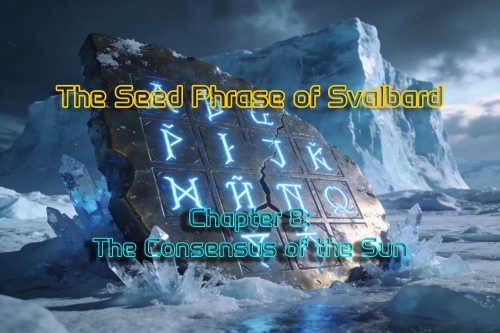
The transaction hash propagated across the dead network like a seed carried on the wind.
Kiran did not know this at the time. He stood in the ruined terminal, watching the confirmation screen flicker, and he understood only that something had happened—something that had been waiting to happen for eighty years. But in the hours and days that followed, the story would reach him in fragments, carried by the same network that had carried the transaction itself.
The hash had been picked up by a node in Reykjavík, one of the few that still survived, its servers humming in a geothermal-heated bunker. From there it had spread to a node in Nuuk, then to a cluster in the Canadian Arctic, then to a scattering of others across the northern latitudes—places where the cold had preserved what the heat had destroyed. Each node verified the transaction, checked the signatures, confirmed that the twelve words had been spoken and the key had been turned.
And then, slowly, the message began to spread in another way.
People talked. The Frostbytes who had been at the terminal returned to the warrens with stories of what they had seen. The Stewards went back to the vault with news that the fund had been opened, the words spoken, the future changed. Within a day, everyone in the settlement knew what had happened. Within a week, the story had reached the scattered outposts that still existed beyond the fjord—the hunting camps, the research stations, the few isolated communities that had survived the collapse.
They called it many things. The Proof-of-Life. The Hard Fork. The Opening. But the name that stuck, the one that would be passed down through generations, was the Consensus of the Sun.
Because on that day, for the first time in anyone’s memory, the sun had broken through the clouds and stayed.
The construction of the geothermal plant began three days after the transaction.
It was not a simple project. The technology was old, the equipment salvaged from ruins that had been picked clean for generations. But the Frostbytes were scavengers, skilled at finding value in what others had discarded, and the Stewards were engineers, trained in the maintenance of systems that had been built to last. Together, they brought something neither group had possessed alone: the resources to build, and the knowledge to make it last.
Kiran spent the first week at the drill site, a kilometer from the vault, where the ground steamed with the heat that had been waiting beneath the ice for millennia. The drilling rig was a relic, its engine salvaged from a ship that had run aground on the coast twenty years ago, its bits forged from metal scavenged from the old server farms. But it worked. Slowly, laboriously, it bit into the permafrost, carving a path toward the heat that would save them all.
Talia was there too, her arm still in a sling, her face set against the pain. She worked alongside the Frostbytes, directing the flow of supplies, coordinating the shifts, making sure that the work did not stop when the sun went down. Her brother Micah had been assigned to the mess tent, helping to distribute rations, and she checked on him every few hours, her hand on his shoulder, her eyes scanning his face for any sign of the cough that had nearly killed him.
“The drill is slowing down,” she said, appearing at Kiran’s side as he studied the readouts from the borehole. “The permafrost is thicker than the surveys predicted.”
Kiran nodded. “We’re hitting a layer of ice that wasn’t in the old models. The drill bits are wearing out faster than we expected.”
“How long?”
“At this rate? Another week. Maybe two.” He looked at the rig, at the Frostbytes and Stewards working together in the cold, and felt the weight of the clock pressing down on him. “We need more bits. Better ones. The old server farms might have—”
“Already on it.” Talia pulled a tablet from her coat, its screen cracked but functional. “Dex took a team to the south trench this morning. There’s a collapsed section that was never fully scavenged. He thinks there might be industrial-grade tools buried under the rubble.”
Kiran looked at her. “The south trench is unstable. He could lose people.”
“He knows.” Talia’s voice was flat. “He’s the one who chose to go. He said—” She stopped, something flickering in her expression. “He said he owed it. For the raid. For the shot that nearly killed me. He said he wanted to build something, instead of destroying it.”
Kiran was silent for a moment. He thought about Dex, standing in the terminal during the Proof-of-Life, his scarred face unreadable, his hands empty. He had not spoken during the ceremony, had not stepped forward to claim a place in the new consensus. But he had been there. And now he was in the south trench, digging through rubble that could bury him at any moment, trying to build something that would last.
“He’ll make it,” Kiran said. “He’s survived worse.”
Talia looked at him, and for a moment, something passed between them—not quite trust, not quite friendship, but something that might become both.
“He better,” she said. “I’m not done yelling at him for getting me shot.”
Kiran laughed. It was a strange sound, unfamiliar in his own throat, but it felt right. “I’ll hold him down while you do it.”
Talia’s lips curved into something that was almost a smile. “Deal.”
The drill bit broke on the ninth day.
Kiran was in the mess tent when he heard the sound—a screech of metal, followed by silence. He was on his feet before the echo had faded, running toward the rig, his heart in his throat.
The drill had stopped. The crew was gathered around the borehole, their faces pale, their voices a murmur of fear and frustration. Kiran pushed through them and saw the damage. The bit had shattered, its fragments scattered across the ice, its shaft twisted and useless.
“We hit something,” the driller said, a Frostbyte woman named Yuki who had operated heavy machinery before the collapse. “A vein of something harder than ice. The bit couldn’t take it.”
Kiran knelt beside the borehole, peering into the darkness. He could see the shattered remains of the bit at the bottom, wedged into the ice. Below it, steam rose from the depths, the heat that had been waiting for them, just out of reach.
“How deep?” he asked.
Yuki checked the readouts. “We’re within fifty meters of the geothermal layer. Maybe less. But without a bit—”
“We get a new bit.” Kiran stood up. “Dex’s team. They were supposed to be back yesterday. Did they—”
A shout came from the edge of the camp. Kiran turned and saw a group of figures emerging from the snow, their coats ragged, their faces exhausted. Dex was at the front, his arm around a woman who was limping, her leg wrapped in a makeshift bandage. Behind them, two other Frostbytes carried a crate between them, its weight bending the poles they used as handles.
Kiran ran toward them. “What happened?”
Dex’s face was gray with exhaustion, but his eyes were bright. “Found the tools. Buried deeper than we thought. The rubble shifted—” He gestured at the limping woman. “Lin broke her leg. But we got what we came for.”
He stepped aside, and the Frostbytes set the crate down. Yuki was there in an instant, prying open the lid with a crowbar. Inside, nestled in packing foam that had survived decades in the dark, were three drill bits. They were old, their surfaces pitted with rust, but they were whole. They were exactly what they needed.
Yuki looked up at Kiran, and for the first time in nine days, she smiled. “These will work. These will definitely work.”
Kiran turned to Dex. The scarred leader of the raid was standing apart from the others, his arms crossed, his face unreadable. But Kiran saw something in his eyes that he had not seen before. Not pride, not triumph. Something quieter. Something like peace.
“You did it,” Kiran said.
Dex shrugged. “We needed bits. I found bits.” He looked at the rig, at the crew gathering around the crate, at the steam rising from the borehole. “The rest is up to you.”
Kiran shook his head. “It’s up to all of us.”
For a moment, Dex said nothing. Then he nodded, a small gesture, almost imperceptible. “All of us,” he agreed.
The new bit went into the ground at dawn on the tenth day.
Kiran stood at the edge of the drill site, watching the rig shudder back to life. The bit bit into the ice, grinding through the layer that had stopped them before, pushing deeper toward the heat below. The crew worked in shifts, not stopping, not resting, driven by something that was not quite hope but was close enough.
Talia was beside him, her arm free of its sling for the first time since the raid. The wound was healing, the medic had said, but she should not be pushing herself. She was pushing herself anyway.
“We’re close,” she said. “The readouts show temperature rising. Fifty meters. Forty. Thirty.”
Kiran stared at the readouts, at the numbers that had been his obsession for months. He had run the calculations a hundred times, had projected the heat flow, the power output, the energy credits that would be generated. But seeing it happen—feeling the ground tremble beneath his feet, watching the steam rise from the borehole—was something else entirely.
Twenty meters. Fifteen. Ten.
The rig shuddered, a deep vibration that Kiran felt in his bones. For a moment, he thought the bit had broken again, that they had come so far only to fail at the last moment. But the vibration did not stop. It grew, deepened, became something that was not destruction but creation.
And then the steam came.
It rose from the borehole in a column of white, hot and pure, the breath of the earth itself. Kiran felt it on his face, a warmth he had never known, a heat that had been waiting beneath the ice for millennia. The crew stepped back, their faces lit by the rising steam, their eyes wide with something that was not fear.
“It’s open,” Yuki said, her voice reverent. “It’s open.”
Kiran looked at the steam, at the heat that would power their future, and he felt something release in his chest. The calculations had been right. The hard fork had worked. The future was not a promise anymore. It was a thing, rising from the ground, warm and real and alive.
He turned to Talia. She was staring at the steam, her face wet with tears she was not trying to hide.
“We did it,” she said. “We actually did it.”
Kiran reached out and took her hand. “We did it.”
They stood together, watching the steam rise into the cold sky, and for the first time in eighty years, the future was not something to wait for. It was something to live.
The power came online three weeks later.
The geothermal plant was not large—a cluster of pipes and turbines, salvaged and rebuilt, humming with the heat of the earth. But it was enough. Enough to light the vault, to warm the warrens, to power the hydroponic bays that fed them all. Enough to turn the long winter from a sentence of death into a season of waiting.
The day the power came on, the settlement gathered at the edge of the warrens to watch. Kiran stood with Talia, with Aris, with Dex and Yuki and all the others who had built something new from the ruins of the old. The sun was setting, painting the sky in shades of orange and pink and gold, and the clouds that had hidden it for so long were gone.
“The Consensus of the Sun,” Talia said, looking up at the sky. “That’s what they’re calling it now. The day we opened the fund. The day we chose to build instead of wait.”
Kiran nodded. “It’s a good name.”
“It’s a true name.” She looked at him, and there was something in her eyes that he had not seen before. Not hope, not fear, not the desperate need that had driven her through the cold snap and the raid and the long weeks of construction. Something else. Something that looked like belonging.
“What happens now?” she asked. “The plant is built. The power is on. What comes next?”
Kiran looked at the settlement, at the lights that were beginning to flicker on in the warrens, at the steam rising from the geothermal plant, at the people who had been enemies three months ago standing together in the snow.
“I don’t know,” he said. “I think we figure it out. Together. Day by day. Building what we need, fixing what’s broken, making sure that the future we’re saving for is one we want to live in.”
Talia smiled. It was a real smile, warm and open, the first he had seen from her since before the Halving.
“That sounds like a plan,” she said.
“It’s not a plan,” Kiran said. “It’s something better. It’s a beginning.”
That night, Kiran walked through the vault one last time.
He had not been back since the Proof-of-Life, had spent every day at the drill site or the geothermal plant, building something new. But tonight, he needed to see the old place. To remember what had been, before he let it go.
The corridors were quiet, the residents gathered in the central hall for a celebration that was still going on. But Kiran did not go to the hall. He walked past the hydroponic bays, past the storage rooms, past the detention cell where he had spent three days waiting to be judged. He walked to the tunnel that led to the inner chamber, the place where he had first seen the words.
The door was open.
He had expected it to be sealed, locked, protected as it had been for eighty years. But the biometric lock was dark, the bolts retracted, the door standing open to the cold. He stepped through and walked down the tunnel, his footsteps echoing in the silence, until he reached the chamber where the plate had rested.
The pedestal was empty.
He stood in the center of the chamber, looking at the place where the words had been. The alloy plate was in the terminal now, he knew, in a case that had been placed in the center of the concourse, visible to anyone who wanted to see it. The words were no longer a secret. They were a history, a record, a thing to be remembered instead of guarded.
He thought about the day he had first seen the plate, the weight of the words settling into his mind. He thought about the ritual, the torchlight, the silence of the chamber. He thought about the promise he had made, the duty he had accepted, the future he had sworn to protect.
He had kept that promise. Not by guarding the words, not by waiting for a future that might never come. By building something new. By choosing to live instead of wait. By opening the lock and letting the future in.
He turned and walked back up the tunnel, leaving the empty chamber behind. The words were still in his mind, as they would always be. But they were not a weight anymore. They were a memory. A beginning. A seed that had finally been planted.
When he emerged from the tunnel, Talia was waiting for him.
“I thought I’d find you here,” she said. “Coming to say goodbye.”
Kiran looked at the tunnel, at the vault, at the mountain that had been his home for seventeen years. “Not goodbye,” he said. “Something else. Something like—”
“Like moving on,” Talia said. “Like building something new.”
Kiran nodded. “Like that.”
They stood together in the corridor, the lights of the vault humming around them, the sounds of celebration echoing from the central hall. Outside, the sun had set, but the sky was not dark. The stars were out, a million points of light scattered across the darkness, and the steam from the geothermal plant rose in a column of white, warm and steady, a beacon against the cold.
“Come on,” Talia said, taking his hand. “There’s a celebration happening. And I heard someone saved us a seat.”
Kiran smiled. “They saved us a seat?”
“Two seats,” Talia said. “Right in the front. Apparently, we’re the guests of honor.”
Kiran laughed. “What happened to not wanting to be remembered?”
Talia’s eyes sparkled. “I changed my mind. Being remembered isn’t so bad. As long as they remember the right things.”
“And what are the right things?”
She tugged him down the corridor, toward the light and the noise and the warmth of the celebration. “That we didn’t give up. That we chose to build instead of wait. That we were the ones who opened the lock and let the future in.”
Kiran let her pull him forward, the words still in his mind, the promise still in his heart. But they were not burdens anymore. They were wings.
The future was not waiting. It was here. And it was theirs to build.
The celebration lasted until dawn.
Kiran sat with Talia in the center of the hall, surrounded by Stewards and Frostbytes, by elders and children, by everyone who had chosen to build something new. They ate food that had been grown in the vault’s hydroponic bays, warmed by the heat of the geothermal plant. They drank water that had been purified by the same energy that had once been hoarded for the future. They told stories—of the founders, of the long wait, of the raid and the hard fork and the day the words were spoken.
And as the sun rose over the ice, painting the sky in shades of gold and pink, Kiran looked at the faces around him and knew that the future was not something to be saved for.
It was something to be lived.
Aris found him as the celebration was winding down, standing at the edge of the hall, watching the light creep across the floor.
“You look different,” Aris said, coming to stand beside him. “Lighter.”
Kiran considered this. “I feel different. Lighter. Like something I was carrying—” He paused, searching for the words. “Like something I was carrying isn’t there anymore.”
Aris nodded. “The words.”
“The words,” Kiran agreed. “They’re still there. In my mind. I don’t think they’ll ever leave. But they don’t feel like a weight anymore. They feel like—” He stopped, looking at his grandparent, at the face that had guided him through seventeen years of waiting. “They feel like a beginning.”
Aris smiled, and for a moment, they looked younger, lighter, as if the weight of eighty years had finally lifted from their shoulders.
“That is what they were always meant to be,” Aris said. “The founders did not give us the words to carry. They gave them to us to plant. To water. To grow into something that would outlast us all.”
Kiran looked out at the hall, at the Stewards and Frostbytes who were cleaning up from the celebration, at the children who were already planning the next day’s games, at the elders who were watching with eyes that had seen too much to be surprised by hope.
“We planted them,” he said. “The words. The fund. The future.”
Aris nodded. “You did. And now—” They looked out the window, at the steam rising from the geothermal plant, at the lights of the warrens that were no longer dim, at the sun breaking over the ice. “Now we see what grows.”
They stood together, watching the dawn, and for the first time in eighty years, the future was not a promise waiting to be kept.
It was a garden waiting to be tended.
That afternoon, Kiran walked to the terminal one last time.
The plate was there, in its case, in the center of the concourse. The words were visible now, the twelve characters that had been locked in the ice for eighty years, waiting for someone to speak them. He stood before the case, reading the words he had carried for so long, and he felt something that was not quite loss and not quite relief.
It was completion.
He reached out and touched the glass of the case, tracing the letters of the first word. Whisper. He had whispered it, in the Proof-of-Life, and the world had heard. He had spoken it, and the lock had opened, and the future had begun.
He turned away from the case and walked out of the terminal, into the light of the sun that was no longer hidden. The steam rose from the geothermal plant, warm and steady, a promise that would be kept every day, for as long as the earth turned and the ice held.
Talia was waiting for him outside, her brother Micah at her side, her face turned to the sun.
“Ready?” she asked.
Kiran looked at the terminal, at the vault, at the warrens that were no longer dark. He looked at the steam rising from the plant, at the children playing in the snow, at the future that was no longer a promise but a thing being built, every day, by people who had chosen to live instead of wait.
“I’m ready,” he said.
He took her hand, and they walked toward the settlement, toward the work that was waiting, toward the future that was theirs to build.
Behind them, the words waited in their case, silent and still, a record of a promise that had been kept.
But the words were not the future.
They never had been.
The future was the steam rising from the earth, the lights in the windows, the children playing in the snow. The future was the choice that had been made, the lock that had been opened, the seed that had finally been planted.
The future was here.
And it was just beginning.
Table of contents:
Introduction
Prologue: The Great Migration
Chapter 1: Vault in the Ice
Chapter 2: Twelve Words to Remember
Chapter 3: The Dividends of Survival
Chapter 4: The Halving
Chapter 5: The Frostbyte Schism
Chapter 6: Hard Fork in a Hard Place
Chapter 7: Proof-of-Life
Chapter 8: The Consensus of the Sun
Chapter 9: A New Genesis Block <<<<<< NEXT
