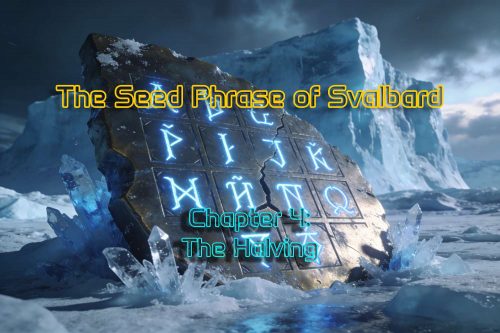
The announcement came without ceremony.
Kiran was in the hydroponic bay, checking the nutrient solution levels in the tomato vines, when the vault’s public address system crackled to life. It was a rare sound—the system was used only for emergencies and official announcements—and it made him straighten, his hand still on the hose.
“Attention, all residents. This is Elder Aris. The Halving will take effect at midnight tonight. All dividend allocations will be reduced by fifty percent in accordance with the Earthseed Protocol. Conservation measures will be implemented immediately. Please report to your section heads for updated rationing schedules.”
The system clicked off. Kiran stood in the warm, damp air of the hydroponic bay, the hose dripping forgotten onto the floor, and felt something cold settle in his chest.
He had known it was coming. The Halving was programmed into the Earthseed smart contract from the beginning, a scheduled reduction designed to extend the life of the fund. The founders had planned it as a necessary sacrifice, a way to ensure that the principal would continue to compound for the full hundred years. But knowing it was coming and experiencing it were two different things.
He looked around the bay. The tomato vines were heavy with fruit, their red globes bright against the green leaves. The lettuce beds were full, the herbs fragrant. The vault’s hydroponics were efficient, productive—but they were also energy-intensive. If the dividends were being cut, the energy credits that powered the grow lights would be cut too.
He thought about Talia, about the heater he had diverted to her shelter, about the thin faces of the Frostbytes huddled in the warrens. The Halving would hit them hardest—their already meager energy supply cut in half. But it would hit the vault too. And when people inside the vault started to feel the pinch, they would look to the Stewards for answers.
Kiran turned off the hose and left the bay, walking through corridors that already seemed quieter, more tense. People were gathered in small groups, speaking in low voices. He caught fragments of conversation as he passed.
“…knew it was coming, but half…”
“…the Frostbytes will starve…”
“…protocol is protocol…”
He reached the central hall, where the three clans had gathered for an emergency session. The stone table was empty this time—no biometric scanner, no brazier. Just the elders and their senior Stewards, standing in a triangle that had become a stage for conflict.
Elder Aris stood at the head of the Root delegation, their face unreadable. Across from them, Saria of the Keepers was speaking, her voice tight with barely suppressed anger.
“We cannot simply accept this. The Halving was designed for a world that no longer exists. A world with global markets, with diversified resources, with—with everything we don’t have. We need to adjust. We need to—“
“We need to follow the protocol.” Orin of the Guardians spoke quietly, but his voice carried. “The founders built the Halving into the contract for a reason. If we start overriding the terms, we undermine the entire system.”
“The founders didn’t know we would be reduced to this!” Saria gestured around the hall, at the gathered Stewards, at the hydroponic towers that lined the walls. “They didn’t know that half our people would be living in ruins, scavenging for scraps. They didn’t know—“
“They knew there would be hardship.” Aris’s voice cut through the argument like a blade. “They knew that the path to the future would be difficult. That is why they made the protocol inflexible. Flexibility leads to erosion. Erosion leads to loss.”
“Loss?” Saria’s voice rose. “We’ve already lost. We’ve lost half our numbers since the founding. We’ve lost the southern outposts, the eastern supply caches, the—“
“We have lost nothing that cannot be regained when the fund is opened,” Aris said. “But if we open it now—if we spend the principal to ease a temporary hardship—we lose everything. The future. The promise. The reason we exist.”
Saria opened her mouth to respond, then closed it. Her hands were shaking. Kiran watched her, and for the first time, he saw not an elder, not a leader, but a woman who was afraid.
He understood. The Halving meant less food, less heat, less light. It meant harder choices, smaller portions, longer nights. It meant that the careful balance the vault had maintained for eighty years was about to tip.
And it meant that the Frostbytes, already at the edge of survival, would be pushed further into the dark.
The first week after the Halving was a study in subtraction.
The grow lights in the hydroponic bay were dimmed by a third, reducing the already slow growth of the vault’s crops. The heating vents in the residential corridors were dialed back, and Kiran woke each morning to a room that was noticeably colder than it had been the day before. The communal meals became smaller, the portions more carefully measured, the variety reduced to the most calorie-dense staples.
People adapted, because they had no choice. But Kiran could see the strain in their faces—the way they lingered over their bowls, the way they wrapped themselves in extra layers, the way they gathered in groups to share body heat in the evenings.
Elder Aris moved through the corridors like a ghost, their presence a reminder of the duty that bound them all. They spoke to the engineers, the farmers, the medics, offering encouragement, reassurance, the same steady certainty they had always provided. But Kiran saw the way their hands trembled when they thought no one was watching.
He found Aris in the observation deck one evening, staring out at the fjord. The sun had set hours ago, but a pale glow still lingered on the horizon, the last trace of the summer that was already fading.
“You should be resting,” Kiran said, closing the door behind him.
Aris did not turn. “Rest is a luxury we can no longer afford.”
Kiran came to stand beside them, looking out at the same gray expanse. The ice had shifted in the past weeks, new pressure ridges forming where the glacier met the sea. The Frostbyte warrens were dark shapes against the snow, their lights dimmer than they had been before.
“The Frostbytes are suffering,” Kiran said. It was not a question.
Aris was silent for a long moment. When they spoke, their voice was softer than Kiran had expected. “I know.”
“Then why—“
“Because the alternative is worse.” Aris turned to face him, and in the dim light, their face was a mask of shadows. “You think I don’t see them out there? You think I don’t know what the Halving means for them? I have watched this community for eighty years. I have seen children born and children buried. I have made choices that kept people alive and choices that let them die. And I have done it all because the promise is worth more than any single life.”
Kiran felt something twist in his chest. “How can you say that? How can you say that a promise is worth more than a child’s life?”
“Because that promise is the only thing that will save the children who come after.” Aris’s voice hardened. “If we open the fund now, we spend it. Not all at once, perhaps, but piece by piece. A little here to ease the cold, a little there to fix the crops. And before we know it, the principal is gone, and we have nothing. Nothing for the future. Nothing for the generations that will come after the thaw. We will have traded their lives for a few more winters of suffering.”
Kiran wanted to argue, but the words stuck in his throat. Aris was not wrong. He had run the calculations himself, in the quiet hours of the night, when sleep would not come. The fund was finite. Every credit spent now was a credit that would not exist when the thaw finally came. And the thaw—the climate models were uncertain, but the best projections said it would be decades before the planet stabilized enough for large-scale rebuilding.
“There has to be another way,” he said finally.
Aris looked at him for a long moment, their ancient eyes unreadable. “Perhaps there is. But I have not found it. And I have been looking for a very long time.”
They turned back to the window, their silhouette small against the vast darkness outside. Kiran stood beside them, and for a moment, he felt the weight of all the years that had passed, all the choices that had been made, all the lives that had been lived and lost in service to a promise that seemed to grow more distant with every passing season.
He left the observation deck with more questions than answers, and the cold followed him down the corridor like a patient hunter.
In the warrens, the Halving was not an abstract concept. It was a slow, grinding death.
Talia had been tracking the energy tokens since the announcement came through the Exchange. The flow from the vault had been cut by half, exactly as promised. But the brokers, sensing the desperation, had raised their prices. What little fuel reached the warrens now cost twice what it had before, and there was never enough to go around.
She stood in the central square, watching the morning distribution. A line of Frostbytes stretched across the frozen ground, their faces gray with exhaustion, their hands wrapped in rags that did little to keep out the cold. At the front of the line, a broker sat behind a table piled with tokens, doling out fuel canisters one by one.
Talia had been standing in line for three hours. She was close enough now to see the broker’s face—a man she knew, named Viktor, who had been a scavenger like her before he figured out there was more profit in hoarding than in hunting. He was counting out tokens with mechanical precision, his eyes scanning the line for anyone who might cause trouble.
When she finally reached the table, Viktor looked up at her and smiled. It was not a friendly smile.
“Talia. Good to see you made it.”
“I need fuel,” she said. “Three canisters.”
Viktor’s eyebrows rose. “Three canisters. That’s a lot of credits.”
“I have the tokens.” She pulled a pouch from her coat and set it on the table. The tokens clinked against each other, a sound that drew the attention of the people behind her.
Viktor opened the pouch, counted the tokens, and shook his head. “This isn’t enough. Not for three canisters.”
“It’s what we agreed on yesterday.”
“Yesterday was yesterday. Prices have gone up.” He gestured vaguely at the line, at the cold, at the sky. “Supply and demand. You know how it works.”
Talia’s hand tightened on the edge of the table. “I have a sick child at home. He needs heat. He needs—“
“Everyone needs something.” Viktor’s voice was flat. “I’m not running a charity. You want fuel, you pay the price. Otherwise, move along.”
Talia stared at him, her blood heating despite the cold. She thought about Micah, who had recovered from the last cold snap but was still weak, still vulnerable. She thought about her mother, who had given her own rations to her children for so long that there was almost nothing left of her. She thought about the heater that Kiran had brought, the one that had saved her brother’s life, and she knew that a single act of kindness would not be enough to keep him alive through the winter.
“I’ll pay the price,” she said. “But I need the fuel now. I’ll bring the rest of the tokens tomorrow.”
Viktor laughed. “Tomorrow? Tomorrow you’ll be dead, or I’ll be dead, or the price will have gone up again. No credit, Talia. You know the rules.”
She wanted to hit him. She wanted to reach across the table and wrap her hands around his throat and squeeze until he understood what it was like to watch your family die because someone had decided that profit was more important than life. But she didn’t. She stood there, her hands shaking, and she forced herself to breathe.
“How much for one canister?” she asked, and the words tasted like ash.
Viktor named a price. Talia counted out the tokens—all of them—and pushed them across the table. Viktor handed her a single fuel canister, small enough to fit in her coat pocket, and turned to the next person in line.
Talia walked away from the table, the canister clutched against her chest, and she did not look back.
She found Dex in the old server trench, where he had been salvaging copper from the collapsed section. He was alone, which was unusual, and when he saw her approach, he set down his tools and waited.
“I heard about the prices,” he said. “Viktor’s bleeding everyone dry.”
“Someone should stop him,” Talia said.
Dex shook his head. “He’s got muscle. Paid for with the credits he’s hoarding. If we try to take him on, we lose more than we gain.”
“So we just let him starve us?”
“No.” Dex’s voice was hard. “We find another way.”
Talia looked at him, at the set of his jaw, the cold fire in his eyes. “You’ve been thinking about this. About the vault.”
Dex didn’t answer immediately. He picked up a piece of copper wire, turned it over in his hands, and then set it down again. “The Halving changes things. Before, there was always a trickle. Enough to keep us alive, if we worked hard enough. But now—now that trickle is half what it was, and the brokers are taking more of it every day. By the time the deep winter comes, there won’t be enough heat for half the warrens.”
“So what do we do?”
“We take what we need.” Dex’s eyes met hers. “The vault has reserves. Emergency stores, backup generators, things the Stewards keep for themselves. If we could get in—“
“We can’t get in.” Talia’s voice was flat. “The doors are sealed. The guards have rifles. We’d be dead before we got within a hundred meters.”
“Not if we don’t go through the doors.” Dex reached into his coat and pulled out a folded piece of paper. He spread it on a crate, and Talia saw that it was a map—hand-drawn, but detailed, showing the vault’s exterior and the surrounding terrain.
“I’ve been watching,” Dex said. “The guards patrol in patterns. They have blind spots, especially at night. And there are old ventilation shafts, from before the vault was sealed. Some of them might still be open.”
Talia studied the map. Dex had marked patrol routes, guard posts, the locations of the cameras he had been able to identify. The ventilation shafts were marked with question marks—he didn’t know if they were open, but he thought they might be.
“This is dangerous,” she said.
“Everything is dangerous.” Dex folded the map and tucked it back into his coat. “But the alternative is sitting here and freezing. And I’m done with that.”
Talia thought about Micah, about the single fuel canister in her pocket, about the long winter ahead. She thought about her father, buried under a thousand tons of rubble, who had left the vault because he believed there was a better way to live. And she thought about Kiran, the boy from the vault who had brought her family warmth when no one else would.
“There’s a Steward,” she said. “A boy named Kiran. He helped us during the cold snap. He might help again.”
Dex’s eyes narrowed. “A Steward? You trust him?”
“I don’t know.” Talia’s voice was honest. “But he saw what was happening. He didn’t look away. Maybe—maybe there are others like him. People inside who know that the Halving is wrong. Who want to change things.”
Dex was silent for a long moment. When he spoke, his voice was careful. “If you can find allies inside, that changes things. But we can’t wait. The deep winter is coming, and when it hits, we won’t have time for plans. We need to be ready.”
“I’ll talk to him,” Talia said. “I’ll find out what he’s willing to do.”
Dex nodded slowly. “Be careful. The Stewards have their own loyalties. If he betrays you—“
“He won’t.” Talia said it with more certainty than she felt. “I don’t think he will.”
Dex picked up his tools again, signaling that the conversation was over. Talia left the trench, the map in her mind, the fuel canister in her pocket, and she walked back toward her shelter with steps that felt heavier than they had before.
Kiran found her at the edge of the warrens, two days later.
He had been watching the Exchange from a distance, trying to understand the flow of goods and credits, when he saw her emerge from a corridor of rusted steel. She was thinner than she had been during the cold snap, her face more drawn, but her eyes were the same—sharp, watchful, burning with something that was not quite hope.
“You came back,” she said, and there was no surprise in her voice.
“I told you I would.” Kiran pulled his coat tighter against the wind. “How is your brother?”
“Alive. For now.” She fell into step beside him, and they walked together through the maze of abandoned server racks. “The Halving is killing us. Not quickly, but it’s killing us. The brokers have raised prices so high that half the warrens can’t afford heat. People are starting to talk about leaving, heading south, trying to find somewhere warmer. But there is nowhere warmer. Not anymore.”
Kiran listened, and the weight in his chest grew heavier. “I’ve been thinking about what you said. About the fund. About the future.”
Talia looked at him, her expression unreadable. “And?”
“And I think you’re right. The system was built for a world that doesn’t exist. The founders didn’t know what would happen. They couldn’t have known. And we’ve been treating their plan like sacred law, when maybe—maybe it was just a plan. Something that was meant to be adapted.”
Talia stopped walking. “Are you saying you’ll help us open the fund?”
Kiran shook his head. “I can’t. Not alone. The words are split three ways. Even if I wanted to—and I’m not sure I do—I can’t access the principal without the other clans.”
“Then what can you do?”
He met her eyes. “I can try to find a way. A way that doesn’t break the promise but doesn’t let people die either. A way that—that forks the mission. Changes it. Makes it something that works for the people who are alive now, not just the people who might be alive later.”
Talia stared at him for a long moment. “You’re talking about a hard fork. A split. Like the old blockchains.”
“Yes.” Kiran’s voice was steady. “The founders created Earthseed as a single chain. But a chain can fork. It can create a new path, a new consensus. One that preserves the original intent but adapts it to new conditions.”
“And you think the other Stewards will agree to this? Your elders? The ones who’ve been guarding the words for eighty years?”
“I don’t know.” Kiran’s hands were shaking, but he didn’t hide them. “But if we don’t try, the Halving will keep happening. The dividends will keep shrinking. And eventually, there won’t be anything left to save.”
Talia was silent for a long time. The wind howled between the server racks, carrying ice crystals that stung their faces. When she spoke, her voice was quiet.
“I was going to ask you to help us break in. Dex—he’s been planning something. A raid on the vault. He thinks if we can get inside, we can force the Stewards to open the fund.”
Kiran’s blood went cold. “A raid? That would—people would die. On both sides.”
“I know.” Talia’s eyes were steady. “That’s why I wanted to talk to you first. To see if there was another way.”
“There is.” Kiran’s voice was urgent now. “Give me time. Let me talk to the other clans, to the elders. Let me try to build consensus. If we can show them that there’s a way to use the fund without destroying it—a way that helps everyone, not just the vault—maybe they’ll listen.”
“And if they don’t?”
Kiran thought about Aris, standing in the observation deck, their face a mask of duty. He thought about Saria, her hands shaking with fear. He thought about the words in his mind, the promise he had sworn to keep.
“If they don’t,” he said, “then we find another way. Together.”
Talia looked at him for a long moment. Then she nodded.
“I’ll talk to Dex. I’ll tell him to wait. But not for long. The deep winter is coming, and when it hits, we won’t have time for patience.”
“I understand.” Kiran pulled a small device from his pocket—a short-range communicator, one of the few he had been able to salvage from the vault’s old stores. “Take this. If something changes—if you need to reach me—use it.”
Talia took the device, turning it over in her hands. “This is valuable. If the brokers find out you gave it to me—“
“They won’t.” Kiran’s voice was firm. “And if they do, I’ll deal with it.”
She tucked the communicator into her coat, and for a moment, something passed between them—not friendship, not yet, but something that might become it. A recognition. An understanding.
“Be careful,” she said. “The vault is full of people who would see you as a traitor for even talking to me.”
“I know.” Kiran smiled, a thin expression that didn’t reach his eyes. “But I think maybe that’s what a Steward is supposed to be. Not someone who guards the past, but someone who plants the future.”
He turned and walked back toward the vault, the wind at his back, the words in his mind, and the weight of a choice that was still waiting to be made.
That night, Kiran sat in his bunk and ran the calculations again.
He had been doing it for weeks now, in the quiet hours when sleep would not come. He had modeled the fund’s growth, projected the dividends, calculated the impact of every possible withdrawal. He had studied the old records, the founders’ notes, the original Earthseed white paper. He knew the system better than anyone except Aris.
And he knew that there was a way.
The geothermal vents beneath the Svalbard archipelago had been mapped by the founders, but never developed. The technology existed—old, but workable. With a fraction of the fund’s principal, they could build a power plant that would provide heat and electricity for the vault and the warrens both. Not forever, but for long enough. Long enough to survive the deep winters, long enough to grow food, long enough to wait for the thaw.
It was a hard fork. A divergence from the original plan, but not a betrayal of it. The founders had wanted to preserve humanity’s ability to rebuild. What could be more faithful to that mission than ensuring that humanity survived to do the rebuilding?
He looked at the numbers again. The geothermal plant would require an initial investment—significant, but not catastrophic. The fund would still grow, still compound, still provide for the future. But it would also provide for the present. The Frostbytes would have heat. The vault would have energy. And the promise would be kept, not as a dead letter, but as a living thing.
He closed his eyes, and the words were there. Whisper. Caldera. Nighthawk. Tethered.
He thought about Talia, standing in the cold, her brother’s life hanging in the balance. He thought about Aris, carrying the weight of eighty years of duty. He thought about the Halving, and the long winter coming, and the choice that he knew, in his bones, he would have to make.
He opened his eyes and looked out the window. The warrens were dark against the snow, their lights dimmer than they had been a month ago. Somewhere out there, Talia was waiting. Dex was planning. And the clock was ticking.
Kiran reached for his coat. He had work to do.
Table of contents:
Introduction
Prologue: The Great Migration
Chapter 1: Vault in the Ice
Chapter 2: Twelve Words to Remember
Chapter 3: The Dividends of Survival
Chapter 4: The Halving
Chapter 5: The Frostbyte Schism <<<<<< NEXT
Chapter 6: Hard Fork in a Hard Place
Chapter 7: Proof-of-Life
Chapter 8: The Consensus of the Sun
Chapter 9: A New Genesis Block
