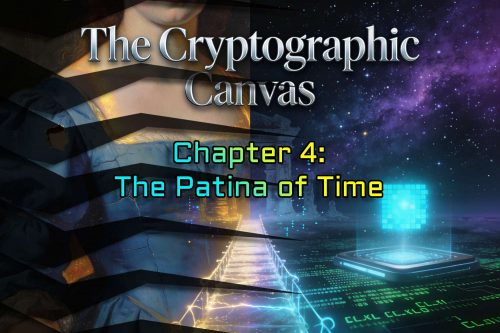
The Collector’s museum was not a place for seeing. Leo understood this within thirty seconds of walking through the doors.
It was a place for possessing.
The building itself was unremarkable from the outside—a sleek, windowless cube on the outskirts of the city, surrounded by a perimeter of perfectly manicured but entirely artificial greenery. The kind of building that could be a data center, a private research facility, or a bunker for the ultra-wealthy. In this case, it was all three.
Inside, the air was different. Leo noticed it immediately. It was too clean, too dry, too perfectly calibrated. There was no dust, no warmth, no hint of the organic world. The lighting was a soft, even glow from hidden sources, designed to illuminate without casting shadows, without creating glare, without doing anything that might disturb the objects it revealed.
And the objects were everywhere.
Leo walked down a long corridor lined with glass cases, each one containing a piece of history that would have made any museum curator weep with envy. A first-edition copy of a 20th-century novel he’d only ever seen in digital facsimiles. A strange, curved musical instrument from ancient Persia, its strings intact after a thousand years. A fragment of what appeared to be a lunar lander, preserved in a vacuum-sealed case. On and on, an endless procession of human achievement, ripped from context and arranged like trophies.
His guide was a silent, efficient woman in a gray jumpsuit who had met him at the security checkpoint. She had not spoken a single word, merely gestured for him to follow. Leo had the distinct impression that she was not a person but an interface, a human extension of the building’s security systems.
They stopped before a set of double doors. The woman pressed her palm to a sensor, and the doors slid open without a sound.
Leo stepped inside.
The room was vast, a private gallery larger than some museums he’d visited. And there, on the far wall, bathed in that perfect, sterile light, hung the woman in the blue dress.
She looked different now. The painting had been cleaned, of course—that was standard procedure before delivery. But this was more than cleaning. The varnish had been stripped and replaced with a modern synthetic coating that would never yellow or crack. The frame had been restored, its minor chips and dings filled and painted over until it looked brand new. The canvas had been relined, the old, weakened backing replaced with a pristine new support.
It was perfect. It was immaculate. It was dead.
“Beautiful, isn’t it?”
The voice came from behind him, soft and cultured, with an accent Leo couldn’t quite place. He turned.
The Collector stood in the doorway, silhouetted against the soft light of the corridor. He was a tall man, thin, dressed in a simple dark tunic that probably cost more than Leo’s annual salary. His face was unremarkable—regular features, pale skin, graying hair—but his eyes were extraordinary. They were the pale blue of a winter sky, and they held no warmth at all. They were the eyes of someone who looked at the world and saw only objects.
“Leo, isn’t it?” The Collector moved into the room, his footsteps silent on the polished floor. “I’ve read your report. Exhaustively. Fascinating work. The chemical signature on the Ghostchain was a particularly elegant touch. I hadn’t expected that.”
Leo found his voice. “Thank you. It was… unexpected.”
“Unexpected discoveries are the best kind, don’t you think?” The Collector circled the painting slowly, his eyes never leaving it. “This piece has been hidden for over a century. Waiting. And now it’s here. With me. Where it belongs.”
Leo nodded, not sure what to say. He felt like a performer who had delivered his lines and was now waiting for the audience to stop clapping so he could exit the stage.
“I have one final question,” The Collector said, stopping beside Leo. “A formality, really. You’ve examined the painting thoroughly. You’ve verified its materials, its age, its provenance. In your expert opinion, is it in perfect condition?”
Leo hesitated. This was the moment. He could give the easy answer, the one that would please the client, close the file, and send him on his way with a generous fee. The painting was authentic. That was what mattered. That was what he’d been hired to determine.
But his eyes drifted to the lower left corner of the canvas. To a tiny, almost invisible flaw. A flake of paint, no larger than a grain of rice, was missing. It was so small that most people would never notice it, even if they were looking. But Leo had spent hours with this painting. He knew every millimeter of its surface. And he knew the story of that missing flake.
“There is one thing,” he said quietly.
The Collector’s pale eyes shifted to him. “Oh?”
Leo walked closer to the painting and pointed to the tiny bare spot. “Here. This paint loss. It’s very small, very old. I analyzed the edges under magnification. The flake came off gradually, over decades, not all at once. It was caused by vibration.”
“Vibration.” The Collector’s voice was flat.
“Yes. See, the pattern is specific. It’s not random cracking from age or humidity. It’s a circular pattern, very faint, radiating from this point. I believe the painting hung for many years near a doorway. A frequently used doorway. Every time the door closed, the wall vibrated slightly. Over decades, that repeated micro-trauma caused this single flake to slowly detach.”
Leo looked at The Collector, hoping to see some spark of understanding, some appreciation for the story encoded in that tiny flaw. “It’s not damage,” he said carefully. “Not really. It’s patina. It’s evidence of the painting’s life. It hung in a home where people lived, where doors opened and closed, where generations passed by. That flake is a record of all those years, all those lives. It’s part of its history. Part of its value.”
The Collector stared at the tiny blemish for a long moment. His expression did not change.
Then he turned to the silent woman in gray, who had followed him into the room and now stood at attention by the door.
“Make a note,” he said. “The restorers will need to fill this before the piece is moved to the east wing. Use the standard protocol for inpaining. I want it indistinguishable from the original surface.”
Leo felt the blood drain from his face. “Wait. You can’t—”
“Can’t?” The Collector’s pale eyes fixed on him, and for the first time, Leo saw something behind them. Not warmth, but a cold, sharp intelligence. “I own this painting. I can do whatever I wish with it. I paid for your expertise to confirm its authenticity, not to lecture me on the aesthetic value of decay.”
“It’s not decay,” Leo insisted, his voice tighter than he intended. “It’s history. It’s the story of the object. If you erase that flake, you’re erasing part of what makes it real. You’re making it a copy of itself.”
The Collector smiled, a thin, humorless expression. “I’m making it perfect. That’s what I paid for. That’s what I always pay for.” He gestured at the room around them. “Do you know what all these objects have in common? They are the finest examples of their kind. The best preserved. The most complete. The ones without flaw. I don’t collect history, young man. I collect perfection. History is just the path that perfection took to reach me.”
Leo opened his mouth to argue, but no words came. What could he say? The Collector was right. He did own the painting. He could have it restored, altered, even destroyed, and there was nothing Leo could do about it. The law was clear. The money had changed hands. The woman in the blue dress was no longer a piece of human history. She was a trophy.
“I think we’re done here,” The Collector said, turning away. “Your fee has been transferred. The representative will see you out.”
The silent woman appeared at Leo’s elbow. He had no choice but to follow.
As he walked down the long corridor of glass cases, past all those perfect, flawless, dead objects, Leo felt a cold emptiness growing in his chest. He had spent his entire career learning to read the stories written in cracks and stains and fading pigments. He had devoted himself to preserving those stories, to ensuring that future generations could still hear the whispers of the past.
And now he had delivered one of those stories into the hands of someone who would silence it forever.
At the exit, the woman pressed her palm to another sensor, and the massive door slid open. Leo stepped out into the artificial garden, the too-perfect greenery, the too-clean air. He took a deep breath, but it didn’t help. The sterility was inside him now.
He was halfway to the transit stop when the memory surfaced.
“Patina is just damage.”
Ada’s voice, clear as day, from their conversation at the Haptic Library. She had said it dismissively, arguing that her digital art was superior because it didn’t decay. He had argued back, defending the beauty of physical history, the stories encoded in wear and tear.
But standing here, in the shadow of The Collector’s fortress of perfection, he finally understood what she meant.
To Ada, patina was damage because damage was all she saw. She had grown up in a world where physical objects were either perfectly preserved in museums or decaying in forgotten corners. She had never known a world where a chipped table leg meant generations of family meals, where a faded photograph meant years of being displayed with love, where a missing paint flake meant a doorway that had opened and closed for fifty years.
But The Collector didn’t see that either. To him, the flake was just a flaw. Something to be erased. Something that diminished the object’s value.
And Leo, standing between them, realized with a sickening clarity that they were both right. Patina was damage. It was decay. But it was also memory, love, history, life. The same thing could be both, depending on who was looking.
He thought of the painting, soon to be “perfected,” its story erased, its life ended. He thought of Ada’s cyan pixel, pristine and unchanging, forever alone in the digital void. Two kinds of preservation. Two kinds of death.
He reached the transit stop and slumped onto a bench, suddenly exhausted. The city hummed around him, oblivious. People passed by, absorbed in their own data streams, their own perfect, sterile lives.
Leo looked down at his hands. The hands that had gently examined a 150-year-old painting. The hands that had traced the story of a missing flake. The hands that had delivered that story to its executioner.
For the first time in his carefully ordered life, Leo had no idea what he was supposed to do next.
Back in the sterile gallery, The Collector stood before the woman in the blue dress, alone now, his silent assistant dismissed. He studied the painting with those pale, cold eyes, cataloging its virtues, its strengths, its place in the hierarchy of his collection.
His gaze drifted to the lower left corner, to the tiny bare spot where paint no longer existed. A blemish. An imperfection. A reminder that this object had once existed in a world of chaos and accident.
Soon, it would be gone. The painting would be perfect. Complete. His.
And yet, as he turned away, something flickered at the edge of his consciousness. A thought, quickly suppressed. A question, immediately unanswered.
If he erased every flaw, every story, every trace of the painting’s journey to him… what would be left?
He shook his head, dismissing the thought. What would be left was a masterpiece. Perfect and eternal. Just like everything else in his collection.
Just like the new piece he had heard about from his sources. A digital artwork on some dead blockchain. A single pixel, cyan, burning in the void. The artist was young, unknown, unprotected.
The Collector smiled. Perfection came in many forms. And he was very, very patient.
Table of contents:
Introduction
Chapter 1: The Burn Address
Chapter 2: Artifact Hunters
Chapter 3: The First Transaction
Chapter 4: The Patina of Time
Chapter 5: The Forger’s Firewall <<<<<< NEXT
Chapter 6: Decoding the Signature
Chapter 7: The Immutable Forgery
Chapter 8: The Aura of Scarcity
Chapter 9: The Living Exhibition
Chapter 10: The Unburnable Token
