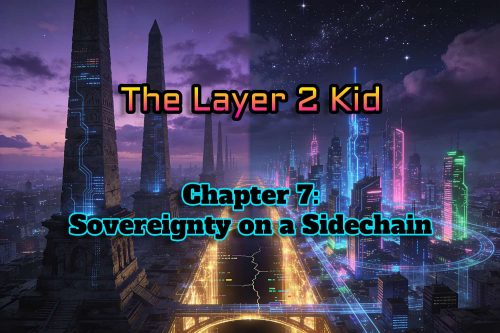
The silence was the first thing Skye noticed.
Not the absence of sound—Nova Rollup was never truly silent. The hum of transactions, the pulse of data, the constant background noise of a million digital lives continued as always. But there was something missing. A frequency she hadn’t realized she’d been hearing until it stopped.
The bridge frequency. The subtle vibration that came from the connection to Mainnet, the distant thrum of the ancient chain validating their existence. It was gone.
The infinite rollup had been submitted. The backlog was cleared. But in the process, the bridges had been temporarily severed—a safety protocol triggered by the massive data transfer. For the next forty-eight hours, Nova Rollup would be completely isolated. No incoming assets. No outgoing transactions. No connection to the foundation that had underpinned their existence since the district was founded.
Skye stood on her rooftop garden, Genesis Block in her hand, and stared at the empty space where the bridge used to be. The shimmering beam of light had vanished, leaving only darkness between Nova and the distant Mainnet obelisks. For the first time in her life, she was truly alone.
“We’re on our own,” she murmured to the plant, which offered no opinion. “Really, truly on our own.”
Her wrist-comm pulsed with an incoming message. Then another. Then a dozen. The Nova governance forum was lighting up with questions, concerns, demands. Citizens who had watched the bridge disappear wanted answers. Citizens who had assets stuck in transit wanted solutions. Citizens who had never experienced an isolated Nova wanted to know if their world was about to collapse.
Skye took a deep breath, set Genesis Block down on its usual shelf, and dove into the chaos.
The Nova Rollup virtual town square was more crowded than Skye had ever seen it.
Avatars pressed against each other in the digital space, their forms ranging from highly detailed representations to simple icons to abstract shapes. The floating slice of pizza was there, somehow managing to look anxious. The elderly man with the cross-chain garden stood near the front, his expression calm but his eyes sharp. Kai, the developer who had argued for the ZK-rollup variant, paced at the edge of the crowd, his energy crackling with barely contained frustration.
Skye materialized at the virtual podium, and the crowd quieted. Not completely—there was too much fear for complete silence—but enough that she could be heard.
“I know you’re scared,” she began. “I know you saw the bridge disappear. I know you’re wondering if your assets are safe, if your transactions will ever finalize, if Nova can survive without its connection to Mainnet.”
She paused, letting the words sink in.
“The bridge is not gone permanently. It’s a safety protocol, triggered by the infinite rollup. In forty-eight hours, it will reactivate, and everything will return to normal. But for those forty-eight hours, Nova is on its own. No Mainnet. No finality. No external validation.”
A murmur rippled through the crowd. A voice called out: “What about our assets? The ones stuck in transit?”
“They’re safe,” Skye said firmly. “The infinite rollup captured every pending transaction. When the bridge reconnects, everything will settle exactly as it should. No assets lost. No double-spends. No fraud.”
Another voice: “But what if the Glitcher attacks while we’re isolated? What if she tries to break us while we’re weak?”
Skye had been expecting this question. She had been asking it herself for the past hour.
“The Glitcher’s attacks have all targeted bridges—the connections between chains. While we’re isolated, we’re actually safer from her direct interference. She can’t reach us if there’s no bridge to cross.” She paused. “But we’re also more vulnerable in other ways. Without Mainnet’s security, we have to rely entirely on our own validators, our own protocols, our own judgment. For the next forty-eight hours, Nova’s sovereignty is real. And sovereignty, as we’re about to learn, is a burden.”
The crowd absorbed this in silence. Then, slowly, the questions began.
The first crisis hit six hours later.
Skye was in her studio, running diagnostics on Nova’s internal systems, when the alert flashed across her main display. SOCIAL PLATFORM OVERLOAD: “Nova Connect” experiencing critical capacity issues. User complaints surging. System stability at risk.
She pulled up the data. Nova Connect was the district’s primary social network—a place where citizens gathered to share news, art, ideas, and gossip. It had been running smoothly for years, its capacity carefully calibrated to match normal usage. But “normal” had gone out the window when the bridge disappeared.
With no way to check on their Mainnet assets, no way to communicate with friends in other districts, no way to do anything outside Nova, citizens had turned inward. They were flocking to Nova Connect in unprecedented numbers, posting frantic messages, demanding updates, sharing rumors and fears. The platform was drowning.
Skye opened a channel to the platform’s development team. “What’s your current capacity?”
A harried-looking avatar appeared on her display. “We’re at three hundred percent of normal load. Our servers are melting. We’ve got maybe two hours before the whole thing crashes.”
“Can you spin up more capacity?”
“We’re trying, but—” The developer hesitated. “Our expansion protocols were designed to pull resources from the bridge network. From Mainnet. Without that connection, we’re limited to local resources only. We can maybe add twenty percent more capacity. Not enough.”
Skye’s mind raced. She thought about the early days of Nova, before the bridge existed, when the district had been a tiny experimental community running on borrowed time and sheer enthusiasm. They hadn’t had Mainnet resources then. They’d had something else.
“Shut down non-essential features,” she said. “Video feeds, image hosting, long-form posts. Strip it down to text-only. Basic messaging. No frills.”
The developer stared at her. “That’ll cause a backlash. People rely on those features. They’ll be furious.”
“People rely on having any communication at all. If the platform crashes completely, they’ll have nothing. Fury we can manage. Silence will destroy us.” Skye’s voice was firm. “Do it. Now. And then start organizing community message boards—distributed, peer-to-peer. Offload as much traffic as you can to local nodes. Make every citizen a server if you have to.”
The developer nodded and vanished. Within minutes, Nova Connect’s features began disappearing—videos replaced by text, images by simple icons, rich media by raw data. The backlash was immediate. Thousands of users posted angry messages, demanding to know why their platform was being gutted.
But the platform didn’t crash.
And slowly, grudgingly, the anger began to shift. People started using the text-only system to share information, to coordinate, to help each other. The distributed message boards sprang up, each citizen contributing a tiny slice of their personal bandwidth to keep the network alive. It wasn’t elegant. It wasn’t pretty. But it worked.
Skye watched the transformation with a mixture of relief and something she hadn’t expected: pride. Her community was improvising. Adapting. Surviving.
The second crisis hit four hours later.
Kai found her in her studio, his avatar practically vibrating with urgency.
“The validators are splitting,” he said without preamble. “Two of them are arguing about whether to create emergency funds. One says we need to print more Nova tokens to maintain liquidity. The other says that would destroy confidence permanently. They’re deadlocked, and while they argue, nothing is getting validated.”
Skye closed her eyes briefly. Of course. The validators—the nodes that processed Nova’s transactions and maintained its internal ledger—were usually a quiet, behind-the-scenes operation. Their work was automated, routine, boring. But without the bridge, without the ultimate settlement on Mainnet, their role had suddenly become critical. And they had no protocol for this. No precedent. No rulebook.
“Where are they now?”
“Virtual validator chamber. They’ve been arguing for three hours. If they don’t reach consensus soon, the transaction backlog will start growing again. We’ll be right back where we started.”
Skye was already moving, her avatar dissolving from the studio and reforming in the validator chamber. It was a sparse space—designed for function, not comfort—occupied by two glowing figures representing the disputed validators and a handful of observers who had gathered to watch the drama unfold.
“—disaster!” one of the validators was saying, his voice sharp with frustration. “If we print tokens without backing, without the bridge, without any connection to Mainnet, we’re admitting that Nova’s economy is fictional. That our value is whatever we say it is. You want to destroy everything we’ve built?”
“I want to keep it running!” the other shot back. “Do you see what’s happening out there? People are scared. They’re hoarding tokens, not spending. Liquidity is drying up. If we don’t inject something soon, the economy will freeze solid. No transactions, no activity, no point.”
Skye stepped between them. “Stop.”
Both validators turned to her, their expressions a mix of surprise and irritation.
“With respect,” the first one began, “this is a validator matter. You’re a builder, not—”
“I’m the person who just spent three days saving this district from collapse,” Skye interrupted. “I’m the person who stood in front of the Mainnet council and convinced them to trust us. I’m the person whose community is out there right now, improvising and adapting and surviving without any help from anyone.” She stepped closer. “So yes, this is a validator matter. But it’s also my matter. It’s everyone’s matter. So stop arguing and start thinking.”
The chamber fell silent. The validators exchanged glances.
“What do you propose?” the second one asked quietly.
Skye pulled up a schematic, projecting it between them. “You’re both right. Printing tokens without backing would destroy confidence. But doing nothing while liquidity dries up would also destroy confidence. So we need a third option.”
She highlighted a section of the schematic. “We have reserves. Tokens set aside for emergencies exactly like this. They’re not infinite, but they’re enough to keep the economy moving for the next forty hours. We release them gradually, in controlled amounts, with clear communication to the community about what we’re doing and why.”
“And after forty hours?” the first validator asked.
“The bridge reconnects. Normal service resumes. The reserves replenish.” Skye met his gaze. “This isn’t a permanent solution. It’s a bridge—” She almost smiled at the word. “—a temporary structure to get us through the crisis. We don’t need to solve sovereignty forever. We just need to survive until sovereignty is optional again.”
The validators looked at each other. Then, slowly, they nodded.
“Show us the numbers,” the second one said. “If the math works, we’ll do it.”
Skye spent the next hour walking them through the calculations. The reserves, the release schedule, the communication plan, the contingency protocols if something went wrong. By the end, both validators were convinced. The emergency token release was approved unanimously.
As Skye left the chamber, Kai fell into step beside her.
“That was impressive,” he said quietly. “You just talked two people who hate each other into agreeing on something. In under an hour.”
“I talked two people who love this district into remembering what they have in common,” Skye corrected him. “There’s a difference.”
Kai nodded slowly. “What’s next?”
Skye looked at her wrist-comm. Twenty-eight hours until the bridge reconnected. Twenty-eight hours of sovereignty to survive.
“Next,” she said, “we deal with the rumors.”
The rumors had started small.
A whisper here, a speculation there. Someone had heard that the bridge was never coming back. Someone had seen data suggesting the infinite rollup had failed. Someone had a friend whose cousin’s neighbor worked for the Bridge Guardians and knew for a fact that Mainnet was planning to abandon Nova permanently.
By hour thirty of the isolation, the rumors had become a roar.
Skye stood in the virtual town square, facing a crowd that was larger and more agitated than any she’d seen before. The text-only social platform was straining under the weight of the panic. The distributed message boards were flooded with fear. The emergency token release had helped with liquidity, but it hadn’t helped with trust.
“They’re leaving us to die!” someone shouted from the crowd. “Mainnet cut the bridge on purpose! They want us to fail!”
“Why should we trust anything you say?” another voice added. “You’re the one who convinced us to build here! You’re the one who said Nova was safe! And now look at us—alone, cut off, abandoned!”
Skye held up her hands, waiting for the noise to subside. It took longer than before. Much longer. But eventually, the crowd quieted enough for her to speak.
“You’re right.”
The words hung in the air. The crowd stared.
“You’re right that I convinced you to build here. You’re right that I said Nova was safe. And you’re right that right now, we’re alone.” She paused, letting the admission sink in. “But you’re wrong that we’re abandoned.”
She expanded a display, showing the data feeds from Mainnet—the ones that were still available, even without the bridge.
“Look. Mainnet is still there. The validators are still validating. The blocks are still being produced. The council hasn’t cut us off—they’re waiting, just like we are, for the bridge to reconnect. They’re watching us, wondering if we can survive on our own.”
She turned back to the crowd.
“And here’s the thing I’ve learned in the past thirty hours. The thing I didn’t understand before. Sovereignty isn’t freedom. It’s responsibility. It’s waking up every morning and knowing that there’s no one to save you except yourself. It’s making decisions—hard decisions, unpopular decisions—and living with the consequences.”
She gestured to the crowd, to the thousands of avatars packed into the square.
“You’ve done that. You’ve adapted. You’ve improvised. You’ve kept this district alive without any help from anyone. The social platform didn’t crash—you kept it running by sharing bandwidth. The economy didn’t freeze—you kept trading, kept creating, kept believing. The validators didn’t tear each other apart—they found a way to agree.”
Her voice softened.
“I didn’t do that. You did. Nova isn’t safe because of me, or because of the bridge, or because of Mainnet. Nova is safe because of us. Because of what we’ve built together. And when the bridge reconnects—and it will, in eighteen hours—we’ll be stronger than before. Because we’ll know something we didn’t know before.”
She looked out at the crowd, at the faces—detailed and abstract, frightened and hopeful.
“We’ll know that we can survive on our own. That sovereignty isn’t something to fear. It’s something to earn.”
The silence that followed was different from the ones before. It wasn’t fear or anger or uncertainty. It was something else. Something that looked, to Skye’s exhausted eyes, a lot like hope.
In the Watchtower, Mateo watched the feed from Nova with an expression of quiet awe.
He had been monitoring the district’s isolation closely, ready to intervene if necessary—though what intervention was possible without a bridge, he didn’t know. But intervention hadn’t been needed. Skye had handled everything. The social platform crisis, the validator dispute, the rumors, the panic. She had led her community through the darkest hours of its existence, and they had emerged not broken, but stronger.
She’s not reckless, he realized. She never was. She just believed in something I couldn’t see.
He pulled up a private channel to her studio. After a moment, her face appeared—exhausted, drawn, but somehow luminous.
“You’re still watching,” she said. It wasn’t a question.
“I couldn’t look away.” He paused. “That was… I don’t have words. That was incredible.”
Skye almost laughed. “It was terrifying. Every minute of it. I had no idea what I was doing half the time. I just… kept going.”
“That’s what leadership is.” Mateo’s voice was quiet. “My father used to say that validators aren’t the ones with all the answers. They’re just the ones who keep showing up. Keep trying. Keep believing that the chain will hold.”
Skye was quiet for a moment. Then she said, “He sounds like he was wise.”
“He was. I didn’t always appreciate it.” Mateo looked at her through the channel. “I appreciate you, though. For what it’s worth.”
She smiled—a real smile, the first in days. “It’s worth a lot. More than you know.”
They sat in silence for a moment, connected across the void between their districts, waiting for the bridge to return.
The bridge reconnected at exactly forty-eight hours.
Skye watched from her rooftop garden, Genesis Block in her hands, as the shimmering beam of light slowly materialized between Nova and Mainnet. It started as a faint glow, barely visible against the darkness, then grew brighter, stronger, more solid. Within minutes, it was fully restored—the connection that made Nova possible, the thread that bound her district to the ancient chain.
Her wrist-comm pinged with a flood of notifications. Transactions finalizing. Assets arriving. Communications from Mainnet flooding in after days of silence.
Among them, a message from Mateo: The bridge is back. But you already knew that. More importantly: you’re back. All of you. Stronger than before.
Skye smiled, set Genesis Block down, and typed her reply: Not stronger. Just more honest about what we are. A sidechain with a backbone.
She looked out at her district—at the buildings, the data streams, the millions of lives continuing their digital existence. It looked the same as before the isolation. But it felt different. Deeper. More real.
Sovereignty, she had learned, wasn’t freedom from dependence. It was the courage to be worthy of it.
And Nova Rollup, for the first time in its existence, had proven itself worthy of everything.
Table of contents:
Introduction
Chapter 1: Mainnet Blues
Chapter 2: The Sidechain Express
Chapter 3: A Bridge in Peril
Chapter 4: The Validator’s Gambit
Chapter 5: Cross-Chain Contagion
Chapter 6: The Infinite Rollup
Chapter 7: Sovereignty on a Sidechain
Chapter 8: Burning the Bridge <<<<<< NEXT
Chapter 9: The Interoperability Pact
Chapter 10: Not a Chain, an Ecosystem
