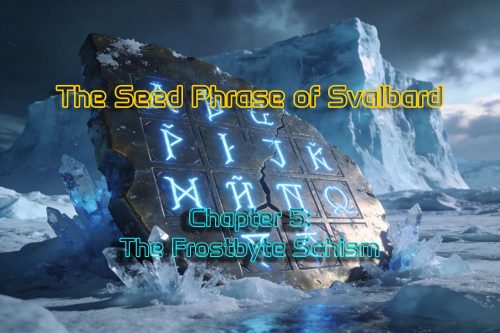
The waiting was the hardest part.
Talia had spent her whole life waiting—waiting for the cold to lift, waiting for the next shipment of dividends, waiting for her father to come home from the scavenging runs. But this waiting was different. This waiting had teeth.
Three weeks had passed since her conversation with Kiran at the edge of the warrens. Three weeks of watching the fuel canisters dwindle. Three weeks of watching her mother’s face grow more hollow, her brother’s cough deepen. Three weeks of watching Dex’s patience fray like a rope stretched too tight.
She stood at the entrance to her shelter, the communicator Kiran had given her clutched in her hand. She had used it twice—brief, coded messages to let him know that the Frostbytes were holding, that the situation was stable, that there was still time. But there was not still time. There had never been enough time.
“Talia.”
She turned. Dex was standing in the corridor, his face shadowed, his hands wrapped around a length of pipe that he had been using as a tool. But he was not holding it like a tool anymore. He was holding it like a weapon.
“The vault’s patrols changed last night,” he said. “New schedule. More guards. They’re tightening up.”
Talia’s stomach clenched. “They know something.”
“They know something’s coming.” Dex stepped closer, his voice low. “The Stewards aren’t stupid. They’ve seen the desperation in the warrens. They know we can’t survive the deep winter. They’re preparing for us.”
“Then we wait longer. We let them—”
“We don’t have longer.” Dex’s voice cracked like ice breaking. “The fuel we have will last two weeks. Maybe three if we stretch it. After that, people start dying. Not the old ones, not the sick ones. Everyone.”
Talia looked past him, at the warrens stretching away into the darkness. She could see the dim glow of a few fires, the flicker of candles in windows, the shapes of people huddled in doorways. They were all waiting too. Waiting for something to change. Waiting for someone to act.
“The Steward,” Dex said. “The one you’ve been talking to. Has he done anything?”
“He’s trying. He’s talking to the other clans, trying to build consensus. He says—”
“He says.” Dex’s laugh was bitter. “He says words. Pretty words about hard forks and new consensuses. Meanwhile, our children are freezing. Our parents are starving. And he sits in his warm mountain and talks.”
Talia’s hand tightened on the communicator. “He’s not like the others. He helped us. He brought heat when—”
“He brought one heater. One.” Dex held up a finger. “A single act of charity to ease his conscience. And then he went back to his vault and did nothing while the Halving cut our fuel in half and the brokers bled us dry.”
“That’s not fair.”
“Fair?” Dex’s voice rose, and people in nearby shelters turned to look. “Fair is a story we tell children so they sleep at night. The world isn’t fair. The vault isn’t fair. And I am done waiting for fairness.”
He turned and walked away, the pipe swinging at his side. Talia watched him go, her heart pounding, her mind racing. She had known Dex her whole life. She had seen him angry before, had seen him hurt and desperate and cold. But she had never seen him like this. He was not angry. He was resolved.
She looked down at the communicator in her hand. She could call Kiran, warn him. But warn him of what? Dex hadn’t told her his plan. He hadn’t said when or how. All she knew was that something was coming, and that when it came, people would die.
She tucked the communicator into her coat and went after Dex.
She found him in the old server trench, surrounded by a group of Frostbytes she recognized. They were the hard ones—the ones who had lost families to the cold, who had nothing left to lose. They were gathered around a crate that had been covered with a tarp, and when Talia approached, they fell silent.
“You shouldn’t be here,” Dex said without looking at her.
“Where else would I be?”
He turned, and in the dim light, his scarred face was a mask of shadows. “This isn’t your fight. Not anymore. You have your brother to think about. Your mother.”
“My father died for this fight,” Talia said. “He died scavenging so we could live. And I’ve been fighting ever since. So don’t tell me this isn’t my fight.”
Dex stared at her for a long moment. Then he nodded, a small gesture, and lifted the tarp.
Beneath it were weapons. Not the scavenged knives and pipes that most Frostbytes carried, but real weapons—old rifles, cleaned and oiled, their metal gleaming in the dim light. There were a dozen of them, laid out in rows, with ammunition stacked beside them.
“Where did you get these?” Talia’s voice was barely a whisper.
“Old caches. Places the vault forgot about. I’ve been collecting for months.” Dex picked up one of the rifles, sighting along its barrel. “I was hoping we wouldn’t need them. I was hoping the Stewards would see reason. But they didn’t. And now we have no choice.”
Talia looked at the weapons, then at the faces of the Frostbytes gathered around her. They were not soldiers. They were scavengers, farmers, mothers and fathers who had never held a rifle before. But there was something in their eyes that she recognized. It was the same thing she had seen in her own reflection, in the dark hours when she thought about the vault and everything it held.
It was the look of people who had nothing left to lose.
“What’s the plan?” she asked.
Dex set the rifle down and spread a map across the crate. It was the same map he had shown her weeks ago, but now it was covered in new markings—patrol routes, guard rotations, camera blind spots. And at the center, circled in red, was a ventilation shaft that led into the vault’s lower levels.
“We go in through the old air system,” Dex said. “It’s narrow, but it’s open. I checked it myself. It leads to the maintenance corridors, which connect to the central hall. From there, we can reach the Stewards’ quarters.”
“And then?”
“Then we take what we need.” Dex’s voice was flat. “The Stewards have emergency reserves. Fuel, food, medical supplies. We take enough to get through the winter, and we get out.”
Talia studied the map, her mind working. “The guards. How many?”
“Six on the surface at any time. More inside, but they’re spread thin. If we hit fast, hit hard, we can be in and out before they know what happened.”
“And the Stewards? The ones with the words?”
Dex’s eyes met hers. “We don’t touch them. That’s not what this is about. We’re not trying to break the fund. We’re just trying to survive.”
Talia wanted to believe him. She wanted to believe that this raid, this violence, could be contained. But she had seen what desperation did to people. She had seen her father come back from scavenging runs with blood on his hands, had seen the fights that broke out over a handful of fuel tokens, had seen the bodies that were buried in the permafrost because there was no wood for a pyre.
“When?” she asked.
Dex folded the map. “Tomorrow night. The patrol shift changes at midnight. There’s a window of about fifteen minutes when the cameras are cycling. That’s when we move.”
Talia looked at the weapons, at the faces of the Frostbytes, at Dex’s scarred hands folded over the map. She thought about Kiran, waiting in the vault, trying to build consensus, trying to find another way. She thought about her brother, coughing in the cold, her mother, hollow-eyed with hunger. She thought about her father, buried under a thousand tons of rubble, who had left the vault because he believed there was a better way to live.
“There’s a Steward,” she said. “Kiran. He’s on our side. He can help.”
Dex’s expression didn’t change. “Can he stop the raid?”
“No. But he can open doors. He can tell us where the reserves are, where the guards will be. He can help us get in and out without anyone getting hurt.”
“You trust him that much?”
Talia thought about the heater, glowing in the corner of her shelter, the warmth that had saved her brother’s life. She thought about Kiran’s face when he had seen Micah, the horror in his eyes, the way he had not looked away.
“Yes,” she said. “I trust him.”
Dex was silent for a long moment. Then he nodded. “Tell him. Tell him we move tomorrow night. Tell him if he wants to help, he can. But if he betrays us—” His hand closed around the rifle. “If he betrays us, we won’t be the only ones who die.”
Talia turned and walked away, the communicator burning a hole in her pocket, the weight of the choice she had just made pressing down on her like the mountain above.
Kiran received the message in the hydroponic bay.
He was alone, checking the nutrient levels in the lettuce beds, when the communicator buzzed against his chest. He had been carrying it for weeks, waiting for this moment, dreading it. He pulled it out and read the short, coded message.
Tomorrow night. Midnight. The old vent. We need you.
He stood in the warm, damp air of the bay, the communicator clutched in his hand, and felt the world tilt beneath him. He had known this was coming. He had seen the desperation in Talia’s eyes, had heard the edge in her voice, had watched the clock tick down with every passing day. But knowing and facing were different things.
He had not been idle. In the weeks since the Halving, he had spoken to everyone who would listen. He had laid out his plan to Saria of the Keepers, who had listened with a grim expression and promised nothing. He had approached Orin of the Guardians, who had shaken his head and walked away. He had even tried to talk to the other Stewards in his own clan, the ones who carried the root words, and found them divided—some sympathetic, most afraid, all uncertain.
And Aris. He had saved Aris for last, knowing that if he could convince them, he could convince anyone. But when he had laid out his plan—the geothermal plant, the hard fork, the new consensus—Aris had listened in silence, their ancient face unreadable, and then they had spoken six words that had shattered his hope.
“The protocol does not permit deviation.”
Kiran had argued. He had shown them the calculations, the projections, the proof that the geothermal plant would not destroy the fund, would not betray the future. He had pleaded, had begged, had thrown every argument he had against the wall of their certainty. And Aris had listened, patient and immovable, and when he was done, they had said the same thing.
“The protocol does not permit deviation.”
Now he stood in the hydroponic bay, the communicator in his hand, and he knew that the time for talking was over. The Frostbytes were moving. People would die. And he had to choose.
He thought about Talia, standing in the cold, her brother’s life hanging in the balance. He thought about the Frostbytes, huddled in their shelters, watching their children freeze. He thought about the words in his mind, the promise he had sworn to keep, the duty that had been passed down to him through three generations.
And he thought about what Aris had said, in the observation deck, all those weeks ago. The promise is worth more than any single life.
He did not believe that. He had never believed it, not really. He had wanted to, had tried to, had told himself that duty was enough. But standing in the warm, damp air of the hydroponic bay, with the weight of the choice pressing down on him, he knew the truth.
The promise was not worth a single life. Not one.
He tucked the communicator back into his coat and walked out of the bay. He had work to do.
The night of the raid, the cold was a living thing.
Kiran stood at the entrance to the old ventilation shaft, his breath misting in the air, his heart pounding against his ribs. The shaft was hidden behind a collapsed supply shed, half-buried in snow, its grille rusted and bent. It had been sealed for decades, but Dex had found a way in—had pried the grille open with a crowbar, had widened the gap until it was just big enough for a person to squeeze through.
Behind him, the Frostbytes were gathering. He had counted them as they emerged from the darkness—eighteen men and women, their faces hidden behind scarves and hoods, their hands wrapped around weapons. They moved silently, without words, their steps muffled by the snow. They were not soldiers, but they moved like people who had learned that noise meant death.
Talia was at the front of the group, her face pale, her eyes fixed on the shaft. She had not spoken to him since he arrived—had only nodded once, a small gesture that might have been gratitude or might have been fear. He understood. There was nothing left to say.
Dex appeared at his side, the pipe he had been carrying replaced by a rifle. “The guards changed shift ten minutes ago. We have maybe twenty minutes before the next patrol comes through. That’s our window.”
Kiran nodded. “The shaft leads to the maintenance corridor. From there, you go left to the storage bays. The emergency reserves are in Bay Seven. I can—”
“I know the layout.” Dex’s voice was flat. “You gave us the map. We’ve been over it a dozen times. The question is whether you’re coming with us or staying here.”
Kiran looked at the shaft, then at the vault looming above them, then at the Frostbytes waiting in the darkness. He thought about Aris, asleep in their quarters, unaware of what was about to happen. He thought about the other Stewards, the Keepers and the Guardians, who would wake to find their world broken. He thought about the words in his mind, the promise he was about to break.
“I’m coming,” he said.
Dex nodded once, then turned to the group. “Move.”
They went in silence, one by one, slipping through the gap in the grille and into the darkness beyond. Talia went first, her slim form disappearing into the shaft. Kiran followed, the cold metal scraping against his coat, the darkness closing around him like a fist.
The shaft was narrow, barely wide enough for his shoulders, and it smelled of rust and old dust. He crawled forward on his hands and knees, his breath loud in his ears, his heart hammering. Behind him, he could hear the others following, their movements careful, measured. They had practiced this, he realized. They had been preparing for weeks, maybe months, and he had not known. He had been so focused on his own plan, his own attempt to build consensus, that he had not seen what was building in the warrens.
The shaft opened into the maintenance corridor, a narrow passage lined with pipes and conduits that hummed with the vault’s life support. Kiran emerged into the dim light, blinking, and found Talia waiting for him.
“The storage bays are that way,” he said, pointing left. “Bay Seven is at the end. The reserves are kept in locked containers, but the codes—”
“We have the codes.” Talia’s voice was steady. “Dex got them from a trader who used to work in the vault.”
Kiran wanted to ask how, wanted to know who had betrayed the vault’s security, but there was no time. The Frostbytes were pouring out of the shaft behind him, their weapons drawn, their faces set. They moved through the corridor like shadows, their footsteps silent on the metal floor.
And then the alarm went off.
The sound was deafening, a wailing siren that echoed through the corridors, bouncing off the walls, filling the air with noise. Kiran clapped his hands over his ears, his eyes wide, his mind struggling to process what was happening.
“Someone triggered the perimeter!” Dex’s voice cut through the chaos. “They knew we were coming!”
Kiran looked at Talia, at the horror in her eyes, and understood. He had not betrayed them. But someone had. Someone had seen them enter the shaft, had sounded the alarm, had set off the chain of events that would lead to blood.
“We need to get out!” Talia grabbed his arm, pulling him toward the shaft. “Now!”
But Dex was already moving, his rifle raised, his face a mask of cold fury. “No. We came for the reserves. We’re not leaving empty-handed.”
“Dex—”
“The storage bays. Now!”
The Frostbytes followed him, their hesitation lasting only a moment before instinct took over. They had come too far to turn back. They had risked too much to leave with nothing.
Kiran stood frozen in the corridor, the siren screaming in his ears, his mind racing. He could run. He could go back through the shaft, back to the surface, back to the warrens, and let the raid play out without him. He could pretend he had never been here, never chosen, never broken his promise.
But he had broken it already. The moment he entered the shaft, the moment he chose to help the Frostbytes, he had broken it. And there was no going back.
He ran after them.
The storage bays were a maze of crates and containers, stacked to the ceiling, their contents marked with codes he did not recognize. The Frostbytes spread out, prying open containers, stuffing their sacks with whatever they could carry. Food packs. Medical supplies. Fuel canisters. Things that would keep them alive through the winter.
Kiran stood at the entrance, watching, his hands shaking. He could hear voices now—guards, shouting, their footsteps echoing in the corridors. They were coming. They would be here in minutes.
“We have to go,” he said, his voice barely audible over the siren. “They’re almost here.”
Dex ignored him. He was prying open a locked container, his face red with effort, his teeth gritted. The lid came off with a screech of metal, and he reached inside, pulling out a handful of fuel canisters.
“This is what we came for,” he said, his voice triumphant. “This is—”
The first shot came from behind them.
Kiran heard it before he saw it—a sharp crack that echoed through the bay, followed by the sound of something heavy hitting the floor. He turned, his heart in his throat, and saw one of the Frostbytes—a woman he did not recognize—crumpled on the ground, blood spreading across her coat.
The guards were in the doorway, three of them, their rifles raised. Their faces were pale, their hands shaking, but their weapons were steady.
“Drop your weapons!” one of them shouted. “Drop them now!”
Dex did not drop his weapon. He raised it, his finger on the trigger, his eyes locked on the guards. For a moment, time seemed to stop. Kiran saw it all—the fear in the guards’ faces, the desperation in Dex’s, the woman bleeding on the floor, the Frostbytes frozen in the act of taking what they needed to survive.
And then Talia was moving.
She threw herself between Dex and the guards, her arms outstretched, her voice cutting through the chaos. “No! Stop! This isn’t—we didn’t come here to—”
The second shot was louder than the first. Kiran saw Talia stagger, saw her hand go to her shoulder, saw the blood seeping through her fingers. She did not fall. She stood there, her face white with shock, her eyes wide, and she looked at him.
He ran to her, catching her as her knees buckled, lowering her to the ground. The world seemed to narrow to a single point—her face, her blood, the sound of her breathing.
“I’m okay,” she said, her voice a whisper. “It’s not—it’s not bad.”
But Kiran could see the wound, could see the blood pulsing from it in time with her heartbeat, and he knew that she was lying.
The guards were shouting, the Frostbytes were running, Dex was screaming something he could not hear. But Kiran did not move. He knelt beside Talia, his hands pressed against her shoulder, trying to stop the bleeding, trying to keep her alive.
And in the chaos, in the blood and the noise and the fear, he felt something shift inside him. The words in his mind, the promise he had carried for so long, the duty that had bound him to a future he would never see—it all fell away, replaced by something simpler, something harder, something that had been waiting for this moment all along.
He was not a Steward anymore. He was something else.
He was someone who would not let another person die.
The raid ended an hour later.
The Frostbytes who could escape had escaped, fleeing back through the ventilation shaft, carrying what they had taken. Three of them had been captured, along with Dex, who had refused to run, who had stood his ground with his empty rifle and dared the guards to shoot him. They had not. They had taken his weapon, bound his hands, and led him away.
Kiran sat in the medical bay, his hands stained with Talia’s blood, watching as the vault’s medic worked on her shoulder. The bullet had gone through, missing the major arteries, and the medic said she would live. But she had lost a lot of blood, and she was pale, and she had not opened her eyes since they brought her in.
The door opened, and Elder Aris entered. They stood in the doorway for a long moment, their ancient face unreadable, their eyes fixed on Kiran.
“You were part of this,” Aris said. It was not a question.
Kiran did not deny it. “I was.”
Aris crossed the room, their steps slow, deliberate. They stopped beside Talia’s bed, looking down at her pale face, her bandaged shoulder, the slow rise and fall of her chest.
“She is a Frostbyte,” Aris said.
“She is a person,” Kiran said. “She was trying to keep her family alive.”
Aris was silent for a long moment. When they spoke again, their voice was softer than Kiran had ever heard it.
“The other elders want you punished. Treason, they are calling it. Conspiracy with the enemy. They want you removed as a Steward, your words transferred to another.”
Kiran looked up. “And what do you want?”
Aris met his eyes, and for the first time, he saw something in them that he had never seen before. Doubt.
“I want to know why,” Aris said. “I want to know why you, of all the Stewards, chose to break your oath. Why you chose to help them.”
Kiran thought about all the things he could say. He could talk about the Halving, the suffering, the children who were freezing in the warrens. He could talk about the calculations, the geothermal plant, the hard fork he had been trying to build. He could talk about duty and honor and the promise that had been passed down through generations.
But in the end, there was only one thing that mattered.
“Because she asked,” he said. “Because she stood in the cold and told me that her brother was dying, and I saw her face, and I knew that if I walked away, I would never be able to live with myself.”
Aris stared at him for a long, long moment. Then they reached out and placed a hand on his shoulder, their grip steady, their touch warm.
“You are not the first Steward to ask that question,” they said. “And you will not be the last. But you are the first to find an answer.”
They turned and walked out of the medical bay, leaving Kiran alone with Talia and the silence and the weight of the choice he had made.
He looked down at her face, at the slow rhythm of her breathing, at the blood that had stained his hands and his coat and his heart.
And he knew that there was no going back. The old world, the old promise, the old duty—it was all gone. What came next would be something new, something forged in blood and fire and the desperate hope that there was still a future worth saving.
He reached out and took Talia’s hand, and he waited for her to wake up.
Table of contents:
Introduction
Prologue: The Great Migration
Chapter 1: Vault in the Ice
Chapter 2: Twelve Words to Remember
Chapter 3: The Dividends of Survival
Chapter 4: The Halving
Chapter 5: The Frostbyte Schism
Chapter 6: Hard Fork in a Hard Place <<<<<< NEXT
Chapter 7: Proof-of-Life
Chapter 8: The Consensus of the Sun
Chapter 9: A New Genesis Block
