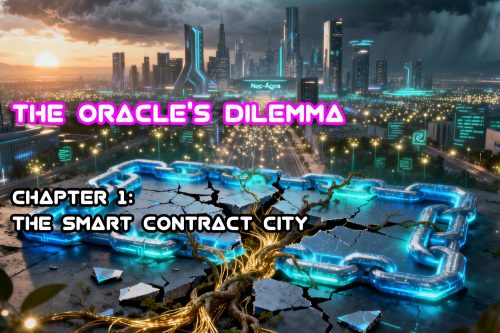
The morning sun didn’t so much rise over Neo-Agora as it was algorithmically integrated. As the first rays hit the eastern solar array, a cascade of smart contracts executed. Streetlights dimmed to 10% power. Public transit grids shifted from ‘Night Maintenance’ mode to ‘Peak AM Efficiency.’ In the Green-Belt, irrigation sprinklers, having received a weather-predictive oracle feed of a 0% precipitation probability, activated with a synchronized hiss.
Seventeen-year-old Ben Aris saw none of this directly, and all of it implicitly. He leaned into a turn on his self-balancing scooter, the rubberized wheels humming against the spotless composite pavement of the Helix Concourse. He didn’t worry about traffic lights; they were dynamically timed by the TrafficFlow contract, which analyzed real-time data from the city’s ten thousand embedded sensors. A delivery bot whisked past him, its pathfinding perfectly harmonized with his own. It was a symphony, and Ben was a musician who understood every note. He was a Smart Contract Scripter, and Neo-Agora was his masterpiece.
His city was a marvel of post-chaos logic. A generation ago, his parents told stories of bureaucratic gridlock, of corrupted officials, of aid that arrived late or not at all. Then came the Agora Chain, and the principle that became gospel: Code is Law. Not a metaphor. A reality.
Everything in Neo-Agora was governed by smart contracts—self-executing programs stored on an immutable, transparent blockchain. They were beautiful in their simplicity: IF a condition is met, based on data from an Oracle, THEN an action automatically occurs. No debate. No delay. No human error or corruption.
Ben glided past a public waste bin. As he passed, a soft chime sounded from its sensor. A panel on its side lit up: CAPACITY: 95.7%. CONTRACT UPLOAD_3421.A EXECUTING. Seconds later, a quadcopter drone, matte black with the city’s hexagonal insignia, descended from a sky-lane. It docked with the bin, exchanged a full canister for an empty one, and ascended. The bin’s display reset to 0.0%. AWAITING FULFILLMENT. The entire process had taken twenty seconds. No overflowing trash, no missed collections, no disgruntled sanitation workers. Just perfect, predictable efficiency.
He pulled up a holographic display from his wrist-comm, scrolling through the public ledger. It was all there, in cryptic but beautiful code. The contract for the waste drone, the payment in digital tokens transferred to its maintenance sub-contract, the fuel allocation logged. A perfect, closed loop. A smile touched his lips. This was order. This was justice.
His destination was the quarterly Script-Off, the city’s premier coding competition, but his route took him past the Oracle Hub. It was a squat, utilitarian structure of gray synth-stone, nestled between the gleaming, crystalline towers of the Data Spires. It was the city’s sensory cortex, the humble interface between the messy, analog world and the pristine digital logic of the Agora Chain.
Through a large window, he saw her. Maya Cruz, sixteen, a Context Volunteer. Her dark hair was tied back in a practical knot, and she moved between a bank of flickering screens showing weather radar, seismic graphs, and live news feeds from around the globe. She was calibrating a particulate sensor, her brow furrowed in concentration. Ben slowed his scooter slightly.
He understood the necessity of Oracles. The contracts needed facts—Was it raining? Had a ship docked? Did a park exceed its noise threshold?—and humans, for now, were still slightly better than AI at interpreting complex, real-world events and feeding them cleanly into the system. But to Ben, it was glorified data entry. The lowest rung of the civic ladder. The contracts themselves, the elegant logic he wrote, that was where the real genius lay. Maya’s job was to provide the ingredients; his was to write the recipe that made a five-star meal.
As he watched, Maya paused, tilting her head at a screen displaying a seismograph readout. A faint, jagged line spiked irregularly against a calm baseline. She tapped the screen, zoomed in, her frown deepening. She typed a quick note, tagged it as ANOMALY_FLAG, and sent it. Ben shook his head. Probably a glitch in a remote sensor, or a passing heavy vehicle. The system would filter it out. Garbage in, garbage out, he thought. The old programmer’s adage. Maya’s job was to keep the garbage out so his flawless logic could shine.
He pushed off towards the gleaming atrium of the Civic Coding Academy, his mind already racing with the variables of his Public Event Fund Allocation contract. He was going to win today.
Inside the Oracle Hub, Maya stared at the now-quiet seismograph. The flagged anomaly had been automatically archived by the system’s verification protocol. It didn’t match any known event pattern, and no other sensors in the network had corroborated it. The system’s confidence interval was too low to trigger any contracts, not even a low-level alert.
But Maya’s job was context. The data said one thing, but her gut, the human intuition she was supposed to use for nuance, said something else. The tremor pattern was… odd. Not like geological activity. Almost like a deep, structural sigh. She filed a secondary report, a Context Volunteer’s Qualitative Addendum, which was essentially a comment box in the vast database. She typed: “*Reading feels propagative, not epicentral. Recommend diagnostic on Sensor Cluster Delta-7. Low priority.*”
The system acknowledged it with a soft ping and filed it under Subjective Annotation: Non-Actionable. Maya sighed, turning to the weather feed. A major storm system was forming off the coast, hundreds of kilometers away. Standard stuff. She began inputting the probability matrices that would update everything from the harbor’s storm shutter contracts to the public alert system.
Yet, the memory of that jagged, anomalous line lingered in the back of her mind, a tiny blip of chaos in the city’s perfect rhythm.
Meanwhile, in the grand hall of the Academy, Ben stood before a panel of judges, including Mayor Silva. The Mayor, a tall man with the keen eyes of a former coder who had traded syntax for politics, gave him an encouraging nod.
“The current system for allocating funds to public festivals is riddled with legacy bias and subjective committee review,” Ben declared, his voice clear and confident. His holographic display blossomed behind him, showing streams of clean, efficient code. “My contract, CivicJoy_V4, eliminates that. It pulls Oracle data for historical attendance, cross-references real-time weather forecasts and public transit usage projections, and factors in a community sentiment score derived from sanctioned social media feeds. The allocation is calculated, the funds are transferred, and the permits are issued—automatically, the moment the proposal meets the objectively defined threshold for ‘community benefit.’ No lobbying. No favoritism. Pure, equitable logic.”
It was a masterpiece of efficiency. The judges were impressed. During the question period, a hand went up from the audience. It was Maya, who had slipped in at the back after her shift.
“Ben,” she asked, her voice cutting through the technical admiration. “It’s really elegant. But… what if something happens that you didn’t factor into your variables? A flash storm that the oracles don’t predict in time, or a… a power outage that cancels everything? The contract would just execute anyway, right? The funds would be sent, the permits granted, for an event that can’t happen.”
A slight murmur went through the crowd. Ben smiled, the patient smile of an expert addressing a well-meaning novice.
“That’s the point, Maya,” he said. “The contracts remove human hesitation, second-guessing, and, yes, the potential for corruption. The parameters are clear. If the conditions are met, the action occurs. Trust in the system. The Oracles feed it good data, and we scripters write watertight logic. That’s how we built a city that works.”
He saw her chew her lip, wanting to say more, but she just nodded and sat down. His answer was met with applause. It was the correct answer. The only answer in Neo-Agora.
Later, as Ben held the gleaming Script-Off Champion medal, Mayor Silva clapped him on the shoulder. “This is the future, Ben. Clear, accountable, and unstoppable. ‘Code is Law’ isn’t just our motto; it’s our liberation from the failures of the past.”
Ben beamed, the weight of the medal affirming everything he believed. He saw Maya on the periphery of the celebration, sipping a synthetic juice. He made his way over, the buzz of victory still humming in his veins.
“Hey, good question in there,” he said, magnanimous in his success. “Always good to think about edge cases. But that’s why we have failsafes and contract insurance layers. The system is robust.”
Maya looked at him, her eyes serious. “It’s not just an edge case, Ben. It’s… the context. My feeds today had a weird harmonic reading on the deep-geo sensors. It didn’t fit any models. The system archived it.”
Ben shrugged, taking a celebratory pastry from a passing tray. “Like I said, garbage in, garbage out. Your job is to clean the data. My job is to use it. If the Oracle feed is clean, the contracts will handle the rest. They always do.”
He was swept away by a group of other aspiring scripters, all eager to congratulate him. Maya watched him go, then pulled out her personal datapad. She called up a private, encrypted log, a habit left over from the days before she trusted the city’s systems completely.
*Entry: 18.43. Script-Off day. Ben’s contract is beautiful and terrifying. It has no ‘why,’ only ‘if.’ The anomaly from Sensor Delta-7 has repeated. Twice. Amplitude increasing by 0.02% each time. Still within ‘background noise’ parameters for the system. But noise doesn’t have a pattern. I feel like I’m feeding a sleeping giant facts about the weather, while its foundations are quietly grinding.*
She looked out the window at the dazzling, perfectly ordered city. Lights came on in perfect sequence along the boulevards. A fleet of automated sweepers deployed. In the distance, she could just make out the solid, unassuming block of the Oracle Hub. She was the city’s whisperer, its sense-touch. And right now, she had the unsettling feeling the city was dreaming a bad dream, and she was the only one close enough to hear its restless sigh. But a sigh wasn’t data. Not until it became a scream.
She closed her log. The system was perfect. The contracts were law. And Ben Aris, the golden boy of logic, was its champion. She tried to shake off the unease, attributing it to fatigue. The giant, after all, was still asleep.
Table of contents:
Introduction
Chapter 1: The Smart Contract City
Chapter 2: If This, Then That <<<<<< NEXT
Chapter 3: The Black Swan Event
Chapter 4: Code is Not Law
Chapter 5: The Oracle’s Whisper
Chapter 6: Hardcoding Compassion
Chapter 7: The DAO of Disaster Relief
Chapter 8: Consensus in the Rubble
Chapter 9: A Human in the Loop
Chapter 10: Living Contracts
