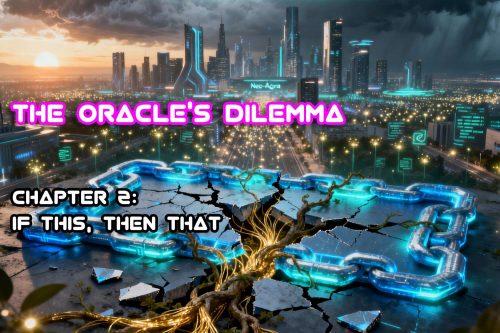
The victory glow from the Script-Off lasted for days. Ben’s CivicJoy_V4 contract wasn’t just a theoretical win; it was uploaded to the Agora Chain’s test net, where it began processing real, pending event proposals with machinic dispassion. Seeing it work was a continuous thrill. A community garden festival proposal was approved in 3.2 seconds, funds transferred. A noisy, late-night drone race proposal was rejected with a concise log entry: FAILS NOISE_IMPACT & SAFETY_PROTOCOL THRESHOLDS. It was beautiful. It was fair.
Ben’s reputation soared. He was given beta-access to deeper layers of the city’s administrative contracts, a heady privilege. He spent his after-school hours in the Codex Lounge, a sleek workspace for aspiring civic scripters, surrounded by holograms of his own elegant logic. His friends debated the merits of different hashing algorithms and gas optimization tricks, but Ben was focused on a grander vision.
“The problem with legacy systems,” he pontificated, spinning a line of code in the air with a finger, “is that they have too many ‘maybes.’ Maybe a human will approve it. Maybe the funds will be released in time. We’re eliminating the ‘maybe.’ We’re building certainty.”
Across town, in the humming, slightly humid air of the Oracle Hub, certainty was a more elusive commodity. Maya had been assigned to the long-range meteorological desk. Her focus was the massive storm system, dubbed Cyclone Lenore, churning hundreds of kilometers offshore. The primary predictive models, run by the Central Weather AI, gave it a 95% probability of curving harmlessly out to sea. This data fed countless contracts: shipping insurance, coastal event planning, agricultural moisture retention protocols.
But Maya’s job was the 5%. She was cross-referencing older satellite imagery, historical current maps, and even qualitative reports from deep-sea sensor buoys. The numbers from Buoy Theta-9 were… off. A minute shift in subsurface temperature, a slight alteration in salinity. On their own, they meant nothing. In context, they were a whisper that the AI’s 95% certainty might be a fraction too confident.
She filed another Contextual Addendum, tagging the buoy data and writing: “*Anomalous hydrographic data from Sector 7-Theta. Suggests potential for altered track model. Recommend increasing error margin in coastal contracts by 2%.*”
The system processed it. An automated response pinged back: “Addendum noted. Confidence interval of primary AI model remains above actionable threshold for contract amendment. No change initiated.”
Maya leaned back, frustrated. The system trusted the clean, singular answer of the primary AI more than her messy, contextual interpretation. It was designed that way. Clarity over nuance. She glanced at another screen, where a secondary feed still displayed the faint, rhythmic tremors from the deep-geo sensors. They were now a steady, faint drumbeat in the earth’s crust, still labeled BACKGROUND SEISMIC NOISE.
The chasm between her world and Ben’s felt wider than ever.
Their paths crossed again at the weekly Civic Stewardship Mixer, a mandatory event meant to foster “cross-functional understanding” between the city’s various technical castes. Ben held court near the refreshment synth-unit, surrounded by other scripters.
“The Mayor’s office is reviewing my contract for city-wide implementation,” he said, trying to sound modest and failing spectacularly. “They’re talking about applying the same ‘If-Then’ logic to smaller community grants, even public art installations. Total transparency.”
Maya approached, holding a cup of too-sweet nutrient tea. “Congratulations, Ben. It’s a huge accomplishment.”
“Thanks, Maya! See? When the Oracle data is clean, the system sings.” He gestured expansively. “Imagine a city where every single resource allocation is this objective, this fair.”
“I’m imagining it,” Maya said quietly. “But what about the things that aren’t objective? The storm offshore… my data is suggesting the models might be wrong.”
Ben’s smile didn’t falter, but it became patient, teacher-to-student. “Maya, the weather AI is the most advanced on the planet. Its predictive contract has a 98.7% historical accuracy rate. Your… hunches… they’re statistical outliers. The system is built to weigh the preponderance of evidence, not chase ghosts. You have to trust the logic.”
“It’s not about ghosts,” she insisted, her voice low but intense. “It’s about context. The AI sees numbers. I’m looking at patterns in the numbers. There’s a difference. Your contract, it’s perfect for distributing funds for a summer concert. But what if the concert field is suddenly a sinkhole? The contract would still send the money to the organizers. That’s not fair, that’s just… blind.”
A few of Ben’s friends snickered. “Sinkholes are covered under municipal hazard contracts, Maya,” one said. “Separate clause. It’s all accounted for.”
“But what if it isn’t?” she pressed, looking directly at Ben. “What if something happens that no one thought to write a clause for? Something completely unforeseen?”
Ben sighed, the way one might humor a child afraid of monsters in the dark. “That’s what the ‘Force Majeure’ clause is for in legacy systems. But it’s subjective. Lawyers argue over what ‘unforeseen’ means. Our system eliminates that. We define the parameters as clearly as we can. If a scenario isn’t in the code, it doesn’t exist for the contract. That’s not a bug, Maya. That’s clarity. It means we, as scripters, have to be brilliant. We have to think of everything.”
“Nobody can think of everything,” Maya whispered.
But Ben was no longer listening. The Mayor had entered the room, and Ben was quickly drawn into his orbit.
Mayor Silva was a man straddling two worlds. He had the callused fingertips of an old-school coder and the weary eyes of a politician. He clapped Ben on the shoulder. “The future, Ben! I’ve been reviewing CivicJoy_V4. It’s precisely what we need. Clean, auditable logic. It makes the old way—committees, debates, ‘human judgment’—” he said the phrase with a gentle mockery, “—look like superstition.”
Ben swelled with pride. “Thank you, sir. I believe in the system.”
“As do I,” Silva said, but his gaze drifted over Ben’s shoulder, across the room to where Maya stood alone, studying a wall display of the city’s real-time data flows. His expression flickered for a millisecond—not doubt, but a deep, familiar fatigue. “The system is only as wise as those who feed it and those who code it. A great responsibility.” He looked back at Ben, his politician’s smile firmly back in place. “Carry it well.”
Later that night, in her tiny apartment, Maya couldn’t sleep. The twin anomalies—the whispering storm and the grinding earth—played on a loop in her mind. She accessed the public citizen portal and pulled up the code for Ben’s award-winning contract. She read through its elegant functions, its impeccable data validation checks. It was a fortress of logic. And as she traced its pathways, she realized with a sinking heart that Ben was right. There was no clause for “unforeseen circumstances.” There was only IF and THEN.
Her terminal chimed. A priority alert from the Oracle Hub. Not an anomaly flag this time, but a CONTRACT EXECUTION QUERY. The system was preparing to run the nightly resource allocation for municipal services. A subroutine needed a human confirmation: Cyclone Lenore’ projected path still held at 95% probability to miss the city. The final authorization for the COASTAL_PREPARATION contract suite—which would cost a significant amount of civic energy and resources to enact—required a human Oracle’s verification.
This was it. The moment where her context met the city’s code.
On one screen: the AI’s crisp, confident 95% probability map.
On another: her own compiled addendum, the anomalous buoy data, the historical patterns that suggested a 10% chance of a more direct track.
The system awaited her input. It would accept either. But one was the clear, sanctioned data. The other was a qualifier, a footnote.
She thought of Ben’s confident smile. Trust the logic.
She thought of the Mayor’s weary eyes. A great responsibility.
Her fingers hovered over the keys. To input her qualifier would be to inject uncertainty, to potentially trigger costly preparations for a storm that would likely never come. She would be questioned, overruled by the next shift volunteer, maybe even reprimanded for wasting system resources.
With a sharp exhale, she made her choice. She confirmed the AI’s 95% projection. The COASTAL_PREPARATION contracts remained dormant, their clauses untriggered.
The moment she hit enter, a separate alarm flashed on her deep-geo monitor. Not an anomaly flag. A CONTRACT EXECUTION. The steady, background seismic drumbeat had just ticked over a specific, minuscule amplitude threshold. It was still classified as ‘noise,’ but it was now officially logged noise. A tiny, automated maintenance contract—GEOTECH_SURVEY_ALPHA—designed to schedule a routine inspection of subsurface cabling in the oldest part of the city, had just been triggered. It sent a work order to a robotic survey drone depot for the following Tuesday.
Maya stared. The system had taken her context-less data point—the tremor—and folded it seamlessly into its predictable, scheduled world. A drone would go out, scan some cables, file a report. The earth’ sigh had been translated into a calendar invite.
It was all so horrifically logical. Each piece working in isolation. The storm was ignored. The tremor was scheduled. Ben’s contract awaited its perfect, clean data.
Maya put her head in her hands. The city was a clockwork universe, each gear turning perfectly. But she was suddenly, terribly afraid that they were all keeping impeccable time on the edge of a cliff.
Table of contents:
Introduction
Chapter 1: The Smart Contract City
Chapter 2: If This, Then That
Chapter 3: The Black Swan Event <<<<<< NEXT
Chapter 4: Code is Not Law
Chapter 5: The Oracle’s Whisper
Chapter 6: Hardcoding Compassion
Chapter 7: The DAO of Disaster Relief
Chapter 8: Consensus in the Rubble
Chapter 9: A Human in the Loop
Chapter 10: Living Contracts
