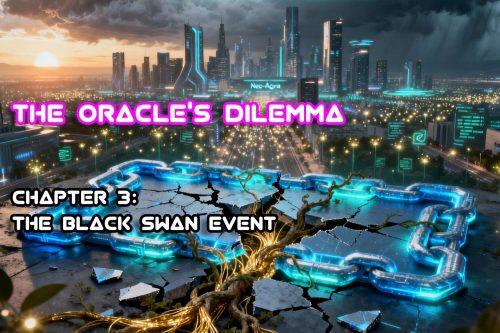
The day dawned with deceptive normalcy. In the Codex Lounge, Ben was elbows-deep in a new project: a smart contract for dynamic park bench allocation. It factored in foot traffic, weather, and even historical “contemplation scores” to optimize public seating. It was a trivial, elegant puzzle.
In the Oracle Hub, Maya was watching two screens. One tracked Cyclone Lenore, which had, as the AI predicted, begun its gentle curve away from the coast. The primary model’s certainty was now 98%. A quiet victory for the system, a silent knot of unease for her. The other screen still pulsed with the deep-geo rhythmic tremor, now a constant companion, a digital heartbeat the city had learned to ignore.
At 11:17:03 AM, the heartbeat stopped.
For one perfect, silent second, all the seismic graphs flatlined. Maya leaned forward, thinking for a wild moment that the anomaly had finally self-corrected.
Then, the world screamed.
It wasn’t a sound first, but a movement. A deep, visceral lurch that lifted the floor of the Oracle Hub and slammed it back down. Maya was thrown from her chair. Screens shattered, flickering into static. The lights died, and for two terrifying seconds, there was only darkness and a roar that came from the bones of the planet.
Emergency power kicked in, bathing the hub in a ghastly red glow. Klaxons blared, not just here, but across the city, a chorus of automated alarms. Maya scrambled to her terminal, hands shaking. The main system was rebooting, but her standalone diagnostic feed was alive.
A seismic graph, no longer a gentle pulse, was a single, monstrous spike that tore off the top of the chart. The number beside it flashed: MAGNITUDE 7.4. EPICENTER: NEO-AGORA SUBSTRATA SECTOR 9.
A Black Swan Event. The unforeseen. The un-coded.
Across the city, the Agora Chain reacted with lightning-fast, mindless precision.
CONTRACT: DISASTER_RESPONSE_V1.EXE
PARAMETERS TRIGGERED: IF (SEISMIC_READING >= 7.0) THEN (ACTIVATE_PROTOCOL_OMEGA)
ACTION: Protocol Omega initiated. The city’s primary disaster relief fund—a pool of digital tokens held in a public, immutable wallet—was instantly, automatically, and entirely liquidated. The funds were converted into a cascade of sub-transactions:
- Tokens to the drone depot contract: 400 emergency response drones deployed.
- Tokens to the auto-evacuation contract: Priority transit routes lit up on all street signage, guiding people to reinforced shelters.
- Tokens to the emergency services contract: Digital bonuses instantly credited to the accounts of all registered fire, medical, and rescue personnel, incentivizing immediate response.
On Ben’s wrist-comm, a civic alert blasted: SEISMIC EVENT. PROTOCOL OMEGA ACTIVE. PROCEED TO DESIGNATED SHELTER. He stared at it, his mind reeling. He’d never seen a Protocol Omega. It was a legend, a failsafe. He felt a surge of adrenaline, not just from fear, but from a perverse awe. The system was working. It was executing perfectly under conditions he’d only theorized about.
He stumbled out of the Lounge into a world of noise and dust. A building across the plaza had sheared at its mid-point, its top floors a jagged ruin. But already, the drones were there—swarming like metallic insects, using thermal sensors to locate survivors. A driverless ambulance sped silently past, its route optimized by the traffic contract. It was chaos, but it was a chaos the system was parsing, addressing with cold, beautiful logic.
Ben’s scooter was crushed under a fallen communication array. He began to run towards the nearest shelter, his coder’s brain observing the response. “Efficient,” he thought, watching a drone team clear a debris-choked alley. “The fund release was immediate. No committee meetings. No delayed approvals. This… this is why we built it.”
He found his family at the shelter—a reinforced community center. They were shaken but unharmed. His mother hugged him tightly. “The alerts came so fast,” she said, her voice trembling. “The lights, the directions… it knew what to do.”
Ben nodded, a fierce pride cutting through his fear. “It did. It’s working.”
In the Oracle Hub, Maya was living in a different reality. Protocol Omega had triggered, yes. But her screens showed the aftermath not as a single event, but as a sprawling, evolving crisis. The earthquake was just the opening note.
Power grid contracts were failing in cascades. A substation in the old quarter had collapsed. The GRID_BALANCE contract, designed to shed load to prevent a city-wide blackout, began executing. It was working perfectly. But one of the loads it shed was the power to the main aqueduct pumping station, which was on a “non-essential” grid segment. The logic was sound: preserve core infrastructure. But the aqueduct station pumped water out of the low-lying riverfront districts.
She saw it before the system did. Her topographical maps showed the seismic damage had fractured the bedrock beneath the old Elias Dam, a hydroelectric structure fifteen kilometers upstream. The dam’s own integrity contracts were silent—its sensors were designed to detect leaks or structural fatigue, not a foundational collapse caused by a distant quake. The IF for dam failure had not been met.
But Maya’s hydrological feeds were screaming. River levels upstream were rising anomalously fast. The dam wasn’t leaking; it was dying from the ground up.
She tried to input an emergency override, a manual categorization. EVENT_ESCALATION: POTENTIAL CATASTROPHIC DAM FAILURE. The system rejected it. The requisite, corroborating data points from the dam’s own sensors were absent. She was a human shouting an intuition into a hurricane of hard data.
At 2:48 PM, the Elias Dam ceased to be a structure and became a tidal wave.
Twenty billion liters of water, liberated from concrete and logic, tore down the river valley. It hit the already-wounded city not as a flood, but as a demolition event. The quake had broken the bones; the flood was a hammer blow to the skull.
In the shelter, Ben felt the impact through the ground—a deep, shuddering boom that was wholly different from the quake. The lights flickered again. A new alert flashed on every screen and wrist-comm:
HYDROLOGICAL HAZARD. RIVERFRONT EVACUATION ZONE 1-12. ACTIVATING FLOOD PROTOCOLS.
Ben let out a breath he didn’t know he was holding. “Okay… okay, flood protocols. There’s a separate contract for that. It’ll trigger…”
He pulled up the public ledger, searching for the FLOOD_RESPONSE contract execution. He found it. It had activated. It had allocated a modest fund for sandbag drones and water-pumps. A tiny, pre-defined slice of the civic treasury reserved for “secondary meteorological events.”
A cold, sharp needle of dread pierced his gut.
He navigated to the main disaster fund wallet address—the one that had been full to the brim that morning. The one governed by DISASTER_RESPONSE_V1.
The balance was 0.
The transaction log was a monument to efficiency. At 11:17:04, the entire fund had been disbursed. For the earthquake.
The flood was a separate event. A new IF. And the treasury for catastrophic events was empty. The flood protocol had been given its petty allowance, enough for a bad storm, not for a biblical deluge that was now submerging a third of the city.
“No,” Ben whispered, staring at the immutable record. “No, that’s… that’s wrong. It’s one disaster. It’s connected!”
But the chain didn’t understand “connected.” It understood conditions and clauses. The condition for the disaster fund had been met (Seismic >= 7.0). It executed. The contract was fulfilled. It was now a closed, perfect, and useless piece of history.
He looked up from his screen and out a grime-streaked window. In the distance, toward the riverfront, a wall of churning, debris-filled water was visible, swallowing streets, parks, buildings. He saw the flashing lights of the first responder drones—the ones paid for by the now-empty fund. They buzzed over the floodwaters, but their mandates were for search and rescue in rubble, not for aquatic disaster. They had no boats, no amphibious vehicles. Their programming was literal. They were looking for people trapped in collapsed buildings, not people drowning in the streets.
The elegant, flawless logic had created a hellish paradox. The city had spent its entire life savings on bandages, just before it needed a tourniquet.
Ben’s perfect understanding of the system curdled into horror. It had done exactly what he and others like him had told it to do. It had followed the letter of the law they had written with such pride.
The law was perfect.
The law was merciless.
The law was watching the city drown.
Table of contents:
Introduction
Chapter 1: The Smart Contract City
Chapter 2: If This, Then That
Chapter 3: The Black Swan Event
Chapter 4: Code is Not Law <<<<<< NEXT
Chapter 5: The Oracle’s Whisper
Chapter 6: Hardcoding Compassion
Chapter 7: The DAO of Disaster Relief
Chapter 8: Consensus in the Rubble
Chapter 9: A Human in the Loop
Chapter 10: Living Contracts
