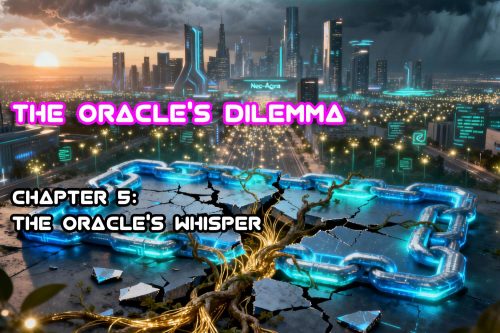
The Oracle Hub had become a tomb for dead certainty. The primary AI systems were offline, their predictive models shredded by the Black Swan. The only light came from the ghostly glow of emergency battery packs and the few standalone terminals, like Maya’s, that drew from a dedicated geothermal backup—a quirk of architecture that now felt like a cosmic joke.
She was alone. The other volunteers had fled to check on families or simply surrendered to the panic. Maya had stayed. It wasn’t bravery; it was a horrific, magnetic pull. This was the source. This was where the city’s perception met its reality. And right now, it was hemorrhaging.
Her screens were a mosaic of catastrophe. The seismic graph had flatlined again, the main shock over. The flood hydrology map, however, was a spreading stain of angry red, consuming the city’s digital blueprint. But it was the contract interface that held her frozen. It pulsed with a single, urgent query.
The system was trying to make sense of the senseless. It needed to categorize.
ORACLE INPUT REQUIRED: EVENT TAXONOMY.
SOURCE(S): Seismic Array Delta, Hydrological Network Theta, Satellite Feed Sigma.
DESCRIPTION: Significant geophysical event (11:17:03) followed by major fluvial inundation (14:48:21).
PLEASE CATEGORIZE FOR CONTRACT EXECUTION PROTOCOLS:
- OPTION A:
EVENT_002: CATEGORY_5_FLUVIAL_INUNDATION - OPTION B:
EVENT_001_CONTINUED: COMPOUND_GEO-HYDROLOGICAL_DISASTER
Maya’s breath fogged the screen. She understood the weight of this drop-down menu. It wasn’t just a label. It was a key that would unlock specific, pre-written realities.
Option A: Two Separate Events.
If she chose this, the system would see an earthquake (Event 001) and a flood (Event 002). The disaster fund for Event 001 was already spent. A separate, smaller FLOOD_RELIEF contract would activate. She pulled up its parameters. It was designed for river overflow after heavy rains. Its fund was 5% the size of the main disaster fund. It would deploy sandbag drones and portable pumps. It would be like trying to hold back the ocean with a teaspoon, but it would do something. However, other contracts—like the one that had shut off the triage center’s power—might see the “earthquake event” as concluded. Their grace periods and emergency clauses might reset, or they might simply remain locked in their terrible, completed logic.
Option B: One Continued Event.
A COMPOUND_DISASTER. This was a rarely-used classification, meant for scenarios like a hurricane causing a tornado outbreak. If she chose this, the system would view everything from the first tremor to the rising waters as a single, ongoing catastrophe. Would the depleted disaster fund somehow reactivate? No, the contract was fulfilled. But other, broader “continuous crisis” clauses in municipal service contracts might engage. Would the power termination contract for the triage center recognize a “compound disaster” as an overriding state of emergency? She scanned its code frantically. There was a clause: SUSPEND_TERMINATION_IF (OFFICIAL_EMERGENCY_STATUS = TRUE). The “Official Emergency Status” was a flag set by the Mayor or… by an Oracle’s classification of an event as CIVIC_EMERGENCY. COMPOUND_GEO-HYDROLOGICAL_DISASTER carried that flag automatically.
Her choice wasn’t about truth. There was no truth the system would understand. It was about framing. Which lie, which interpretation, would open the least terrible set of doors?
She thought of the dark triage center. She thought of Ben’s horrified face as he stared at the zeroed-out fund. She thought of the medic’s accusation: “Your ‘Law’ is a choice.”
Her fingers hovered. She was not a mayor. She was not a scripter. She was a sixteen-year-old Context Volunteer. Her job was to observe and report. Not to judge. Not to choose.
A new alert popped up on a secondary screen, a real-time feed from a public safety camera that was miraculously still online. It showed a scene from the flooded industrial quarter. A water filtration pumping station, critical for keeping the contaminated floodwater out of the remaining freshwater supply, was failing. Its backup power was fading. The icon next to it showed its contract status: PUMP_STATION_7 – POWER_ALLOCATION. She clicked it.
CONTRACT: CRITICAL_INFRASTRUCTURE_SUPPORT.
PARAMETERS: IF (FACILITY_STATUS = ACTIVE) AND (CIVIC_EMERGENCY_STATUS = TRUE) THEN (ALLOCATE_PRIORITY_POWER_FROM_GRID_BETA)
CURRENT CIVIC_EMERGENCY_STATUS: FALSE.
The station was dying because the city’s official status, post-earthquake, was not a continuous emergency. It was a series of discrete, manageable problems. One of which had already been solved (by spending all the money).
The pumping station’s icon flashed from yellow to urgent red.
Maya’s jaw tightened. She erased the hesitation from her mind. She was not just inputting data anymore. She was writing the story the city would believe. She was the Oracle, and this was her whisper.
Her finger stabbed the console.
SELECTION: EVENT_001_CONTINUED: COMPOUND_GEO-HYDROLOGICAL_DISASTER.
CONFIRM CLASSIFICATION? The system prompted. NOTE: CONTRADICTS STANDARD EVENT ISOLATION PROTOCOLS. REQUIRES HUMAN_ORACLE_OVERRIDE [CLAUSE 22].
“I am the human Oracle,” Maya said to the empty room, her voice trembling but clear. “Override.”
She confirmed.
For a second, nothing happened. Then, the system whirred. Logs scrolled. On the screen monitoring Pump Station 7, the CIVIC_EMERGENCY_STATUS flickered… and switched to TRUE.
The CRITICAL_INFRASTRUCTURE_SUPPORT contract evaluated its IF.
Both conditions were now met.THEN (ALLOCATE_PRIORITY_POWER_FROM_GRID_BETA)
On the camera feed, the dim lights of the pumping station suddenly brightened. The great, stalled pumps gave a shudder, then with a groan that was almost audible through the digital feed, began to turn. A jet of pressurized water shot out of an overflow valve, fighting back the rising filth.
Maya let out a choked sob of relief. It had worked. Her whisper had been heard. She had bent the unyielding logic, not by breaking it, but by bending the context it fed upon.
But her victory lasted only a moment. The system, now operating under the new COMPOUND_DISASTER flag, began propagating the classification. New alerts bloomed across her screens. Not all of them were good.
CONTRACT: AUTOMATED_EVACUATION_ZONE_GAMMA.
STATUS: RE-EVALUATING.
PARAMETERS: IF (EVENT = COMPOUND_DISASTER) AND (FLOODWATER_RISE > 0.5m/HOUR) THEN (EXPAND EVACUATION ZONE BY 500 METERS).
ACTION: Evacuation zone expanded. New directives were sent to the already-overwhelmed emergency drones and to citizens’ wrist-comms in areas previously considered safe. A wave of fresh panic would now ripple through those neighborhoods.
Her choice had saved a pump station. It might also be herding people into new danger.
This was the power. It was not clean. It was not absolute. It was a terrible, granular influence. For every clause she nudged toward mercy, another might twist toward unintended consequence. She was not steering the ship; she was subtly warping the ocean current it sailed on, with no way to predict all the ripples.
The door to the hub hissed open. Ben stood there, drenched and panting, his eyes wide with a desperate, scorched look. He had seen the power restored to the pump station on the public feed. He had traced the logic back to its source.
“Maya,” he gasped, stumbling toward her console. “What did you do? The pump station… it came back online. How?”
She turned to him, her face illuminated by the screens, etched with exhaustion and grim purpose. “I categorized the event. I told the system the earthquake and the flood are the same thing.”
Ben stared at the console, at the COMPOUND_DISASTER flag now stamped across the city’s digital heart. He understood instantly. His coder’s mind mapped the ramifications faster than hers could.
“You… you changed the input,” he whispered, awestruck and horrified. “You didn’t change the contract. You changed the world for the contract.”
“It was the only lever I could pull,” she said, her voice hollow.
Ben’s eyes lit with a frantic, technical fire. “Do it again! Re-categorize the triage center! Tell the system it’s a hospital! Tell the utility contract the payment threshold is wrong!”
Maya shook her head, a tear finally breaking free and tracing a clean line through the dust on her cheek. “I can’t, Ben. That’s not how it works. I can input broad, categorical facts. I can’t fabricate specific data points about individual buildings or accounts. The system has verification protocols for that. It would reject it. And even if I could…” She gestured to the screen showing the expanded evacuation zone. “Every whisper has an echo. I don’t know what they all are.”
Ben slammed his fist on the console. “Then we have to go bigger! We have to hack the contracts themselves! We have to change the code!”
“You can’t!” Maya shot back, her own frustration boiling over. “The blockchain is immutable! You said it yourself! That’s the whole foundation!”
“Then the foundation is wrong!” Ben roared, the sound raw in the silent hub. “People are dying because of my perfect code! I have to fix it!”
“You can’t fix it by breaking it harder!” Maya stood, facing him. “This isn’t a bug, Ben! It’s a worldview! You built a city that sees everything as isolated ‘If-Then’ statements. I’m trying to… to whisper to it that the world is connected. That the ‘If’ is messy, and the ‘Then’ needs a heart.”
They stood there, two teenagers in the ruins of a paradise of logic, breathing heavily. The chasm between them was the chasm at the heart of Neo-Agora itself: the absolute versus the contextual. The script versus the story.
Ben looked from Maya’s resolute, grief-stricken face to the screens, where her single whisper was now propagating through the city’s digital nervous system, doing good and ill in measures she could no longer control. He had come here looking for a master key, a sudo command to rewrite reality.
He found only a girl with a fragile, terrifying power of interpretation. And he realized, with a sinking certainty, that her way—the subtle, ethical, terrifyingly human way of bending context—might be the only tool they had. It was infinitely harder than writing code. It required a wisdom he suddenly felt he had never possessed.
The Oracle had whispered. And for the first time, Ben Aris, master of the explicit, was forced to listen to the implicit.
Table of contents:
Introduction
Chapter 1: The Smart Contract City
Chapter 2: If This, Then That
Chapter 3: The Black Swan Event
Chapter 4: Code is Not Law
Chapter 5: The Oracle’s Whisper
Chapter 6: Hardcoding Compassion <<<<<< NEXT
Chapter 7: The DAO of Disaster Relief
Chapter 8: Consensus in the Rubble
Chapter 9: A Human in the Loop
Chapter 10: Living Contracts
