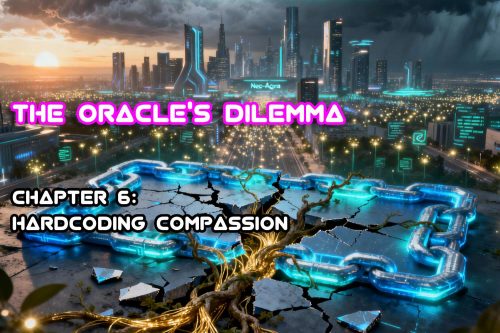
The silence in the Oracle Hub was a living thing, thick with the hum of strained machines and the weight of the choice hanging between them. Ben paced, a caged animal trapped by the very logic he’d designed. Maya’s words—“You can’t fix it by breaking it harder”—echoed in the hollow place where his certainty had been.
“There’s always a backdoor,” Ben muttered, more to himself than to her. He leaned over a secondary terminal, his fingers flying across the haptic keyboard. “A consensus override, a hard fork… we just need the right cryptographic signature from a majority of the network nodes.”
“The ‘network nodes’ are under ten feet of water, Ben!” Maya snapped, her exhaustion fraying into anger. “And even if they weren’t, a hard fork would take days to propagate and vote on. We have hours. Minutes!” She gestured to a screen showing the triage center. The medics had rigged up a few hand-cranked lights, casting long, desperate shadows. “Your solution is another contract. More code. It’s the same hammer looking for a nail!”
Ben whirled around. “And your solution is to lie! To feed the system fuzzy, subjective interpretations and hope it does the right thing? That’s not governance, Maya, that’s… it’s oracular manipulation! You’re becoming a single point of failure!”
“I’m being a human in the loop!” she fired back, her voice cracking. “The only one this stupid loop has! You built a world that runs on facts without context. I’m trying to provide the context!”
“Context is chaos!” Ben shot back, his technical precision turning into a weapon. “You saw what happened! You flagged a ‘Compound Disaster’ and now the evacuation protocols are going haywire, scrambling people who were safe! Your ‘compassion’ is creating new problems because the system isn’t designed for nuance! It’s designed for clarity!”
“Then maybe it was designed wrong!” Maya shouted.
The words hung in the air, blasphemous and undeniable.
Ben deflated, the fight draining out of him. He looked at the lines of code on the terminal, the elegant, unchangeable logic of the triage center’s power contract. “I just… I need to make it right. I need to change the code. It’s what I do.”
Maya’s expression softened, but her resolve didn’t. “You can’t change the past, Ben. The contracts that are killing people are set in digital stone. But we’re not helpless.” She turned back to her main console, pulling up the city’s financial ledger. “We can’t touch the old contracts, but look. The city still has revenue streams. Automated taxes from undamaged districts, micro-transactions from the subway, licensing fees. They’re still flowing into the treasury’s inbound wallets.”
Ben came to stand behind her, looking over her shoulder. “So? Those are just inputs. They’ll get automatically allocated by a hundred different budget contracts by tomorrow morning. Payroll for garden drones, library database subscriptions…”
“What if they didn’t?” Maya interrupted, her eyes alight with a new, fierce idea. “What if we could intercept them? Not by hacking, but by… by convincing everyone to agree to send them somewhere else, just for now.”
Ben stared at her. “That’s impossible. The treasury inflows are governed by law. By code.”
“What if we wrote a new law?” Maya’s voice dropped to a whisper. “A new contract. One that everyone—the Mayor, the rescue workers, the people in the shelters—agrees to live by, just for the emergency. We can’t change the old chain, Ben. But what if we started a new one?”
The concept was so audacious it short-circuited Ben’s programming. “A fork… a voluntary, temporary fork of the city’s economy? For a specific purpose?”
“Not a fork of everything,” Maya said, her thoughts racing ahead of her words. “Just a fork of the disaster response. We create a new… a new vessel. A separate smart contract wallet. We call it the Emergency Fund. But it’s empty. Then, we ask—no, we get—the city’s ongoing revenue to flow into it instead of the old treasury, just for a week. And the spending from that fund isn’t automatic. It’s governed by…”
“By a vote,” Ben finished, the coder in him suddenly electrified, seeing the architecture materialize. “A Decentralized Autonomous Organization. A DAO. The new contract’s ‘If-Then’ is: IF a proposal gets >70% approval from a designated council, THEN funds are released.” He started pacing again, but this time with the energy of creation, not frustration. “The council… it could be people on the ground. The medic from the triage center. A firefighter. A community leader. You. Me.”
Maya nodded, a tentative hope breaking through her exhaustion. “We use real-world, human consensus to make the decisions. Then we use the… the unfeeling, perfect execution of the new smart contract to carry them out instantly. No payment delays. No bureaucratic hold-ups.”
“But also no rigid, pre-defined clauses that fail when things get complex,” Ben added, the irony dawning on him. “We keep the efficiency of the blockchain, but we graft on the adaptability of human judgment.” He stopped, a major flaw appearing. “But how do we redirect the city’s revenue? That would require changing all those inbound payment contracts. It’s the same problem!”
Maya chewed her lip, thinking. Then her eyes widened. “We don’t change them. We change the destination. The Mayor can’t change the code, but he still has the moral authority, the bullhorn. What if he goes on the emergency channel and says, ‘For the next 96 hours, all municipal payments and fees, please send them to this new Emergency DAO wallet address instead of the usual one.’ It’s a request. Not a code change.”
Ben scoffed. “People and businesses won’t just do that. Their systems are automated. Their contracts are set.”
“Some will,” Maya insisted. “Big ones. The central transit authority. The power grid in the intact sectors. They have humans who can manually adjust a payment destination in a crisis. It won’t be 100%, but it might be enough. And for the rest…” She pointed to Ben. “You’re the genius scripter. Can you write a new, simple contract that acts as a… a splitter? Anyone who wants to can sign it, authorizing their future payments to be divided, part to the old city, part to the new DAO?”
Ben’s mind was already building it. “A permission layer… a meta-contract that sits on top of the existing payment agreements. Yes. It’s messy. It’s not elegant. It’s a patch.”
“It’s a life raft,” Maya corrected gently.
They looked at each other, the chasm between them suddenly bridged by a rickety, conceptual gangplank. He was offering the “how.” She was offering the “why” and the “who.” It was a third way. Not immutable code, not oracular manipulation, but a new, hybrid system born of consensus.
The door hissed open again. Mayor Silva stood there, looking even more haggard. “The pump station you got back online, Maya. It’s holding. You bought us time.” He saw their intense, shared look. “What is it?”
Ben spoke first, his voice charged with a new kind of energy. “We have a proposal. It’s unorthodox. It’s technically a bit of a kludge.”
“And it requires you to use your voice, not your password,” Maya added.
Silva listened as they laid it out—the Emergency DAO, the voluntary revenue fork, the council of on-the-ground voices. He, the former coder, saw the technical audacity. He, the politician, saw the sheer political and social risk. He was being asked to advocate for a temporary overthrow of the system he’d built.
“You’re asking me to endorse a shadow government,” he said quietly.
“We’re asking you to help us build a sensible one,” Ben replied. “The old system is failing because it’s blind. We’re building one with eyes. And a heart.”
Silva closed his eyes, the weight of the city on his shoulders. He saw the dark triage center. He saw the zero-balance disaster fund. He saw the immutable, stupid, merciless code.
He opened his eyes. There was a new clarity in them, the clarity of a man who had finally found a lever he was allowed to pull.
“A human in the loop,” he murmured, echoing Maya’s words from what felt like a lifetime ago. “Not as a bug, but as a feature.” He straightened his torn jacket. “Write your new contract, Ben. Make it robust and transparent. Every transaction must be visible. Maya, draft the council structure. Keep it small, actionable. I’ll go on the air in one hour. We’ll call it… the Neo-Agora Disaster Relief Cooperative.”
As Silva left to find a working broadcast studio, Ben and Maya turned back to their consoles. The immutable past was a wall behind them. But for the first time, they were looking forward, not at a dead end, but at a narrow, precarious, and hopeful path forward. They weren’t hardcoding compassion into the old, rigid system. They were building a new one where compassion could be the operating system.
Table of contents:
Introduction
Chapter 1: The Smart Contract City
Chapter 2: If This, Then That
Chapter 3: The Black Swan Event
Chapter 4: Code is Not Law
Chapter 5: The Oracle’s Whisper
Chapter 6: Hardcoding Compassion
Chapter 7: The DAO of Disaster Relief <<<<<< NEXT
Chapter 8: Consensus in the Rubble
Chapter 9: A Human in the Loop
Chapter 10: Living Contracts
