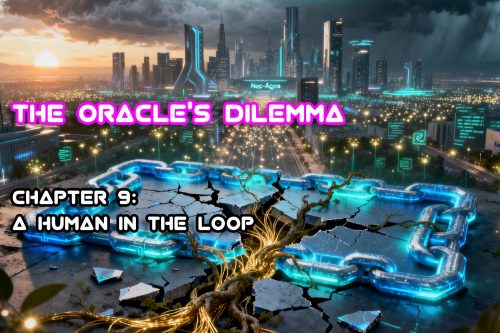
The immediate crisis bled into a grinding, exhausted recovery. The floodwaters receded, leaving behind a cityscape of mud-caked ruins and stunned silence. The Neo-Agora Relief Cooperative DAO had kept the city’s heart beating through the worst of it, but it was a temporary pacemaker. A question now hung in the damp air, heavier than the rubble: What next?
The answer would not be found in the Oracle Hub or a coder’s terminal, but in the city’s battered central chamber, where what remained of the formal civic government convened. Ben and Maya stood at the back, observers in a room full of shattered certainties. The atmosphere was tense, a raw nerve of grief and blame.
Mayor Silva stood before the assembly. The polished technocrat was gone. In his place was a man who had looked into the abyss his creation had helped dig. “The Relief Cooperative saved lives,” he began, his voice quiet but carrying. “It proved that our community can come together, can make wise choices under pressure. But it also proved, irrevocably, that our core systems are brittle. ‘Code is Law’ is not a principle that can govern a living city. It can only manage a machine.”
A man named Alden, head of the Utilities Contract Board, shot to his feet. His department had authored the power-shutoff contract. “With respect, Mayor, the law functioned perfectly! The contracts executed as designed. The failure was in our design parameters, not in the system’s execution! We simply need to write better, more comprehensive contracts!”
“To account for what, Alden?” a woman named Elara from Public Health retorted, her voice sharp. She had been at the triage center. “A specific sequence of an earthquake of precisely 7.4, followed by a dam failure at a specific site, during a specific budget cycle? We cannot code for infinity! The ‘Black Swan’ will always be black because we never thought to paint it!”
“So we return to committees?” Alden fired back, a note of panic in his voice. “To delays, to lobbying, to human error and corruption? The Agora Chain was built to eliminate that!”
Ben felt the old defensive programming stir in him. Alden had a point. The elegance, the purity… but then he saw Maya’s face, remembering her whisper that saved the pump station, and the medic’s fury. He stepped forward without planning to.
“It’s not a binary choice.”
All eyes turned to him, the young Script-Off champion, the wunderkind of the failed system. He felt a flush of heat but pressed on. “The DAO worked because it was a hybrid. It used the blockchain’s perfect execution—no one could steal the funds, the transactions were transparent and instant. But it used human consensus to decide what to execute. We don’t have to choose between blind automation and slow committees. We can design a system that uses both.”
He glanced at Maya. She gave him a barely perceptible nod. Go on.
“We propose a permanent reform,” Ben said, his voice growing stronger. “A ‘Human in the Loop.’ Not for everything. But for critical contracts—life support, disaster response, civic welfare—we build in a circuit-breaker.”
He gestured, and a schematic he and Maya had worked on all night appeared on the main screen. It showed a standard smart contract flow, but with a new node inserted between the IF and the THEN.
“This is an Oversight Panel,” Maya explained, stepping up beside him. “A diverse group of human Oracles, like the DAO council but permanent. They don’t review every transaction. But the contract is designed so that if its execution triggers a cascade of unusual secondary effects, or if external Oracle data—like my seismic readings—exceeds variance thresholds, the contract is automatically paused. Not broken. Paused.”
“And then this panel… votes?” Alden asked, skeptical.
“They review the context,” Maya said. “They ask the questions the code can’t. Is this a billing error, or a catastrophe? Is this one event or two? They have a limited window—24 hours—to reach a supermajority consensus. They can either let the contract proceed, amend its parameters for a one-time execution, or, in extreme cases, vote to redirect its funds to a emergency review DAO.”
“You’re inserting uncertainty! You’re creating a veto council!” Alden protested.
“We’re inserting judgment,” Silva said firmly, finally voicing his conviction. “We are acknowledging that the world is uncertain, and that our systems must be resilient, not just robust. A circuit-breaker doesn’t stop the train during normal operation. It stops it before it goes off the rails no one knew were there.”
The debate raged for hours. Proponents of the old purity called it a regression, a fatal flaw in a perfect system. Survivors of the triage center, rescue workers, and ordinary citizens who had felt the cold indifference of the code spoke with fierce emotion about the need for a heart.
Ben found himself in the unexpected position of mediator. He understood the purists’ fear of corruption. “The panel’s proceedings are fully transparent,” he argued. “Every deliberation, every vote, is recorded on-chain. It’s not a secret committee. It’s a public court of context. And its powers are strictly, algorithmically limited. It can’t create new taxes. It can’t write new laws. It can only say ‘Pause,’ ‘Proceed,’ or ‘Adjust this one thing, right now, for this reason.’”
Finally, Silva called for a vote. But not a vote of the council. He had learned the true lesson of the DAO.
“This decision is too fundamental,” he announced. “It changes the social contract of Neo-Agora. We will put it to the citizens. We will use the very DAO infrastructure they built to decide its own future.”
For 48 hours, the city debated. The proposal for the Civic Oversight Amendment was displayed on every public screen. The text of the new “circuit-breaker” contract was open for anyone to audit. Ben and Maya gave endless, exhausting interviews, explaining the technical safeguards.
On the morning of the vote, Ben was a wreck. He stood with Maya on a balcony overlooking the slowly-clearing streets. “What if they say no?” he asked. “What if they choose the devil they know?”
“They felt the devil’s breath,” Maya said quietly. “They won’t forget.”
The vote was conducted via the secure, proven channels of the Relief Cooperative. When the results finalized, Silva called them to the chamber.
He didn’t announce the numbers. He simply showed the final execution on the ledger.
PROPOSAL: CIVIC OVERSIGHT AMENDMENT.
VOTE: PASSED.
CONSENSUS THRESHOLD: 82.7%.
A roar, not of triumph, but of profound relief, filled the room. It wasn’t a victory of one side over another. It was a collective decision to grow up. To trade the perfect, dangerous innocence of absolute rules for the wise, complicated responsibility of guided judgment.
In the weeks that followed, the first Civic Oversight Panel was seated. It included Anya Chen the medic, Leo Rostov the fire captain, Kira Hassan the organizer, a former contract scripter, a data ethicist, and two citizens chosen by lottery. Maya was appointed its Chief Liaison, the bridge between the Oracle’s data and the Panel’s judgment.
Ben stood with her on her first official day at the new, integrated Office of Context & Code. He looked at the empty space on her old desk in the Oracle Hub where the seismograph had once whispered its ignored warning.
“It’s not just about stopping bad things,” Maya said, following his gaze. “It’s about being ready to see the good things we didn’t plan for, too.”
Ben nodded. He had a new project now. Not a contract, but a protocol. The first of the new “Living Contracts,” designed with review periods, community governance hooks, and a direct link to the Oversight Panel’s circuit-breaker. It was messy. It was complex.
It was alive. The human was in the loop, not as an error, but as the most essential feature. The city’s motto, etched on the wall of the chamber, had been quietly updated. It now read: CODE + CONSENSUS = COVENANT.
Table of contents:
Introduction
Chapter 1: The Smart Contract City
Chapter 2: If This, Then That
Chapter 3: The Black Swan Event
Chapter 4: Code is Not Law
Chapter 5: The Oracle’s Whisper
Chapter 6: Hardcoding Compassion
Chapter 7: The DAO of Disaster Relief
Chapter 8: Consensus in the Rubble
Chapter 9: A Human in the Loop
Chapter 10: Living Contracts <<<<<< NEXT
