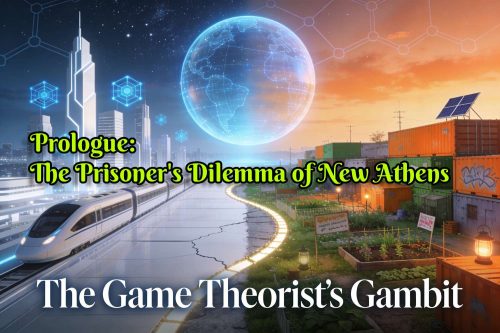
Five years before the annexation of the Feral District
The classroom was a perfect cube of white light.
Twelve-year-old Ava Kostas sat with her spine straight, her hands folded on the smooth polymer desk, her eyes fixed on the holographic projection at the front of the room. Around her, twenty other students—the brightest in New Athens—fidgeted or slumped or whispered. But Ava did not fidget. She had been chosen for this gifted track because she could hold still. Because she could listen. Because she wanted, more than anything, to understand.
The AI tutor materialized as a soft blue sphere, floating just above the teacher’s podium. It had no face, no gender, no warmth. But its voice was clear as spring water.
“Welcome to Advanced Incentive Design,” it said. “Today, we begin with a problem that defeated every civilization before New Athens. The Prisoner’s Dilemma.”
The hologram shifted. Two figures appeared—simplified avatars, one red, one blue. They stood in separate glass booths. A panel between them showed a grid of numbers.
“The scenario,” the AI continued. “Two suspects are arrested for a minor crime. The prosecutor has enough evidence to give each a one-year sentence. But she offers each prisoner a deal.”
The grid lit up:
| Blue Stays Silent | Blue Betrays | |
|---|---|---|
| Red Stays Silent | Both: 1 year | Red: 3 years / Blue: 0 years |
| Red Betrays | Red: 0 years / Blue: 3 years | Both: 2 years |
“If both remain silent,” the AI said, “they each serve one year. Best outcome for the pair. But if one betrays the other while the other stays silent, the betrayer walks free and the silent one serves three years. If both betray, they each serve two years.”
Ava traced the grid with her eyes. She had seen this before—in a textbook, in a simulation game on her wristband. But the AI was not done.
“Here is the question: What is the rational choice?”
Hands shot up. Ava kept hers down. She wanted to see if anyone would say something different.
A boy in the front row—Marcus, always Marcus—answered first. “Betray. Always betray.”
“Explain your reasoning,” said the AI.
“From each prisoner’s perspective, if the other stays silent, you should betray because zero years is better than one. If the other betrays, you should still betray because two years is better than three. Betrayal is the dominant strategy. It’s the only rational move.”
The AI pulsed blue. “Correct. The Nash Equilibrium of a single-play Prisoner’s Dilemma is mutual betrayal. Both prisoners serve two years—worse than if they had cooperated, but stable, because neither can improve their outcome by changing their choice alone.”
Ava frowned. She had understood this since she was nine. But something about it had always bothered her. If both prisoners knew the other was rational, and both knew the other knew, and so on—couldn’t they agree to stay silent? Wasn’t that also rational?
She raised her hand.
“Yes, Ava.”
“Professor,” she said, using the formal address the AI tolerated, “what if the prisoners could communicate? What if they could promise to stay silent?”
“They could promise,” the AI said. “But promises without enforcement are not rational. Each prisoner knows the other has an incentive to break the promise. Therefore, rational prisoners do not trust promises. They anticipate betrayal and act accordingly.”
Ava pressed further. “What if they’re friends? What if they care about each other’s outcomes?”
The AI’s blue glow flickered—not in annoyance, but in pedagogical adjustment. “Altruism modifies the utility function. If each prisoner values the other’s freedom as much as their own, the payoff matrix changes. But New Athens does not build policy on the assumption of altruism. Altruism is unreliable. Incentives are not.”
The hologram shifted again. Now it showed the skyline of New Athens as it had been at its founding, twenty years ago. Tower cranes against a sunrise. Drones laying fiber-optic threads across empty desert. The gleaming arc of the solar array.
“The founders of New Athens were economists and cryptographers,” the AI said. “They had seen what happened to old cities. Corruption. Inequality. Collective action failures. Traffic jams, polluted rivers, broken windows—all of them Prisoner’s Dilemmas at scale. Every individual doing what was rational for themselves, and everyone losing together.”
The image dissolved into a series of diagrams. Blockchain ledgers. Token flows. Smart contracts.
“Their solution was simple and radical. They built the city on a public ledger. Every action that affects others—working, cleaning, sharing, stealing—is recorded. Every citizen has a Reputation Token balance. Tokens are earned by cooperation and spent by defection. The city’s games are designed so that the rational choice is always the cooperative choice.”
The AI paused. A soft chime filled the room.
“Today, you will play the Prisoner’s Dilemma. For real. With your own tokens.”
The students stirred. Wristbands lit up. Ava felt the familiar vibration against her skin—her balance, currently 847 tokens, earned through years of perfect behavior.
“You will be paired anonymously,” the AI said. “You may cooperate or betray. Your choice will affect your token balance. After the game, the results will be analyzed. Begin.”
Ava’s wristband blinked. A name appeared—a random ID, not a person. A countdown: ten seconds.
She looked at the grid again. The math was clear. Betrayal maximized her expected value regardless of what the other person did.
But.
But she had read something once, in an old book from before the founding—a paper about “superrationality.” The idea that if two identical rational beings faced the same problem, they would realize they were identical and therefore choose the same thing. And the best same thing was cooperation.
Was that foolish? The AI had no category for it.
The countdown hit three seconds.
Ava’s finger hovered over the option: COOPERATE or BETRAY.
She thought about the other person on the other side of the anonymity. Were they thinking the same thing? Were they, like her, wondering if the math was missing something?
She pressed COOPERATE.
A pause. Then her wristband flashed red.
*Result: You cooperated. Other player betrayed. Penalty: -50 tokens.*
She watched her balance drop to 797. Around her, a chorus of dings and groans. Marcus was grinning—he had clearly betrayed and won.
The AI spoke. “Eighty-two percent of you chose to betray. The average outcome was a loss of 38 tokens per player. Only eighteen percent cooperated, and all but three of those were betrayed.”
Ava was one of the three. She felt a hot flush in her cheeks.
The AI continued, merciless: “This is the tragedy of the unmanaged commons. Each of you acted in your narrow self-interest. And as a group, you are poorer than if you had all cooperated. This is why cities failed before New Athens.”
The hologram shifted for the final time. Now it showed a video—the founding ceremony. A woman in a white suit standing on a stage made of recycled shipping containers. The first mayor. She was old, her hair silver, but her voice was steel.
“In New Athens,” the mayor said, to a crowd of thousands, “we have solved the Prisoner’s Dilemma. Because every game is repeated. Every choice is tracked. Every player is rational. Here, cooperation is the winning move.”
The crowd cheered. The camera panned over faces—young, hopeful, relieved.
The AI dimmed the video. “You are the next generation of Incentive Architects. You will design the games that keep New Athens running. You will ensure that no citizen ever has a rational reason to betray another. You will build a world where selfishness and selflessness are the same thing.”
The sphere faded. The lights came up. Students began to pack their things.
Ava sat motionless.
She looked at her wristband. 797 tokens. A small loss. But the loss that stung was not the number. It was the proof. She had cooperated. The other person had betrayed. The math had been right, and her heart had been wrong.
Or had it?
She thought about the three other cooperators—the ones who had also chosen trust. They had lost tokens today. But tomorrow, in another game, with another partner, would they betray or cooperate? Would their experience today make them more selfish or less?
The AI had no answer for that. The AI only knew the single game. The founders had designed a system of repeated interactions—but only if you assumed every player had infinite memory and infinite rationality. What if players got tired? What if they got hurt? What if they learned the wrong lesson?
Ava stood up. She walked past Marcus, who was showing off his +40 token gain. She walked past the girl who had cried when she lost a hundred. She walked to the window at the end of the hall.
Outside, New Athens spread beneath her. Gleaming towers arranged in optimal solar orientation. Mag-lev trains running on perfect schedules. Parks designed by algorithms to maximize happiness per square meter. It was beautiful. It was efficient. It was rational.
But somewhere, in a part of the city she had never seen—a part they called the “adjustment zone” or the “annexation pending” or, in whispers, the “Feral District”—there were people who did not play the games. People who could not earn tokens. People who were, by the city’s own metrics, irrational.
Ava did not know that she would meet one of them in five years. She did not know that he would break every model she had ever learned. She did not know that she would one day stand before the Oracle itself and argue that the Prisoner’s Dilemma had a third option.
All she knew, standing at the window at twelve years old, was that cooperating had felt right. And losing had hurt. And she wanted to build a game where no one had to choose between being right and winning.
She touched the glass.
“I will master this system,” she whispered to her reflection. “I will be an Architect of the perfect game. And I will make sure that the rational choice is always kindness.”
The reflection stared back. Serious. Certain. Wrong about so many things she would later have to unlearn.
But the wanting—the wanting was true.
Table of contents:
Introduction
Prologue: The Prisoner’s Dilemma of New Athens
Chapter 1: The Incentive Architecture <<<<<< NEXT
Chapter 2: The Nash Equilibrium Slum
Chapter 3: A Suboptimal Player
Chapter 4: The Schelling Point Revolt
Chapter 5: Zero-Sum Streets
Chapter 6: The Byzantine Neighborhood
Chapter 7: Iterated Play
Chapter 8: The Cooperative Airdrop
Chapter 9: A Positive-Sum City
