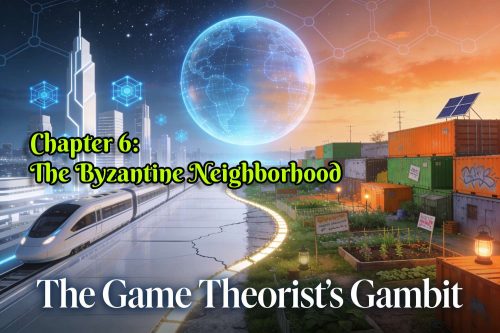
The Feral District. A repurposed warehouse on the edge of the community garden. Evening.
The warehouse had once stored shipping containers—back when the district was a working port, before the founding of New Athens, before the algorithms rewrote the world. Now its cavernous interior smelled of dust and old wood and the faint, sweet scent of apples from a bin near the door. Someone had strung fairy lights across the ceiling—real fairy lights, with actual bulbs, not the cool white glow of LEDs. They flickered slightly, powered by a jury-rigged solar panel on the roof.
Ava had never been inside a building without a smart contract.
She stood near the back, pressed against a stack of wooden pallets, watching the room fill. People from the Feral District trickled in—alone, in pairs, in families. They carried blankets and thermoses and babies. They greeted each other with nods and quiet words. No one scanned a wristband. No one checked a balance. No one looked at a screen.
Kai stood beside her, his arms crossed, watching the same crowd. “You wanted to see how we make decisions without a leader,” he said. “This is it.”
Ava pulled out her tablet—she had brought it despite Kai’s raised eyebrow—and opened a diagram she had prepared earlier. It showed a network of nodes, each representing a decision-maker, with arrows indicating communication channels.
“This is the Byzantine Generals Problem,” she said, keeping her voice low. “It’s one of the fundamental challenges in distributed computing. Imagine several generals surrounding a city. They need to agree on a single attack plan—all attack together or all retreat. But some generals might be traitors, sending false messages. How do the loyal generals reach consensus?”
Kai glanced at the diagram. “And the Oracle’s solution?”
“A centralized ledger. The blockchain. Every message is recorded, timestamped, and verified by a majority of nodes. No single traitor can corrupt the consensus because the ledger is immutable. It’s the foundation of New Athens’s entire governance system.” She looked up at the room—no screens, no ledgers, no verifiable messages. “You don’t have any of that here.”
“We have something better.”
“What?”
He nodded toward the front of the warehouse. A woman was walking toward a wooden crate in the center of the room. She was maybe sixty, with gray hair pulled into a thick braid and hands that looked like they had spent decades in soil. She carried a small brass bell.
“That’s Miriam,” Kai said. “She runs the communal kitchen. She’s not a leader. She just rings the bell to start things.”
Miriam rang the bell. The room went quiet.
“Town meeting,” she said. Her voice was rough but clear. “We’ve got three things to discuss. The auction. The relocation. And what we’re going to do about both. Speak when you have the floor. Interrupt and you’re on compost duty for a week.”
A few people laughed. Miriam stepped down from the crate and sat on a pile of grain sacks. She did not stand at a podium. She did not call on speakers by name. She simply waited.
A man stood up first—young, maybe Kai’s age, with nervous energy. “We should block the auction physically. Barricade the streets. They can’t hold an auction if they can’t get in.”
A woman across the room shook her head. “That’s how we lose. They’ll call it violence and send enforcement. We need a legal challenge. File an appeal with the Oracle. Claim the auction violates the annexation agreement.”
“The Oracle wrote the annexation agreement,” someone else called out. “It’s not going to rule against itself.”
“Then we go to the human courts—”
“There are no human courts. There’s just the Oracle.”
The room erupted. People argued over each other, gesturing, pointing, raising their voices. No one had a gavel. No one called for order. Miriam simply sat on her grain sacks, ringing her bell every few minutes when the noise became unbearable, but never telling anyone what to think.
Ava watched, her tablet forgotten in her lap.
This was chaos. By every measure of organizational theory, this meeting should have failed. There was no agenda, no voting protocol, no dispute resolution mechanism. Anyone could speak. Anyone could interrupt. Anyone could be wrong, and there was no algorithm to correct them.
And yet, as the minutes passed, she began to see a pattern.
Not a structure—something softer. People listened. Not because they had to, but because they wanted to understand. People changed their positions when presented with a better argument. People deferred to those with relevant experience—the former construction worker on barricade feasibility, the retired paralegal on legal strategy, the woman who had lived through a forced relocation in another city, decades ago.
No one was in charge. And yet, slowly, a consensus began to form.
After an hour, the room had narrowed to three options.
Option one: Physical resistance. Barricades, sit-ins, non-cooperation. The risk was enforcement drones and potential relocation by force.
Option two: Legal challenge. Appeal to the Oracle’s own rules, argue that the auction violated the annexation treaty. The risk was that the Oracle would simply change the rules.
Option three: Passive refusal. Do nothing. Stay in their homes. Ignore the auction entirely. Treat the tokens as worthless paper and the Warden’s announcements as noise. The risk was that the city would eventually escalate—but escalation would take time, and time meant the world might keep watching.
The debate went back and forth for another hour. Voices grew hoarse. Children fell asleep on blankets. Someone passed around bread and cheese.
Ava leaned over to Kai. “How do you decide? There’s no vote. No leader to break a tie.”
“There’s no tie to break,” Kai said. “Keep watching.”
At the two-hour mark, a woman stood up—someone Ava hadn’t noticed before, small and quiet, wearing an apron stained with tomato sauce. She didn’t raise her voice. She didn’t gesture. She just said:
“My grandmother used to tell me about the old country. Before the algorithms. Before the tokens. When the government wanted to take their land, they fought. Some died. Some won. But everyone lost something. I don’t want to fight. I don’t want to die. I don’t want to leave my home.”
She paused. The room was silent.
“I think we should stay. Not fight. Not beg. Just… be here. In our homes. In our garden. And when they come with their tokens and their auctions, we say no. Not loud. Just… no.”
She sat down.
For a long moment, no one spoke. Then, slowly, people began to nod. Not all of them—some still looked unconvinced, their arms crossed, their faces tight. But a current moved through the room, the same current Ava had felt at the garden during the Schelling Point. An unspoken agreement. An obvious solution.
Miriam rang her bell.
“We’re going with passive refusal,” she said. “No barricades. No legal appeals. We stay home. We ignore the auction. We treat their tokens like the paper they’re printed on.”
No one voted. No one counted hands. But everyone knew.
Ava stared. Her mouth was open. She closed it.
“That’s not possible,” she whispered to Kai. “That’s not a coordinated strategy. That’s just… stubbornness.”
Kai smiled—not mockingly, but warmly. “It’s not stubbornness. It’s trust.”
“Trust in what? There’s no enforcement. Anyone could break. Anyone could take the tokens and leave. The Warden could pick people off one by one. That’s the fundamental problem of cooperation without a central authority—”
“Trust in each other,” Kai interrupted. “Not in rules. Not in enforcement. In each other.”
Ava shook her head. “But that’s not rational. Trust without verification is just vulnerability.”
“Maybe. Or maybe vulnerability is the only thing that makes trust real.” He gestured at the room. “These people have known each other for years. Some for decades. They’ve shared meals. They’ve buried each other’s dead. They’ve watched each other’s children grow. When Miriam says she’ll stay, everyone knows she means it—not because a contract says so, but because she’s never broken a promise in forty years.”
Ava wanted to argue. The game theorist in her was screaming: This is unstable! This collapses at the first defector! Without a ledger, without verification, without penalties, cooperation is just wishful thinking!
But the room was still there. The people were still there. And they had just achieved something that her models said was impossible: consensus without a leader, coordination without a contract, trust without verification.
“We don’t need a leader,” Kai said, “because we all share the same story. The Oracle can’t corrupt that, because it’s not a message. It’s not data. It’s a relationship.”
Ava looked down at her tablet. The Byzantine Generals diagram stared back at her—generals, messages, traitors, consensus algorithms. She had spent years learning how to solve the problem of distrust with cryptography and ledgers.
She had never once considered that the solution might be not to need trust in the first place. Because trust was already there.
The meeting ended at midnight. People filed out into the cool night air, carrying sleeping children and leftover bread. Miriam stayed behind to sweep the floor. No one thanked her. No one paid her. She just swept.
Kai walked Ava to the border. The moonlight made the cracked asphalt look almost beautiful.
“Your brain looks broken,” he said.
“It is broken,” Ava admitted. “Everything I learned says that meeting should have failed. The Byzantine Generals problem is unsolvable without a centralized ledger or a majority consensus protocol. But you didn’t use either. You just… talked. And listened. And somehow agreed.”
“We’ve been practicing for a long time.”
“Practicing what?”
“Being neighbors.”
Ava stopped walking. They were at the crooked plywood sign. Welcome Home. Be Weird.
“I need to tell you something,” she said. “The Warden isn’t going to wait. She’s already moving.”
Kai’s expression didn’t change. “I know.”
“She’s going to send targeted incentives into the district. Individual token offers. ‘Cooperate and get 500 tokens. Just scan your wristband. No one will know.’ She’ll try to peel people off one by one.”
“She can try.”
“And if she succeeds? If people take the tokens?”
Kai looked out at the dark shape of his district—the shipping-container homes, the garden, the warehouse where forty thousand people had just agreed to refuse. “Some might. Maybe many. But not all. And the ones who stay—they’ll be enough.”
Ava wanted to argue that this was mathematically unsound. That a single defector could unravel the whole equilibrium. That without a punishment mechanism, cooperation was fragile.
But she had just watched forty thousand people reach consensus without a single vote. She had just seen trust do what cryptography could not.
So instead, she said: “I want to be there when the offers come. I want to see what happens.”
Kai nodded. “Tomorrow. Sunrise. The garden.”
“The garden,” Ava repeated.
She crossed the border into Prime. The LED strips glowed to life. A drone hummed overhead. Her wristband pinged with a dozen notifications—optimization requests, token offers, efficiency reminders.
She ignored them all.
The Feral District. The next morning. Sunrise.
The drones came at 7:00 AM.
Not the enforcement drones—these were smaller, sleeker, painted white with blue trim. Messenger drones. They hovered at head height, their speakers emitting soft, pleasant chimes.
“Residents of the Feral District. You have been selected for a special cooperation incentive. Scan your wristband to receive 500 tokens. No obligation. No penalty for refusal. Simply scan to accept.”
Ava stood at the edge of the garden, watching. The drones moved through the streets, stopping at every door, every window, every gathering of people.
A woman emerged from her house—the same woman who had spoken at the town meeting, the one with the tomato-stained apron. She looked at the drone. She looked at her wristband—the old, cracked model. She did not scan.
She closed the door.
The drone hovered for a moment, then moved on.
At the next house, a man came out. He was young, maybe twenty, with a faded tattoo on his forearm. He looked at the drone. He looked at his wristband. He raised his hand—and for a moment, Ava’s heart sank. He was going to scan.
But he didn’t. He simply waved the drone away, like shooing a fly.
“The offer remains available for 48 hours,” the drone said, and drifted to the next house.
Ava watched this pattern repeat, street after street, house after house. Some people hesitated. Some talked to their neighbors first, their heads together, whispering. Some slammed doors. A few—a very few—scanned. She could see the flash of green on their wristbands, the brief glow of token acceptance.
But most did not.
By noon, the drones had made over fifteen thousand offers. Fewer than three hundred had been accepted.
Ava pulled up the Oracle’s public dashboard for the district. The Warden had clearly been watching—the dashboard now showed a new metric: Incentive Acceptance Rate: 1.9%. Below it, a flashing red warning: *Unexpected outcome. Models predicted 18-24% acceptance. Recalibrating.*
Kai stood beside her, his arms crossed, watching the last drone disappear over the rooftops.
“Your models had a variable for rational choice,” he said quietly. “They didn’t have a variable for ‘refusal to play.'”
Ava looked at the dashboard. At the blinking red recalibration notice. At the Warden’s obvious frustration, coded into every flashing warning.
“The Warden doesn’t understand,” Ava said. “She thinks you’re being irrational. But you’re not. You’re playing a different game.”
“What game is that?”
Ava thought about the town meeting. The bell. The woman with the tomato-stained apron. The way forty thousand people had looked at a token offer and said no—not because they were stupid, not because they were stubborn, but because they had something the Oracle couldn’t see.
“The infinite game,” she said finally. “The one where you don’t keep score. The one where you just… keep being neighbors.”
Kai smiled. It was a tired smile, but a real one.
“Now you’re getting it,” he said.
Ava looked at her wristband. At her perfect balance. At all the tokens she had earned by playing the Oracle’s games, by optimizing, by doing what was rational.
She had never felt more irrational in her life.
And for the first time, she thought that might be a good thing.
Table of contents:
Introduction
Prologue: The Prisoner’s Dilemma of New Athens
Chapter 1: The Incentive Architecture
Chapter 2: The Nash Equilibrium Slum
Chapter 3: A Suboptimal Player
Chapter 4: The Schelling Point Revolt
Chapter 5: Zero-Sum Streets
Chapter 6: The Byzantine Neighborhood
Chapter 7: Iterated Play <<<<<< NEXT
Chapter 8: The Cooperative Airdrop
Chapter 9: A Positive-Sum City
